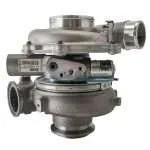
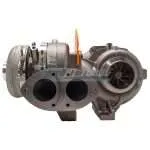
If you run John Deere PowerTech engines, sooner or later you’re going to face a turbocharger problem. The 4045, 6068, and 6090 PowerTech platforms power everything from combines and tractors to backhoes, generators, and marine applications, and when the turbo starts losing boost you’ll see it in the exhaust, the power curve, and eventually the fuel bill. This guide walks through symptoms, part identification, actuator replacement, and the real cost math on new versus remanufactured units for these engines.
PT Turbo has been rebuilding and supplying diesel turbochargers since 1978. Over 45 years of turbo work means we’ve seen every PowerTech failure mode there is, and we stock both new and remanufactured units plus the actuators, cartridges, and hardware to get you running again.
Know Your PowerTech Engine Before You Order
The three most common PowerTech displacements each use different turbo hardware, and grabbing the wrong unit costs you time you don’t have during a harvest or a jobsite deadline. Here’s the quick breakdown.
| Engine | Displacement | Typical Power | Common Turbo Style | Applications |
|---|---|---|---|---|
| PowerTech 4045 | 4.5L, 4-cylinder | 75 to 173 hp | Wastegated fixed geometry, some VGT on Final Tier 4 | Compact tractors, skid steers, gensets |
| PowerTech 6068 | 6.8L, 6-cylinder | 150 to 275 hp | Single or series turbo, wastegated / VGT | Combines, sprayers, backhoes, marine |
| PowerTech 6090 | 9.0L, 6-cylinder | 280 to 400+ hp | Series turbo (fixed + VGT), high-flow single | Large tractors, harvesters, industrial power |
Emissions tier matters as much as displacement. Interim Tier 4 and Final Tier 4 engines frequently run variable geometry turbos with electronic actuators, while older Tier 2 and Tier 3 blocks lean on simpler wastegated designs. Always match by the turbo part number on the nameplate and the John Deere part number on the turbo or the actuator, not just the engine model. For a deeper dive on the 6.8L specifically, our John Deere 6068 Turbocharger Guide breaks down agricultural and construction fitments in detail.
Symptoms of a Failing PowerTech Turbocharger
PowerTech turbos rarely die all at once. They telegraph the failure, and catching it early saves the engine from oil starvation, overfueling, or a turbine wheel grenading into the exhaust. Here’s how symptoms scale with severity.
| Severity | Symptom | Likely Cause |
|---|---|---|
| Early | Slight power loss, delayed throttle response | Sticking VGT vanes, dirty actuator linkage |
| Early | Whistle or siren noise under load | Boost leak, cracked charge pipe, worn seals |
| Moderate | Blue or black smoke, rising oil consumption | Failing shaft seals, worn bearings |
| Moderate | Boost pressure fault codes, no wastegate control | Failed pneumatic actuator or vacuum line |
| Severe | Excessive shaft play, grinding, metal in oil | Bearing failure, imminent wheel contact |
| Severe | Sudden total boost loss, heavy smoke | Compressor or turbine wheel damage |
A common mistake on PowerTech engines is condemning the whole turbo when the actual failure is the actuator. If the cartridge spins freely and you have no shaft play but you’re throwing boost control codes, the actuator is the first suspect. That’s an inexpensive fix compared to a full unit.
Actuator Failure: The Most Overlooked PowerTech Repair
On wastegated turbos a pneumatic actuator moves the wastegate; on variable geometry turbos an electronic actuator moves the vanes. Both take a beating from heat cycling. When a diaphragm cracks, the electronics fail or the linkage seizes, you lose precise boost control, and the ECU flags it fast. Replacing the actuator instead of the entire turbo is often the smart move when the core is otherwise healthy.
Which actuator you need depends on the turbo make fitted to your PowerTech. BorgWarner and Garrett are both OEM suppliers across the 4045, 6068, and 6090 lineups.
One critical note: actuators are calibrated to the turbo. After installing a replacement, a wastegate actuator rod has to be set to spec, and an electronic VGT actuator has to be calibrated so the vanes reach both stops correctly. Get the calibration wrong and you’ll either underboost or peg the vanes closed and overspeed the turbo. If you’re not sure on the setting for your specific unit, contact PT Turbo and we’ll walk you through the reference dimension.
Turbocharger Replacement: Step-by-Step
The R&R procedure is broadly the same across the PowerTech family, though the 6090 series turbo setup adds a second charger to the sequence. Here’s the workflow our techs follow.
1. Prep and diagnose
Confirm the failure is the turbo and not a downstream restriction, plugged DPF, or intake leak. Check shaft play by hand: axial and radial movement should be minimal with no contact against the housings. Log any boost or DPF fault codes before you clear them.
2. Remove the old unit
Let the engine cool. Disconnect the oil feed and drain lines, the coolant lines if fitted, the exhaust manifold or downpipe bolts, and the intake and charge air connections. On VGT units, unplug or disconnect the actuator signal line. Cap every open port immediately so nothing drops into the oil galleries or intake.
3. Inspect the supporting systems
Most repeat turbo failures come from a cause the mechanic never fixed. Before the new turbo goes on, verify:
- Oil feed line is clear and not coked internally
- Oil drain is unobstructed and the gasket surface is clean
- Air filter and intake tract are clean with no debris
- No exhaust restriction downstream
- Fresh oil and a new filter are ready to go in
4. Install and prime
Use new gaskets, never reuse them. Pre-fill the turbo center section with clean engine oil through the feed port and spin the shaft by hand to distribute it. Torque the oil feed and exhaust fasteners to spec. Before the first start, crank the engine with the fuel shut off or disabled until you see oil pressure, then start and idle for several minutes with no throttle to establish bearing lubrication.
5. Verify boost and calibration
On VGT units, confirm the actuator sweeps fully and boost tracks the commanded value. Clear codes, road test or load test, and recheck for leaks once everything is back to temperature.
New vs Remanufactured: The Real Cost Decision
For fleet managers and owner-operators, the choice usually comes down to downtime and budget. A quality remanufactured turbo built to OE tolerances performs identically to new and carries a warranty, at a meaningful discount.
| Factor | New OEM Turbo | Remanufactured Turbo | Actuator-Only Repair |
|---|---|---|---|
| Typical cost | Highest | 25 to 50% less | Lowest (see actuator prices) |
| When to choose | Catastrophic core damage | Healthy or repairable core | Core good, actuator failed only |
| Lead time | Can be long for some fitments | Usually in stock | Fast, often same day |
| Warranty | Full | Full | Component warranty |
The math usually favors the remanufactured route when the core is sound. You get OE-level performance and a full warranty without paying the new-unit premium or waiting on a back-ordered fitment, and for a combine or genset that has to run now, in-stock availability is worth as much as the dollars saved. Reserve the new OEM turbo for when the core is genuinely destroyed, housings cracked, or wheels contacted the housing.
And don’t skip past the actuator-only column. If your diagnosis points to a boost control fault with a healthy, free-spinning core, swapping the actuator is the cheapest and fastest fix on the board. Match it to the turbo part number, set it up to spec, and you’re back in service for a fraction of what a full replacement costs.
Frequently Asked Questions
What are the signs of a failing turbocharger on a John Deere PowerTech engine?
Common symptoms include loss of boost pressure, reduced power, excessive exhaust smoke, and increased fuel consumption. You may also hear whining or grinding noises from the turbo.
Which John Deere engines does this turbocharger guide cover?
This guide covers the 4045, 6068, and 6090 PowerTech platforms used in combines, tractors, backhoes, generators, and marine applications.
Can I replace a John Deere PowerTech turbocharger myself?
Yes, with the right tools and part number you can perform the replacement, but it requires careful attention to oil supply lines, gaskets, and proper torque specs to avoid damage.
PT Turbo rebuilds John Deere PowerTech 4045, 6068 and 6090 turbochargers. See our turbocharger rebuild service.
Need a Turbocharger?
PT Turbo has rebuilt and sold turbochargers since 1978. We stock remanufactured units for Cummins, Duramax, Power Stroke, Detroit Diesel, and more — backed by a 12-month unlimited mileage warranty and same-week shipping from San Bernardino, CA.
📞 (909) 824-1020 · 346 S I St. #3, San Bernardino, CA 92410 · [email protected]
More From PT Turbo
 Duramax LLY Turbocharger: Symptoms, Garrett GT3788VA Replacement & Cost (2004-2005)
- Ford F-250/F-350 Super Duty Turbocharger Guide: 6.0L, 6.4L & 6.7L Powerstroke Compared
- Peterbilt 389 Turbocharger Guide: Cummins ISX & PACCAR MX-13 Applications
- International ProStar Turbocharger Guide: MaxxForce 13 Replacement & Upgrade Options