Garrett T4 Turbocharger: Flange Specs, Applications & Replacement Reference
When a diesel builder asks us about a Garrett T4 Turbocharger, the question is almost always about a turbine inlet flange rather than one single part number. T4 is an industry flange standard that names how the turbine housing bolts to the exhaust manifold or up-pipe, and Garrett (along with BorgWarner and others) offers many different turbos with that flange. Getting the flange right matters, but it is only one of several things you have to match before a turbo will bolt on and perform.
At PT Turbo we have been rebuilding and supplying turbochargers since 1978, more than 45 years, and we stock both new and remanufactured units across the Garrett and BorgWarner catalogs. This reference walks through what the T4 flange is, how it compares to other flanges, which turbos use it, and how to match a correct replacement.
What the T4 Turbine Inlet Flange Is
A turbine inlet flange is the bolted joint at the “hot” side of the turbo where exhaust enters the turbine housing. The common bolt-together standards are T2, T3, T4 and T6, with V-band being the clamped alternative. The larger the number, the larger the opening and the more exhaust flow the flange is designed to pass.
The T4 flange uses a four-bolt pattern with a bolt spacing of roughly 82.55 by 69.85 mm. It sits above T3 in flow capacity and is the go-to inlet for mid-to-large frame turbos: the kind used on big-displacement diesels and higher-horsepower builds. You will find T4 inlets in both open (undivided) and divided (twin-scroll) forms, which we cover below.
Because T4 is a standard and not a model, two turbos can share a T4 flange and share almost nothing else. The compressor wheel, turbine wheel, bearing system and A/R can all be completely different. That is why the number on the compressor housing data plate, not the flange, is what you order by. For background on how the turbine side works, Garrett publishes useful material at garrettmotion.com, and the general operating principles are covered on the turbocharger overview page.
T4 vs T3, T6 and V-Band
The flange sets the exhaust opening size and the mounting pattern. It does not by itself tell you anything about boost, spool or horsepower. Use the table below to understand what each flange is for, not to size a turbo.
| Flange | Mounting | Typical use | Relative flow capacity |
|---|---|---|---|
| T3 | Four-bolt, smaller opening | Small to mid-frame turbos | Lower |
| T4 | Four-bolt, ~82.55 x 69.85 mm spacing | Mid to large frame diesel and performance turbos | Higher |
| T6 | Four-bolt, larger opening | Large frame, high-horsepower turbos | Highest of the common bolt flanges |
| V-band | Clamped ring | Quick-change and tight packaging | Depends on housing, not the clamp |
One practical difference: bolt flanges like T3 and T4 use studs and nuts, while V-band housings clamp with a single ring. Many Garrett performance units are offered in more than one configuration. The GT3582R turbochargers, for example, ship with T3, T4 or V-band turbine inlets depending on the part number, so the flange alone does not identify that turbo.
Which Turbos Use the Garrett T4 Turbocharger Flange
On the Garrett side, the T4 flange shows up across the mid and large GT and GTX frames used on diesel pickups, medium-duty trucks and performance builds. The GT3582R is the most familiar example because it is sold in a T4 version alongside its T3 and V-band versions.
BorgWarner’s S-series overlaps heavily here. The S300 family is offered with T4 turbine housings in 0.88, 0.91 and 1.00 A/R (the 0.80 A/R is a T3 housing on the S300GX), and the S400 family uses T4 housings in 0.90, 1.00, 1.10 and 1.25 A/R, with the larger units moving to the T6 flange. You can see our stock on the S300 and S400SX model pages. The A/R number controls how quickly the turbine spools versus how much it flows up top; a smaller A/R spools sooner, a larger one flows more at high rpm.
Because the same flange carries so many different cartridges, never assume a T4 turbo from one engine will suit another just because it bolts up. Match the engine’s required compressor and turbine wheel sizes and A/R, then confirm the flange.
Divided (Twin-Scroll) vs Open T4
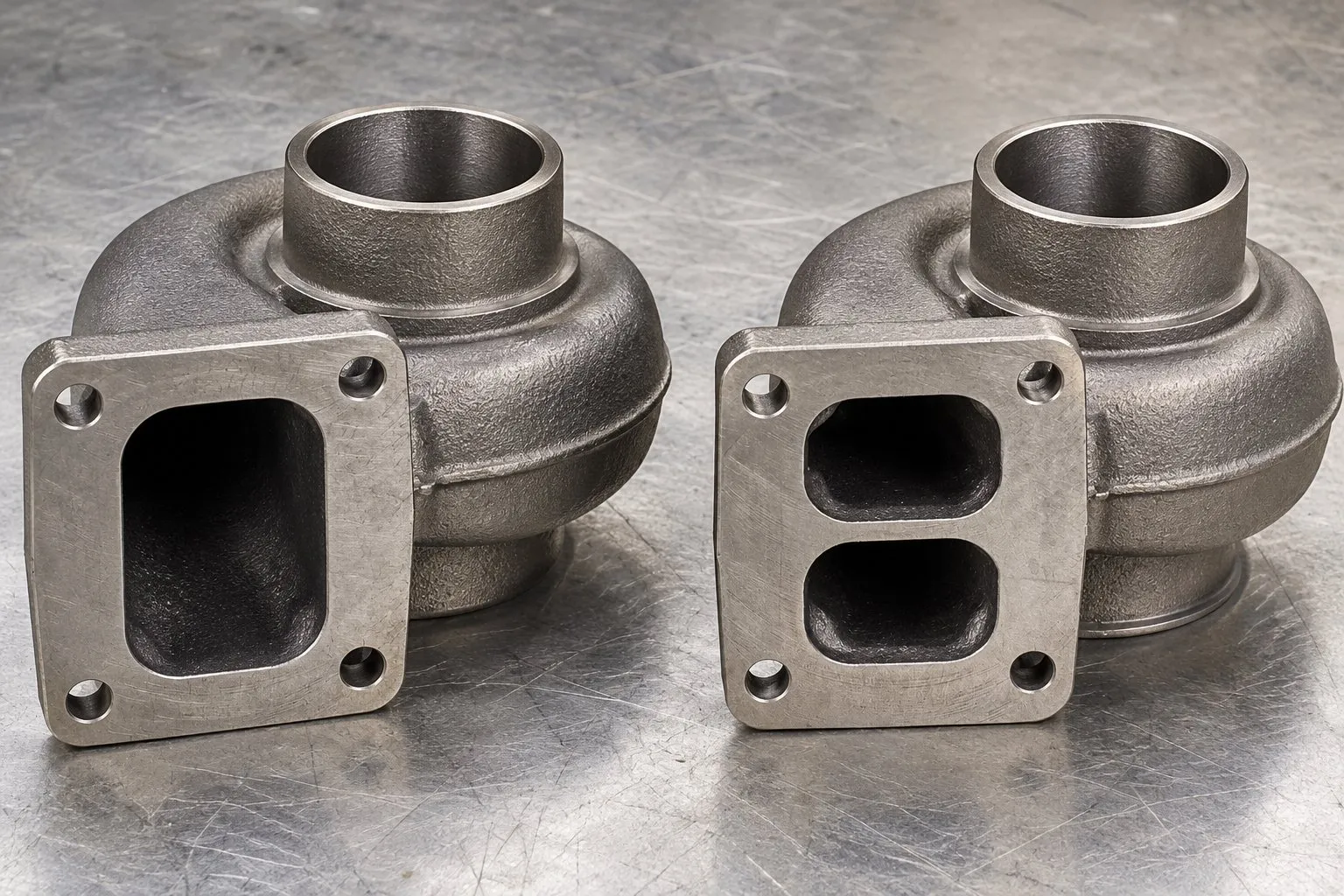
T4 comes in two forms. An open or undivided T4 has a single exhaust opening feeding the turbine. A divided T4 splits the inlet into two passages, which pairs with a divided (twin-scroll) manifold to keep cylinder pulses separated for better low-end response.
The two are not interchangeable at the gasket. A divided housing bolted to an open manifold loses the benefit of the split, and an open housing on a divided manifold simply merges the two runners. When you order, state whether your manifold and up-pipe are open or divided so the turbine housing matches.
- Open T4: single inlet, simplest to plumb, common on many diesel and street builds.
- Divided T4: two inlet passages for twin-scroll manifolds, better pulse separation and spool.
- Gasket: must match the housing style; an open gasket will not seal a divided flange correctly.
Matching a T4 Replacement Correctly
The flange narrows the field but does not finish the job. Work through these before you buy:
- Data plate number: read the full part number off the compressor housing. Garrett numbers run as a six-digit base, a dash and four digits, with an S or W suffix on aftermarket units; the first digit after the dash tells you the sales channel (0 original equipment, 5 new replacement, 9 remanufactured).
- Compressor and turbine wheels: inducer and exducer sizes set the airflow and spool. Two T4 turbos with very different wheels will drive the engine completely differently.
- Turbine A/R: confirm the A/R stamped or listed for your unit, because the same housing casting is sold in several A/R values.
- Inlet style: open or divided T4, matched to your manifold.
- Oil and water fittings: confirm feed and drain orientation and whether the bearing housing is water-cooled.
Casting numbers on the housings are not part numbers; one casting serves many turbos, so do not order from a casting mark. If you are unsure, send us the full tag number and photos and we will identify it.
We supply remanufactured turbochargers and new units, and we also run an in-house turbo rebuild service if you would rather keep your original housings and core. For what a rebuild runs on a given model, see our turbo rebuild price list rather than guessing; most rebuilds ship in 3 days or less, and the price is confirmed after inspection and before any work starts.
Installation and First-Start Notes
T4 is a bolted joint, so it relies on clean, flat sealing faces, a correct gasket and even torque across the four fasteners. Use the manifold and turbo maker’s torque figure and tightening sequence; there is no single universal number across all applications. Check that studs are not stretched and that the exhaust face is not warped before you reuse it.
Before first start on any turbo, prime it: fill the oil inlet with clean engine oil, turn the compressor wheel by hand, then crank or idle a few minutes before putting it under load. Follow the engine maker’s first-start steps only. There is no required break-in mileage schedule, no early oil change and no first-miles boost limit beyond what the manufacturer specifies.
If a prior turbo failed, replace the oil feed line rather than reusing it, confirm the drain runs downhill into the pan above the oil level, and inspect the charge air cooler. Debris from a broken compressor wheel cannot be reliably flushed out of a cooler; most failures trace back to the oil supply, so sort the oil path before blaming the new part.
Turbos we list for the GT3582R and S300
Listings for the turbo models named in this guide that can be ordered online today. Several part numbers can fit one engine by year and rating, so match the number on your turbo’s tag, or call (909) 824-1020 and we will match it for you.
Frequently Asked Questions
Is a Garrett T4 a specific turbocharger model?
No. T4 is a turbine inlet flange standard, not a model. Many different Garrett and BorgWarner turbos share the T4 flange while using different wheels, A/R and bearing systems. Always order by the full number on the data plate, not by the flange.
Will any T4 turbo bolt onto my manifold?
Only if the inlet style matches. An open T4 housing fits an open (undivided) manifold, and a divided T4 housing fits a twin-scroll divided manifold. The bolt pattern is the same, but a mismatch in the divider wall and gasket will not seal or perform correctly, so confirm open versus divided before ordering.
Can PT Turbo match a T4 replacement from the tag number?
Yes. Send us the full part number off the compressor housing along with photos of the inlet and oil fittings, and we will identify the exact unit and tell you whether we have it new, remanufactured, or can rebuild your core. You can reach the shop through our contact page or at (909) 824-1020.
Need a Turbocharger?
PT Turbo has rebuilt and sold turbochargers since 1978. We stock remanufactured units for Cummins, Duramax, Power Stroke, Detroit Diesel, and more — backed by a 12-month unlimited mileage warranty. Units in stock at our shop in San Bernardino, CA ship the same day when ordered before 2 PM Pacific, Monday through Friday.
📞 (909) 824-1020 · 346 S I St. #3, San Bernardino, CA 92410 · [email protected]