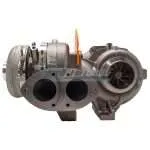
If you run a Cummins ISM, you already know the turbo is the heart of how this 10.8L workhorse makes power. The ISM has powered everything from Class 8 highway tractors to fire trucks and motorcoaches since the late 1990s, and across its production life it ran two very different turbocharger philosophies: the fixed-geometry Holset HX55 on early and mid-life engines, and the variable-geometry Holset HE531V on the later EGR-equipped builds. Knowing which one you’ve got, how it fails, and what it costs to replace correctly is the difference between a clean repair and a comeback. This guide breaks down both turbos for on-highway ISM applications.
ISM Turbocharger Overview: HX55 vs HE531V
The Cummins ISM was offered in ratings from roughly 280 to 500 horsepower, and the turbocharger spec tracks closely with emissions era and power rating. Pre-EGR ISM engines (1998 to roughly 2002) almost universally ran the HX55, a fixed-geometry wastegated turbo. With the arrival of cooled EGR in 2002 and the tighter standards that followed, Cummins moved many ISM ratings to the HE531V, a variable-geometry turbo (VGT) with a sliding nozzle ring. On these engines the ring is moved by an air-operated actuator: the ECM switches a turbocharger control valve that meters truck air to it. ISM engines built for the 2007 emissions standard moved on to variable-geometry turbos with an electronic actuator, such as the HE451VE 5457026H. PT Turbo lists the HE531V 3768266H for the ISM and QSM11; some ratings carry an HE431V instead, so match the number on the tag.
Here’s the practical difference. The HX55 uses exhaust energy through a fixed turbine housing and dumps excess drive pressure through a wastegate. It’s simple, durable, and easy to service. The HE531V actively changes the effective turbine geometry to build boost faster at low RPM and bleed it off up top, which improves throttle response, helps drive the EGR loop, and supports engine braking through the VGT mechanism. More performance and emissions capability, but more parts that can stick, foul, or fail.
| Spec | Holset HX55 | Holset HE531V |
|---|---|---|
| Type | Fixed geometry, wastegated | Variable geometry (VGT) |
| Typical ISM era | 1998–2002 (pre-EGR) | 2002 to about 2006 (EGR) |
| Boost control | Wastegate / actuator | Sliding nozzle moved by an air-operated actuator |
| Engine brake support | No | Yes (VGT-assisted) |
| Compressor wheel | ~76 mm class | ~76 mm class |
| Service complexity | Low | Moderate to high |
| Common failure points | Wastegate, shaft play, oil seals | Stuck nozzle ring, actuator, control valve and air supply |
If you’ve worked on the light-duty Cummins variable-geometry units, the HE531V will feel familiar in concept. The same sliding-nozzle principles apply, and our Cummins ISB 6.7L turbocharger guide on VGT operation and common failures is worth a read if you want the deep dive on how the geometry physically moves and why soot kills it.
How the HE531V Variable Geometry Actually Works
The HE531V controls boost by sliding a nozzle ring across the turbine wheel. At low engine speed, the nozzle closes down, accelerating exhaust gas across the turbine to spool quickly and kill turbo lag. As RPM and load climb, the nozzle opens to let more flow through without overspeeding the wheel. The actuator drives a lever that moves that ring through its travel many times a minute. On the HE531V it is an air actuator, fed with truck air through a control valve that the ECM switches.
That constant movement is exactly why these turbos fail. Soot and carbon from the exhaust and EGR flow pack into the nozzle ring vanes. Over time the ring starts to drag, then sticks. When it sticks closed you get overboost faults, high drive pressure, and possible turbine overspeed. When it sticks open you get low boost, sluggish response, derate, and poor engine brake performance. The control side fails too: a leaking air line, a leaking actuator or a faulty control valve sets the same boost codes when the cartridge is mechanically fine.
The lesson on every VGT ISM repair: never just bolt on a turbo and walk away. Verify the actuator moves the nozzle through its full travel, confirm the EGR system is healthy, and address whatever caused the original sooting. Otherwise the replacement fouls on the same schedule.
Common ISM Turbo Failure Symptoms and Severity
The ISM gives you warning before it strands a truck, if you know how to read it. Here’s how the symptoms typically progress, broken out by severity so you can triage in the bay.
| Severity | Symptoms | Likely Cause |
|---|---|---|
| Early | Slow spool, mild power loss, light EGR-side soot | Beginning nozzle ring fouling (VGT) or wastegate creep (HX55) |
| Moderate | Boost-related fault codes, intermittent derate, whistle, oil in charge pipe | Sticking nozzle, actuator drift, early seal wear |
| Severe | Constant derate, heavy smoke, surge, loud bearing noise, no engine brake | Seized geometry, failed bearings, shaft contact |
| Critical | Excessive shaft play, blue smoke, oil consumption, metal in compressor | Bearing failure, wheel contact, imminent grenade |
Two checks settle most diagnoses fast. First, grab the compressor wheel and check axial and radial play. Any wheel-to-housing contact or visible rub means the cartridge is done. Second, on the HE531V, command the actuator through its sweep with a diagnostic tool and watch for smooth, full travel. Notchy or incomplete movement confirms a fouled or seizing nozzle ring.
Replacement Options: New, Reman, or Rebuild
You’ve got three legitimate paths on an ISM turbo, and the right one depends on the failure and your downtime tolerance.
New OEM Holset
A genuine new HX55 or HE531V gives you factory tolerances and the longest service life, but it’s the priciest route and lead times can sting depending on availability. Best for trucks you intend to keep in the fleet long term.
Remanufactured
For most on-highway ISM owners, a properly remanufactured turbo is the sweet spot. A quality reman comes with a new or rebuilt CHRA, balanced rotating assembly, new seals and bearings, and on VGT units a cleaned or replaced nozzle ring and verified actuator. PT Turbo has been doing this since 1978, and our remanufactured turbochargers are built to OE spec and balanced before they ship. You get new-turbo reliability at a meaningful discount.
Rebuild Your Existing Unit
If your housings and core castings are good and the failure is in the bearings, seals, or wheels, rebuilding the turbo you already have is often the most cost-effective answer. Our turbo rebuild service tears down, inspects, replaces wear components, and balances the assembly. On HE531V units we evaluate the nozzle ring and actuator so you’re not putting a fouled geometry back on the engine.
| Option | Relative Cost | Best For |
|---|---|---|
| New OEM Holset | $$$$ | Long-term fleet keepers, maximum life |
| Remanufactured | $$ | Best value, fast turnaround, OE spec |
| Rebuild existing | $$ | Good cores, cost-conscious repairs |
Not sure which way to go on your specific ISM rating or VIN? Contact PT Turbo with your engine serial and we’ll confirm the exact turbo and the best replacement path. You can also browse our full inventory on the shop all turbos page.
Installation: Gaskets, Hardware, and Doing It Right
A turbo is only as good as the install. The most common comeback we see isn’t a bad turbo, it’s a reused gasket that leaks or a missing oil supply seal that starves the bearing on startup. Replace every gasket and seal in the turbo path, and prime the oil feed before you crank.
For a complete ISM install, a full gasket and hardware kit covers the exhaust manifold-to-turbo, turbo-to-downpipe, and oil feed and drain connections. To get the right kit:
- Installation kits are listed by turbo model: send us the number on your turbo and we will match the kit for your HX55 or HE531V.
Whichever kit you choose, the install discipline is the same. Torque the manifold and downpipe fasteners to spec in sequence, never reuse a crush washer on the oil feed banjo, and make sure the drain line is clear and unkinked so oil can gravity-return. A restricted drain builds crankcase pressure behind the seals and pushes oil into the compressor, which looks exactly like a failed turbo on the next inspection.
Before you button it up, prime the bearing with clean oil and bar the engine over or crank with the fuel cut to build pressure before the first fire. On the HE531V, finish by checking the control side: the control valve needs full supply air, the line to the actuator must not leak, and the rod should move the nozzle through its full travel when the valve is commanded with the diagnostic tool. On a later ISM with an electronic actuator, run the actuator calibration instead. Skip the control-side check, or the calibration on an electronic unit, and you’ll chase boost codes on a turbo that’s mechanically perfect.
Frequently Asked Questions
What turbocharger does the Cummins ISM use?
The Cummins ISM used the fixed-geometry Holset HX55 on pre-EGR engines and the variable-geometry HE531V on EGR engines from 2002 to about 2006 (some ratings carry an HE431V). Engines built for the 2007 emissions standard moved to variable-geometry turbos with an electronic actuator, such as the HE451VE.
What is the difference between the HX55 and HE531V turbos?
The HX55 is a fixed-geometry turbocharger used on earlier ISM engines, while the HE531V is a variable-geometry turbo offering improved boost control and response across the RPM range.
What engine size is the Cummins ISM?
The Cummins ISM is a 10.8L diesel engine that has powered Class 8 highway tractors, fire trucks, and motorcoaches since the late 1990s.
Further reading: Learn more about turbocharger technology.
Shopping by part number?
Every part number we stock for the Holset HX55 is on one page, with live prices and stock: Holset HX55 turbos and parts.
Need a Turbocharger?
PT Turbo has rebuilt and sold turbochargers since 1978. We stock remanufactured units for Cummins, Duramax, Power Stroke, Detroit Diesel, and more — backed by a 12-month unlimited mileage warranty and same-week shipping from San Bernardino, CA.
📞 (909) 824-1020 · 346 S I St. #3, San Bernardino, CA 92410 · [email protected]