Excessive Turbo Lag on a Diesel: Causes, Diagnosis & Whether to Repair or Replace
Excessive turbo lag on a diesel is one of the most common complaints that lands a truck on the shop lift, and it is also one of the most misdiagnosed. Drivers describe it as a “dead pedal” off the line, a hesitation when merging, or a truck that just will not build boost like it used to. The frustrating part is that turbo lag has half a dozen root causes, and only one or two of them actually mean the turbo itself is bad.
At PT Turbo, we have been rebuilding and diagnosing turbochargers since 1978. Over 45-plus years we have seen every version of this problem, from a stretched actuator rod to a soot-choked VGT. This guide walks you through what causes lag, how to diagnose it properly, and how to decide whether to repair a component or replace the whole unit.
What Turbo Lag Actually Is (and What It Is Not)
Turbo lag is the delay between demanding power and the turbocharger delivering usable boost pressure. Every turbo has some lag by nature, since exhaust gas has to spin the turbine wheel before the compressor can pack air into the intake. On a healthy modern diesel, that delay is nearly imperceptible.
The problem is excessive lag, meaning boost that arrives late, slow, or incomplete. This is different from a total loss of boost, which usually throws a code like P0299 underboost. Lag is often intermittent and load-dependent, which is exactly why it fools so many technicians.
If you want the engineering background on how a turbo builds pressure, the turbocharger overview on Wikipedia is a solid primer. But the practical reality is this: lag is a symptom, not a diagnosis.
Common Causes of Excessive Turbo Lag on a Diesel
Before you condemn the turbo, understand that most lag complaints trace back to a handful of failure points. Here is where we start every diagnosis.
1. Failing or Sticking Actuator
The actuator controls either the wastegate or the variable-geometry vanes. When it sticks, drifts out of calibration, or loses its vacuum or boost reference signal, the turbo cannot adjust vane position or wastegate opening fast enough. The result is delayed spool and inconsistent boost.
Pneumatic actuators are a frequent culprit because the diaphragm inside them fatigues and the rod stretches over time. A weak actuator will pass a quick static test but fail under real load, which is why so many get missed.
2. VGT Vanes Stuck With Soot and Carbon
On variable-geometry turbos, the vanes ride in a nozzle ring that packs with dry soot and carbon, especially on trucks that idle a lot or run short cycles. Sticky vanes cannot close to build low-RPM boost, producing classic off-idle lag. This often shows up alongside a P003A boost control code on Cummins and Duramax platforms.
For a deeper look at how variable geometry works, the VGT reference explains vane operation clearly.
3. Intake and Exhaust Restrictions
A clogged air filter, collapsed intake boot, or restricted charge-air cooler starves the compressor. On the exhaust side, a loaded diesel particulate filter or a crushed downpipe creates backpressure that slows spool dramatically.
4. Boost Leaks
Cracked intercooler end tanks, split silicone boots, and loose clamps bleed pressure before it reaches the cylinders. The turbo spins harder to compensate, which feels exactly like lag while it fights to catch up.
5. EGR and Sensor Faults
A stuck-open EGR valve dumps inert exhaust into the intake and kills throttle response. Faulty MAP, MAF, or boost pressure sensors feed the ECM bad data, so the actuator gets commanded to the wrong position. Learn more about how recirculation affects intake charge in this EGR overview.
6. Worn Turbo Bearings and Shaft Play
When the center cartridge wears, the shaft develops excessive radial or axial play. The wheels can contact the housing, and the assembly loses efficiency. This is genuine turbo failure, and it usually means a rebuild or replacement.
How to Diagnose Excessive Turbo Lag on a Diesel Step by Step
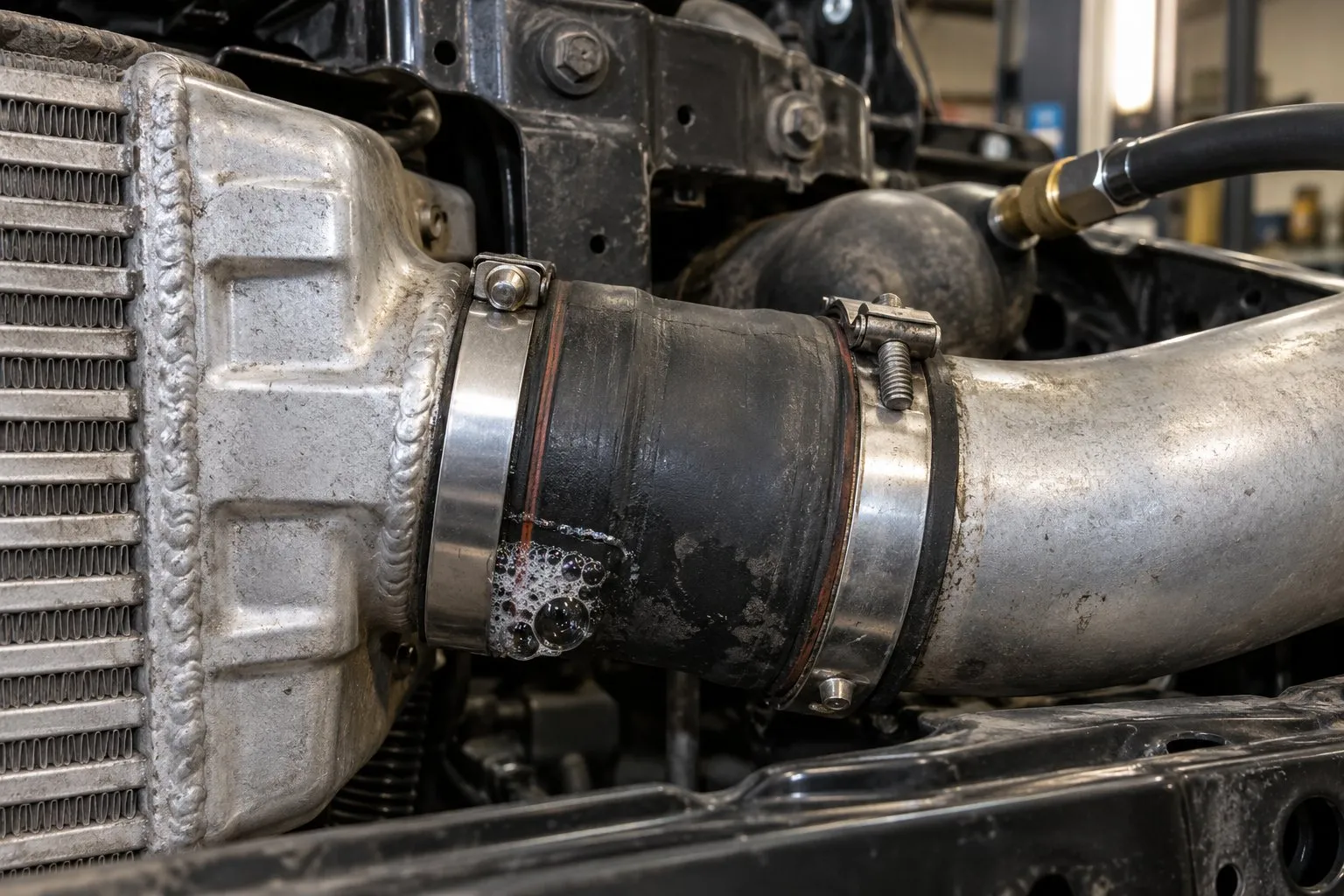
Diagnosis is about eliminating the cheap and common causes before spending money on the turbo. Work in this order.
- Scan for codes first. Pull all active and stored codes. Lag paired with P0234 overboost or underboost codes points you toward actuator and control faults.
- Inspect the air path. Check the filter, all boots, clamps, and the charge-air cooler for cracks and oil. Pressure-test the intake tract if you have any doubt.
- Watch live data. Compare commanded boost to actual boost with a scan tool during a road test. A wide gap that grows under load points at the actuator or vanes.
- Test the actuator. On a pneumatic actuator, apply vacuum or pressure and confirm full, smooth travel with no sticking; an electronic one is checked with a scan tool. A rod that binds or fails to hold position is a confirmed fault.
- Check for shaft play. With the intake off, feel for excessive radial and axial movement in the compressor wheel. Any wheel-to-housing contact means the cartridge is done.
- Inspect the VGT mechanism. On variable-geometry units, verify the vanes move freely through their full range.
If you want a platform-specific walkthrough, our Caterpillar C13 turbocharger diagnosis guide shows this process applied to a real engine.
Repair or Replace? Making the Right Call
Once you have isolated the fault, the repair-versus-replace decision comes down to what actually failed. Not every lag complaint needs a new turbo.
| Root Cause | Recommended Action | Relative Cost |
|---|---|---|
| Failed pneumatic actuator | Replace actuator only | Low |
| Sooted VGT vanes (no wear) | Clean or rebuild cartridge | Low to Medium |
| Boost leak / intake restriction | Repair air path, no turbo work | Low |
| Worn bearings, shaft play | Rebuild or replace turbo | Medium to High |
| Damaged wheels / housing scoring | Replace turbo | High |
The takeaway is that many lag complaints are solved by a part that costs a fraction of a full turbo. The actuator is the single most cost-effective fix when it is the confirmed cause.
When an Actuator Swap Solves It
If your testing confirms a weak or sticking pneumatic actuator on an otherwise healthy turbo, replacing that one component restores proper spool without touching the cartridge. PT Turbo stocks actuators for many common applications; send us the turbo number.
When to Rebuild or Replace the Turbo
If you find shaft play, wheel damage, or a scored housing, the turbo needs attention. Our turbo rebuild service restores the cartridge to spec with new bearings, seals, and balancing, which is often the smart move for older or hard-to-find units.
For a faster turnaround, a remanufactured turbocharger delivers new-unit performance at a lower price. Every reman turbo we ship is disassembled, inspected, rebuilt with new internals, and balanced. You can also shop all turbos to find your exact fitment.
The thread running through all of this is simple: confirm the fault before you spend. A methodical road test and a few minutes with a vacuum pump or a scan tool will tell you whether you are looking at an actuator, a soot problem, or a worn cartridge, and each of those lands in a very different price bracket.
Match the repair to what actually failed and you keep good turbos in service and only replace the ones that are truly done. That is how you keep a truck making boost without throwing money at parts it never needed.
Frequently Asked Questions
What causes excessive turbo lag on a diesel?
Common causes include worn turbo bearings, boost leaks, clogged air filters, sticking VGT vanes, and restricted exhaust flow. Only a proper diagnosis reveals the true root cause.
How do you diagnose turbo lag on a diesel engine?
Start by checking for boost leaks, inspecting the air intake and filter, and testing the VGT actuator. A boost pressure test and scan tool data help pinpoint the exact issue.
Should I repair or replace a diesel turbocharger?
Repair makes sense for minor issues like stuck vanes or actuator faults, while replacement is often best for worn bearings, shaft play, or damaged turbine wheels. Cost and mileage should guide the decision.
Need a Turbocharger?
PT Turbo has rebuilt and sold turbochargers since 1978. We stock remanufactured units for Cummins, Duramax, Power Stroke, Detroit Diesel, and more — backed by a 12-month unlimited mileage warranty. Units in stock at our shop in San Bernardino, CA ship the same day when ordered before 2 PM Pacific, Monday through Friday.
📞 (909) 824-1020 · 346 S I St. #3, San Bernardino, CA 92410 · [email protected]