Black Smoke and Turbocharger Failure: How to Tell If the Turbo Is the Cause
Black Smoke and Turbocharger Failure often get blamed on each other, but the truth is more complicated: a smoking diesel doesn’t automatically mean your turbo is toast, and a bad turbo doesn’t always throw black smoke. Knowing the difference saves you from replacing a turbo when the real culprit is a much cheaper sensor or a clogged air filter.
At PT Turbo, we’ve been diagnosing and rebuilding turbochargers since 1978, that’s 45+ years of pulling failed units off diesel engines and figuring out what actually went wrong. This guide walks you through exactly how to tell whether black smoke is a turbo problem or something else in the fuel and air system.
What Black Smoke Actually Tells You
Black smoke is unburned or partially burned diesel fuel exiting the exhaust as soot. In every case, it means one thing at the chemical level: your engine has too much fuel relative to the amount of air it’s getting.
That air-to-fuel imbalance can come from two directions. Either the engine is dumping in too much fuel, or it isn’t getting enough air to burn the fuel it has. The turbocharger sits squarely on the air side of that equation.
A healthy diesel runs an air-fuel ratio around 20:1 or leaner under load. When that ratio drops, combustion goes incomplete, and the leftover carbon blows out the stack as black soot. Your job as a diagnostician is to figure out which side of the ratio broke.
When Black Smoke and Turbocharger Failure Are Actually Connected
The turbo causes black smoke when it fails to deliver the boost pressure the ECU expects. On older mechanical engines the fueling stays the same while the airflow drops, so the ratio goes rich. Newer electronic engines cut fuel to match the air they measure, so low boost shows up more as lost power than as heavy smoke. Here are the turbo-side failures that genuinely produce black smoke.
Stuck or Failed Wastegate Actuator
On a conventional turbo, the pneumatic actuator controls the wastegate, which regulates boost. If the linkage seizes with the wastegate open, it bleeds off boost, leaving you low on air and heavy on smoke.
Actuators are one of the most common bolt-on failures we see, and they’re often mistaken for a dead turbo. A pneumatic actuator can restore correct wastegate operation without replacing the whole cartridge.
Swapping an actuator is far cheaper than a full turbo replacement, and it’s the first thing to check when boost is low but the shaft still spins freely.
Sticking VGT/VNT Vanes
Variable geometry turbos control boost by moving internal vanes. Soot and carbon buildup can seize those vanes, and when they stick in the open position, boost collapses and black smoke pours out under acceleration. You can read more about how these units work at this overview of variable-geometry turbochargers.
Damaged Compressor Wheel or Worn Bearings
A compressor wheel with chipped or bent blades cannot move air efficiently. Worn center bearings let the shaft wobble, killing compressor efficiency and sometimes letting the wheel contact the housing. Both drop boost and cause a rich, smoky condition.
Boost Leaks Downstream of the Turbo
This one isn’t strictly the turbo, but it looks identical. A blown intercooler boot, cracked charge pipe, or leaking clamp lets pressurized air escape before it reaches the cylinders. The turbo spins fine, but the air never arrives, so the engine runs rich.
When Black Smoke Is NOT the Turbo
Just as often, black smoke has nothing to do with the turbocharger. Before you condemn the unit, rule out these fuel-side and air-restriction causes.
- Clogged air filter: The cheapest possible cause. A restricted filter starves the engine of air just like a dead turbo. Check it first, every time.
- Faulty injectors: Leaking or over-fueling injectors dump excess diesel that can’t fully burn. This is a classic black smoke source with a perfectly healthy turbo.
- Bad MAF or boost pressure sensor: If the ECU misreads airflow, it can add too much fuel. A cheap sensor can mimic a turbo failure.
- EGR problems: A stuck-open EGR valve recirculates inert exhaust gas, displacing fresh air and richening the mixture.
- Clogged DPF or restricted exhaust: Backpressure from a plugged diesel particulate filter cuts airflow and power. On a DPF truck, visible black smoke at the tailpipe usually means the filter is cracked or missing.
- Over-aggressive tuning: Bad or maxed-out fuel maps command more fuel than the air system can support.
Step-by-Step: Diagnosing the Source of Black Smoke
Work this sequence in order. It moves from cheapest and easiest to most involved, so you don’t waste labor pulling a turbo that was fine all along.
1. Pull Codes and Read Live Data
Scan for boost-related and fueling codes. Compare commanded boost to actual boost on live data. If the ECU commands 25 psi and you only see 12 psi, you have an air-side problem worth chasing.
2. Inspect the Air Filter and Intake Tract
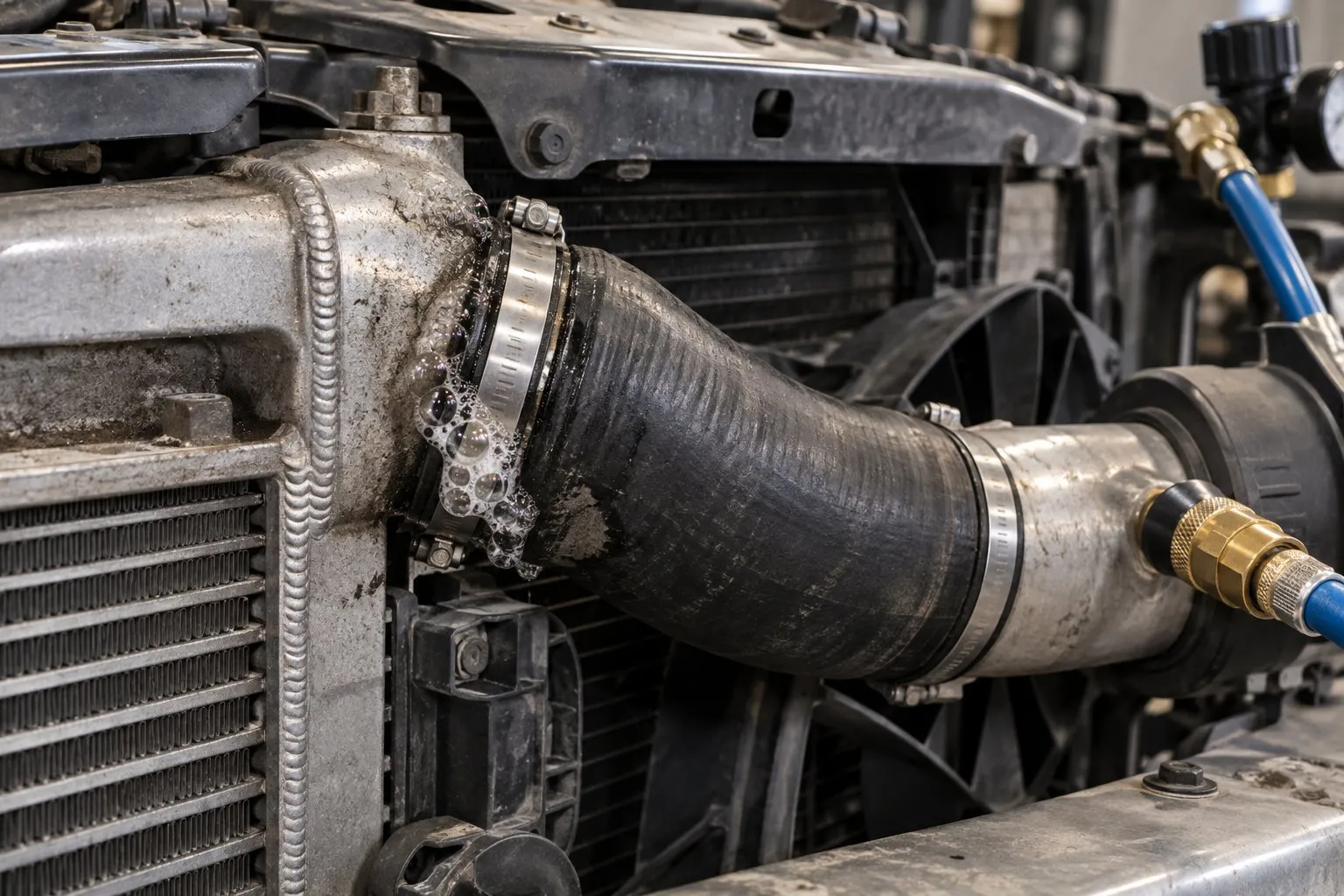
Remove the filter and look for restriction. Check every boot, clamp, and charge pipe for leaks or oil residue. A boost leak test with shop air at 20 to 25 psi will find cracks you can’t see.
3. Check the Actuator and Wastegate
With the engine off, apply vacuum or pressure to the actuator and watch the rod move. It should stroke smoothly and hold. A rod that won’t move, or a diaphragm that won’t hold pressure, means the actuator is done.
4. Inspect the Turbo Directly
Pull the intake hose and check for shaft play. A tiny amount of side-to-side movement is normal, but in-and-out axial play should be barely perceptible, and nothing should rub. Look for wheel damage, oil in the compressor housing, and carbon on VGT vanes.
5. Test Injectors and Fuel System Last
If air delivery checks out, move to fueling. A cylinder contribution test or injector balance test will point to a leaking or over-delivering injector. For a deeper walk-through of boost-related diagnosis, see our guide on low boost pressure on a diesel.
Black Smoke vs Other Exhaust Colors
Exhaust color is one of the fastest ways to narrow a diagnosis. Here’s how the three main colors line up with likely causes so you don’t chase the wrong system.
| Smoke Color | Root Cause | Turbo Involved? | Common Fix |
|---|---|---|---|
| Black | Too much fuel or too little air | Sometimes (low boost, stuck vanes, bad actuator) | Actuator, air filter, injectors, boost leak repair |
| Blue | Oil burning in combustion | Sometimes (oil past the turbo’s piston ring seals, usually from a restricted oil drain, high crankcase pressure or a clogged air filter) | Find the cause first (drain, breather, air filter, engine wear), then rebuild the turbo only if it is worn |
| White | Unburned fuel or coolant | Rarely | Injectors, timing, head gasket |
If your smoke is blue rather than black, the diagnosis shifts to oil getting into the intake or exhaust, covered in our article on blue smoke and turbocharger oil seal failure. If it’s white, read our breakdown of white smoke causes. And if you’re hearing unusual noise along with the smoke, our guide on turbo whine vs normal turbo noise helps confirm bearing wear.
Repair vs Replace: Your Options When the Turbo Is the Cause
Once you’ve confirmed the turbo is genuinely at fault, you have three real paths. The right one depends on what specifically failed and your budget.
| Option | Best For | Relative Cost | Turnaround |
|---|---|---|---|
| Replace actuator only | Good cartridge, bad wastegate control | Lowest (quoted by part number) | Same day |
| Rebuild existing turbo | Worn bearings/seals, salvageable housings | Moderate | A few days |
| Remanufactured unit | Wheel damage, major internal failure | Higher | Fast, off the shelf |
If only the actuator failed, replace that part and keep the turbo.
Rebuilding makes sense when the housings are intact but the center section is worn out. If the shaft has play, the seals are leaking, or the bearings are shot but the compressor and turbine wheels are clean, a rebuild brings the unit back to spec for a fraction of a new turbo. It takes longer than an actuator swap because the cartridge comes apart and gets rebalanced, but you keep your original matched housings.
Go remanufactured when the wheels are chipped, the shaft is bent, or the damage runs deep enough that a rebuild isn’t worth the gamble. A reman unit is tested and ready to bolt on, so it gets a down truck back on the road fastest. When you’re weighing the three, let the actual failure decide: a bad actuator never justifies a reman, and a shattered compressor wheel never justifies just a new rod.
Frequently Asked Questions
Does black smoke always mean my turbocharger has failed?
No, black smoke often points to fueling issues, a clogged air filter, or a faulty sensor rather than the turbo itself. A failing turbo doesn’t always produce black smoke.
What are the real causes of black smoke in a diesel engine?
Black smoke is usually caused by an over-rich air-fuel mixture, which can stem from a clogged air filter, faulty injectors, or a bad sensor. It indicates incomplete combustion, not necessarily turbo failure.
How can I tell if my turbocharger is actually the problem?
Check for signs like loss of power, whining noises, blue or excessive smoke, and oil leaks around the turbo. Proper diagnosis rules out cheaper causes before replacing the turbo.
If the turbo turns out to be the cause, PT Turbo’s turbo rebuild service can restore proper boost and fueling.
Need a Turbocharger?
PT Turbo has rebuilt and sold turbochargers since 1978. We stock remanufactured units for Cummins, Duramax, Power Stroke, Detroit Diesel, and more — backed by a 12-month unlimited mileage warranty. Units in stock at our shop in San Bernardino, CA ship the same day when ordered before 2 PM Pacific, Monday through Friday.
📞 (909) 824-1020 · 346 S I St. #3, San Bernardino, CA 92410 · [email protected]
More From PT Turbo
- P0046 Turbocharger Boost Control Circuit Range/Performance: What It Means & How to Fix It
 Turbocharger Failed on a Fresh Engine Rebuild: The Most Common Reasons Why
- Crankcase Pressure and Turbocharger Failure: The Connection Diesel Owners Miss
- P0299 on 6.7L Cummins: HE300VG vs HE351VE Turbo Diagnosis Guide