White Smoke from Diesel Engine: Is It the Turbocharger, Head Gasket or Injector?
White smoke from a diesel engine is one of the most misdiagnosed problems we see at PT Turbo, and after 45+ years of rebuilding turbos and troubleshooting failures, we can tell you the fix is almost never what people first assume. Owner-operators point at the turbo. Fleet mechanics blame the head gasket. The parts counter sells an injector. And often, none of those was the real culprit.
The good news is that white smoke tells you a very specific story if you know how to read it. The color, the smell, the timing, and the conditions under which it appears all narrow down the cause fast. This guide walks you through it the way we would on the phone with a customer.
What White Smoke Actually Means
White smoke from a diesel engine is unburned or partially burned fuel, coolant turning to steam, or condensation. Unlike blue smoke (oil) or black smoke (excess fuel under load), white smoke is about fuel that never combusted properly or a fluid that shouldn’t be in the combustion chamber at all.
The trick is figuring out which type you have. Steam from coolant smells sweet and antifreeze-like. Raw fuel smells sharp and diesel-heavy. Harmless startup condensation is thin, wispy, and disappears within a minute or two once the engine warms.
Get the smell and the timing right and you’ve already eliminated half the possible causes.
Quick Reference: White Smoke by Cause
| Symptom | Likely Cause | Smell | When It Appears |
|---|---|---|---|
| Thin white smoke on cold start, clears in 1-2 min | Normal condensation | None / faint diesel | Cold mornings only |
| Persistent white smoke, rough idle, hard start | Injector fault / low compression | Raw diesel | All conditions, worse cold |
| Sweet-smelling white smoke, coolant loss | Head gasket / cracked head | Sweet antifreeze | Constant, worse under load |
| Gray haze with poor boost, whistling | Turbo / actuator underperformance | Faint diesel | Under acceleration |
Is It the Injector? Start Here
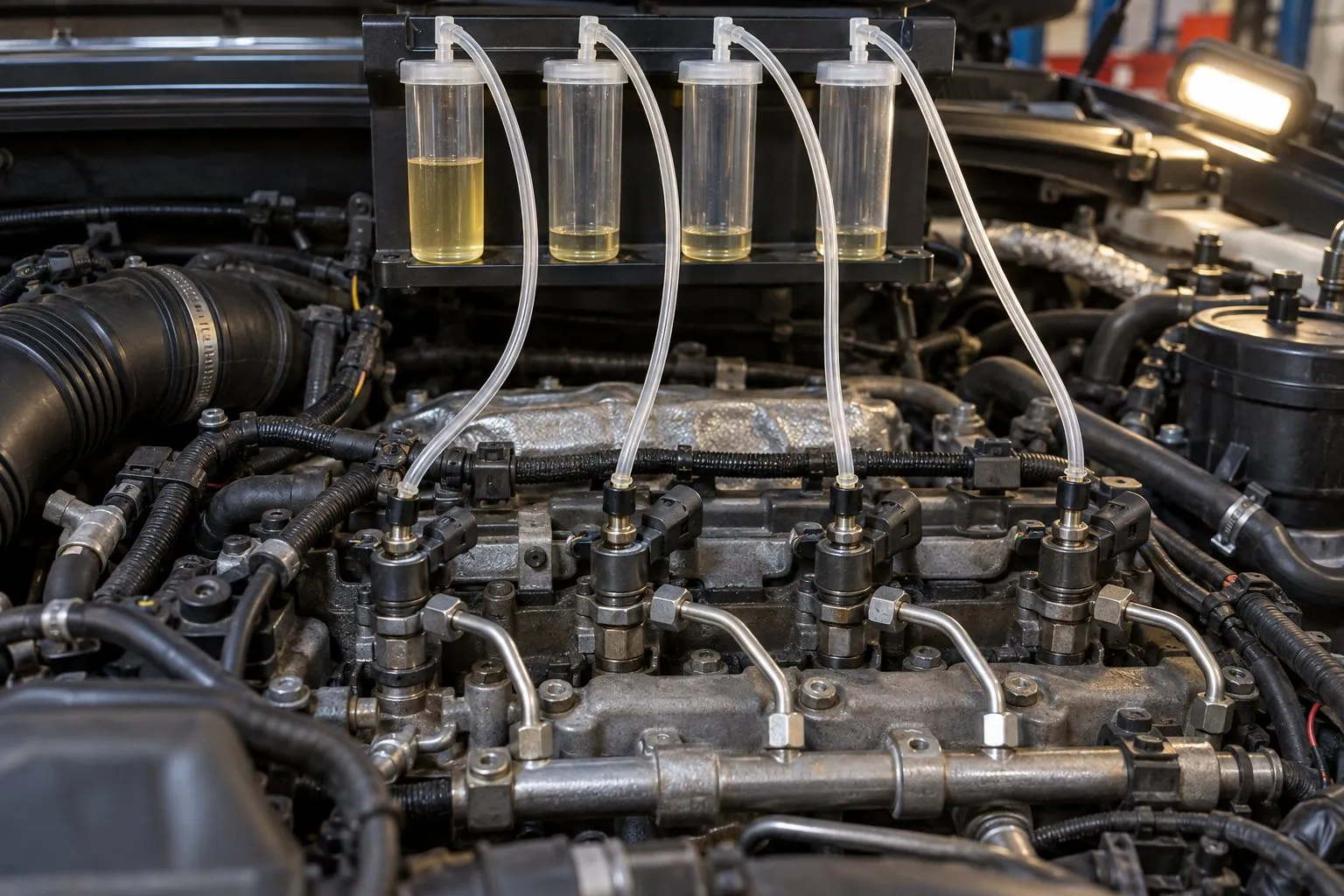
Injectors are the number one cause of white smoke on high-mileage diesels, and they’re where you should start because testing is cheap. When an injector delivers poor spray pattern, wrong timing, or leaks fuel past a worn nozzle, that raw fuel doesn’t ignite. It exits the tailpipe as white smoke.
Classic signs of an injector problem include a rough, lopey idle that smooths out as the engine warms, a hard start when cold, and that unmistakable raw diesel stink in the smoke. On many engines you can isolate the bad cylinder with a cylinder cut-out test using your scan tool. Kill each injector one at a time. When cutting a cylinder makes little or no rpm drop, or the white smoke clears, you’ve found it.
Worn injectors also tend to knock and rattle because fuel is dumping in at the wrong point in the stroke. On common-rail systems, a leak-back test measures how much fuel each injector returns. An injector returning far more than its neighbors is failing internally.
- Rough cold idle that clears with heat
- Raw diesel smell in the smoke
- Hard starting, extended cranking
- Uneven leak-back rates between cylinders
- Injector knock or rattle
Is It the Head Gasket? The Coolant Test
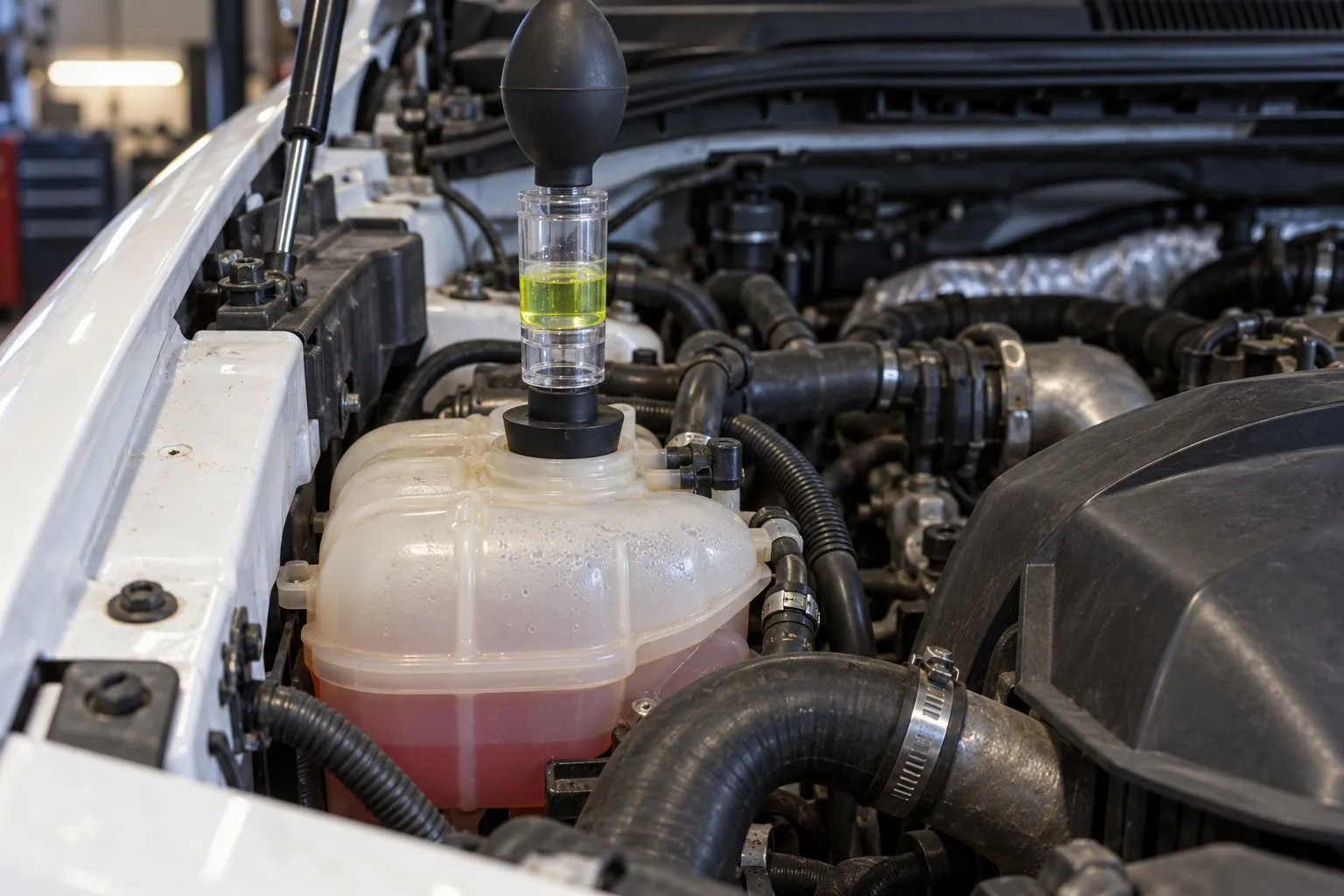
A blown head gasket or cracked head lets coolant seep into the combustion chamber, where it flashes into steam. This produces thick, sweet-smelling white smoke that does not clear as the engine warms. In fact it often gets worse under load and can billow continuously.
The tells here are different from an injector problem. You’ll lose coolant with no visible external leak. You may see bubbles in the coolant reservoir from combustion gases pushing into the cooling system. Check your oil too. Coolant in the oil turns it into a milky, chocolate-milk sludge on the dipstick and under the oil cap.
Two field tests confirm it fast. A combustion leak (block) test uses a chemical that changes color when exhaust gas is present in the coolant. A cooling system pressure test that slowly bleeds down with no external leak points to coolant escaping internally.
Head gasket failure is the most expensive of the three causes to fix, so confirm it before you tear anything down. Overheating, from a failing water pump or clogged radiator, is usually what killed the gasket in the first place, so address the root cause.
Is It the Turbocharger? Read the Signs
The turbo gets blamed constantly, but a failing turbo more often causes blue or black smoke than white. Blue smoke usually means oil is passing the turbo seals, which we cover in detail in our guide to blue smoke and turbocharger oil seal failure.
A turbo that fails to build boost changes the smoke too, but not to white: without enough air the mixture runs rich and the smoke turns black or dark gray, especially under acceleration. On modern diesels low boost is often not the turbo cartridge at all. It’s a boost leak or the actuator that controls the wastegate or variable-geometry vanes.
A Stuck Actuator: Gray Smoke Often Mistaken for White
When an actuator sticks (or, on a pneumatic one, loses its diaphragm), the wastegate or VGT vanes no longer move correctly. The turbo either overboosts, underboosts, or hunts, and combustion suffers. A sticking variable-geometry mechanism, in particular, throws boost and fueling out of sync and produces poor throttle response with dark or gray smoke rather than true white smoke. You can read how variable-geometry turbochargers control boost to understand why the actuator is so critical.
Replacing a failed actuator usually costs less than replacing the whole turbo, and it’s one of the most overlooked fixes in the shop.
Before you condemn the cartridge, verify the actuator moves freely through its full range and holds vacuum or pressure. Many turbos are scrapped over an actuator fault. A pneumatic actuator is cheap; an electronic actuator costs more and must be calibrated to the turbo, and on some turbos (Garrett REA/SREA) it is not sold separately. Calibration specs come from the engine maker’s service information or the turbo maker’s technical support, so have the turbo serial number ready.
Don’t Forget the Simple Stuff: EGR and DPF
On emissions-equipped diesels, white smoke sometimes traces back to the aftertreatment system. A stuck-open EGR valve dilutes the intake charge, which mostly shows as black smoke and soot; on a cold engine, unburned fuel can also look white or gray. A saturated diesel particulate filter that can’t complete a regen also disrupts combustion behavior.
These are worth ruling out with a scan tool before you go deep into the engine. Pull codes, check EGR position, and look at DPF soot load. It’s a five-minute check that can save you a needless teardown.
Repair vs Replace: What It Costs
Once you’ve isolated the cause, the decision is repair, rebuild, or replace. Here’s how the three main causes stack up in real terms.
| Cause | Typical Fix | Relative Cost | Downtime |
|---|---|---|---|
| Stuck turbo actuator | Replace actuator, recalibrate | Low (see actuator prices) | 1-3 hours |
| Failed turbo cartridge | Rebuild or reman turbo | Medium | Half day |
| Faulty injector | Replace injector(s), recode | Medium to high | Half to full day |
| Blown head gasket | Head gasket, machine work | High | 2-4 days |
If the turbo itself is worn out, you have two smart options. Our turbocharger rebuild service restores your existing unit to spec with new bearings, seals, and balancing.
The second option is a remanufactured unit when your core is too far gone to save, which gets you back on the road with a known-good turbo and a warranty behind it. For a stuck actuator or a single bad injector, there’s no reason to replace the whole assembly. Match the fix to the actual fault and you keep the repair bill where it belongs.
The takeaway after all these years is simple: diagnose before you spend. White smoke narrows down fast when you read the smell, the timing, and the conditions, and the cheapest likely cause is almost always worth ruling out first. Plenty of good turbos get scrapped and plenty of sound heads get pulled because nobody ran the five-minute checks before reaching for the wrench.
Frequently Asked Questions
What causes white smoke from a diesel engine?
White smoke is usually caused by unburned fuel from a faulty injector, or coolant entering the combustion chamber from a bad head gasket. A turbo or actuator fault gives dark or gray smoke that can be mistaken for it. Proper diagnosis is key since it’s often misdiagnosed.
Is white smoke from a diesel engine caused by the turbocharger?
Rarely. A turbo or actuator fault gives blue, black or gray smoke rather than true white smoke. Owners often blame the turbo when the actual cause is a failing injector or head gasket, so a thorough inspection is essential before replacing parts.
How do I tell if white smoke is from a head gasket or an injector?
Coolant loss, sweet-smelling smoke, and overheating point to a head gasket, while a fuel smell and rough idle suggest a bad injector. A professional diagnosis confirms the exact cause and prevents unnecessary repairs.
Need a Turbocharger?
PT Turbo has rebuilt and sold turbochargers since 1978. We stock remanufactured units for Cummins, Duramax, Power Stroke, Detroit Diesel, and more — backed by a 12-month unlimited mileage warranty. Units in stock at our shop in San Bernardino, CA ship the same day when ordered before 2 PM Pacific, Monday through Friday.
📞 (909) 824-1020 · 346 S I St. #3, San Bernardino, CA 92410 · [email protected]