Hot Shutdown Turbocharger Damage: Why It Happens and How to Identify It
Hot shutdown turbocharger damage is one of the most common, and most preventable, causes of premature turbo failure we see come across the bench at PT Turbo. It happens when a diesel engine is shut off immediately after hard work, before the turbocharger has a chance to cool down. The result is oil that literally cooks inside the center housing, and a bearing system that starts dying long before the driver notices a single symptom.
After 45+ years rebuilding turbochargers, we can usually spot the signature of a hot shutdown the moment we split the housing. This article breaks down exactly why it happens, how to identify it, and how to keep it from destroying your next unit.
What Actually Happens During a Hot Shutdown
A turbocharger center shaft spins at anywhere from 100,000 to 250,000 RPM under load. That shaft rides on a thin film of pressurized engine oil inside the journal and thrust bearings. As long as the engine is running, oil keeps flowing, carrying away heat and lubricating the bearings.
When you shut the engine down while the turbo is still glowing hot from a hard pull, several bad things happen at once. Oil flow stops instantly, but the turbine housing can be sitting at 900 to 1,200 degrees Fahrenheit. The residual heat soaks back into the center housing with nowhere to go.
The stagnant oil trapped in the bearing area gets baked. It oxidizes into hard carbon deposits, a process technicians call “coking.” Those deposits build up on the shaft, in the oil passages, and around the bearings, choking off future oil flow and accelerating wear.
Why Turbos Are So Vulnerable to Heat Soak
The turbine side of a turbocharger is bolted directly to the exhaust manifold, so it absorbs enormous heat. When airflow through the housing stops, there is no convection cooling and no oil cooling. This is called heat soak, and the center housing temperature can actually climb after shutdown before it starts to drop.
Modern variable-geometry turbochargers make this worse. The VGT mechanism and its actuator sit right in the heat path, and coked oil can seize the vane mechanism just as easily as it seizes a bearing.
How to Identify Hot Shutdown Turbocharger Damage
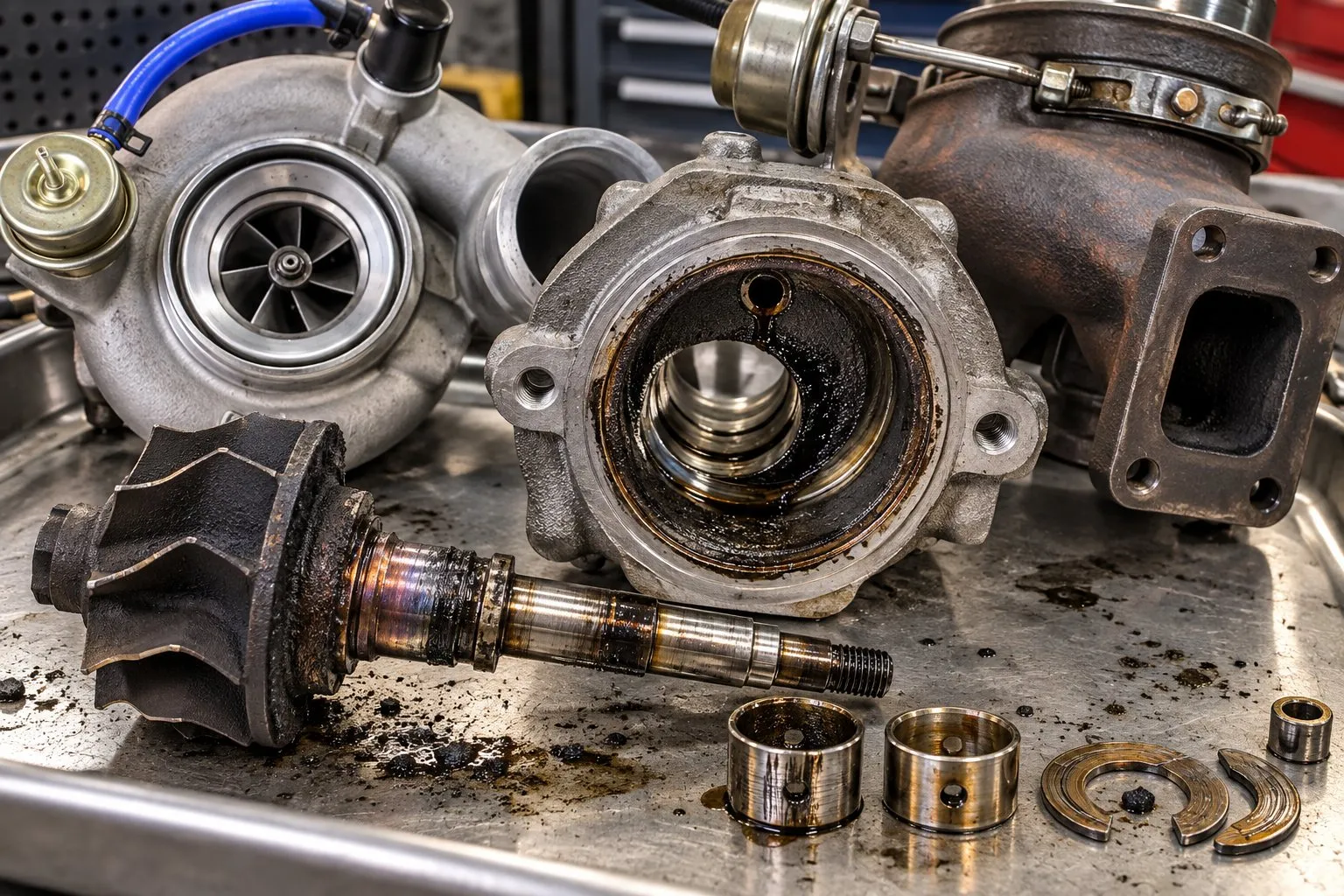
The tricky part about hot shutdown damage is that it builds up over hundreds of cycles. You rarely get one dramatic failure. Instead you get gradual bearing wear, oil consumption, and eventually a unit that spins down slowly or makes noise. Here is what to look for.
Visual Signs on Teardown
- Hard black carbon deposits on the shaft and in the center housing oil galleries. This is the smoking gun.
- Blue or purple discoloration of the shaft near the turbine wheel from extreme heat.
- Scored or bluish journal bearings that show heat-related wear.
- Coked oil feed line that is partially or fully blocked with hardened carbon.
- Excessive shaft play, both radial and axial, from worn bearings.
Symptoms Before Teardown
Drivers and fleet managers usually notice these warning signs first. Catching them early can save the engine, not just the turbo.
| Severity | Symptoms | What It Means |
|---|---|---|
| Early | Slight oil consumption, faint blue smoke on startup, minor turbo whine | Bearings starting to wear, seals affected by carbon |
| Moderate | Noticeable oil in the intake, reduced boost, longer spool time | Shaft play increasing, oil coking restricting flow |
| Severe | Grinding or rattling noise, heavy smoke, boost loss, actuator sticking | Bearing failure, possible VGT vane seizure, imminent turbo death |
If you are already seeing scored wheels, it is worth comparing against other failure modes. Our guides on compressor wheel damage and turbo oil starvation help you tell the difference, because coking and oil starvation often go hand in hand.
Hot Shutdown vs Oil Starvation vs Foreign Object Damage
Correct diagnosis matters because the fix and the prevention are completely different. A turbo killed by coking needs different corrective action than one killed by debris or a bad oil supply. Here is how the three most common failure modes compare.
| Failure Mode | Root Cause | Telltale Sign | Prevention |
|---|---|---|---|
| Hot shutdown / coking | No cooldown before shutoff | Hard carbon deposits, heat-blued shaft | Idle-down, turbo timer, synthetic oil |
| Oil starvation | Low oil pressure or blocked feed | Scoring, heat-blued journals, metal transfer | Oil supply service, prime after install |
| Foreign object damage | Debris through intake or exhaust | Chipped or bent wheel blades | Filter maintenance, clean install |
If the wheels show impact damage rather than heat damage, read our breakdown of turbine wheel damage from foreign object ingestion. And if you are chasing a coolant or soot problem alongside the turbo, the connection between EGR cooler failure and turbo damage is worth understanding too.
The Role of the Actuator in Hot Shutdown Failures
On modern VGT and wastegated turbos, the actuator is one of the first casualties of heat soak and coking. Carbon buildup binds the vane mechanism or wastegate linkage, and the actuator can no longer move it through its full range. You get erratic boost, limp mode, and fault codes even when the core is still mechanically sound.
We frequently replace actuators on units brought in for boost complaints. A sticking actuator caused by carbon is a classic downstream effect of repeated hot shutdowns. Here are common replacement units PT Turbo keeps in stock.
If you are not sure which actuator matches your turbo, send us the part numbers off the compressor cover nameplate. Our team has cross-referenced tens of thousands of units and can confirm the correct fit before you buy. You can reach us through the PT Turbo contact page.
How to Prevent Hot Shutdown Turbocharger Damage
Prevention costs nothing and adds years to turbo life. These are the practices we recommend to every fleet and owner-operator we work with.
Idle Down Before Shutdown
Let the engine idle for two to three minutes after hard work, before switching it off. Idling drops exhaust gas temperature dramatically and keeps oil circulating through the bearings. Coming off a mountain grade or a long highway pull, give it the full three minutes. Light around-town driving needs less.
Use the Right Oil and Change It On Schedule
High-quality synthetic oil resists coking far better than conventional oil because it tolerates higher temperatures before breaking down. Combined with on-time oil changes, this is one of the cheapest forms of insurance you can buy. Clean oil also means clean oil passages feeding the turbo.
Install a Turbo Timer on Hard-Working Trucks
A turbo timer keeps the engine idling for a preset period after you remove the key, then shuts it down automatically. For trucks that see constant heavy duty cycles, this removes human error from the equation. It guarantees the cooldown happens every single time.
For deeper background on how turbo bearing systems handle heat, Garrett Motion and BorgWarner both publish solid technical resources on turbocharger operation and thermal management.
Repair or Replace: What to Do With a Coked Turbo
Once a turbo has significant carbon buildup and bearing wear, it needs to come apart. A quality rebuild removes all coked oil, replaces the bearings, seals, and worn hardware, and rebalances the core.
Frequently Asked Questions
What causes hot shutdown turbocharger damage?
It occurs when a diesel engine is shut off immediately after hard work, before the turbo cools down. The residual heat cooks the oil inside the center housing, damaging the bearing system.
How can I identify hot shutdown turbocharger damage?
Look for coked or carbonized oil in the center housing, scored bearings, and discolored shafts. These signs indicate the oil overheated and broke down during shutdown.
How do I prevent hot shutdown turbocharger damage?
Allow the engine to idle for a few minutes after heavy use so the turbo can cool before shutting down. Installing a turbo timer can automate this process for consistent protection.
Heat-soaked bearings and coked oil are repairable. See PT Turbo’s turbo rebuild service.
Need a Turbocharger?
PT Turbo has rebuilt and sold turbochargers since 1978. We stock remanufactured units for Cummins, Duramax, Power Stroke, Detroit Diesel, and more — backed by a 12-month unlimited mileage warranty. Units in stock at our shop in San Bernardino, CA ship the same day when ordered before 2 PM Pacific, Monday through Friday.
📞 (909) 824-1020 · 346 S I St. #3, San Bernardino, CA 92410 · [email protected]
More From PT Turbo
- Turbo Whine vs Normal Turbo Noise: How to Tell if Your Turbocharger Is Failing
 Turbo Whine on Ford 6.0L Powerstroke: Normal Noise vs Bearing Failure Guide
- Black Smoke and Turbocharger Failure: How to Tell If the Turbo Is the Cause
- Diesel Engine Low Power: Is It the Turbocharger? Complete Diagnosis Guide