6.7L Cummins Low Power: Turbocharger vs Fuel System Diagnosis Guide
Chasing 6.7L Cummins Low Power is one of the most common diagnostic calls we get, and the fix is usually simpler than owners fear once you split the problem into the two systems that actually make power: the air side and the fuel side. A diesel makes torque by burning fuel with enough air, so a truck that feels gutless, smokes, or falls on its face under load is either short on boost or short on fuel. Guessing wrong gets expensive, because a turbocharger and a set of injectors sit at opposite ends of the price spectrum.
This guide walks through how to tell the difference on a 2007.5 and newer Ram 2500/3500 with the 6.7L Cummins, which engine codes point where, and what to confirm before you pull a turbo. PT Turbo has been rebuilding turbochargers since 1978, more than 45 years, and we stock both new and remanufactured units for these trucks, so we see where this diagnosis goes sideways.
Air Side vs Fuel Side: How to Split the Problem
The 6.7L Cummins uses a single variable geometry turbocharger. From 2007.5 to 2012 that is the Holset HE351VE, and from 2013 on it is the Holset HE300VG. Both move a sliding nozzle with an electronic actuator that is calibrated to the turbo, and both carry coolant lines for that actuator. If you want the deeper comparison, see our HE351VE vs HE300VG breakdown.
Air-side low power usually comes with a boost complaint you can see on a gauge or a scan tool: boost that never reaches commanded, boost that builds slowly, or boost that spikes and then collapses. Fuel-side low power tends to arrive with hard starts, a rough idle, fuel-trim or rail-pressure codes, or a sudden derate with no smoke at all.
| Symptom | Points to the turbo (air side) | Points to fuel system |
|---|---|---|
| Boost below commanded under load | Yes | Rare |
| Slow spool, lazy throttle response | Yes | Possible |
| Black or dark gray smoke with low boost | Yes | Possible |
| Hard cold start, long crank | No | Yes |
| Rough idle, miss, cylinder balance fault | No | Yes |
| Rail pressure not reaching target | No | Yes |
| Whistle, grinding, or oil in the charge pipes | Yes | No |
Turbo-Side Causes of 6.7L Cummins Low Power
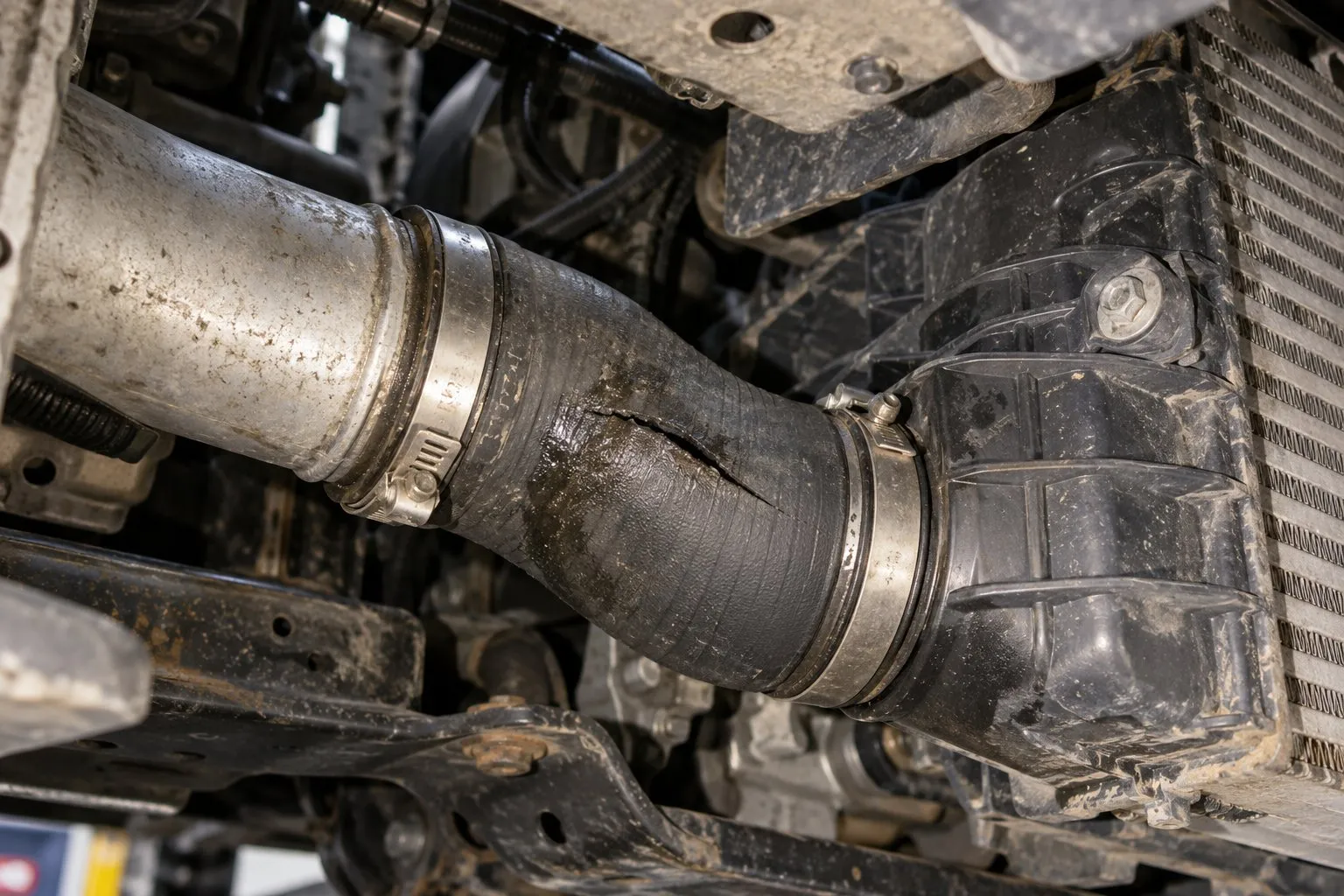
The variable geometry nozzle is the heart of the air side on this engine. The PCM commands the actuator to move the sliding nozzle closed at low RPM for quick spool and open at high RPM and light load. When soot builds on the nozzle ring, the slide binds, and that is where most driveability complaints on these turbos start.
A nozzle stuck closed gives overboost and high drive pressure. A nozzle stuck open gives exactly what you are chasing here: low boost, lazy spool, and dark smoke under throttle because the engine is getting fuel without the matching air. For a fuller picture of how the geometry works and what fails first, read our Cummins ISB 6.7L turbocharger guide and this plain-language overview of a variable-geometry turbocharger.
Other air-side causes worth ruling out before condemning the turbo:
- Electronic actuator fault. The actuator can fail or lose calibration and leave the nozzle in the wrong position.
- Boost leaks. A loose clamp, split boot, or cracked intercooler lets charge air escape. The turbo then spins harder to chase target boost, which can overspeed it, so fix leaks promptly.
- Plugged air filter or restricted intake. Simple, cheap, and often skipped.
- Worn turbo bearings. Shaft play beyond the maker’s limit, or wheel contact with the housing, kills efficiency. Some side-to-side rock is normal on a journal-bearing turbo, so condemn it for in-and-out play you can feel or for a wheel touching the housing, not for any movement at all.
- Exhaust leak ahead of the turbine. A leak in the manifold or up-pipes lets exhaust escape before the turbine, which slows spool and lowers boost. It does not raise backpressure.
One mechanical reminder that saves good turbos: oil in the charge pipes is not automatic proof of a failed seal. A thin film is normal on an engine with crankcase ventilation. Check the breather, air filter, oil level, and the oil drain before you blame the compressor seal. Oil from the turbo itself reaches the charge pipe only past the compressor-side seal, and a restricted drain backs oil up past both seals.
Fuel-Side Causes of 6.7L Cummins Low Power
When boost is reaching commanded but the truck still feels dead, move to the fuel side. The common rail system has to deliver volume and pressure on demand, and any weak link shows up as low power, especially under load.
- Clogged fuel filters. The 6.7L runs a two-stage filtration setup. A neglected filter starves the high-pressure pump and is the first thing to check because it is the cheapest.
- Weak lift pump or supply restriction. Low supply pressure to the high-pressure pump limits what the rail can build.
- High-pressure pump wear. A tired pump cannot hold commanded rail pressure under heavy demand, which sets rail-pressure codes and triggers a derate.
- Worn or leaking injectors. Injectors that return too much fuel, stick, or spray poorly cause rough running, a miss, cylinder-balance faults, and reduced power.
- Restricted exhaust aftertreatment. A loaded diesel particulate filter or a failed regen cycle drives the ECM into a derate that feels exactly like low power. Check soot load and regen history before you touch the fuel system.
Note that on a modern electronic diesel, a boost leak does not make the ECM add fuel. The smoke limiter caps fueling by measured airflow, so chasing a fuel fault when the real problem is on the air side is a dead end. Read the data, not the symptom alone.
Reading the Codes: What They Actually Mean for 6.7L Cummins Low Power
Codes narrow the search fast on this platform. Pull them with a capable scan tool and interpret them before you part-cannon the truck. A broad reference to common turbocharger fault codes helps, but here are the ones that matter most on a 6.7L Cummins.
| Code | Meaning | Where it points |
|---|---|---|
| P0299 | Turbocharger underboost condition | Air side: nozzle, actuator, leaks, restriction |
| P0234 | Turbocharger overboost condition | Air side: nozzle stuck closed |
| P003A | Boost control position exceeded learning limit | Air side: actuator or binding nozzle |
| P226C | Boost control A slow response | Air side: actuator or sticking nozzle |
| P0401 | Insufficient EGR flow | Air/EGR: cooler or valve, soot |
Remember that P003A is a learning-limit code, not a sensor or circuit code, and it usually means the actuator cannot move the nozzle through its full range. On these trucks the fault reporting is often by SPN/FMI as well, so cross-check both. P132B is a Ford 6.7L Power Stroke code and does not belong on a Cummins diagnosis.
Confirming the Turbo Before You Replace It
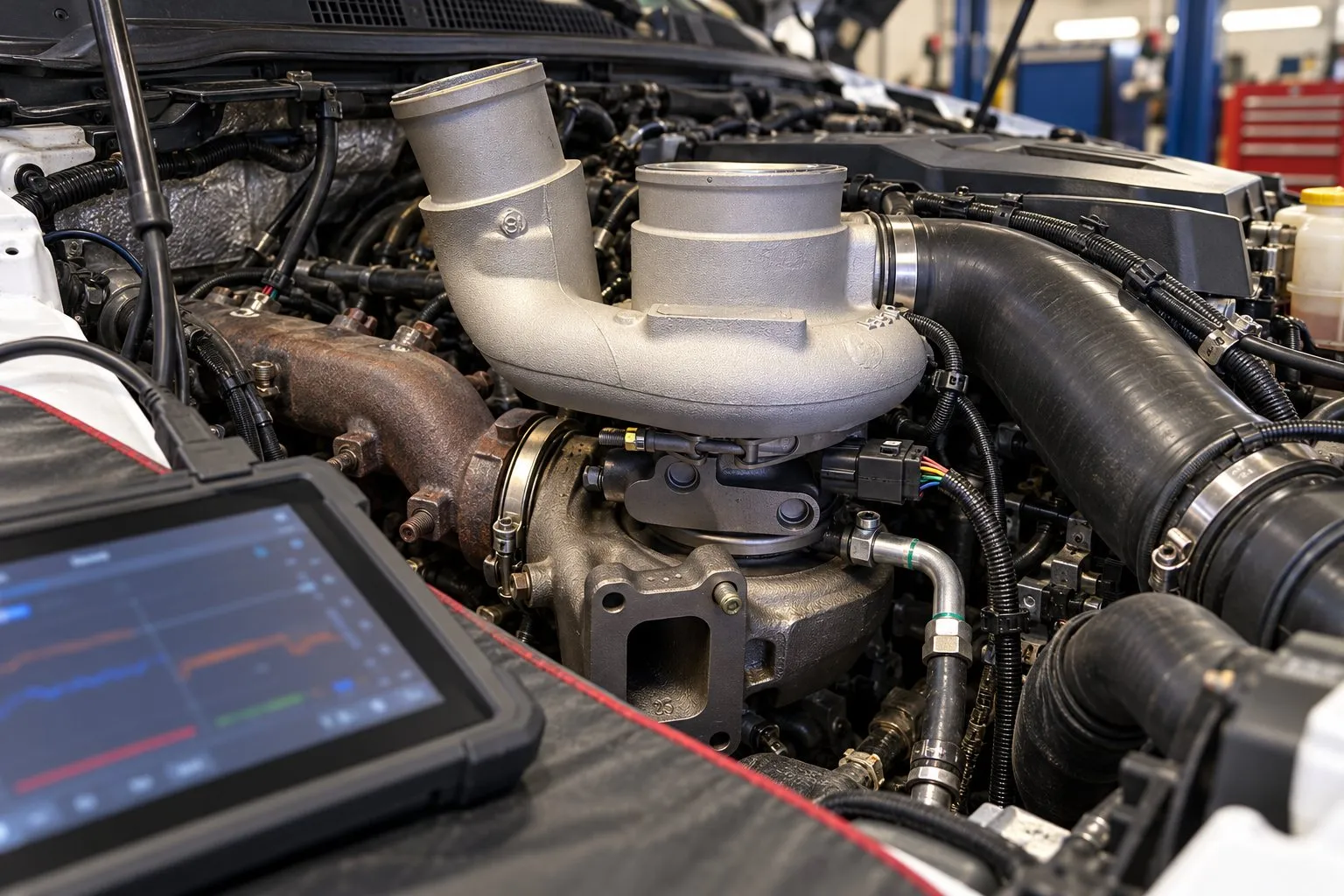
Do not replace a turbo on a hunch. Command the actuator with a scan tool and watch the nozzle respond. If the nozzle is binding on soot, sometimes it frees with service; if the actuator is dead or the bearings are gone, the unit comes off.
Never force the electronic actuator’s arm by hand. The gears are self-locking and break. If you pull the actuator to check the nozzle, unbolt it and move the vane lever instead. When you fit a new or calibrated actuator on a Cummins, run the INSITE install routine with the actuator plugged in but not yet bolted to the turbo, then mount it and calibrate without cycling the key.
The turbo lives in the engine bay near the passenger fender and comes out from there. This is not a cab-off job; that is Ford 6.0L and 6.4L work. Either turbo weighs about 50 pounds with its actuator, so plan the lift. When you prime a replacement, fill the oil inlet with clean engine oil, turn the wheel by hand, and crank the engine while keeping it from starting per the service manual’s named fuse or connector. On a common-rail engine you do not “disconnect the fuel.”
New or Remanufactured: Getting the Right Part
Once you have confirmed the turbo, match the part number on the data plate, not the casting number. One casting serves many turbos, so the tag number plus wheel sizes and A/R are what confirm fitment. The HE351VE and HE300VG do not swap directly for each other; the actuators and wiring differ, and adapter harnesses exist for conversions.
PT Turbo stocks new turbos and remanufactures in-house. A remanufactured turbocharger is a cost-effective route, and our turbo rebuild service covers both of these Cummins units. Current rebuild pricing by model is on our turbo rebuild price list; most rebuilds ship in 3 days or less, and the price is confirmed after inspection before any work starts.
| Option | What you get | Best for |
|---|---|---|
| New turbo | Factory-fresh unit, no core | Owners who want zero downtime risk |
| Remanufactured turbo | Rebuilt cartridge, balanced, warranted | Value without cutting quality |
| Rebuild your core | Your unit refreshed and returned | Keeping your original housings |
Our remanufactured units carry a 12-month, unlimited-mileage warranty, and the core return window on reman turbos is 30 days. Fleet customers can arrange priority turnaround and core stocking by phone. For model-level detail on these trucks, our Ram 2500/3500 6.7L Cummins turbocharger guide is the companion piece to this diagnosis.
Turbos we list for the HE351VE and HE300VG
Listings for the turbo models named in this guide that can be ordered online today. Several part numbers can fit one engine by year and rating, so match the number on your turbo’s tag, or call (909) 824-1020 and we will match it for you.
Frequently Asked Questions
Can a bad turbo actuator cause low power without any smoke?
Yes. If the electronic actuator leaves the sliding nozzle open, boost falls short of commanded and the truck feels lazy, often with a P0299 or P003A code. Because the engine’s smoke limiter caps fuel to measured airflow, you may see little smoke even though power is down. Command the actuator with a scan tool and watch the nozzle move before deciding.
How do I know if it’s the injectors or the turbo on my 6.7L Cummins?
Watch boost against commanded and watch rail pressure against target on a scan tool. If boost lags but rail pressure is fine, look at the turbo, nozzle, and leaks. If boost is normal but you have hard starts, a rough idle, cylinder-balance faults, or rail pressure that will not reach target, the fuel side is the likely culprit.
Do I need to calibrate the turbo actuator after replacement?
Yes, on these electronic VGT turbos the actuator is calibrated to its own turbo. On a Cummins, run the INSITE install routine with the actuator plugged in but not yet bolted on, then mount it and calibrate without cycling the key. Skipping this leaves the nozzle uncalibrated and can set learning-limit codes. Call PT Turbo at (909) 824-1020 if you need help matching the right unit.
Need a Turbocharger?
PT Turbo has rebuilt and sold turbochargers since 1978. We stock remanufactured units for Cummins, Duramax, Power Stroke, Detroit Diesel, and more — backed by a 12-month unlimited mileage warranty. Units in stock at our shop in San Bernardino, CA ship the same day when ordered before 2 PM Pacific, Monday through Friday.
📞 (909) 824-1020 · 346 S I St. #3, San Bernardino, CA 92410 · [email protected]
More From PT Turbo
 Turbocharger Failed on a Fresh Engine Rebuild: The Most Common Reasons Why
- Turbo Whine vs Normal Turbo Noise: How to Tell if Your Turbocharger Is Failing
- Intercooler Failure Symptoms: How a Bad Intercooler Damages Your Turbocharger
- Diesel Engine Low Power: Is It the Turbocharger? Complete Diagnosis Guide