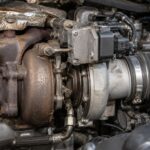
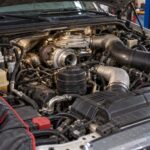
Understanding Turbo Surge vs Compressor Surge is one of the most common points of confusion we hear at PT Turbo, and getting it wrong can cost you a compressor wheel, a set of bearings, or an entire cartridge. The two terms get used interchangeably, but they describe the same underlying physics from different angles. If you run diesel trucks, heavy equipment, or performance engines, knowing exactly what’s happening inside that compressor housing will save you real money and downtime.
After 45+ years rebuilding turbochargers, we’ve torn down thousands of units killed by surge. The damage pattern is almost always the same, and so is the fix once you know what to look for. Let’s break it down properly.
What Compressor Surge Actually Is
Compressor surge is the aerodynamic stall that happens when the compressor tries to push air into the intake faster than the engine can swallow it. Pressure builds downstream, the airflow reverses violently, and boost momentarily backs up through the compressor wheel. Then pressure drops, flow resumes, and the cycle repeats.
You’ll hear it as a fluttering, chattering, or “stuttering pigeon” sound, usually right after you lift off the throttle. That noise is compressed air slamming backward across the compressor blades. It sounds harmless to some ears, but each surge event hammers the thrust bearing and shock-loads the wheel.
On a compressor map, surge is the hard limit on the left side. Every turbo has a surge line, and when your operating point crosses to the left of it, the compressor can no longer sustain stable flow. The basic turbocharger operating principles explain why this boundary exists in the first place.
Turbo Surge vs Compressor Surge: Same Event, Different Wording
Here’s the plain truth on Turbo Surge vs Compressor Surge: they refer to the same phenomenon. “Compressor surge” is the technically precise term because the surge originates in the compressor stage, not the turbine side. “Turbo surge” is the shop-floor shorthand people use because the whole turbocharger is what’s chattering.
The distinction only matters when you’re diagnosing. If someone tells you their turbo “surges,” they almost always mean compressor surge. There is no separate turbine-side surge event in the way the term is thrown around. Keep that straight and you’ll cut through half the confusion online.
What Causes Surge in Diesel Applications
Surge is a mismatch between boost pressure and airflow demand. Anything that chokes airflow downstream or forces the turbo to overspool for the conditions can trigger it. In diesel and heavy-duty applications, we see a handful of repeat offenders.
- Snap throttle lift: Closing the throttle or backing off under boost traps high-pressure air with nowhere to go.
- Oversized or mismatched turbo: A compressor too large for the engine runs deep in the surge region at low flow.
- Restricted intake or intercooler: A clogged air filter, crushed charge pipe, or fouled intercooler chokes flow.
- Boost leaks and failed couplers: Sudden pressure loss followed by recovery can set up cyclic surging.
- Faulty wastegate or VGT actuation: A sticking actuator holds too much boost at the wrong time.
- EGR and DPF restriction: Backpressure changes from a loaded diesel particulate filter or a stuck EGR system can shift the operating point into surge.
On modern variable-geometry turbos, actuator problems are a leading cause. When the vanes don’t move to their commanded position, the turbo can build boost far outside its stable range. Understanding how variable-geometry turbochargers modulate flow makes it clear why a lazy actuator turns into a surging turbo.
Symptoms by Severity: Catch It Early
Not all surge is equally dangerous. Occasional light flutter on throttle lift won’t destroy a turbo overnight, but sustained heavy surging will grenade the thrust bearing fast. Use this table to gauge how urgent your situation is.
| Severity | What You Hear / Feel | Damage Risk | Action |
|---|---|---|---|
| Mild | Light flutter on quick throttle lift only | Low, cumulative over time | Inspect intake, check for boost leaks |
| Moderate | Repeated chatter, brief power hesitation | Accelerating bearing wear | Test actuator and wastegate, check restrictions |
| Severe | Loud barking, visible boost oscillation, smoke | Imminent wheel and bearing failure | Stop driving, inspect turbo immediately |
If you’re hearing severe surge, don’t keep loading the engine. Every barking cycle is driving the shaft back and forth against the thrust bearing, and once that bearing lets go, metal contact between the wheels and housings follows within seconds.
How to Diagnose and Fix Turbo Surge
Diagnosis follows the airflow path. Start at the air filter and work toward the intake manifold, then check the boost control system. Most surge complaints trace back to one of three areas: a restriction, a leak, or a failing actuator.
Step 1: Rule Out Restrictions and Leaks
Inspect the air filter, charge pipes, intercooler, and every coupler and clamp. A collapsed hose or a split boot creates exactly the pressure instability that sets up surge. Pressure-test the intake tract if you have the equipment. A boost leak that closes and reopens under load is a classic hidden surge trigger.
Step 2: Verify Boost Control and Actuator Function
On both wastegated and variable-geometry turbos, the actuator is the component that decides how much boost the turbo makes and when. A sticking, leaking, or worn actuator is one of the most frequent causes of surge we diagnose. If the diaphragm has failed or the calibration has drifted, the turbo will hold boost into conditions where it should be bleeding off.
On a pneumatic actuator, test with a hand vacuum or pressure pump and confirm the rod travels its full stroke smoothly at the rated spec; an electronic actuator is tested with the scan tool’s sweep test. If it hangs, leaks down, or won’t hit its stop, replace it. Trying to nurse a bad actuator along is how a cheap part turns into a cartridge failure.
Step 3: Replace the Actuator With the Correct Part
We stock pneumatic actuators for a wide range of Garrett and Mitsubishi turbos. Matching the exact part number to your turbo is critical, because spring rate and stroke are calibrated to that specific compressor and turbine housing combination.
If you’re not sure which actuator matches your turbo, send us your turbo part number through our contact page and we’ll confirm the correct fit before you order.
Step 4: Address Turbo Sizing and Mechanical Damage
If your turbo has been surging for a while, or if it was oversized for the application from the start, actuator work alone won’t fix it. A compressor that lives in its surge region needs to be resized or the whole turbo rematched. And if the bearings and wheels are already damaged, that unit needs a rebuild.
Repair, Rebuild, or Replace: What Makes Sense
Once surge has damaged a turbo, you have three paths. The right one depends on how far the damage has progressed and your budget for downtime.
| Option | Best For | Typical Cost Level | Turnaround |
|---|---|---|---|
| Actuator replacement | Boost control fault, no wheel damage | Lowest | Same day install |
| Turbo rebuild | Worn bearings, minor wheel damage, original core | Moderate | Short, core-dependent |
| Reman or new turbo | Severe damage, cracked housing, no usable core | Highest | Off the shelf |
For most surge cases we see, the honest answer is start with the cheapest path that fully fixes the fault. If the wheels spin free with no in-and-out shaft play and the housings are clean, a new actuator gets you back on the road the same day. Throwing a whole turbo at a boost control problem is wasted money.
The moment you feel in-and-out shaft play, see wheel contact marks, or find oil in the compressor housing, that core needs to come apart. A rebuild on a good casting is almost always the better value than a reman, as long as you catch it before the bearings have scored the shaft. Once surge has worked a turbo long enough to crack a housing or shatter a wheel, you’re buying a replacement and there’s no shortcut around it.
Whichever path fits your situation, fix the root cause first. Install a fresh actuator or a rebuilt turbo onto an engine that still has a restriction, a boost leak, or a mismatched compressor, and you’ll be back to chattering within weeks.
Frequently Asked Questions
What is the difference between turbo surge and compressor surge?
They describe the same underlying physics from different angles, where airflow reverses across the compressor wheel. Turbo surge refers to the whole unit, while compressor surge pinpoints the affected component.
What causes compressor surge in a turbocharger?
Surge happens when the compressor tries to push more air than the engine can accept, often after a throttle lift or closed valve. This reverses airflow and destabilizes the compressor wheel.
How do you fix turbo surge?
Fixes include installing a properly sized turbo, adding a blow-off or bypass valve, and correcting boost and airflow mismatches. Choosing the right compressor map for your application prevents surge and protects the cartridge.
Surge that has already damaged the compressor wheel or bearings can be repaired. See PT Turbo’s turbo rebuild service.
Need a Turbocharger?
PT Turbo has rebuilt and sold turbochargers since 1978. We stock remanufactured units for Cummins, Duramax, Power Stroke, Detroit Diesel, and more — backed by a 12-month unlimited mileage warranty and same-week shipping from San Bernardino, CA.
📞 (909) 824-1020 · 346 S I St. #3, San Bernardino, CA 92410 · [email protected]