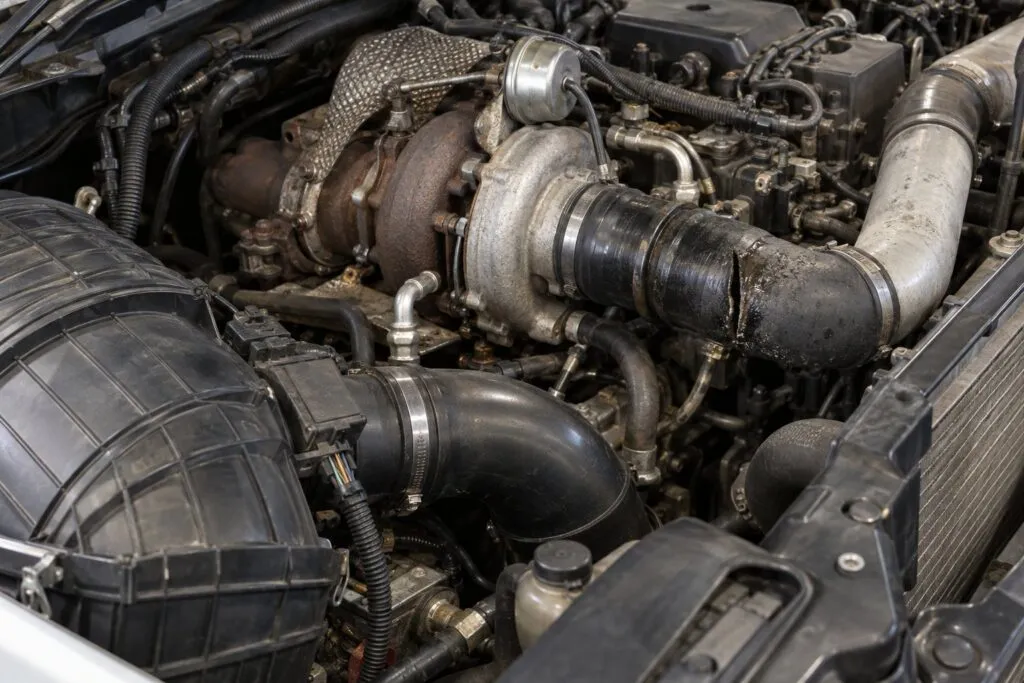
The P0101 Mass Air Flow Sensor Code and Turbocharger relationship is one of the most misunderstood diagnostic situations we see come through the shop, and chasing the wrong part costs owner-operators real money and downtime. P0101 is a MAF sensor performance code, but on a turbocharged diesel or gas engine, the sensor rarely fails in isolation. More often it is reporting a genuine airflow problem created somewhere between the air filter and the intake manifold, and the turbocharger sits right in the middle of that path.
At PT Turbo we have spent 45+ years diagnosing and rebuilding turbochargers, and we can tell you that a P0101 with boost complaints is a signal to inspect the entire induction system, not just swap a $60 sensor. This guide breaks down what the code actually means, how the turbo influences it, and how to isolate the real fault.
What the P0101 Code Actually Means
P0101 is defined as “Mass Air Flow (MAF) Sensor Circuit Range/Performance Problem.” The ECM sets it when the airflow value reported by the MAF sensor falls outside the expected range for a given engine speed, load, and throttle position.
This is different from P0100 (circuit malfunction) or P0102/P0103 (low/high input). Those point to wiring and voltage faults. P0101 means the sensor is electrically alive and reporting, but the number it reports does not match what the ECM expects the engine to be breathing.
On a turbocharged engine, the ECM cross-references MAF data with the boost pressure sensor (MAP), the throttle or fuel command, and RPM. When actual airflow drifts from the model, the code trips. That drift is very often a mechanical airflow leak or a turbo not producing commanded boost.
Why the Turbocharger Triggers a P0101 Mass Air Flow Sensor Code and Turbocharger Faults Overlap
The MAF sensor measures the mass of air entering the engine before it reaches the compressor. Anything that changes airflow downstream, or lets unmetered air in, throws off the correlation the ECM is watching.
Here is where the turbocharger comes into play:
- Boost leaks after the compressor: A cracked charge pipe, blown intercooler boot, or leaking clamp lets metered air escape. The MAF counted it, but it never made it to the cylinders.
- Wastegate or VGT actuator faults: If the turbo is not building commanded boost, actual airflow lags the model and P0101 (or an accompanying underboost code) sets.
- Worn compressor wheel or shaft play: A tired turbo moves less air than the ECM expects at a given RPM.
- Restricted or oiled MAF element: A leaking compressor seal can push oil mist upstream on some setups, contaminating the sensor.
Because the MAF and the turbo are two ends of the same air path, a fault in one shows up as a data mismatch that the ECM blames on the sensor. That is why P0101 so frequently rides alongside P0299 underboost or, less commonly, P0234 overboost codes.
Common Causes Ranked by How Often We See Them
After decades of teardown work, the pattern is consistent. Most P0101 codes on turbo diesels are not the sensor itself. Use this table to prioritize your diagnosis before you spend a dime.
| Likely Cause | Frequency | Turbo-Related? | Typical Fix Cost |
|---|---|---|---|
| Boost/intercooler leak or loose clamp | Very common | Yes | $20 – $150 |
| Dirty or oil-fouled MAF element | Common | Sometimes | $0 – $80 |
| Faulty wastegate/VGT actuator | Common | Yes | see actuator prices |
| Restricted air filter or intake | Moderate | No | $30 – $90 |
| Worn turbo (shaft play, damaged wheel) | Moderate | Yes | $400 – $1,800 |
| Failed MAF sensor | Less common | No | $50 – $250 |
Price ranges in this article are general estimates to help with budgeting, not PT Turbo quotes. Our current prices are on each product listing, and our rebuild prices are on the turbo rebuild price list.
Notice that the sensor itself is near the bottom of the list. Replacing it first is the single most common mistake we hear about from customers who call in still chasing the code.
Step-by-Step Diagnosis
Work the air path in order, from filter to intake. This keeps you from replacing parts on a hunch.
1. Inspect the Intake Tract and MAF
Pull the intake tube and check the MAF element for oil film, dust, or debris. Clean it with dedicated MAF cleaner only, never brake clean. Confirm the air filter is not clogged and the housing is sealed. Any unmetered air entering after the sensor will skew readings.
2. Pressure-Test the Charge Air System
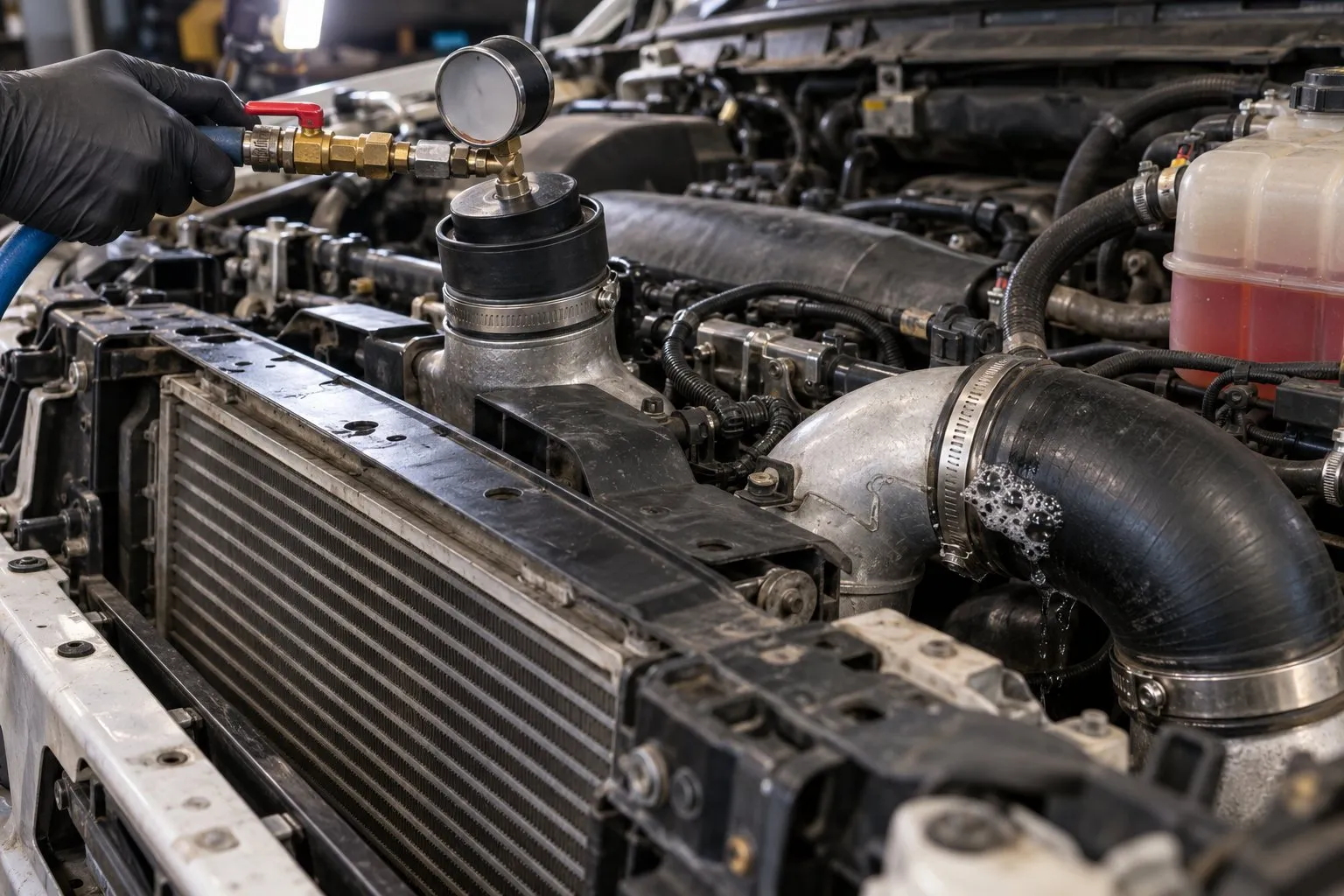
Cap the intake and pressurize the charge pipes to around 25-30 psi with a boost leak tester. Listen for hissing at boots, clamps, and the intercooler end tanks. This is the highest-yield test for a turbocharged P0101, and it takes ten minutes.
3. Compare MAF and MAP Data
With a scan tool, log MAF (g/s) and boost pressure under load. If commanded boost is not being reached, the problem is upstream of the sensor logic. This points you toward the actuator or the turbo itself rather than the MAF.
4. Check the Turbo Actuator
A sticking or failed actuator prevents the wastegate or VGT vanes from moving correctly, so the turbo under or over delivers air. Inspect the actuator rod for free travel and, on a pneumatic unit, the diaphragm for vacuum/pressure leaks. A failed actuator will corrupt airflow long before the turbo core does.
5. Assess Turbo Health
Check the compressor wheel for shaft play, blade damage, and oil in the compressor housing. Excessive axial or radial play means the turbo is worn and no longer moving rated airflow. At that point a rebuild or replacement is the fix, not another sensor.
Actuators: The Overlooked Fix for Airflow Codes
On turbo diesels, the actuator is often the real culprit behind airflow mismatches. When it cannot hold or move the wastegate or the vanes, boost and metered airflow diverge, and codes like P0101 follow. Replacing an actuator is far cheaper than a full turbo, and we stock the correct units for common platforms.
Matching the exact part number to your turbo is critical, since spring rates and rod geometry differ between units. You can learn more about Garrett hardware at Garrett Motion.
When the Turbo Itself Is the Problem
If the actuator checks out, the charge system holds pressure, and the MAF is clean but the airflow model is still off, the turbo core is the suspect. Worn bearings, a damaged compressor wheel, or eroded variable-geometry vanes all reduce the air a turbo can move.
At this stage you have two solid paths. A professional turbo rebuild service restores your original unit to spec, or you can drop in one of our remanufactured turbochargers for a faster turnaround. Both come with our reputation behind them.
Here is how the replacement options generally compare:
| Option | Relative Cost | Turnaround | Best For |
|---|---|---|---|
| New OEM turbo | Highest | Varies by availability | Warranty-critical fleet units |
| Remanufactured turbo | Moderate | In stock, ships fast | Most owner-operators and fleets |
| Rebuild your core | Lowest per unit | Requires downtime | Hard-to-find or specialty turbos |
Match the path to your situation. A fleet that cannot afford a truck sitting usually wins with a reman unit off the shelf, while a shop with a rare or discontinued turbo is better served sending the core in for a rebuild. The deciding factors are downtime tolerance and whether your exact unit is still available.
Whichever route you take, do not install a fresh turbo until you have confirmed the charge pipes hold pressure and the actuator moves freely. A boost leak or sticking actuator will set P0101 again on a brand-new unit, and you will be right back where you started with money already spent.
Looking for a different code? Our list of turbocharger fault codes gives the standard definition of every boost-related code and the kind of fault it points to.
Frequently Asked Questions
What does the P0101 code actually mean?
P0101 is a Mass Air Flow (MAF) sensor performance code, indicating the sensor’s airflow readings are outside the expected range for current engine operating conditions.
Can a bad turbocharger trigger a P0101 code?
Yes. Turbo boost leaks, worn seals, or a failing turbo can disrupt airflow, causing the MAF sensor to report readings that set a P0101 code even when the sensor itself is fine.
Should I replace the MAF sensor if I get a P0101 code?
Not immediately. On turbocharged engines, always check for intake leaks and turbo issues first, since replacing the sensor without fixing the root cause often wastes money and time.
Need a Turbocharger?
PT Turbo has rebuilt and sold turbochargers since 1978. We stock remanufactured units for Cummins, Duramax, Power Stroke, Detroit Diesel, and more — backed by a 12-month unlimited mileage warranty and same-week shipping from San Bernardino, CA.
📞 (909) 824-1020 · 346 S I St. #3, San Bernardino, CA 92410 · [email protected]
More From PT Turbo
 Boost Pressure Drops at Highway Speed: Diagnosing Intermittent Turbo Problems
- Turbocharger Seized: Causes, What to Check First & Repair vs Replace Decision
- Crankcase Pressure and Turbocharger Failure: The Connection Diesel Owners Miss
- Hot Shutdown Turbocharger Damage: Why It Happens and How to Identify It