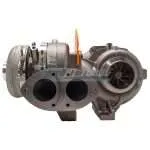
Mack MP8 Turbocharger Replacement Guide: Symptoms, Parts & Cost
If you run a Mack truck with an MP8 engine, the turbocharger is the single component most likely to leave you stranded on the shoulder with a boost fault code and a full trailer. On most trucks the Mack MP8 turbocharger is a variable geometry (VGT) unit that lives a hard life under EGR heat, soot loading, and constant nozzle cycling. When it starts to fail, it rarely dies clean. You get derates, whistles, black smoke, and VGT fault codes long before it quits entirely. This guide walks you through the failure symptoms, the real replacement parts, actuator options, and what the job actually costs so you can make the right call between a rebuild, a reman, or a new unit.
How the Mack MP8 Turbocharger Works
The MP8 is Mack’s 13-liter inline-six, sharing its architecture with the Volvo D13. Most MP8 trucks run a Holset variable geometry turbocharger, the HE451VE or the HE400VG sold for later trucks (the turbo-compound MP8HE is a different arrangement). The VGT uses a nozzle ring that slides inside the turbine housing to change exhaust gas velocity across the RPM range. At low RPM the nozzle closes down to spool boost fast and kill turbo lag. At high RPM it opens up to prevent overspeed and control backpressure for the EGR system.
That sliding nozzle mechanism is exactly why these turbos fail. The nozzle ring rides in a soot-heavy exhaust stream, and when carbon builds up it sticks. A sticking nozzle ring throws off boost control, sets codes, and puts the engine into derate. The electronic actuator that drives the nozzle is often the first thing to go while the CHRA (center housing rotating assembly) is still perfectly good.
Symptoms of a Failing MP8 Turbocharger
Don’t wait for a hard failure. The MP8 gives you plenty of warning if you know what to watch for. Here’s how the symptoms typically progress from nuisance to no-go.
| Severity | Symptom | Likely Cause |
|---|---|---|
| Early | Sluggish throttle response, slow spool | Nozzle ring beginning to stick, actuator lag |
| Early | High-pitched whistle or whine under load | Air leak, worn seal, or nozzle wear |
| Moderate | Black smoke, poor fuel economy | Incorrect boost, a nozzle stuck open |
| Moderate | VGT actuator fault codes (SPN 641) | VGT actuator or position sensor fault |
| Severe | Engine derate, limp mode | Boost out of range, ECM protection |
| Severe | Oil in charge pipe, blue smoke | Failed bearing / seal, shaft play |
| Critical | Grinding, metal in downpipe, no boost | Bearing failure, wheel contact |
The most common real-world complaint is a truck that pulls fine cold but goes into derate once it heats up, or one that throws an intermittent boost pressure code that clears and comes back. Most often that’s a sticking nozzle ring or a weak actuator, not a spun bearing. That distinction matters, because it changes whether you replace the whole turbo or just the actuator.
Do the Shaft Play Check First
Before you condemn a turbo, pull the intake boot and grab the compressor wheel. A little radial play is normal on a journal-bearing turbo. You want only slight in-and-out (axial) movement, within the turbo’s service spec, and no contact between the wheel and housing. If the shaft feels loose or you see rub marks on the compressor wheel, the CHRA is done and you’re looking at a rebuild or replacement. If the shaft is tight but the truck still won’t hold boost, focus on the nozzle and actuator.
Actuator vs. Full Turbocharger Replacement
This is where you save real money. On many MP8 turbo faults, the rotating assembly is healthy and the failure is in the actuator or the nozzle mechanism it controls. An electronic actuator that has failed internally or can no longer move the nozzle through its full travel will set the same boost codes as a dying turbo, but it costs less to fix.
Always verify the part number and calibration against your specific application before ordering an actuator. A replacement electronic actuator has to match the turbo and be calibrated to it with a diagnostic tool, or the ECM will fault it right back. If you’re not sure which unit matches your setup, our team can cross-reference it. That’s the advantage of buying from a shop that has been doing this since 1978. With 45-plus years in the turbocharger business, PT Turbo can tell you whether your problem is a bolt-on actuator fix or a full replacement before you spend a dime on the wrong part.
New vs. Remanufactured MP8 Turbocharger Cost
When the CHRA is toast and the nozzle is worn or coked beyond cleaning, you have three paths: a brand-new OEM turbo, a quality remanufactured unit, or rebuilding your existing core. Here’s how they compare on cost and turnaround.
| Option | Typical Cost Range | Turnaround | Best For |
|---|---|---|---|
| New OEM turbocharger | $3,762 to $4,120 (3 listings) at PT Turbo | In stock to several days | Fleet spec, warranty priority |
| Remanufactured turbocharger | $3,641 to $3,884 (2 listings) at PT Turbo | Same day if in stock | Best value, proven reliability |
| Rebuild your core | From $575 at PT Turbo (price list) | 3 days or less for most rebuilds | Cost control, keeping matched hardware |
| Actuator only | see actuator prices | Same day | Healthy CHRA, actuator fault |
Price ranges in this article are general estimates to help with budgeting, not PT Turbo quotes. Our current prices are on each product listing, and our rebuild prices are on the turbo rebuild price list.
For most owner-operators and fleets, a remanufactured turbocharger is the sweet spot. A properly reman unit gets a new CHRA, new bearings, a balanced rotating assembly, a cleaned and reconditioned nozzle ring, and a fresh actuator, all tested to spec. You get near-new performance at a substantial discount over OEM. If you’d rather keep your original housing and matched hardware, our turbo rebuild service can restore your core to factory tolerances with VSR balancing.
MP8 Turbocharger Replacement Tips
Replacing the turbo on an MP8 is straightforward if you follow a clean process. Rushing it is how you end up back under the truck in a week.
- Find the root cause. A turbo that failed from oil starvation or a bad EGR will kill the new unit too. Check oil supply and drain lines and inspect for debris before installing.
- Prime the bearing. Pre-fill the oil inlet and spin the shaft by hand before firing the engine. Idle at least 3 to 5 minutes on first start to establish oil flow.
- Replace the oil feed line. Coked or restricted feed lines are the number one cause of repeat failures. Never reuse a questionable line.
- Clean the charge air system. If the old turbo shed metal, debris is sitting in the CAC and piping. Flush it or you’ll ingest it.
- Verify actuator calibration. After install, the ECM may need a VGT calibration or forced regen cycle. Confirm nozzle travel with a scan tool.
- Torque to spec. V-band clamps and exhaust hardware have specific torque values. Over-torque distorts the housing, under-torque leaks.
If you also service light-duty diesels, the same diagnostic logic applies across platforms.
Check shaft play first, confirm whether the nozzle or the actuator is at fault before condemning the CHRA, and always trace the failure back to its root cause. Stuck vanes on a Power Stroke or a Duramax tell the same story as a stuck nozzle on an MP8: soot loading and heat, not necessarily a worn rotating assembly. The platform changes, the failure mode does not.
The payoff is knowing when a cheap actuator saves you a full turbo, and when a worn CHRA means you’re past the point of patching it. Do the checks in order, verify calibration after every install, and you keep trucks out of the derate loop and on the road where they earn their keep.
Frequently Asked Questions
What are the symptoms of a failing Mack MP8 turbocharger?
Common signs include boost fault codes, engine derates, whistling noises, black smoke, and loss of power. The VGT unit rarely fails cleanly, so symptoms often appear gradually.
Why do Mack MP8 turbochargers fail?
Most MP8 engines use a variable geometry turbo that endures constant EGR heat, soot loading, and nozzle cycling. This harsh environment causes the nozzle to stick and the unit to wear over time.
How much does it cost to replace a Mack MP8 turbocharger?
Turbocharger replacement costs vary based on parts and labor, typically ranging from a few thousand dollars for the turbo plus installation. Choosing OEM versus aftermarket parts affects the final price.
Further reading: Learn more about turbocharger technology.
Need a Turbocharger?
PT Turbo has rebuilt and sold turbochargers since 1978. We stock remanufactured units for Cummins, Duramax, Power Stroke, Detroit Diesel, and more — backed by a 12-month unlimited mileage warranty. Units in stock at our shop in San Bernardino, CA ship the same day when ordered before 2 PM Pacific, Monday through Friday.
📞 (909) 824-1020 · 346 S I St. #3, San Bernardino, CA 92410 · [email protected]
More From PT Turbo
- Caterpillar C7 Turbocharger: Common Failures, Part Numbers & Replacement Guide
 Ford 6.7L Powerstroke Turbocharger Guide: GT32 Failures, Symptoms & Replacement Cost
- PACCAR MX-11 Turbocharger Guide: Replacement Cost & Kenworth/Peterbilt Fitment
- Mack MP7 Turbocharger Guide: Shared with Volvo D11 & What That Means for Parts