Emergency Vehicle Diesel Turbocharger Maintenance: Ambulance, Fire & Police Fleet Guide
Emergency Vehicle Diesel Turbocharger Maintenance is unlike any other fleet discipline because an ambulance, fire engine, or police diesel cannot afford a roadside failure, yet these trucks live on the exact duty cycle that kills turbochargers fastest. Long idle periods at the scene, cold starts straight into wide-open throttle, PTO loads, and stop-and-go response runs all stack the odds against the bearing system and the variable geometry hardware. Getting ahead of that wear is the difference between a unit that stays in service and one that strands a crew.
PT Turbo has rebuilt turbochargers since 1978, and in more than 45 years of family-owned work we have seen how first-response duty cycles differ from over-the-road hauling. This guide covers what actually fails on these trucks, how to inspect for it, and how to source the right replacement when a unit has to be back in service fast.
Why emergency duty cycles are hard on turbos
The turbocharger lives on oil. Most turbo failures trace back to the oil supply, not to a manufacturing defect, and the way first-response vehicles are operated attacks the oil film from several directions at once.
- Extended idling at the scene. Low oil pressure at idle, hot soak heat from the exhaust, and little airflow let oil cook in the center housing. On an engine with a diesel particulate filter, long idle also stalls passive regeneration, so soot builds and the active regens come more often.
- Cold start to full load. A response run puts the turbo under boost before the oil has fully warmed and circulated. The maker’s first-start steps (clean oil in the inlet, hand-turn the wheel, a few minutes of idle before load) apply every time a unit is replaced.
- No cool-down. Crews shut down fast. After a hard pull or heavy PTO work the turbo needs a few minutes of idle before key-off so the bearing oil does not coke in the hot housing.
- Soot on the vanes. Idle-heavy service loads the exhaust side with carbon, and on a variable geometry turbo that soot can stick the nozzle or the vane mechanism, which shows up as low boost or overboost faults.
These stressors are the same ones we cover in our broader fleet diesel turbocharger maintenance program, but emergency fleets feel them harder because idle hours often outrun road miles.
Common emergency vehicle platforms and their turbos
Emergency fleets run a wide mix of chassis. Ambulances are often built on van and pickup platforms, while fire apparatus and larger rescue trucks carry medium- and heavy-duty engines. Always match the number on the turbo’s data plate rather than ordering by engine name alone, because many of these engines changed turbos across model years.
| Platform / engine | Factory turbo | How the vanes/gate are controlled |
|---|---|---|
| Ford 6.0L Power Stroke (E-Series vans 2004-2010, common ambulance chassis) | Garrett GT3782VA | Engine oil moves the vanes through a VGT solenoid; no electric actuator and no vane position sensor |
| Ford 6.7L Power Stroke (2011-2019) | Garrett GT32 SST (2011-2014), Garrett GT37 (2015-2019) | Engine oil moves the vanes through a PCM-driven VGT solenoid; 2020-on trucks use an electronic vane actuator |
| GM Duramax 6.6L (LLY/LBZ/LMM/LML) | Garrett GT3788VA | Engine oil moves the vanes through a VGT solenoid, with a separate vane position sensor; no electric actuator |
| Ram 6.7L Cummins (2007.5-2012) | Holset HE351VE | Variable geometry, electronic actuator; coolant lines feed the actuator |
| Ram 6.7L Cummins (2013 on) | Holset HE300VG | Variable geometry, electronic actuator (feedback is inside the actuator) |
| Fire apparatus / rescue, Cummins ISL 8.9L (2007 emissions on) | Holset HE431VE | Sliding nozzle, electronic actuator calibrated to the turbo |
Note that the Holset variable turbos use a sliding nozzle ring, not pivoting vanes, and their actuators are electronic. The Ford and Duramax units above move their vanes with engine oil through a solenoid, so there is no external vane actuator to test with a pressure pump or calibrate with a scan tool. Knowing which type you have keeps you from chasing the wrong part.
What fails first, and the warning signs
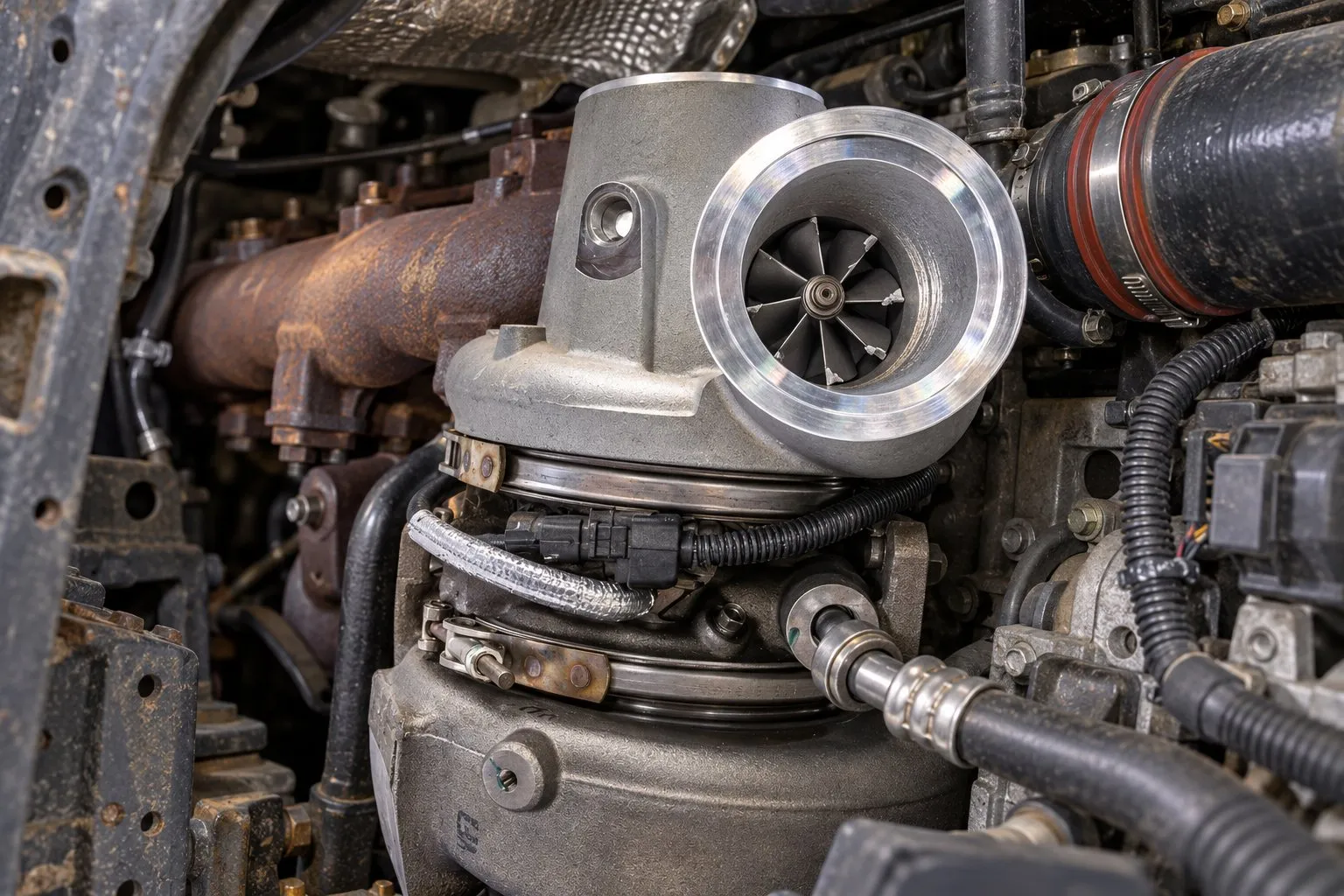
On idle-heavy first-response trucks the failures cluster around three areas: the oil-fed bearing system, the variable geometry mechanism, and anything downstream of a shed compressor wheel. Catching them early keeps a small fix from becoming a full teardown.
| Symptom | Likely cause | Severity |
|---|---|---|
| Low boost, slow spool, black or gray smoke under load | Soot-stuck vanes/nozzle, leaking charge pipe, or exhaust leak ahead of the turbine | Investigate soon |
| Overboost fault or high drive pressure | Variable nozzle stuck closed from carbon | Investigate soon |
| Blue-gray smoke, oil in the charge pipes | Check breather, oil level, and drain first; seal wear last | Diagnose before condemning |
| Whine or grinding that tracks turbo speed under load | Bearing wear or shaft imbalance | Remove from service |
| In-and-out shaft play you can feel, or wheel contact with the housing | Failed thrust or journal bearing | Remove from service |
One caution on the shaft-play check: some side-to-side rock is normal on a journal-bearing turbo with no oil pressure. Condemn a unit for in-and-out play you can feel, for a wheel that touches its housing, or for play beyond the maker’s limit, never for any movement at all.
Boost-related fault codes help point the way. P0299 is an underboost condition and P0234 is overboost; P2563 is a boost control position sensor range/performance fault, which only applies to a turbo that actually has a vane position sensor (the Ford 6.0L does not, so those codes do not apply to it). You can read the full set of definitions in our turbocharger fault code reference. For background on how the vane hardware itself works, the overview of the variable-geometry turbocharger is a solid primer.
A practical maintenance routine for Emergency Vehicle Diesel Turbocharger Maintenance
The goal with first-response fleets is to protect the oil and keep the exhaust side from loading up with soot. None of this is exotic; it is discipline applied to a punishing duty cycle.
- Keep oil changes tight. Idle hours age oil without adding odometer miles, so track engine hours, not just mileage. Use the oil category the engine maker specifies.
- Protect the oil feed. After any bearing failure or coked oil, replace the oil feed line rather than reuse it. A restricted feed is a feed-side failure that starves the bearings.
- Watch the drain. The oil drain is a gravity return that must run downhill and enter the pan above the oil level. A restricted drain backs oil up past the seals; a leaking drain gasket is an external leak.
- Manage regeneration. On DPF-equipped trucks, allow the active regens the engine calls for. Chronically interrupted regens from short idle cycles load the system; the diesel particulate filter overview explains why complete regens matter.
- Enforce cool-down. A few minutes of idle after a hard run or heavy PTO work, longer after sustained load, keeps the bearing oil from coking at shutdown.
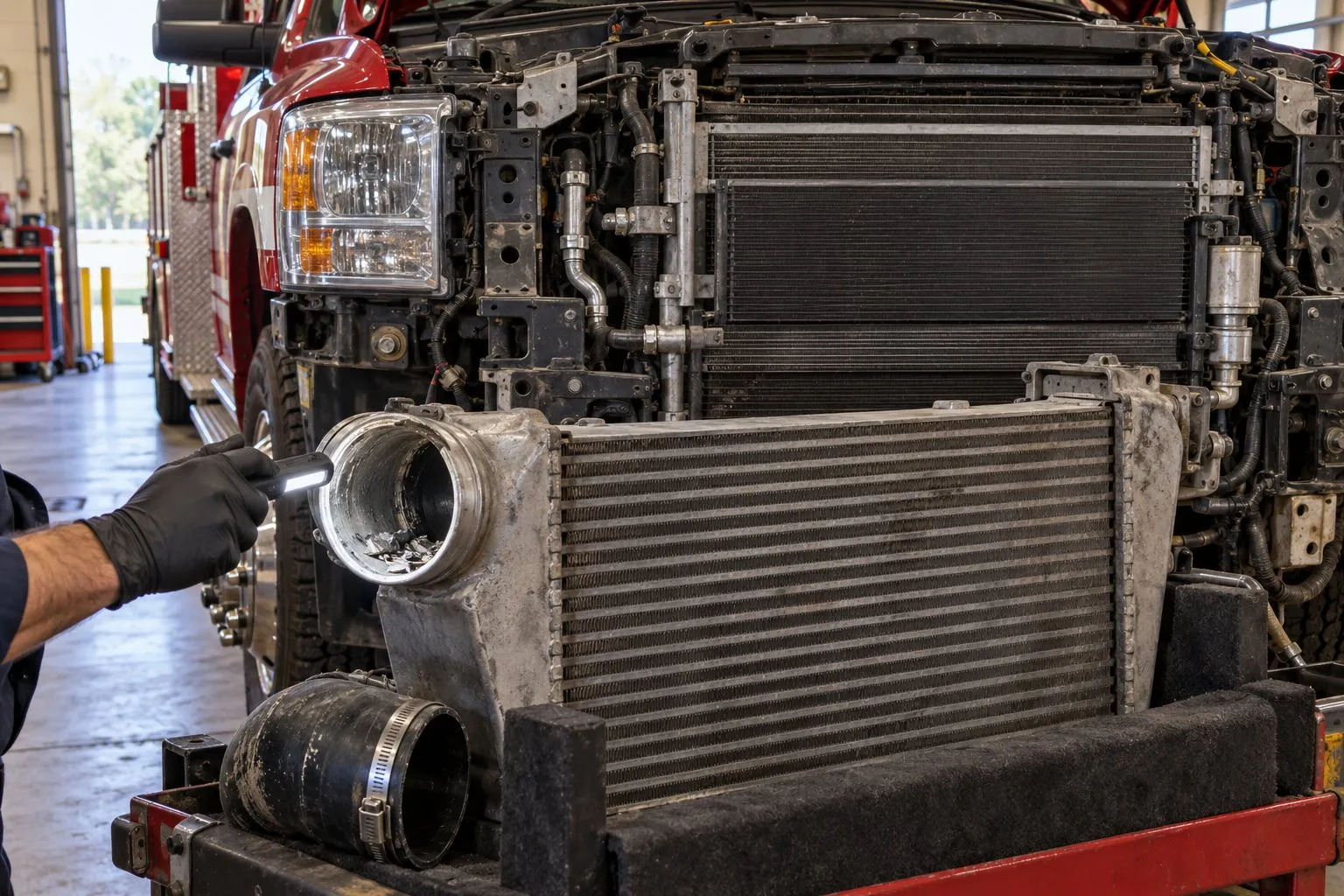
- Inspect the charge air cooler after any failure. If a compressor wheel sheds metal, replace the intercooler. Debris in the fins cannot be reliably flushed and goes straight into the engine on restart. Also inspect the charge piping and boots.
On high-pressure EGR engines like the Power Stroke, Duramax, and Cummins, the recirculated gas returns to the intake after the compressor, so EGR carbon never reaches the compressor wheel. Soot on a variable nozzle comes from the exhaust side, which is why idle-heavy service shows up there first.
Sourcing replacements with minimum downtime
When a frontline unit is down, turnaround is everything. PT Turbo stocks both new and remanufactured turbochargers, and we remanufacture in-house, which gives first-response fleets two paths back to service.
| Option | Best when | Notes |
|---|---|---|
| New turbo | You want a factory-fresh unit with no core to return | Match the data plate number; many platforms changed turbos by year |
| Remanufactured turbo | You want a tested unit back fast at lower cost than new | 12-month unlimited-mileage warranty; core returned within 30 days |
| Rebuild your own core | Your original is a correct-fit unit worth restoring | Most rebuilds ship in 3 days or less; price confirmed after inspection |
Every remanufactured and rebuilt cartridge is balanced on a Vibration Sorting Rig before it ships, and our units carry a 12-month, unlimited-mileage warranty. For in-house work, our turbo rebuild service covers the bearings, seal rings, and thrust parts, and the price is confirmed after inspection and before any work starts. See real model-by-model pricing on our turbo rebuild price list rather than relying on guesses.
Fleets running multiple identical chassis benefit from stocking their common cores ahead of a failure. We arrange priority and rush turnaround for fleet customers by phone, and our fleet turbocharger pricing guide explains how volume operators lower per-unit cost. For larger apparatus, the semi truck turbocharger guide covers the same heavy-duty Holset and Garrett units many rescue trucks share.
Frequently Asked Questions
Does extended idling really damage an ambulance turbo?
Yes. Long idle means low oil pressure and high soak heat with little airflow, which lets oil cook in the center housing and loads the exhaust side with soot. On a variable geometry turbo that soot can stick the nozzle, and interrupted idle cycles also stall DPF regeneration. Tracking engine hours for oil changes and enforcing a short cool-down before shutdown both help.
How do I know which turbo my fire or rescue truck uses?
Go by the number stamped on the turbo’s data plate, not the engine name, because many of these engines changed turbos across model years. The plate sits on the compressor housing. If you send us that number, we will confirm the exact fit and whether we have it new, remanufactured, or ready to rebuild.
Is a remanufactured turbo reliable enough for frontline service?
A properly remanufactured unit is rebuilt to the maker’s clearances, fitted with new bearings and seals, and balanced on a Vibration Sorting Rig before it ships. Ours carry a 12-month, unlimited-mileage warranty. For a frontline vehicle, pairing a tested reman unit with a replaced oil feed line and a clean charge air cooler gives you a dependable return to service.
Need a Turbocharger?
PT Turbo has rebuilt and sold turbochargers since 1978. We stock remanufactured units for Cummins, Duramax, Power Stroke, Detroit Diesel, and more — backed by a 12-month unlimited mileage warranty. Units in stock at our shop in San Bernardino, CA ship the same day when ordered before 2 PM Pacific, Monday through Friday.
📞 (909) 824-1020 · 346 S I St. #3, San Bernardino, CA 92410 · [email protected]
More From PT Turbo
 How Long Does a Turbocharger Rebuild Take? Realistic Timelines Explained
- Electronic Actuator Failure on Diesel Trucks: Symptoms, Diagnosis & Replacement Cost
- What Is a Variable Geometry Turbocharger? How VGT Works & Common Failures
- RV and Motorhome Diesel Turbocharger Guide: Cummins ISB & Freightliner Chassis