RV and Motorhome Diesel Turbocharger Guide: Cummins ISB & Freightliner Chassis
This RV and Motorhome Diesel Turbocharger Guide focuses on the Cummins ISB engine family and the Freightliner chassis that carry so many diesel pushers, because when boost drops on a loaded coach climbing a grade, the turbo is usually where the trouble starts. Freightliner Custom Chassis motorhomes run Cummins B-series and L-series power across a wide span of model years, and each generation uses a different Holset turbocharger with different controls and different failure patterns. Getting the right unit depends on matching the number on the turbo’s data plate, not guessing from the coach’s brand or length.
PT Turbo has been rebuilding turbochargers since 1978, more than 45 years, and we stock both new and remanufactured Holset units for these engines. This guide walks through which turbo lives on which engine, how the variable geometry hardware works, how it fails, and what to do when it does.
Which Cummins Turbo Is on Your Freightliner RV Chassis
Diesel motorhomes on Freightliner chassis are usually powered by one of three Cummins families: the ISB 6.7L, the ISC 8.3L, or the ISL 8.9L. The turbo you need is tied to the engine and its emissions year, so start by reading the Cummins engine dataplate for the CPL, then read the number stamped on the turbo’s compressor housing.
The ISB is the 24-valve B-series introduced in 1998, and the later 6.7L version is the one you will find on many mid-size diesel coaches and bus-style chassis. In medium-duty and chassis form the ISB 6.7L is listed with the Holset HE351VE or the HE341VE, or the HE300VG, all sliding-nozzle variable geometry turbos with an electronic actuator. Our supplier numbers include 5327358HX (an HE300VG) for a 260 hp ISB 6.7L rating and 3771658RX for the 2007-2008 ISB 6.7L.
Larger diesel pushers move up to the ISC and ISL. The earlier ISC 8.3L and ISL 8.9L carried the wastegated HX40W; the 2007-emissions and later engines moved to a Holset variable geometry turbo with an electronic actuator of the HE431VE type, with HE400VG and HE300VG units on later ratings. Smaller four-cylinder B-series chassis use the wastegated HE221W.
| Engine family | Typical Holset turbo | Vane / gate control |
|---|---|---|
| ISB 6.7L (chassis, medium-duty) | HE351VE, HE341VE or HE300VG | Variable nozzle, electronic actuator |
| ISB 4-cylinder (4.5L B-series) | HE221W | Fixed geometry, wastegated |
| ISC 8.3L / ISL 8.9L (pre-2007) | HX40W | Fixed geometry, wastegated |
| ISC 8.3L / ISL 8.9L (2007 emissions on) | HE431VE type, later HE400VG / HE300VG | Variable nozzle, electronic actuator |
Fitment here follows the number on the tag, not the floorplan. Two identical-looking coaches can carry different turbo part numbers because of a horsepower rating or an emissions-year change, so send us the number before ordering.
How the Variable Geometry Turbo Works
Holset variable geometry turbos use a sliding nozzle ring, not pivoting vanes on a unison ring. The nozzle narrows the gas path at low engine speed to spool the turbine fast and build boost early, then opens as airflow climbs to keep drive pressure and exhaust temperature in check. That behavior is what gives a loaded motorhome usable torque off the line and controlled boost on a long pull. You can read the general principle on variable-geometry turbochargers.
On the ISB, ISC, and ISL variable geometry Holsets, the nozzle is moved by an electronic actuator, and that actuator must be calibrated to its own turbo. These units also carry coolant lines, which the older wastegated HX-family turbos did not. Never move the actuator arm by hand; the gears are self-locking and break. If you need to check the nozzle, unbolt the actuator and move the lever.
Because the 6.7L has a diesel particulate filter, the ECM leans on the turbo during regeneration to manage exhaust temperature. Soot that builds on the nozzle ring over years of idling and short runs is one reason these turbos lose their smooth response.
Common Failures and Symptoms
Most turbo failures on these engines trace back to the oil supply or to the variable nozzle and its actuator. The center housing is cast iron and the bearings are journal type on these Holsets, so a dirty feed, extended oil change intervals, or a hot shutdown after a grade will show up as bearing wear and shaft play beyond the maker’s limit.
The nozzle itself is the other half of the story. A nozzle stuck closed gives overboost and high drive pressure; stuck open gives low boost and sluggish spool. On a heavy coach, either one is obvious on the first hill.
| Symptom | Likely cause | What to check first |
|---|---|---|
| Low boost, slow spool, dark smoke | Nozzle stuck open, actuator fault, or leak before the turbine | Actuator function, charge piping, up-pipes and manifold |
| Overboost, high drive pressure | Nozzle stuck closed with soot | Nozzle movement, soot on the ring |
| Whine or grinding, oil use | Bearing wear, shaft play past the limit | In-and-out play, wheel contact, oil feed condition |
| Oil in the charge pipes | Often crankcase vapor, not always the seal | Breather, air filter, oil level, drain |
A light oil film in the intake tract is normal crankcase vapor on an engine with closed ventilation, so check the breather, air filter, oil level, and drain before condemning a seal. Pooled oil is a different story. Some side-to-side rock at the wheel is also normal on a journal-bearing turbo; condemn it for in-and-out play you can feel or for wheel contact with the housing, not for any movement at all.
A leak in the up-pipes or exhaust manifold lets gas escape before the turbine, so you get low boost, slow spool, and higher exhaust temperature. That is an exhaust leak, not a boost leak, and it does not push soot into the turbo.
Fault Codes and Actuator Calibration
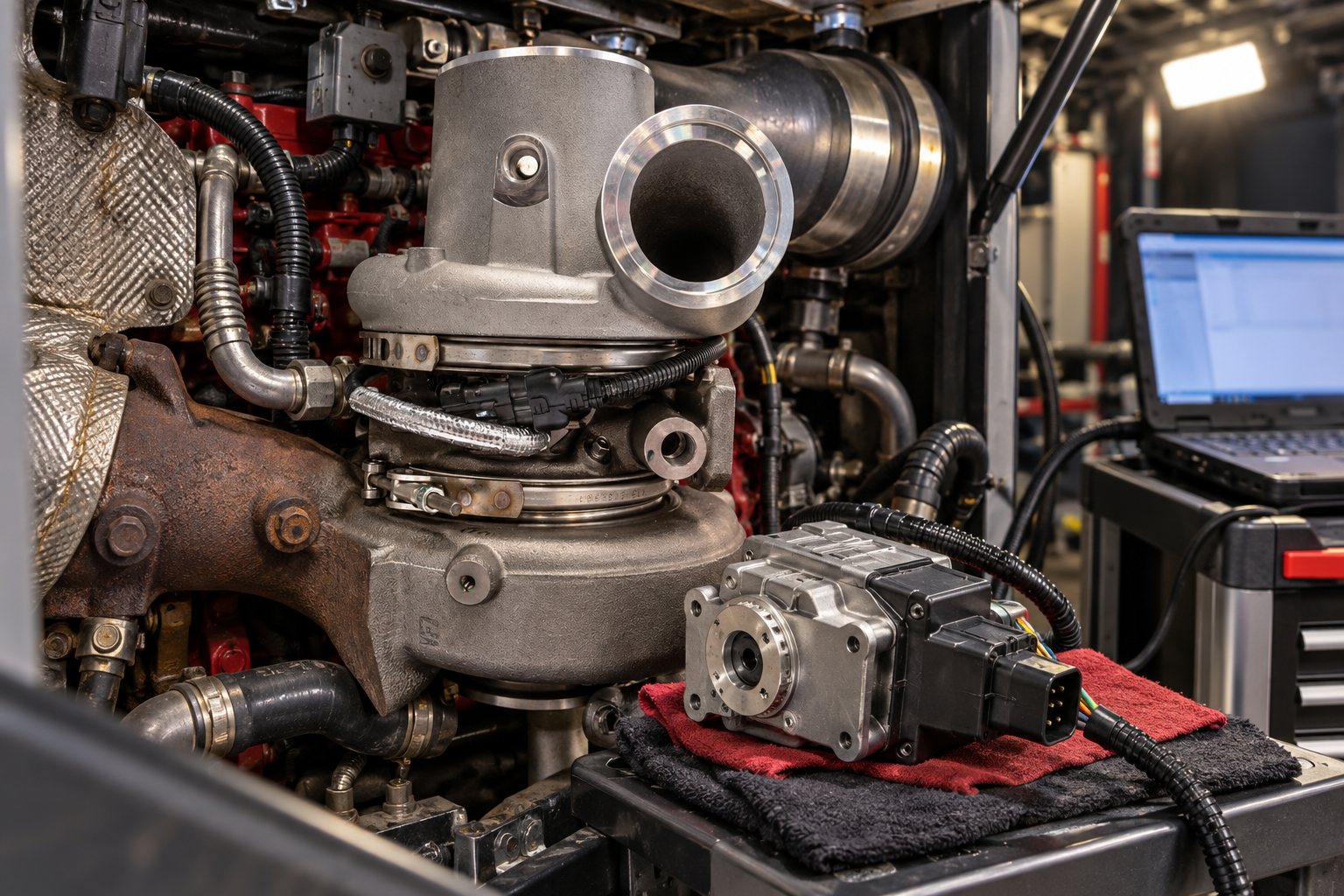
How the engine reports a fault depends on the chassis. The ISB, ISC, and ISL report through Cummins fault codes read with INSITE, with turbo-related numbers that include SPN 641 for the VGT actuator. On systems that show generic OBD-II codes, the usual ones are P0299 for underboost, P0234 for overboost, and P003A, which is “Turbocharger Boost Control A Position Exceeded Learning Limit.” P003A is a learning-limit code, not an overboost or sensor code.
When you replace a Cummins electronic actuator, follow the procedure exactly. Run the INSITE install routine with the new actuator plugged in but not yet bolted to the turbo, then mount it and calibrate without cycling the key. Skip a step and you will chase a position code that is really an install error.
The HE300VG has no separate vane position sensor; its position feedback is inside the actuator. For a deeper look at how these units are controlled and where they fail, see our Cummins ISB 6.7L turbocharger guide and our HE351VE vs HE300VG comparison.
Using This RV and Motorhome Diesel Turbocharger Guide to Choose New or Remanufactured
Once you have the part number off the tag, you have two solid paths: a new Holset unit or a professionally remanufactured one. Both are legitimate for a motorhome, and the right choice usually comes down to availability and budget rather than quality.
Our remanufactured turbochargers are rebuilt in-house with new bearings, seal rings, and thrust parts, then balanced on a vibration sorting rig. If you still have your core, our turbocharger rebuild service restores your own unit; most rebuilds ship in 3 days or less, and the rebuild price is confirmed after inspection and before work starts. Current pricing is on each product page and our turbo rebuild price list, or call us at (909) 824-1020.
| Consideration | New Holset | Remanufactured |
|---|---|---|
| Core required | No | Yes, return within 30 days |
| Internals | All new | New bearings, seals, thrust parts; balanced |
| Warranty | 12 months, unlimited mileage | 12 months, unlimited mileage |
| Turnaround on your core | Ships from stock or supplier | Most rebuilds ship in 3 days or less |
Fleet and rental-coach operators can arrange priority turnaround and stocking of common cores by phone. Whichever route you take, follow the maker’s first-start steps: fill the oil inlet with clean engine oil, turn the wheel by hand, crank or idle a few minutes before load, and replace the oil feed line after any bearing failure rather than reusing it.
One more habit that protects a coach turbo: give it a few minutes of idle after a hard pull or a long grade before shutdown, and keep pre-turbo exhaust temperature under about 1,250 F while towing. Hot shutdowns cook the oil in the bearing housing and are a leading cause of early failure.
Turbos we list for the HE300VG, HE351VE and HE341VE
Listings for the turbo models named in this guide that can be ordered online today. Several part numbers can fit one engine by year and rating, so match the number on your turbo’s tag, or call (909) 824-1020 and we will match it for you.
All HE300VG listings · All HE351VE listings · All HE341VE listings
Frequently Asked Questions
How do I know exactly which turbo is on my Freightliner RV chassis?
Read the Cummins engine dataplate for the CPL, then read the number stamped on the turbo’s data plate on the compressor housing. The engine family and its emissions year decide the turbo, and part numbers change between ratings, so match the tag rather than ordering by coach model. Send us that number and we will confirm the correct unit.
Can I reuse my old actuator on a replacement ISB turbo?
These Holset actuators are calibrated to their own turbo, so an actuator and turbo should be matched and set up together. When you fit a new Cummins actuator, run the INSITE install routine with it plugged in but not yet bolted on, then mount and calibrate it without cycling the key. Never move the actuator arm by hand, since the gears are self-locking and break.
Is a remanufactured turbo reliable enough for a heavy diesel pusher?
Yes. A properly remanufactured unit gets new bearings, seal rings, and thrust parts and is balanced before it ships, and it carries the same 12-month unlimited-mileage warranty as a new one. The bigger factors in turbo life on a motorhome are clean oil, sensible service intervals, and a proper cool-down after grades and towing.
Need a Turbocharger?
PT Turbo has rebuilt and sold turbochargers since 1978. We stock remanufactured units for Cummins, Duramax, Power Stroke, Detroit Diesel, and more — backed by a 12-month unlimited mileage warranty. Units in stock at our shop in San Bernardino, CA ship the same day when ordered before 2 PM Pacific, Monday through Friday.
📞 (909) 824-1020 · 346 S I St. #3, San Bernardino, CA 92410 · [email protected]