Caterpillar 320 Excavator Turbocharger Guide: C7.1 Engine Application & Replacement
Use this Caterpillar 320 excavator turbocharger guide when a C7.1-powered 320 loses power in the dig, smokes under load or leaves oil where it should not be. The C7.1 turbo system is simpler than the variable geometry setups on modern pickups and highway trucks. An excavator still works it hard with dust, long idle hours and heavy steady load, and each of those leaves its own marks on a failed turbo.
This guide covers how the C7.1 turbo system is laid out, how to identify the exact turbo on your machine, how these turbos fail, how to check one on the machine, and the installation steps that protect a replacement.
The C7.1 Engine in the Cat 320
Caterpillar has fitted the 320 with different engines across its generations and markets, so first confirm that you have a C7.1. Read the engine information plate and serial number instead of going by the machine model. This guide covers 320 excavators with the C7.1, which displaces 7.0 L (427.7 cu in).
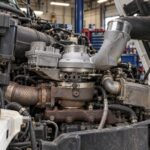
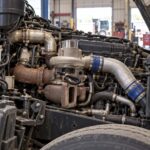
The C7.1 uses fixed geometry turbocharging. Most ratings run a single wastegated turbo, and higher ratings use two turbos in series. No C7.1 has a variable geometry turbo, so there are no vanes, no unison ring and no vane actuator to calibrate. When boost is wrong, look at the turbo, the wastegate and the air and exhaust plumbing around them.
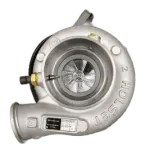
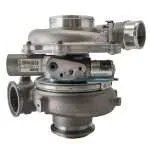
Caterpillar does not build its own turbochargers. BorgWarner and Garrett supply them, so the turbo on your engine carries the turbo maker’s part number on its data plate. The plate often shows a Caterpillar number as well.
Single Turbo or Series Pair
Look at the turbo installation before you order anything. In a series system the low-pressure turbo takes in filtered air first, and the high-pressure turbo compresses that air again before it reaches the charge air cooler. Each turbo in the pair has its own part number, so read both tags.
In a series system, debris only travels downstream. Pieces of a failed low-pressure compressor wheel go into the high-pressure compressor, and pieces of a failed high-pressure turbine wheel go into the low-pressure turbine. When one turbo of a pair breaks up, inspect the turbo downstream of it before you close up the job.
The C7.1 Is Not the C7
The C7.1 is a different engine from the on-highway C7 that Caterpillar built from 2003 to 2009 for trucks, buses and motorhomes. A turbo for one engine does not fit the other. If you also run C7 trucks, our Caterpillar C7 turbocharger guide covers that engine. For C9-powered machines in the same fleet, see the Caterpillar C9 turbocharger guide.
Reading the Turbo Tag
Order by the part number on the turbo’s data plate. Clean the plate gently, because a wire brush can erase stamped characters.
- BorgWarner: the tag sits on the compressor housing. It shows the BorgWarner part number (6 or 11 digits), a serial number and, on factory-fitted turbos, the engine maker’s part number.
- Garrett: the part number is six digits, a dash, four digits and a letter, for example 765155-5007S. The first digit after the dash shows the sales channel: 0 for original equipment, 5 for new aftermarket and 9 for remanufactured. Plate position varies by plant.
- Casting numbers on the housings are not part numbers. One casting serves many turbos, so a casting number can only narrow the search.
- “Superseded” means the old number has been replaced by a newer one. Either number can lead you to the right unit.
Search our store by the number on the tag. If nothing matches, call (909) 824-1020 with the turbo number and the engine serial number. We will quote a replacement by part number or rebuild your turbo.
How C7.1 Turbos Fail in Excavator Work
Oil causes most turbo failures. Garrett states that more than 90 percent of turbo failures come from oil starvation or oil contamination. On an excavator, the usual triggers are:
- Running the oil past the change interval.
- Low oil level.
- Leaking or blocked oil pipes.
- Hard throttle on a cold engine before oil pressure has built.
- Fitting a turbo without priming it.
Shutting down a hot engine causes a different problem. Oil left in the center housing cooks into carbon, which builds up over many shutdowns and wears the bearings. After heavy digging, idle the engine for the time Cat gives in the operation and maintenance manual before you shut it off.
Dust is the next threat on a job site. The intake pipe between the air filter and the turbo is under suction, so a crack or loose clamp there pulls in unfiltered air. Dust leaves pitting on the leading edges of the compressor blades. Bent or chipped blades point to a solid object, such as a loose part or debris left in the intake.
Long idle periods between loads can bring oil out of the turbine end first. That usually clears once the machine goes back to work. A blocked or kinked oil drain does more harm: it backs oil up in the center housing, so oil leaks past both seals. The drain runs on gravity, so it must slope downhill and enter the oil pan above the oil level.
The wastegate has its own failure modes. A flapper that does not seat lets exhaust bypass the turbine, which gives low boost and slow spool. On a boost-opened actuator, a leaking diaphragm makes the gate open late, which causes overboost, not underboost. An exhaust leak before the turbine, such as a cracked manifold or a blown gasket, also cuts boost and raises exhaust temperature.
| Symptom | Check first | When the turbo is the cause |
|---|---|---|
| Black or dark gray smoke, engine lugs in the dig | Air filter restriction, intake and charge-air leaks, exhaust leaks before the turbine, wastegate seating | Damaged wheels, wheel contact with the housing, a wastegate stuck open |
| Blue-gray smoke | Long idle periods, oil drain routing, crankcase pressure, engine wear | Worn turbine-end seal after the other causes are ruled out |
| Oil pooled in the charge pipes or cooler | Breather, air filter, oil level, drain line (a light oil film is normal crankcase vapor) | Worn compressor-end seal or worn bearings |
| Whine or siren under load | Exhaust leaks before the turbine, charge-air leaks | Wheel rubbing the housing, bent blades |
| Overboost fault | Wastegate actuator, its hose and its linkage | Wastegate seized shut |
| Oil on the outside of the center housing | Feed and drain gaskets and fittings | Rarely the turbo; this is an external leak |
Checking the Turbo on the Machine
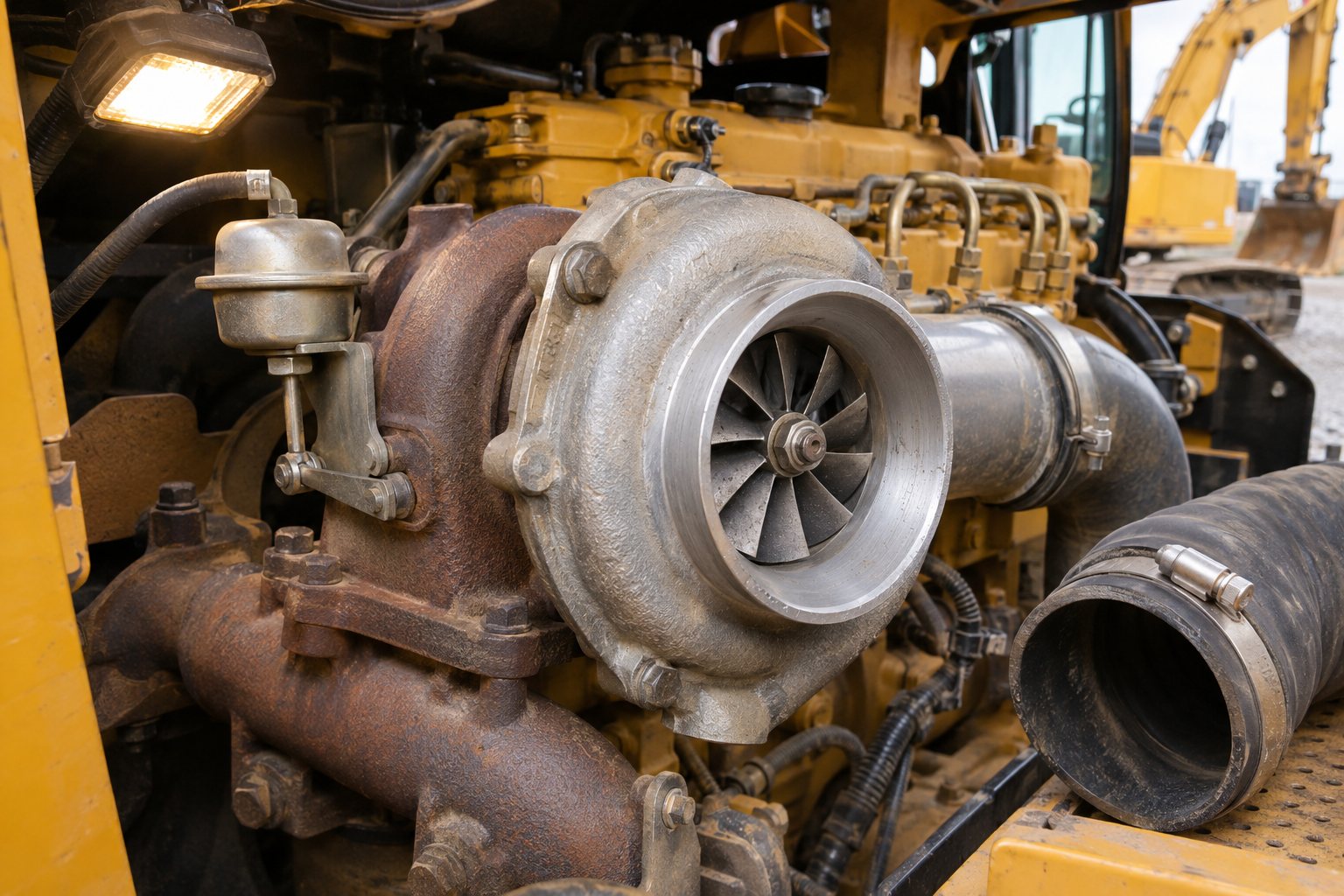
Start with the machine’s fault codes and live engine data in Cat’s service software. Excavators report Caterpillar diagnostic codes, not the generic OBD-II P-codes used on pickups. Compare the boost and intake readings with the values in Cat’s service information for your engine serial. Then, with the engine off and cool, check the turbo itself:
- Shaft play: remove the intake pipe and rock the compressor wheel. Some side-to-side movement is normal on a journal-bearing turbo. In-and-out play you can feel, or a wheel that touches the housing, condemns the turbo. Typical axial play on journal-bearing turbos is 0.001 to 0.004 in, but use the maker’s limit for your unit.
- Compressor blades: pitting points to dust, and bent tips point to an object. A turbo with blade damage gets replaced or rebuilt. A damaged wheel is never straightened and reused.
- Turbine wheel: damage on the inlet edges means debris came from the engine side. Find the source before you fit another turbo.
- Back face of the compressor wheel: an “orange peel” surface with damaged blades points to overspeed. A charge-air leak makes the turbo spin faster to reach target boost and can overspeed it.
- Wastegate: if the actuator is a diaphragm canister worked by boost, put a hand pressure pump on it. The rod should move smoothly and the diaphragm should hold pressure. Also check that the linkage moves freely.
- Oil analysis: turbo journal bearings are bronze, so rising copper can point to bearing wear. Compare the result with your machine’s earlier samples and the lab’s limits.
Replacing the Turbo: Steps That Protect the New Unit
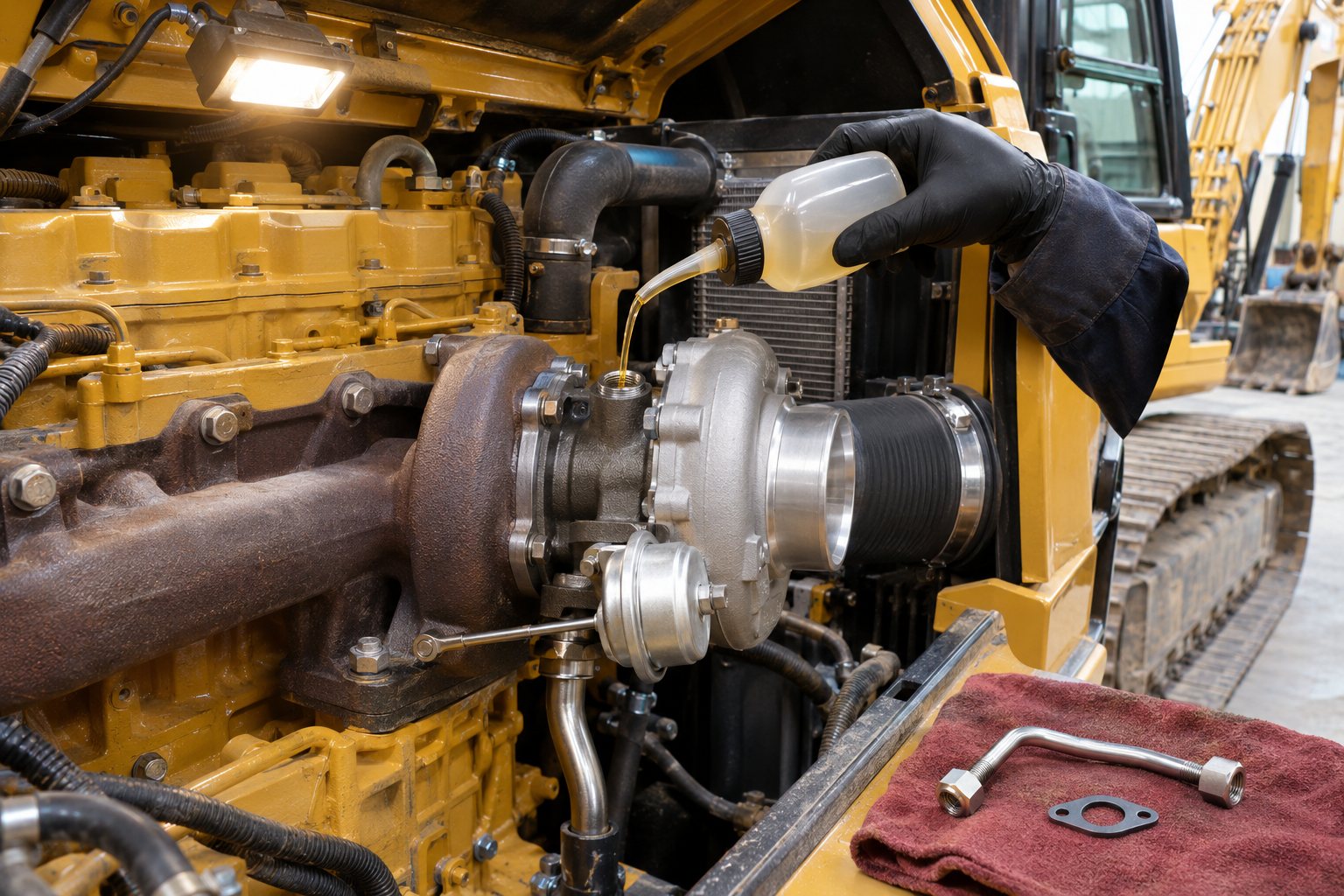
A new turbo fitted to a machine that still has the old problem will fail the same way. Fix the cause first, then follow these steps:
- Oil: change the oil and filter. After a bearing failure or coked oil, fit a new oil feed line rather than flushing the old one. Check that the drain is clear and slopes downhill.
- Gaskets: use new feed, drain and exhaust gaskets. Do not put sealant on the oil inlet or drain gaskets.
- Charge air cooler: if the compressor wheel shed metal, replace the charge air cooler. MAHLE and Nissens both advise this, because metal caught in the fins cannot be flushed out reliably. Inspect and clean or replace the charge piping as well.
- Intake: clean the path from the air filter to the turbo inlet, and replace any cracked pipe or tired clamp. Replace the air filter when the restriction indicator calls for it.
- Fasteners: torque the mounting nuts, V-band clamps and oil fittings to Cat’s figures for your engine.
- Priming: fill the oil inlet with clean engine oil and turn the wheel by hand. Crank for 10 to 15 seconds while keeping the engine from starting, using the method in Cat’s service manual. Never run the engine with the oil feed capped.
- First start: idle 3 to 4 minutes and check for oil, exhaust and air leaks before putting the machine to work. A turbo needs no break-in period, so there is no reduced-boost period and no early oil change.
Afterward, keep to Cat’s oil schedule, or its severe-service schedule if the machine idles a lot or works in dust. Good oil, clean air and a correct installation give the new turbo the best chance of a long service life.
Rebuild, New or Remanufactured: Your Options
PT Turbo has been family-owned and rebuilding turbochargers since 1978. That is more than 45 years of work on diesel turbos for trucks, machines and equipment, out of our shop in San Bernardino, California. These are your options for a C7.1 turbo:
| Option | What you get | Best when |
|---|---|---|
| Rebuild your turbo | Your own turbo returned with worn parts replaced, VSR balanced and inspected | Housings are sound and the turbo number is hard to find |
| New replacement | A new unit matched to the number on your tag | Housings or wheels are damaged beyond repair |
| Remanufactured unit | A tested, flow-tested unit with a calibrated wastegate or actuator; availability depends on core supply | A matching listing turns up when you search by your tag number |
Every turbo our in-house rebuild service handles is VSR balanced and gets a final quality inspection, which includes a leak test, a visual inspection and a wastegate function check. Most rebuilds ship in 3 days or less. We confirm the rebuild price after inspection and before any work starts, and the turbo rebuild price list shows our rates by turbo. Rebuilds carry a 12-month warranty.
To look for a replacement, search the store and our remanufactured turbochargers by the number on your tag. Stock changes daily, so call (909) 824-1020 or use the contact page to confirm. Fleets running several 320s can arrange priority or rush turnaround, and we can stock their common cores; set this up by phone.
Frequently Asked Questions
Does the C7.1 in a Cat 320 have a variable geometry turbo?
No. The C7.1 runs a single wastegated turbo on most ratings and two turbos in series on higher ratings, all fixed geometry. There are no vanes or vane actuator to diagnose or calibrate, so boost faults come down to the turbo, the wastegate and the air and exhaust plumbing.
Can I fit a C7 turbo to a C7.1?
No. The C7.1 is a different engine from the 2003-2009 on-highway C7, and their turbos do not interchange. Order by the part number on your turbo’s data plate, not by the engine name or a housing casting number.
What should be replaced along with the turbo?
Fit new oil feed, drain and exhaust gaskets, change the oil and filter, and fit a new oil feed line after any bearing failure or coked oil. If the compressor wheel shed metal, replace the charge air cooler as well. Also check the air intake path for cracks and loose clamps before the new turbo goes on.
Need a Turbocharger?
PT Turbo has rebuilt and sold turbochargers since 1978. We stock remanufactured units for Cummins, Duramax, Power Stroke, Detroit Diesel, and more — backed by a 12-month unlimited mileage warranty. Units in stock at our shop in San Bernardino, CA ship the same day when ordered before 2 PM Pacific, Monday through Friday.
📞 (909) 824-1020 · 346 S I St. #3, San Bernardino, CA 92410 · info@ptturbo.com
More From PT Turbo
 International MaxxForce DT Turbocharger: VGT Actuator Problems & Replacement
- Mack MP7 Turbocharger Guide: Shared with Volvo D11 & What That Means for Parts
- Cummins ISX Turbocharger Guide: HE400VG, HE451VE & HE561VE Differences Explained
- Duramax LLY Turbocharger: Symptoms, Garrett GT3788VA Replacement & Cost (2004-2005)