AGCO & Fendt Turbocharger Guide: Agricultural Equipment Diesel Applications
This AGCO & Fendt Turbocharger Guide is written for the people who keep Fendt, Massey Ferguson, Valtra, Challenger and Gleaner iron running in the field, where a down tractor during planting or harvest costs real money. AGCO’s equipment runs on a mix of in-house AGCO Power diesels and other makers’ engines, and the turbochargers bolted to them come from the major suppliers rather than from AGCO itself. That means the single most important thing you can do before ordering any part is read the number off the turbo’s own data plate, not the tractor model on the hood.
PT Turbo has been rebuilding turbochargers since 1978, more than 45 years, and we stock both new and remanufactured units for agricultural, construction and on-highway diesels. Below is how these turbos are built, how they fail, and how to get the right replacement the first time.
Why the engine, not the tractor, decides the turbo
A Fendt, a Massey Ferguson and a Valtra can share the same AGCO Power engine family, and two tractors with the same badge and horsepower can carry different turbos depending on the emissions tier and build year. A wrong vehicle match is worse than no match at all, so we never guess fitment off a model name.
Agricultural diesels move through emissions tiers much the way on-highway engines do, and each step tends to change the charging system. Earlier Tier 3 and interim Tier 4 engines commonly run a fixed geometry turbo with a wastegate. Later Final Tier 4 engines are more likely to carry a variable geometry turbo with an electronic actuator, often alongside EGR, a diesel oxidation catalyst and a diesel particulate filter.
Because of that, the only reliable path is the part number on the turbo’s tag. Casting numbers on the housings only narrow the search; one casting serves many turbos. Confirm with the tag number plus wheel sizes and the turbine housing A/R.
Turbo types you will find across the AGCO & Fendt Turbocharger Guide range
Across AGCO Power and the other diesels fitted to AGCO equipment, you will meet three broad charging arrangements. Knowing which one you have tells you what can fail and what you can test.
Fixed geometry with a wastegate
This is the classic ag turbo: a fixed turbine nozzle with a wastegate that bleeds exhaust around the turbine to cap boost. The wastegate is worked by a boost-referenced actuator or by a solenoid-controlled signal. BorgWarner’s fixed geometry families are common here, including the BorgWarner S200 on smaller engines and the BorgWarner S300 on mid-displacement engines. The BorgWarner S400 frame appears on larger engines.
Variable geometry with an electronic actuator
Later ag engines move to a variable geometry turbo, which changes the effective nozzle area to build boost early and still flow at rated speed. BorgWarner lists variable geometry turbos for agricultural engines including the BorgWarner S300BV and the BorgWarner B2UV, both with electronic actuators. You can read more on how these work in the variable geometry turbocharger overview.
The electronic actuator on these is calibrated to its own turbo with a service tool at assembly. Never move an electronic actuator’s arm by hand; the self-locking gears inside break. If the actuator must come off, unbolt it and move the vane lever instead.
Series (two-stage) charging
Some higher-rated engines use two turbos in series, a larger low-pressure unit feeding a smaller high-pressure unit, with the wastegate on the high-pressure turbo. On a two-stage system there are no variable vanes to blame, so diagnosis starts at the wastegate, the control air or solenoid, and the piping between stages.
| Charging type | How boost is controlled | What usually fails first | What to check |
|---|---|---|---|
| Fixed geometry, wastegated | Wastegate opens to cap boost | Wastegate linkage, actuator diaphragm or solenoid | Free wastegate travel, actuator signal, boost vs target |
| Variable geometry, electronic actuator | Nozzle/vane area changes with load | Soot-bound vanes, actuator, position feedback | Vane movement, actuator codes, calibration |
| Series two-stage | Wastegate on the high-pressure turbo | Wastegate control, inter-stage piping, seals | Control air/solenoid, clamps, boost at each stage |
How AGCO and Fendt turbos fail
Most turbo failures trace back to the oil supply, not to a defect in the turbo. Clean oil at the right pressure, delivered through a clear feed and drained freely back to the pan, is what keeps the bearings alive. That is as true on an AGCO Power engine as it is on any over-the-road diesel.
Watch for these patterns, which hold across agricultural diesels:
- Oil starvation: a plugged or kinked feed line, a tired oil pump, or long storage without priming. Bearings and shaft wear quickly.
- Restricted drain: a blocked or steeply tilted return raises pressure in the bearing housing and pushes oil past the seals at both ends. A leaking drain gasket, by contrast, is an external leak.
- Foreign object damage: dirt past a torn air filter or a split intake boot chews the compressor leading edges; debris off the engine damages the turbine.
- Soot-bound vanes: on variable geometry turbos, heavy soot from a stuck-open EGR valve or a leaking cooler can bind the nozzle, giving overboost when stuck closed or low boost when stuck open.
- Hot shutdowns: parking a hard-worked engine without a cool-down lets oil coke in the center housing. Idle a few minutes after a heavy pull before shutdown.
On engines with high-pressure EGR, remember the exhaust is drawn off before the turbine and returned to the intake. EGR gas does not pass through the turbine or “migrate” to the vanes; too much EGR fouls the vanes only through the extra soot that combustion produces. A leaking EGR cooler sends coolant into the intake and cylinders, showing up as white smoke, not as hotter gas at the turbine. You can review the basics in this EGR overview.
Diagnosing before you pull the turbo
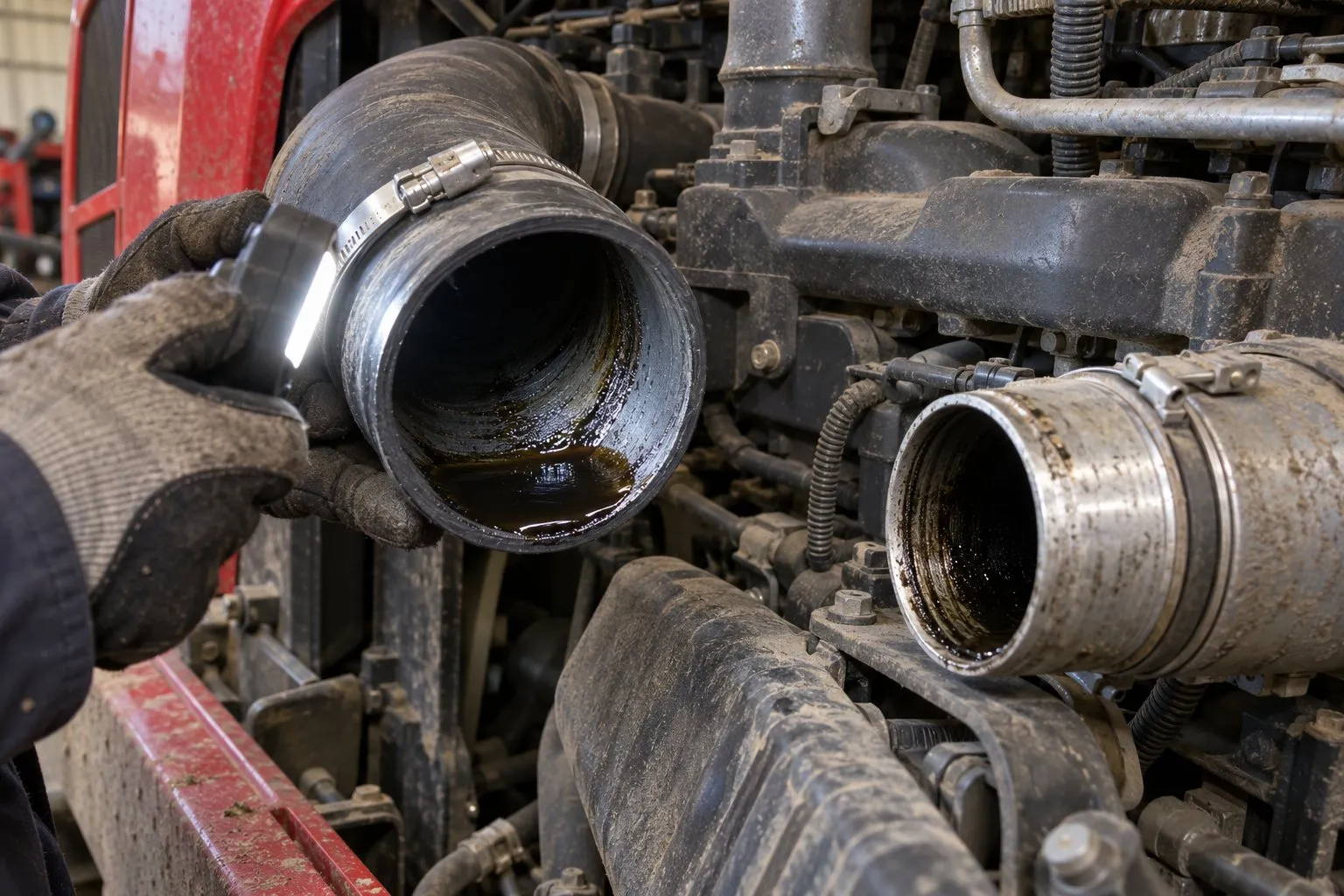
Blue-gray smoke and oil in the intake are usually not a failed turbo seal. Check the crankcase breather, air filter, oil level and the drain first; a light oil film in the charge piping is normal crankcase vapor, while pooled oil points to a problem. Black or dark gray smoke means low boost and too little air, not oil past the seals.
When you do inspect the turbo, some side-to-side rock at the wheel is normal on a journal bearing turbo with no oil pressure. Condemn it for in-and-out play you can feel, for wheel contact with the housing, or for play beyond the maker’s limit, never for any movement at all.
On engines with a boost control solenoid or an electronic actuator, pull the codes. Underboost and overboost codes point you at the wastegate or the vanes; a boost control circuit code points at wiring, the solenoid or the sensor. Match any code to the engine maker’s definition before you condemn hardware. Our guides to the Cummins ISL and Caterpillar C9 cover the same diagnostic logic on industrial engines you may also run in your fleet.
New, remanufactured or rebuilt
You have three good paths once a turbo is confirmed bad. A new unit is the simplest drop-in. A remanufactured turbocharger is a complete, balanced unit built to spec with a core charge. A turbo rebuild returns your own numbered unit, which matters when the exact part is hard to source for an older AGCO Power engine.
| Option | What you get | Best when | Core |
|---|---|---|---|
| New | Factory-fresh complete unit | You want a straight drop-in and the part is stocked | No core |
| Remanufactured | Complete unit rebuilt to spec and balanced | You need a ready-to-fit unit at lower cost than new | 30-day core return, you pay return shipping |
| Rebuild (your unit) | Your own numbered turbo, rebuilt and balanced | The exact part is scarce or you want to keep your casting | None; it is your core |
Most rebuilds ship in 3 days or less, and the rebuild price is confirmed after inspection and before any work starts. You can see our real pricing on the turbo rebuild price list. For a specific AGCO Power or Fendt turbo, send us the number off the tag through our contact page or call so we match the exact unit.
First-start steps after replacement
Whether you fit a new, reman or rebuilt turbo, follow the engine maker’s first-start steps. Fill the oil inlet with clean engine oil, turn the wheel by hand, then crank or idle a few minutes before putting the unit under load. The manual names the fuse or connector that keeps a common-rail engine from starting while you crank to build oil pressure; do not disconnect the fuel system.
If a compressor wheel came apart, replace the charge air cooler. Metal shed into the fins cannot be flushed out reliably, and it will travel straight into the engine on the next start. Inspect and clean the charge piping and boots at the same time.
Frequently Asked Questions
How do I identify the right turbo for my Fendt or Massey Ferguson?
Read the part number off the data plate on the turbo’s compressor housing and match that number. The tractor model and horsepower are not enough, because emissions tier and build year change the turbo. Casting numbers only narrow it down; confirm with the tag number, wheel sizes and turbine housing A/R.
Does an AGCO variable geometry turbo need calibration after replacement?
Yes. A variable geometry turbo with an electronic actuator is calibrated to its own turbo with the correct service tool, and the actuator arm must never be forced by hand because the gears will break. A reman or new unit supplied for that engine comes set up for it, so follow the maker’s install and calibration procedure.
Can PT Turbo rebuild a turbo for an older AGCO Power engine that is no longer stocked?
Often yes. When the exact part is scarce, rebuilding your own numbered core keeps your casting and gets you a balanced unit built to spec. Send the number off the tag and we will tell you what we can do for that specific turbo.
Need a Turbocharger?
PT Turbo has rebuilt and sold turbochargers since 1978. We stock remanufactured units for Cummins, Duramax, Power Stroke, Detroit Diesel, and more — backed by a 12-month unlimited mileage warranty. Units in stock at our shop in San Bernardino, CA ship the same day when ordered before 2 PM Pacific, Monday through Friday.
📞 (909) 824-1020 · 346 S I St. #3, San Bernardino, CA 92410 · [email protected]
More From PT Turbo
 Emergency Vehicle Diesel Turbocharger Maintenance: Ambulance, Fire & Police Fleet Guide
- OEM vs Aftermarket Turbocharger: What Is the Difference and Which Is Worth It?
- Best Turbocharger Upgrade for Towing: What to Consider Before You Buy
- Semi Truck Turbocharger Replacement Cost: Cummins ISX, DD15 & PACCAR MX-13