Oil Field Diesel Equipment Turbocharger Guide: High-Duty Cycle Replacement Strategy
In this oil field diesel equipment turbocharger guide, we focus on the one thing that separates a well service rig, frac pump, or power unit from an over-the-road truck: the duty cycle. Oil field diesels live at sustained high load, often for twelve-hour tours, in heat and airborne dust, and that workload punishes a turbocharger harder than any highway mile. PT Turbo has rebuilt turbochargers since 1978, and the failure patterns we see on heavy industrial units trace back to that relentless load far more than to any defect in the turbo itself.
Whether you run Cummins QSX15 power units, Caterpillar C15 and C18 iron, or Detroit gensets, the replacement strategy is the same: understand how the turbo fails under a high-duty cycle, match the correct part number to the engine, and plan downtime around parts availability rather than reacting to a dead unit on location.
Why High-Duty Cycle Service Kills Turbos Faster
A turbocharger on a frac pump or drilling rig rarely sees the light cruise that lets a truck turbo coast and cool. It spends hours near rated speed, which means the shaft is spinning fast and the bearings depend entirely on clean, cool, pressurized oil. Most turbo failures trace back to the oil supply, and on continuous-load equipment the oil takes the most abuse.
Three things stack up in oil field work. Heat soaks the center housing and cokes oil in the bearing system. Dust loads the air filter, and a restricted inlet pulls oil past the compressor-side seal. Long idle periods between hard runs let oil weep at the turbine end. None of these is a manufacturing fault, but all of them end the same way.
- Coked oil and bearing wear: from heat soak and skipped oil service intervals.
- Compressor-side oil leaks: often a plugged air filter or a crankcase breather problem, not the seal itself.
- Foreign object damage: dust and debris chewing the compressor or turbine wheel leading edges.
- Actuator faults on variable geometry units: soot and varnish binding the mechanism on EGR engines.
Before you condemn a turbo for oil in the charge piping, check the breather, air filter, oil level, and the oil drain. A light film of oil in the pipes is normal crankcase vapor on any engine with closed ventilation. Pooled oil is the warning sign. For the mechanics of how a turbo actually works and where it loses efficiency, Wikipedia’s turbocharger overview is a solid refresher.
Matching the Turbo to Your Oil Field Engine
A wrong turbo is worse than no turbo. Oil field equipment is often repowered, re-rated, or fitted with industrial versions of familiar engines, so the engine name alone does not tell you the part number. Always go by the number stamped on the turbo’s data plate, which sits on the compressor housing on Holset units and BorgWarner nameplates alike. The casting number on a housing only narrows the search; one casting serves many turbos.
The table below groups common oil field diesels by the turbo families we stock and rebuild. Confirm your exact unit by the tag number, not by the engine badge.
| Engine (oil field / industrial) | Typical turbo family | Type |
|---|---|---|
| Cummins QSX15 / ISX15 (later) | HE400VG, HE500VG | Variable geometry, electronic actuator |
| Cummins ISX (EGR, 2003 to 2007) | HE551V | Variable geometry, air-operated actuator |
| Cummins ISX (2007 to 2010) | HE561VE, HE551VE | Variable geometry, electronic actuator |
| Cummins ISX (pre-EGR) | HX55W, HX60W | Fixed geometry, wastegated |
| Cummins QSL9 / ISL 8.9L | HX40W, HE431VE | Wastegated / variable geometry |
| Cummins QSB6.7 (Tier 3 / Tier 4) | HX35W, HE300VG | Wastegated / variable geometry |
| Caterpillar C15 ACERT (series) | High-pressure turbo by engine part number + GTA5518B low-pressure turbo | Two turbos in series, wastegate on HP |
| Detroit Series 60 (gensets, EGR) | GTA4502V, HE531VE | Variable geometry |
Caterpillar does not build its own turbos; Garrett and BorgWarner supply them. The C18 industrial engine runs a single turbo on ratings up to roughly 630 hp and series twin turbos on the 700 to 800 hp ratings. We cover the range in our Caterpillar C18 turbocharger guide. For medium-duty power units on the ISC and ISL, see our Cummins ISC and Cummins ISL turbocharger guides.
Fixed Geometry vs Variable Geometry Under Load
Older oil field iron and many prime-power gensets run fixed geometry Holset turbos like the HX80 and HX82 on the big-bore engines, or BorgWarner S400 frames on repowers. These have no vanes to foul and no actuator to calibrate, which is a real advantage on a continuous-load engine that never sees a regen cycle. A fixed geometry wastegated turbo that loses boost is usually a wastegate not seating or a bearing worn out, and the diagnosis is straightforward.
Tier 4 and EGR-era engines brought variable geometry turbos, where a moving nozzle or vane set tailors drive pressure across the load range. Holset variable turbos use a sliding nozzle driven by an electronic actuator on the VE and VG models. The payoff is better response and emissions control; the cost is a mechanism that soot and varnish can bind on a dirty, hard-working engine. A variable-geometry turbo stuck closed gives overboost and high drive pressure, while stuck open gives low boost and sluggish spool.
On these units, never move the electronic actuator’s arm by hand; the self-locking gears will break. The actuator is calibrated to its own turbo with the correct service tool after it is fitted. If you replace a Cummins actuator, run the install routine with it plugged in but not yet bolted to the turbo, then mount and calibrate without cycling the key.
New vs Remanufactured for a High-Duty Cycle Fleet
The right choice depends on uptime, not just the invoice. PT Turbo stocks new turbochargers and remanufactures units in-house, so a fleet can standardize on whichever path keeps rigs running. Our remanufactured turbochargers are rebuilt to spec and balanced, and our turbocharger rebuild service can turn your own core when the exact unit is scarce.
| Factor | New turbocharger | Remanufactured turbocharger |
|---|---|---|
| Availability of exact number | Depends on supply | Often available; we can rebuild your core |
| Core charge | None | Core return within 30 days |
| Actuator (VGT units) | Included, calibrated to turbo | Rebuilt or replaced, calibrated to turbo |
| Warranty | 12 months, unlimited mileage | 12 months, unlimited mileage |
| Shipping | Stock ships same day before 2 PM Pacific | Most rebuilds ship in 3 days or less |
For a fleet, the smart move is to stock your common cores and let us prioritize rush turnaround by phone. Rebuild pricing is confirmed after inspection and before any work starts, and our real prices by model are on the turbo rebuild price list. For units we do not list, pricing is on the product page or a call to (909) 824-1020.
Replacement Best Practices on Location
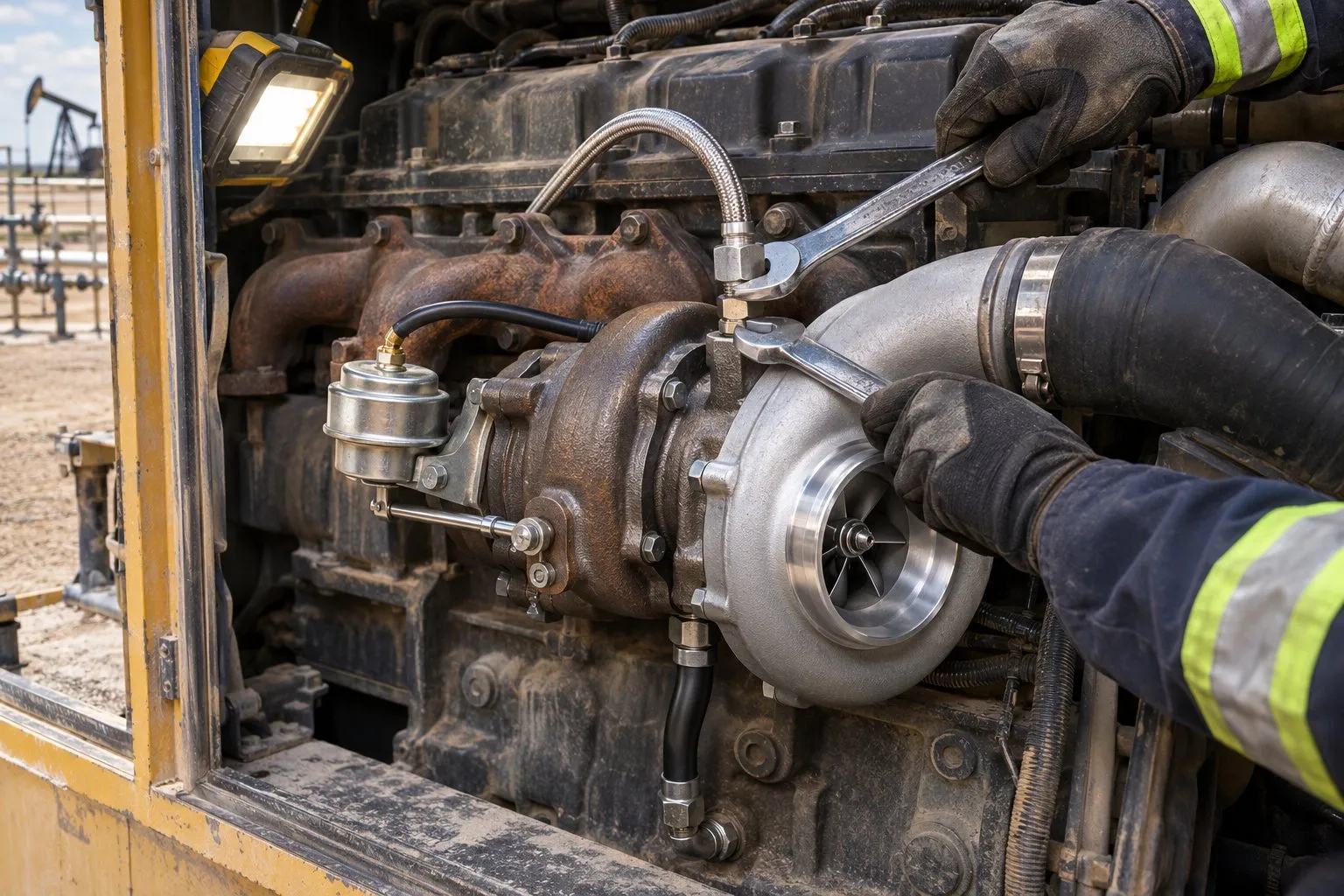
When a turbo goes down on a pad, the temptation is to bolt on a replacement and run. Skipping the supporting work is how the second turbo fails as fast as the first.
- Find the root cause first. If the compressor wheel shed metal, that debris went downstream into the charge air cooler. Metal cannot be flushed out of a cooler reliably, so the cooler should be replaced and the charge piping cleaned or replaced.
- Replace the oil feed line. After a bearing failure or coked oil, fit a new feed line rather than cleaning and reusing it.
- Check the drain. The oil drain is a gravity return that must run downhill and enter the pan above the oil level. A restricted drain backs oil up past the seals.
- Service the air side. A new air filter and a check of the inlet ducting matter more in dusty field conditions than anywhere else.
- Follow the maker’s first-start steps. Fill the oil inlet with clean engine oil, turn the wheel by hand, then crank or idle a few minutes before putting the engine under load.
On continuous-load equipment, enforce a cool-down idle of a few minutes after a hard pull before shutdown. Shutting a heat-soaked turbo straight from full load cokes the oil in the bearing housing and shortens the life of the next unit you install. If you need help identifying a unit from the tag or sourcing a scarce industrial number, contact PT Turbo or browse the full turbo catalog.
Frequently Asked Questions
How do I identify the exact turbo on my oil field power unit?
Read the part number on the data plate, which is on the compressor housing for Holset units and on the nameplate for BorgWarner and Garrett. Do not order by the engine badge or the casting number on the housing, because industrial engines are often re-rated and one casting serves many different turbos. Send us the tag number and we will match it.
Is a remanufactured turbo reliable enough for continuous high-load duty?
Yes, when it is rebuilt to spec and balanced. A properly remanufactured turbo uses new bearings, seal rings, and thrust parts, and on variable geometry units the actuator is calibrated to that turbo. It carries the same 12-month unlimited-mileage warranty as a new unit, and the failures we see on field equipment come from oil supply and air filtration, not from reman cartridges.
Why does my variable geometry turbo keep setting a boost control code?
On a hard-working EGR engine, soot and varnish can bind the sliding nozzle and overload the actuator, which sets a position or boost code. Confirm whether the mechanism is sticking before replacing the actuator, and never force the actuator arm by hand. After any actuator replacement, calibrate it to the turbo with the correct service tool following the maker’s routine.
Need a Turbocharger?
PT Turbo has rebuilt and sold turbochargers since 1978. We stock remanufactured units for Cummins, Duramax, Power Stroke, Detroit Diesel, and more — backed by a 12-month unlimited mileage warranty. Units in stock at our shop in San Bernardino, CA ship the same day when ordered before 2 PM Pacific, Monday through Friday.
📞 (909) 824-1020 · 346 S I St. #3, San Bernardino, CA 92410 · info@ptturbo.com