2007.5-2010 Duramax LMM Turbocharger: DPF System Interaction & Failure Patterns
The 2007.5-2010 Duramax LMM turbocharger is a Garrett GT3788VA variable geometry unit, and it was the first Duramax turbo to share its working life with a diesel particulate filter. That one change, the addition of the DPF and the in-cylinder regeneration strategy that keeps it clean, reshaped how this turbo is worked and how it fails. If you own, drive, or wrench on an LMM, understanding that relationship is the difference between chasing symptoms and fixing the root cause.
PT Turbo has rebuilt turbochargers since 1978, more than 45 years of family-owned work, and we stock both new and remanufactured units for this engine. Below is how the LMM turbo and the DPF system interact, how that interaction drives wear, and what to check before you condemn a turbo.
Where the LMM Sits in the Duramax Timeline
The 6.6L Duramax has run six generations, and the emissions hardware grew with each one. The LLY and LBZ ran EGR and an oxidation catalyst with no DPF. The LMM added the particulate filter. The LML then added SCR and DEF dosing.
All four of those middle generations use a version of the Garrett GT3788VA. On the LLY, LBZ, LMM and LML the vanes are moved by engine oil: the ECM drives a VGT solenoid on the center housing, oil meters to a piston that rotates the unison ring, and a separate vane position sensor reports back. There is no electric actuator, stepper motor, or vacuum can to replace on this turbo.
| Generation | Years | Turbo | Emissions hardware |
|---|---|---|---|
| LLY | 2004.5-2005 (early 2006) | GT3788VA | EGR + oxidation catalyst |
| LBZ | 2006-2007 | GT3788VA | EGR + oxidation catalyst |
| LMM | 2007.5-2010 | GT3788VA | EGR + DOC + DPF |
| LML | 2011-2016 | GT3788VA (own version) | EGR + DOC + DPF + SCR/DEF |
How the DPF changes the LMM turbo’s job
The particulate filter sits downstream of the turbine, so soot it collects never reaches the turbine wheel. What matters to the turbo is how the LMM keeps that filter clean. The DPF loads with soot and must be burned off periodically, a process called regeneration, covered well in this overview of the diesel particulate filter.
To light off a regen, the LMM injects extra fuel late in the combustion cycle to raise exhaust temperature. Some of that post-injection fuel washes past the rings and ends up in the crankcase. That is the same oil that feeds and lubricates the turbo bearings. The later LML addressed this with a ninth injector in the exhaust, so do not blame the LML for regen fuel dilution, but on the LMM the in-cylinder strategy is real.
Diluted oil loses film strength and viscosity. A turbo spinning at high speed on thinned, fuel-contaminated oil is working harder to hold its bearings apart, and over time that shows up as bearing wear. Oil quality, not just oil quantity, is the quiet factor behind many LMM turbo failures.
Turbos we list for the Duramax LMM
Listings matched to the Duramax LMM by their fitment data or their part number, orderable online today. Several part numbers fit one engine by year, rating and vehicle, so match the number on your turbo’s tag, or call (909) 824-1020 and we will match it for you.
Common LMM Turbo Failure Patterns
Most turbo failures across every diesel trace back to the oil supply, and the LMM is no exception. The difference here is that regeneration and EGR give the oil and the vanes a harder life. Here is what we see on these units.
- Sticking vanes. Heavy EGR means more soot in combustion, and that soot builds carbon on the unison ring and vane pack. Vanes stuck closed give overboost and high drive pressure; stuck open give low boost and sluggish spool.
- Bearing wear from contaminated oil. Fuel-diluted oil from frequent regens, long idling, or stretched oil changes accelerates bearing wear and can end in shaft play you can feel in and out, or wheel contact with the housing.
- VGT solenoid and vane position sensor faults. The oil control solenoid and the position sensor are both electrical, and either can set codes without the turbo itself being worn out.
- Oil in the charge pipes. A light film is normal crankcase vapor on any engine with closed ventilation. Pooled oil points at the seal or, more often, a restricted drain, high crankcase pressure, or an air inlet restriction.
Before condemning the turbo, remember that some side-to-side rock at the wheel is normal on a journal bearing turbo. Condemn it for in-and-out play you can feel, for wheel contact with the housing, or for play beyond Garrett’s limit. For how variable vanes work in general, this reference on the variable-geometry turbocharger is a solid primer.
Trouble Codes and What They Actually Mean
The LMM reports the turbo’s health through boost, position, and circuit codes. Reading them correctly saves you from throwing parts at the problem. On this engine the vane position sensor exists, so unlike the Ford 6.0L you do get real position feedback.
| Code | Meaning | Typical direction to look |
|---|---|---|
| P003A | Boost control A position exceeded learning limit | ECM could not learn the vanes’ open or closed limits during its idle sweep; sticking or carboned vanes |
| P2563 | Boost control position sensor A range/performance | Commanded vs actual vane position mismatch, or the sensor itself |
| P0045 | Boost control A circuit/open | VGT oil control solenoid circuit |
| P0046 | Boost control A circuit range/performance | Solenoid circuit, not a vane sensor code |
| P0299 | Underboost | Boost leak, sticking vanes open, EGR fault, worn turbo |
| P0234 | Overboost | Vanes sticking closed, high drive pressure |
P003A is a learning-limit code, not an overboost or underboost code. After a vane repair or turbo replacement, run the vane position learn with a scan tool; the ECM also relearns over normal operation.
Cleaning Carbon vs Replacing the Turbo
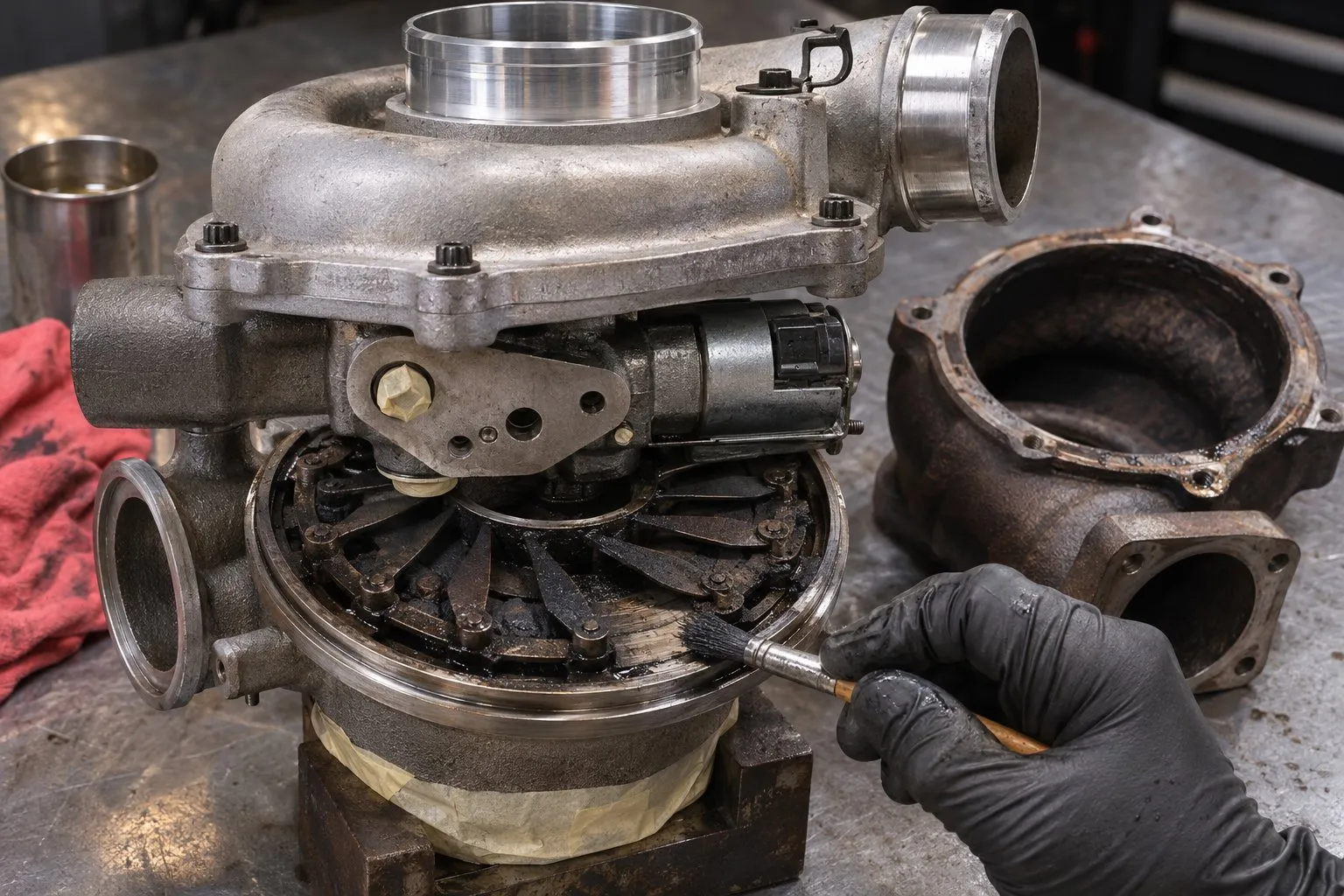
If the vanes are sticking but the bearings are within spec, carbon cleaning can bring an LMM turbo back. Wet the vanes and unison ring with carburetor cleaner per the service procedure and keep solvent out of the bearing housing. Never soak the whole cartridge for hours.
If you have measurable bearing wear, shaft play you can feel in and out, or wheel contact, cleaning will not save it. At that point you are choosing between a new unit, a remanufactured turbo, or sending yours in for our turbo rebuild service. A proper rebuild replaces bearings, seal rings and thrust parts, and the cartridge is balanced on a VSR before it ships.
Removal is not a quick top-side job. The turbo sits in the valley at the rear of the engine, and the procedure includes inner fenders, coolant, heat shields, the downpipe, both up-pipes (three 12 mm 12-point bolts each at the turbo), and three 17 mm pedestal bolts. Plan the labor accordingly.
Keeping the Replacement Alive
Because the LMM’s oil does double duty, the maker’s maintenance schedule matters more here than on a pre-DPF truck. Follow GM’s oil life system and shorten intervals for towing, heavy idling, or dusty work, where regens are more frequent and fuel dilution climbs. Replace the air filter when the restriction indicator says so.
When you fit a turbo, follow the maker’s first-start steps: fill the oil inlet with clean engine oil, turn the wheel by hand, crank or idle a few minutes before load, and check for leaks. There is no break-in mileage schedule and no first-miles boost limit. Let active regens finish rather than cutting them short, since a stopped regen loads the DPF and drives the engine to run more aggressive cycles later.
For more on the control side of this turbo, our LMM variable geometry turbocharger guide walks through the solenoid and vane diagnostics in depth.
Frequently Asked Questions
Does the DPF cause LMM turbo failures directly?
No. The DPF sits downstream of the turbine, so its soot never touches the turbo. The indirect link is regeneration: the LMM injects late fuel to burn off the filter, and some of that fuel dilutes the crankcase oil that lubricates the turbo bearings, which accelerates wear over time.
Can I clean sticking vanes on my LMM turbo instead of replacing it?
If the bearings are healthy and the vanes are only carboned, cleaning per the service procedure can restore proper operation. Wet the vanes and unison ring with the specified solvent and keep it out of the bearing housing. If you have in-and-out shaft play you can feel or wheel contact, cleaning will not help and the cartridge needs a rebuild or replacement.
What does it cost to rebuild an LMM turbo?
Rebuild pricing is confirmed after inspection and before any work starts, since it depends on what the cartridge needs. You can see our current rebuild pricing on the turbo rebuild price list, or contact PT Turbo at (909) 824-1020 and we will walk you through it. Most rebuilds ship in 3 days or less.
Need a Turbocharger?
PT Turbo has rebuilt and sold turbochargers since 1978. We stock remanufactured units for Cummins, Duramax, Power Stroke, Detroit Diesel, and more — backed by a 12-month unlimited mileage warranty. Units in stock at our shop in San Bernardino, CA ship the same day when ordered before 2 PM Pacific, Monday through Friday.
📞 (909) 824-1020 · 346 S I St. #3, San Bernardino, CA 92410 · info@ptturbo.com
More From PT Turbo
 Volvo D13 Turbocharger Guide: Holset HE451VE, Symptoms & Replacement Options
- Mack MP7 Turbocharger Guide: Shared with Volvo D11 & What That Means for Parts
- Caterpillar C15 Turbocharger Guide: Common Failures, Replacement Parts & Cost
- Ford F-650 & F-750 Turbocharger Guide: Cummins ISB & 6.7L Powerstroke Applications