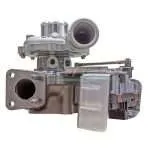
The Holset HE300VG is the variable geometry turbocharger bolted to the 6.7L Cummins in Ram pickups since 2013 and to many medium-duty ISB engines, and if you turn wrenches on Ram 2500/3500 trucks or medium-duty Cummins ISB platforms, you already know it lives and dies by that sliding nozzle assembly. When the variable geometry mechanism sticks, the actuator fails, or the electronics quit talking, you get a truck that limps, smokes, and throws codes that send owners into a panic. This guide breaks down exactly how the HE300VG’s variable geometry works, what fails and why, and how to handle a proper replacement without wasting money.
How the HE300VG Variable Geometry System Actually Works
Unlike a fixed-geometry turbo with a wastegate, the HE300VG controls boost by physically changing the effective area of the turbine housing. Inside the housing sits a sliding nozzle ring, a machined sleeve that moves fore and aft over the turbine wheel. At low RPM the ring slides in to shrink the exhaust flow path, accelerating gas velocity across the turbine blades so the turbo spools fast and kills lag. At high RPM and load, the ring slides back to open the flow area, letting the engine breathe without overspeeding the turbo or building excess backpressure.
On the HE300VG, that sliding nozzle is driven by an electric rotary actuator, sometimes called the VGT actuator or smart actuator, mounted on the compressor side. The Cummins ECM commands actuator position hundreds of times per second based on RPM, load, boost demand, and even exhaust brake requests. The actuator reports its actual position back to the ECM, which is why a mechanically stuck nozzle ring usually throws a position or correlation fault almost immediately.
One feature Cummins built into the HE300VG that mechanics love: the variable vanes double as an integrated exhaust brake. Closing the nozzle ring against exhaust flow generates significant backpressure for engine braking, which is why you never see a separate exhaust brake butterfly valve on these trucks. It also means the vanes cycle constantly, and constant motion in a soot-laden environment is exactly why they eventually stick.
Common HE300VG Failure Modes and Symptoms
Nearly every HE300VG problem traces back to one of three areas: the sliding vane mechanism, the actuator, or the bearing system. Soot and carbon buildup is the number one enemy. Every regen cycle and every mile of stop-and-go driving deposits carbon around the nozzle ring, and eventually the ring binds in its bore. The actuator keeps commanding movement, the ring refuses, and the ECM logs a fault.
Here’s how the symptoms typically stack up by severity:
| Severity | Symptoms | Likely Cause |
|---|---|---|
| Early / Mild | Slight loss of power, weak exhaust brake, occasional check engine light | Carbon starting to bind the nozzle ring |
| Moderate | Overboost or underboost codes, sluggish spool, black smoke, P0299 / P003A | Sticking nozzle ring, actuator struggling, position correlation fault |
| Severe | Limp mode, no boost, actuator not responding, whistling or grinding | Seized vanes, failed actuator, or shaft/bearing failure |
The most common trouble codes you’ll pull are P003A (turbocharger boost control position exceeded learning limit), P0299 (turbocharger underboost), and various VGT actuator circuit codes. A P003A after a cold start that clears when warm almost always means carbon binding rather than a dead actuator. If the code sets hard and the actuator won’t cycle during a self-test, you’re looking at either a failed actuator or a fully seized ring.
We cover the electronic side of this platform in depth in our Cummins ISB 6.7L Turbocharger Guide, which walks through the same variable geometry principles found on both the pickup and medium-duty engines.
Actuator Failures and Replacement Parts
The actuator is the single most-replaced component on any variable geometry turbo, and the HE300VG is no exception. The Cummins unit uses an electronic actuator that is matched to the turbo part number. Getting the actuator right is critical because a mismatched or miscalibrated unit will never hold the correct nozzle position.
A Word on HE300VG Actuator Calibration
The electric actuator on the HE300VG is matched to the specific turbo and must be calibrated to it with a service tool after installation. You cannot simply bolt on a used actuator from another truck and expect it to work. It has to learn the vane travel limits. This is why buying a properly remanufactured complete turbo with a calibrated actuator saves headaches over piecing together used parts.
New vs Remanufactured HE300VG: Cost and Value
When a customer needs an HE300VG, the first question is always new versus reman. A brand-new genuine Holset unit carries a premium price, while a quality remanufactured turbo delivers OEM performance for meaningfully less money. The key is that “remanufactured” means the core was fully disassembled, cleaned, the vane ring replaced or restored, new bearings and seals installed, and the assembly balanced and flow-tested. A cheap “rebuilt” turbo that only got a wash and a new seal kit is not the same thing.
| Option | Typical Price Range | Best For |
|---|---|---|
| New Holset HE300VG | $1,713 to $9,680 (36 listings) at PT Turbo | Warranty-sensitive fleets, low-hour trucks |
| Quality Remanufactured HE300VG | $2,449 to $4,904 (12 listings) at PT Turbo | Owner-operators and shops wanting OEM performance at lower cost |
| Actuator-only replacement | see actuator prices | Confirmed actuator failure with a healthy cartridge |
PT Turbo has been rebuilding turbochargers since 1978, over 45 years, and we stock both new and remanufactured units. Every reman that leaves our shop is balanced and tested to factory spec. Browse our remanufactured turbochargers or, if you want your original core restored, our turbo rebuild service gives you your matched unit back with a warranty.
For a full cost breakdown specific to the Ram platform, including labor estimates, see our Ram 2500/3500 6.7L Cummins Turbocharger Guide.
HE300VG Replacement: Step-by-Step Overview
Replacing an HE300VG on a 6.7L Cummins is a solid day’s job for a competent tech. Here’s the general sequence:
- Let the engine cool completely to avoid warped exhaust components and burns.
- Disconnect the battery and the VGT actuator connector.
- Remove the intake tube, charge air piping, and heat shields.
- Disconnect the oil feed and drain lines and the coolant lines if equipped.
- Remove the exhaust downpipe / V-band clamp and loosen the turbo mounting nuts on the exhaust manifold.
- Lift the turbo out, being careful with the studs and the actuator.
- Always install new gaskets, and prime the new turbo with clean engine oil at the feed port before startup.
- After install, run the actuator installation and calibration routine with a service tool, then verify that the nozzle sweeps its full travel.
Two things trip up most installers. First, failing to prime the oil feed leads to a dry startup and premature bearing failure. Second, skipping the actuator calibration leaves you chasing phantom boost codes. Take the extra ten minutes on both.
HE300VG vs HE351VE: Know Which Turbo You Have
Cummins used the HE351VE on 2007.5-2012 trucks and switched to the HE300VG on 2013 and later 6.7L pickups.
The two do not swap directly (the actuators and their wiring differ), and ordering the wrong one is the fastest way to lose a day of shop time. The easiest way to confirm which turbo is actually on the truck is to read the turbo tag rather than trusting the model year alone, since trucks get swapped parts and crossover builds happen more than people admit.
Beyond the tag, the actuator is your tell. The HE351VE and the HE300VG do not share calibration, and an actuator that learns fine on one platform will throw position faults on the other. When in doubt, pull the number off the housing and cross-reference it before you buy a thing.
Price ranges in this article are general estimates to help with budgeting, not PT Turbo quotes. Our current prices are on each product listing, and our rebuild prices are on the turbo rebuild price list.
Frequently Asked Questions
What engines use the Holset HE300VG turbocharger?
The HE300VG is used on the 6.7L Cummins in Ram 2500/3500 trucks from 2013 (the 2007.5 to 2012 trucks use the HE351VE), as well as on medium-duty Cummins ISB platforms.
What are common signs of a failing HE300VG turbocharger?
Common symptoms include a truck that limps or goes into limp mode, excessive smoke, loss of power, and communication faults from the electronic actuator or sticking variable geometry mechanism.
Why does the variable geometry mechanism on the HE300VG stick?
The sliding nozzle assembly can stick due to soot, carbon buildup, and heat cycling, which restricts movement of the variable geometry vanes and causes performance issues.
Further reading: Learn more about variable-geometry turbochargers.
Shopping by part number?
Every part number we stock for the Holset HE300VG is on one page, with live prices and stock: Holset HE300VG turbos and parts.
Need a Turbocharger?
PT Turbo has rebuilt and sold turbochargers since 1978. We stock remanufactured units for Cummins, Duramax, Power Stroke, Detroit Diesel, and more — backed by a 12-month unlimited mileage warranty and same-week shipping from San Bernardino, CA.
📞 (909) 824-1020 · 346 S I St. #3, San Bernardino, CA 92410 · [email protected]
More From PT Turbo
 Turbocharger Core Exchange Programs: How They Work and What to Expect
- Subaru EE20 2.0L Diesel Turbocharger Guide: Outback & Forester Applications
- Garrett GTB1752VK and GTB1752VKL Turbochargers: Chevy Colorado & GMC Canyon 2.8L Duramax Guide
- BorgWarner Schwitzer Turbocharger Guide: S-Series, K-Series & KKK Reference