Holset HX50 Turbocharger: Large Displacement Cummins & Industrial Applications
The Holset HX50 Turbocharger is a large-frame, fixed geometry unit built for the big-displacement diesels that move freight and run equipment all day, and it has earned a reputation for taking abuse that smaller turbos would not survive. Holset sized the HX50 for engines in the roughly ten-liter class and above, which is why you find it on Cummins L10 and M11 power along with several European heavy engines. If you run one of these engines or keep a fleet on the road, understanding what the HX50 does, how it fails, and how to get the right replacement will save you downtime.
PT Turbo has been a family-owned turbocharger specialist since 1978, more than 45 years of rebuilding and supplying diesel and industrial turbos. We stock both new units and remanufactured turbochargers, so the guidance below is written to help you match the correct part to your engine the first time.
What the Holset HX50 Turbocharger Is
The HX50 belongs to Holset’s HX family, which are fixed geometry turbochargers. There are no pivoting vanes, no unison ring, and no electronic actuator to calibrate. Boost is a function of wheel size, housing A/R, and, on the wastegated versions, how the wastegate is controlled.
Holset was founded in 1952 in Huddersfield, England (the name joins its founders’ surnames, Holmes and Croset), and Cummins bought the company in 1973. It has been Cummins Turbo Technologies since 2006. That heritage matters because Holset’s heavy-duty turbos are engineered as original equipment on Cummins engines and spec’d to specific customer part numbers, not sold as generic frames.
In Holset naming the letter W means wastegated. So an HX50 without the W is a non-wastegated unit, while the HX50W adds an integral wastegate to limit peak boost. The part number you need is on the data plate, usually on the compressor housing (on some wastegated units, on the wastegate actuator), and that number, not the frame name, is what determines fitment.
Engine Applications for the HX50
The HX50 was fitted across a range of large-displacement engines. It sits in Holset’s lineup between the smaller HX40 family used on 8.3-liter engines and the larger HX55 used on the M11, ISM and QSM11.
- Cummins L10
- Cummins M11
- Scania
- MAN
- Iveco
Because the same frame appears on engines from more than one manufacturer, and because each application uses its own compressor wheel, turbine housing and wastegate setting, you cannot order an HX50 by engine name alone. Two trucks with the same displacement can carry HX50 units with very different flow. Always go by the number on the tag.
If your engine is an M11 or a later Cummins ten-liter, confirm whether it left the factory with an HX50 or an HX55, since both show up on that family depending on rating and build year.
How the HX50 Works
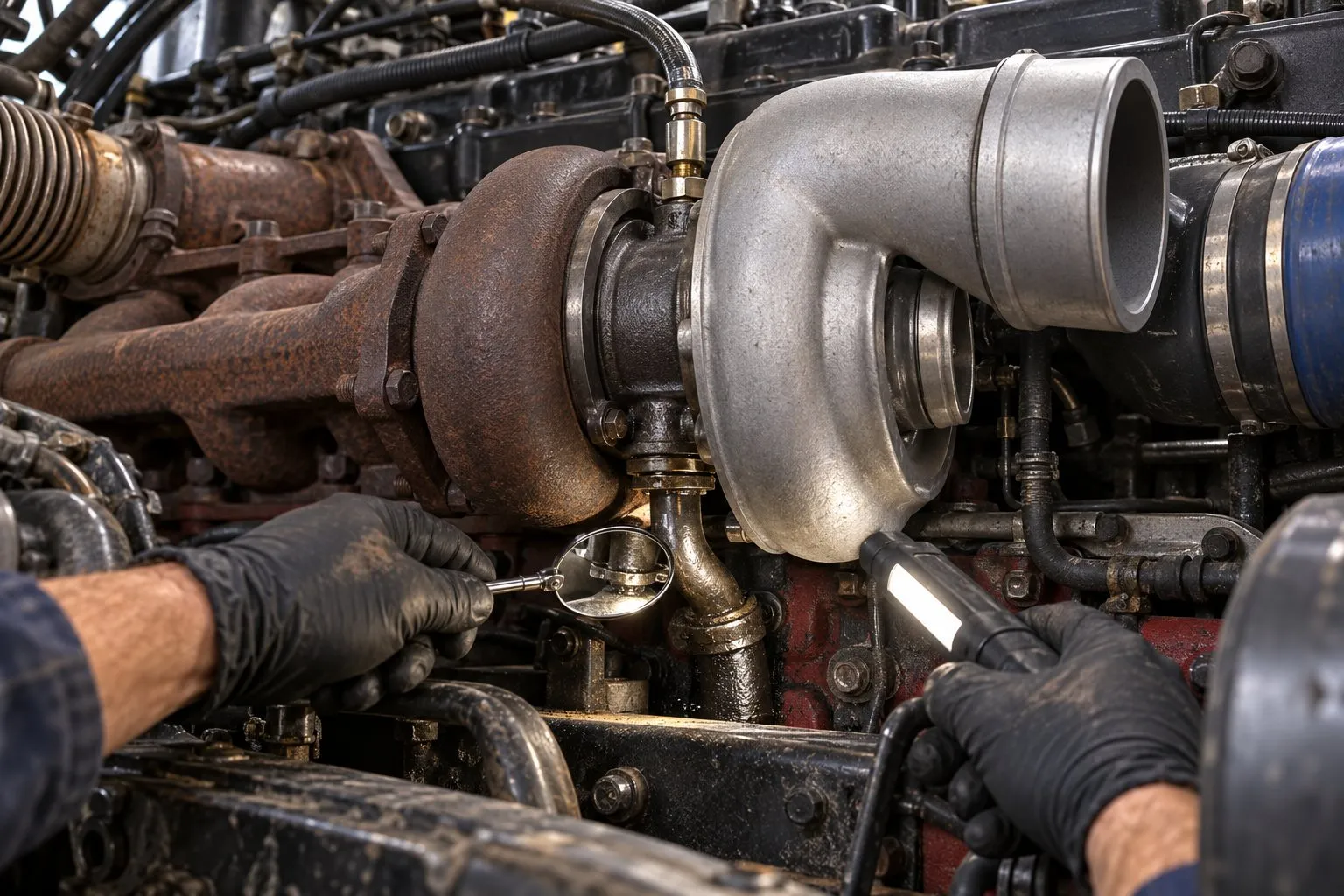
Exhaust energy spins the turbine wheel, which drives the compressor wheel on the same shaft, pushing pressurized air into the intake. The HX50 rides on a journal bearing supported by a pressurized oil film, which is why oil supply and oil quality are the single biggest factor in how long one of these turbos lasts. A turbocharger is a simple machine in principle, and the basic operating cycle is the same across every diesel on this list.
On a wastegated HX50W, the wastegate diverts exhaust around the turbine once target boost is reached. On a boost-opened wastegate, the actuator diaphragm is what sets when the gate cracks open. If that diaphragm leaks, the gate opens late and the engine overboosts, the opposite of what many people assume. A flapper that will not seat properly lets exhaust slip past the turbine, which gives you low boost and slow spool, not boost creep.
Because the HX50 is fixed geometry, it has none of the vane-fouling or actuator-calibration problems that plague variable geometry Cummins turbos. If you want to compare how a VGT behaves instead, our Cummins ISB 6.7L turbocharger guide walks through the sliding-nozzle design and its failure modes in detail.
Common HX50 Failure Modes
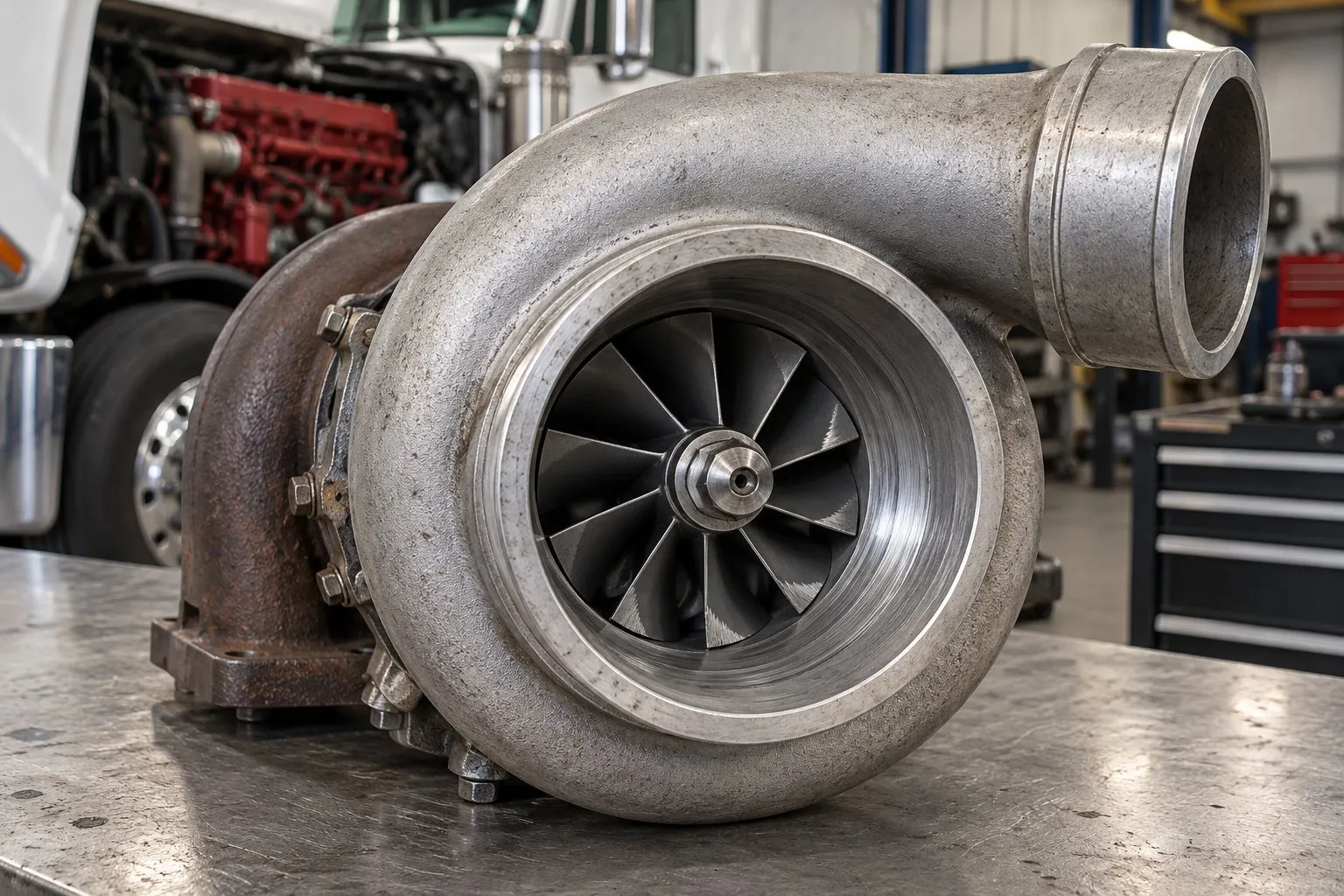
Most turbo failures trace back to the oil supply, and the HX50 is no exception. A restricted feed line starves the bearing; a blocked or kinked drain backs oil up past the seals. Before you condemn a turbo for leaking, check the breather, the air filter, the oil level and the drain, because some oil film in the charge pipes is normal on any engine with closed crankcase ventilation.
| Symptom | Likely Cause | What to Check First |
|---|---|---|
| Blue-gray smoke, oil in charge pipes | Compressor-side seal leak or crankcase pressure | Breather, air filter restriction, oil drain, oil level |
| Low boost, slow spool, high EGT | Wastegate flapper not seating, or a leak in the up-pipes/manifold before the turbine | Wastegate linkage, exhaust joints upstream of the turbine |
| Overboost | Leaking wastegate actuator diaphragm (gate opens late) | Actuator diaphragm and signal line |
| Grinding, shaft noise, wheel contact | Bearing wear from oil starvation or contamination | In-and-out shaft play, wheel-to-housing contact |
| Chipped or bent turbine blade edges | Debris through the turbine inlet | Source of debris upstream; wheel must be replaced, not reused |
When you check shaft play, do not condemn a journal-bearing turbo for every bit of movement. Some side-to-side play at the wheel nose is normal with no oil pressure, and it can feel like a definite rock. The real tests are in-and-out (axial) play you can feel, play beyond the maker’s limit, or any contact between a wheel and its housing. Debris damage always shows on the leading edges of the turbine wheel, and a blade with that kind of damage gets replaced, never rebalanced.
Imbalance wears bearings over time; it does not make a turbo overspeed. And a crack in the up-pipes or exhaust manifold lets exhaust escape before it reaches the turbine, costing you boost and raising exhaust temperature, rather than pushing soot into the turbo.
New vs Remanufactured HX50 Turbocharger
You generally have three paths with an HX50: buy a new unit, buy a remanufactured one, or send your own core in for rebuild. Each has a place depending on your downtime tolerance and budget.
| Option | Best For | Notes |
|---|---|---|
| New Holset unit | Fleets needing a known-new baseline, no core available | Current pricing is on the product page or call (909) 824-1020 |
| Remanufactured HX50 | Fast turnaround with a proven core on the shelf | Balanced cartridge, new wear parts; see our remanufactured turbochargers |
| Rebuild your core | Keeping your exact OE part number and matched housings | 3 days or less for most rebuilds; turbocharger rebuild service |
A proper rebuild replaces the bearings, seal rings and thrust parts, then the cartridge is balanced on a Vibration Sorting Rig before reassembly. After a bearing failure or coked oil, the oil feed line should be replaced rather than reused, because debris trapped in the line will take out the new bearing. PT Turbo confirms the rebuild price after inspection and before any work starts, and every rebuild carries a 12-month unlimited-mileage warranty. For current pricing on a specific HX50, see our turbo rebuild price list.
Getting the Right Holset HX50 Turbocharger the First Time
A wrong turbo is worse than no turbo, so the most important step is reading the data plate (usually on the compressor housing) and giving us that number. Casting numbers on the housings are not part numbers, since one casting serves many different turbos, so do not order from a casting mark.
When you contact us, have the following ready:
- The Holset assembly number from the data plate
- The engine make, model and rating
- Whether your unit is wastegated (HX50W) or non-wastegated (HX50)
- The turbine and compressor housing orientation if you have a custom installation
If you also run light-duty Cummins trucks, our 5.9L Cummins turbocharger guide covers the HX35 and related Holset units on the Ram platform. You can browse everything we carry in our store, or reach the shop directly through the contact page or at (909) 824-1020.
Turbos we list for the HX50
Listings for the turbo models named in this guide that can be ordered online today. Several part numbers can fit one engine by year and rating, so match the number on your turbo’s tag, or call (909) 824-1020 and we will match it for you.
Frequently Asked Questions
Is the Holset HX50 a variable geometry turbo?
No. The HX50 is a fixed geometry turbocharger with no pivoting vanes, no unison ring and no electronic actuator. Boost is controlled by the wheel and housing sizing, and on wastegated HX50W units by the wastegate. That simplicity is a big reason it holds up so well in heavy service.
What engines use the HX50?
Holset fitted the HX50 to large-displacement diesels including the Cummins L10 and M11, plus Scania, MAN and Iveco engines. Because the same frame appears on engines from multiple manufacturers with different wheels and housings, you should never order by engine name alone. Match the assembly number on the compressor-housing data plate.
Should I rebuild my HX50 or buy a replacement?
If your core is intact and you want to keep your exact OE part number and matched housings, a rebuild is usually the best value, and most rebuilds ship in 3 days or less. If you need a unit faster or have no usable core, a remanufactured or new HX50 may fit better. Call (909) 824-1020 and we will help you decide based on your core and your timeline.
Shopping by part number?
Every part number we stock for the Holset HX50 is on one page, with live prices and stock: Holset HX50 turbos and parts.
Need a Turbocharger?
PT Turbo has rebuilt and sold turbochargers since 1978. We stock remanufactured units for Cummins, Duramax, Power Stroke, Detroit Diesel, and more — backed by a 12-month unlimited mileage warranty. Units in stock at our shop in San Bernardino, CA ship the same day when ordered before 2 PM Pacific, Monday through Friday.
📞 (909) 824-1020 · 346 S I St. #3, San Bernardino, CA 92410 · [email protected]
More From PT Turbo
 Audi 2.0L TDI Turbocharger Guide: A3, A4, A5 & Q3 Common Failures & Replacement
- Land Rover TD4 2.0L Turbocharger Guide: Defender, Discovery Sport & Range Rover Evoque
- Mitsubishi TD06 Turbocharger: Marine, Industrial & Performance Applications
- Garrett vs Holset vs BorgWarner: Which Diesel Turbo Brand Lasts Longest?