AGCO Challenger Tractor Turbocharger Guide: MT700, MT800 & MT900 Applications
Use this AGCO Challenger tractor turbocharger guide to find the right turbo for an MT700, MT800 or MT900 before a tractor sits in the shed waiting on the wrong part. These machines pull heavy draft for long hours in dust and heat, which is a hard life for a turbocharger. The series badge narrows the search, but only the tag on the turbo identifies the part. This guide covers how to read that tag, the turbo layouts on the Caterpillar engines that power many of these tractors, how field work destroys turbos, and how to fit a replacement so it lasts.
MT700, MT800 and MT900: Why the Badge Is Not a Part Number
The MT700 and MT800 are rubber-track tractors. The MT900 is a four-wheel-drive wheel tractor. Each series name covered more than one generation, and engines, power ratings and emissions hardware changed along the way. Two tractors with the same series badge can carry different turbos, so ordering by tractor model alone is how the wrong unit gets shipped.
Challenger started as a Caterpillar tractor line, and many MT-series tractors carry Caterpillar engines. Caterpillar does not build its own turbochargers. Garrett and BorgWarner supply them. On factory-fitted units, the tag normally shows the turbo maker’s number and the engine maker’s part number, and either one gets you to the right replacement.
Where to find the number
- BorgWarner: the nameplate sits on the compressor housing. It shows the BorgWarner part number, the serial number and, on factory-fitted turbos, the engine maker’s part number. BorgWarner part numbers run six or eleven digits.
- Garrett: the nameplate is on a housing, but its position varies by region and plant. Garrett part numbers are six digits, a dash, four more digits and usually a letter suffix.
- Any other maker: look for a riveted or engraved plate on a housing, and photograph it before you clean anything.
Do not order by the casting number cast into a housing. One casting serves many turbos, so it only narrows the search. If the tag is missing or burned unreadable, record the engine serial number from the engine plate, photograph both housings and the oil and exhaust connections, and call the shop.
Caterpillar Engine Families and Their Turbo Layouts
If the engine plate on your Challenger shows a Caterpillar engine, the table below narrows what you are looking at. It describes the engine families, not a particular tractor rating, so the tag still has the final word.
| Engine family | Turbo layout | Notes | Order by |
|---|---|---|---|
| Cat C9 | Single turbo, never two in series | BorgWarner S310 family on most ratings. S200AG / S200ACG on some machine ratings. Variable vanes only on 2007-and-later truck engines. | BorgWarner number on the tag |
| Cat C13 | Single on most machine ratings. Two in series on ACERT truck engines. | Never had a variable-vane turbo | Number on each turbo’s tag |
| Cat C15 | Single on most machine ratings. Two in series on ACERT truck engines. | Never had a variable-vane turbo | Number on each turbo’s tag |
| Cat C18 | Single, or two in series on higher ratings | Turbos supplied by Garrett or BorgWarner | Number on each turbo’s tag |
On the C9, the S310 family covers most ratings, with numbers such as S310G080, S310CG080, S310G116 and S310G122. Some machine ratings carry BorgWarner S200 turbochargers instead. Our Caterpillar C9 turbocharger guide goes deeper on that engine.
Series systems need extra care. Debris only travels downstream. Pieces of a failed low-pressure compressor wheel go into the high-pressure compressor, and pieces of a failed high-pressure turbine wheel go into the low-pressure turbine. When one stage fails, inspect the other before the tractor goes back to work.
If the engine plate names a different maker, the same rule holds: read the tag and order by that number.
How Field Work Kills Tractor Turbos
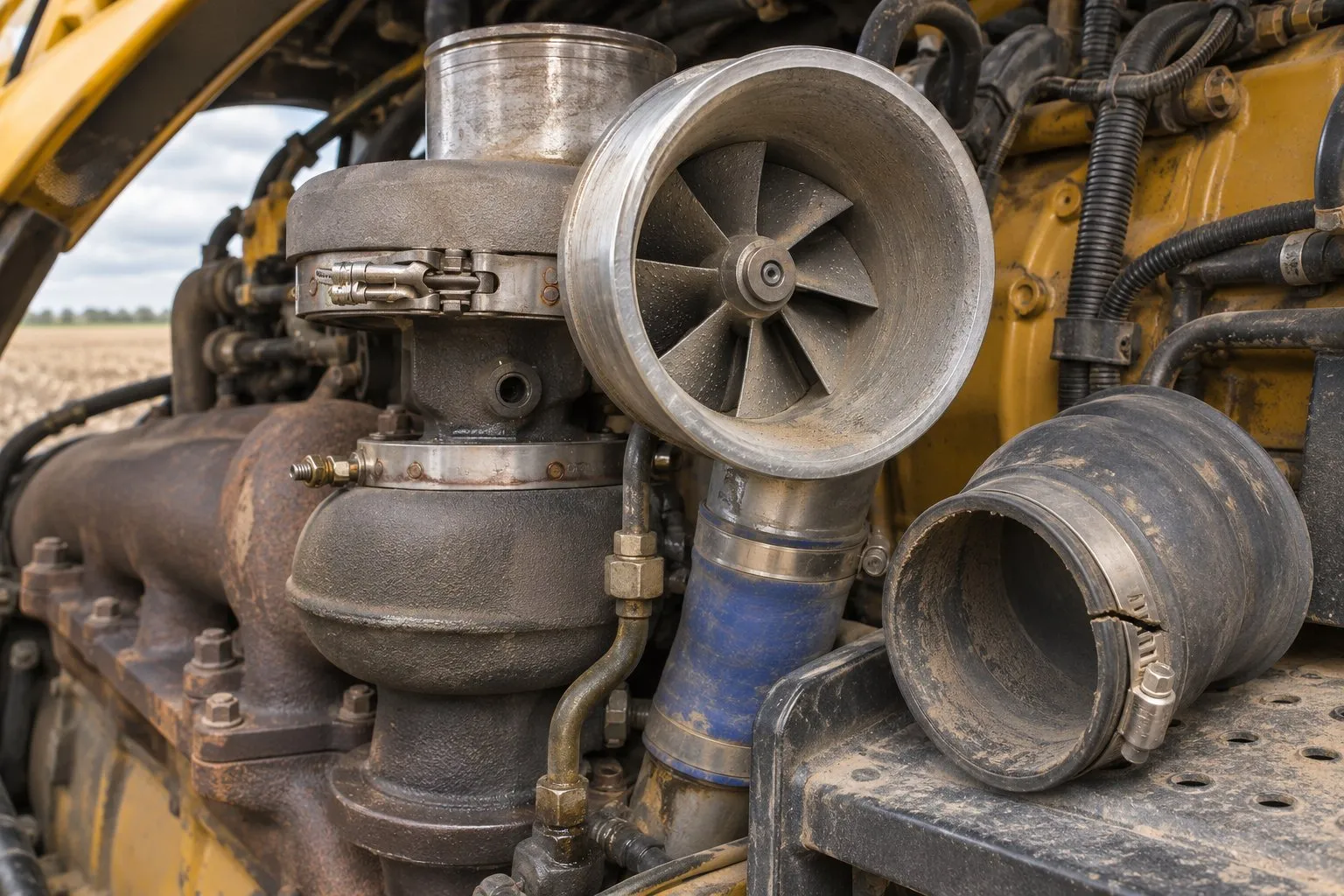
Garrett states that more than 90 percent of turbo failures come from oil starvation or oil contamination. Garrett names foreign objects as the third main cause. A tractor working dry ground exposes its turbo to all three.
Dust and intake leaks
Everything between the air filter and the compressor is under suction. A cracked inlet pipe, a loose clamp or a torn boot there cannot leak boost. Instead it pulls unfiltered dust straight into the compressor.
Dust shows as pitting and wear on the compressor inlet blades. Bent or chipped blades point to impact from a solid object. Replace the air filter when the restriction indicator says so, check that it seats properly, and inspect the inlet ducting at every service.
Oil supply and oil quality
Starvation comes from:
- Low oil pressure.
- A blocked or leaking feed line.
- Hard acceleration from a cold start.
- A turbo fitted without priming.
Contamination scores the bearings. It comes from carbon, engine wear debris, dirt let in during servicing, a faulty filter bypass or worn-out oil. Change oil and filters on the maker’s schedule, or its severe-service schedule when the tractor idles a lot or works in heavy dust.
Heat and hot shutdowns
Shutting down right after a heavy pull leaves oil sitting in a very hot center housing, where it cokes. Carbon builds in the bearing area and around the seals until the shaft is running on abrasive deposits. Give the engine the cool-down idle your operator’s manual calls for before you shut it off.
Exhaust leaks before the turbine
A cracked manifold or a leaking manifold gasket lets exhaust escape before it reaches the turbine wheel. The result is low boost, slow response and higher exhaust temperature. It is an exhaust leak, not a boost leak, and a new turbo will not cure it.
Diagnosing Low Power, Smoke and Noise
Turbos often get blamed for problems that start elsewhere. Work through the system before you pull the turbo.
| Symptom | What it points to | Check first |
|---|---|---|
| Black or dark gray smoke, low power | Too little air, low boost | Air filter restriction, charge-air leaks, exhaust leaks before the turbine, then the turbo |
| Blue-gray smoke | Oil being burned | Breather, air filter, oil level, turbo drain and engine wear, then the turbo seals |
| White smoke | Coolant, or unburned fuel on a cold engine | Cooling system and fuel system, not the turbo |
| Whine or siren noise | A leak or wheel contact | Exhaust joints before the turbine and charge-air joints, then wheel contact |
| Oil at both ends of the turbo | Restricted drain | Drain routing, kinks, crankcase pressure against the service manual |
| Oil on the outside of the center housing | Gasket or line leak | Feed and drain gaskets and fittings |
Off-road engines report faults through the machine’s own diagnostics, generally as SPN and FMI numbers rather than the OBD-II P-codes used on road vehicles. On J1939 systems, intake manifold pressure is SPN 102. The FMI tells you whether the reading is above normal, below normal, or the signal itself is bad. A signal fault points to the sensor and its wiring before the turbo.
When you pull the intake pipe and check the shaft, some side-to-side rock at the wheel is normal on a journal-bearing turbo with no oil pressure. Condemn it for:
- In-and-out play you can feel.
- A wheel that touches its housing when rocked.
- Play beyond the maker’s limit.
A light oil film in the intake tract is normal crankcase vapor. Oil pooled in the pipes or the charge air cooler is different: check the breather, air filter, oil level and drain before you blame the seals.
Fitting a Replacement or Rebuilt Turbo
A new turbo on an engine with the old fault fails the same way. Fix the cause first, then fit the turbo with these steps:
- Oil feed line: fit a new one after any bearing failure or coked oil. Garrett recommends a new line. Do not flush and reuse the old one.
- Oil drain: it is a gravity return. It must run downhill, within about 15 to 20 degrees of straight down, and enter the pan above the oil level, with no kinks or sagging hose.
- Gaskets: use new oil feed and drain gaskets, with no sealant.
- Charge air cooler: replace it if the old compressor wheel came apart. MAHLE and Nissens both say metal in the fins cannot be flushed out reliably. Inspect the charge pipes too, and clean or replace them.
- Priming: fill the oil inlet with clean engine oil and turn the wheel by hand.
- Cranking: crank 10 to 15 seconds with fueling disabled by the engine maker’s procedure.
- First idle: start the engine and idle 3 to 4 minutes, checking for oil, exhaust and air leaks before putting it under load.
There is no break-in beyond those first-start steps. Once the turbo passes the leak check, the tractor can go back to work.
PT Turbo is family-owned and has been rebuilding turbochargers since 1978, more than 45 years, out of San Bernardino, California. Through our turbo rebuild service, you can send in the turbo from your Challenger. Every unit we rebuild in-house is balanced on a VSR (Vibration Sorting Rig) and gets a final quality inspection: a leak test, a visual inspection and an actuator or wastegate function check.
Most rebuilds ship in 3 days or less. The price is confirmed after inspection, before work starts, and the turbo rebuild price list shows our rates by turbo model. Rebuilds carry a 12-month warranty with unlimited mileage.
To buy a replacement, search the store or our remanufactured turbochargers by the number on your turbo’s tag. Current pricing is on each product page. Stock changes daily, so if the number does not come up, call (909) 824-1020 or use the contact form.
Items in stock at the shop ship the same day when ordered before 2 PM Pacific, Monday through Friday. Most other orders ship within 1 to 2 business days. Remanufactured units take a core return within 30 days. Operations running several machines can call to arrange priority turnaround and to keep their common cores on hand.
Frequently Asked Questions
Where is the part number on a Challenger tractor turbo?
It is on the nameplate. On BorgWarner turbos the plate sits on the compressor housing. On Garrett turbos it is on a housing, but the position varies by plant. Order by that number, not by the casting number or the tractor model. If the plate is unreadable, have the engine serial number and photos ready and call (909) 824-1020.
Should I rebuild my Challenger turbo or replace it?
If the housings are sound and the cause of the failure has been fixed, rebuilding your own turbo keeps the exact part on the engine. Inspection decides what can be reused. A turbine wheel with blade damage is replaced, never rebalanced and reused. The rebuild price is confirmed after inspection, and most rebuilds ship in 3 days or less.
How long should a Challenger idle before shutdown after heavy work?
Use the time in the operator’s manual for your engine, because makers’ figures differ. Cummins, for example, gives 3 to 5 minutes after extended full-power operation and none after normal running. The idle lets the center housing cool so oil does not coke on hot surfaces. A hard pull at the end of a field followed by an immediate shutdown is the case that needs it most.
Need a Turbocharger?
PT Turbo has rebuilt and sold turbochargers since 1978. We stock remanufactured units for Cummins, Duramax, Power Stroke, Detroit Diesel, and more — backed by a 12-month unlimited mileage warranty. Units in stock at our shop in San Bernardino, CA ship the same day when ordered before 2 PM Pacific, Monday through Friday.
📞 (909) 824-1020 · 346 S I St. #3, San Bernardino, CA 92410 · info@ptturbo.com