Mining Equipment Turbocharger Guide: Cat, Komatsu & Liebherr Heavy Diesel Applications
This Mining Equipment Turbocharger Guide walks diesel techs and fleet managers through the turbochargers that keep Caterpillar, Komatsu and Liebherr machines moving, and how to match the right unit to an engine that lives in dust, heat and constant load. Mining duty is brutal on a turbo: long hours at high exhaust temperature, altitude at the pit rim, fine abrasive dust, and heat soak when a loaded truck idles down. Getting the part right the first time matters more here than on any highway truck, because a wrong turbo on a haul truck or shovel is downtime measured in lost loads.
At PT Turbo we have been rebuilding turbochargers since 1978, family-owned and now past 45 years in business, and we stock both new and remanufactured turbochargers for these heavy diesel platforms. Below is how the major mining engines are turbocharged, what tends to fail, and how to make sure the number you order is the number your engine wants.
What makes mining turbos different
Most mining and quarry engines run a single turbocharger, and the bigger ratings run two turbos in series rather than variable geometry. That is a deliberate choice: a sliding-nozzle or variable-vane turbo earns its keep in on-highway emissions duty, but off-highway machine engines often favor simpler fixed-geometry or wastegated units that tolerate dust and heat.
Caterpillar does not build its own turbochargers. Garrett and BorgWarner supply them, so the “Cat” turbo on your engine is really a BorgWarner S-series or a Garrett unit under a Cat part number. Komatsu is split: its smaller machines run Cummins engines with Holset turbos, while its own larger engines carry Komatsu’s KTR-series. Liebherr builds its own diesels and sources turbos from the major makers, so the tag number is your only reliable guide.
Caterpillar machine engines by frame
Cat machine engines map fairly cleanly onto BorgWarner S-frames, but ratings vary and the part number is the final word. The spread below reflects how our catalog and BorgWarner’s own frame listings line up.
| Cat engine | Typical turbo family | Arrangement |
|---|---|---|
| 3116 / 3126 / C7 | BorgWarner S200AG / S200G; some 3126B/3126E and C7 ratings use an S300 | Single |
| C9 / C9.3 | BorgWarner S310 family; some machine ratings an S200AG | Single, never series |
| C4.4 / C7.1 | Single wastegated turbo, or two in series on higher ratings | Single or series (no VGT) |
| C13 / C15 (machine) | Single on most machine ratings | Single |
| C18 (industrial) | Single up to about 630 hp; series twin turbos on 700 to 800 hp ratings | Single or series |
A couple of points worth drilling into. Among Cat machine engines, only the 2007-and-later C7 and C9 use a variable-vane turbo; the C13 and C15 never did. If someone tells you they are chasing a “VGT fault” on a machine C15, the diagnosis is already off the rails.
The frame families you will reach for most are the BorgWarner S200 on the 3116/3126/C7 ratings and the heavier S300 on the uprated 3126E and some C7 units. For the full C9 picture, our Caterpillar C9 turbocharger guide breaks down the S310 variants by part number. On every one of these, go by the number on the turbo’s data plate, not the engine name and not the housing casting number, because a single casting serves many different turbos.
Komatsu: Cummins-based and Komatsu’s own engines
Komatsu’s turbo picture depends entirely on which engine family you are under. The smaller machines are Cummins-powered, so the turbo is a Holset.
- S4D102 / S6D102 are the Cummins 4BT / 6BT, fitted with the Holset HX30 or HX35.
- SAA6D107E is the Cummins QSB6.7. Tier 3 ratings run an HX35W; Tier 4 ratings run a single sliding-nozzle VGT.
- SAA6D114E is the Cummins QSL9 (the 8.3 / 8.9 family), running Holset turbos that range from the wastegated HX40W to the variable-geometry units on EGR and later ratings.
For those Cummins-based machines, our Cummins QSB turbocharger guide and Cummins ISL guide cover the HX35W, HX40W, HE431V and HE400VG by engine version. The 108-series engine sits in the PC300 size class; the 125-series moves you up into PC400 territory.
Komatsu’s own larger engines carry Komatsu KTR-series turbos, not Holset. The SAA6D125E-5 runs a KTR90 and the SAA6D140E-5 a KTR110. Do not let a parts lookup put a “Holset HX55” on an SAA6D125, because that cross is wrong. BorgWarner’s S2B, S2D and S3A are the usual replacement path for the older 95, 108 and 125 series. On Komatsu’s Tier 4 machines the variable-geometry turbos are moved hydraulically, which is a different service animal from an electronic-actuator highway VGT.
A Mining Equipment Turbocharger Guide for Liebherr and the tag number
Liebherr designs and builds its own D-series diesels for excavators, haul trucks and mining shovels, and sources the turbochargers from the major turbo makers. Because there is no single “Liebherr turbo,” the only safe way to order is off the data plate on the compressor housing.
That tag carries the turbo maker’s part number, which is what cross-references to a new or remanufactured unit. The casting number on the housing only narrows the search; wheel sizes and turbine housing A/R confirm it. When in doubt, send us the turbo or the full number and let us match it, rather than ordering off an engine serial alone. Our contact page and the shop line, (909) 824-1020, are the fastest way to confirm a Liebherr fitment.
How mining turbos fail, and what to check first
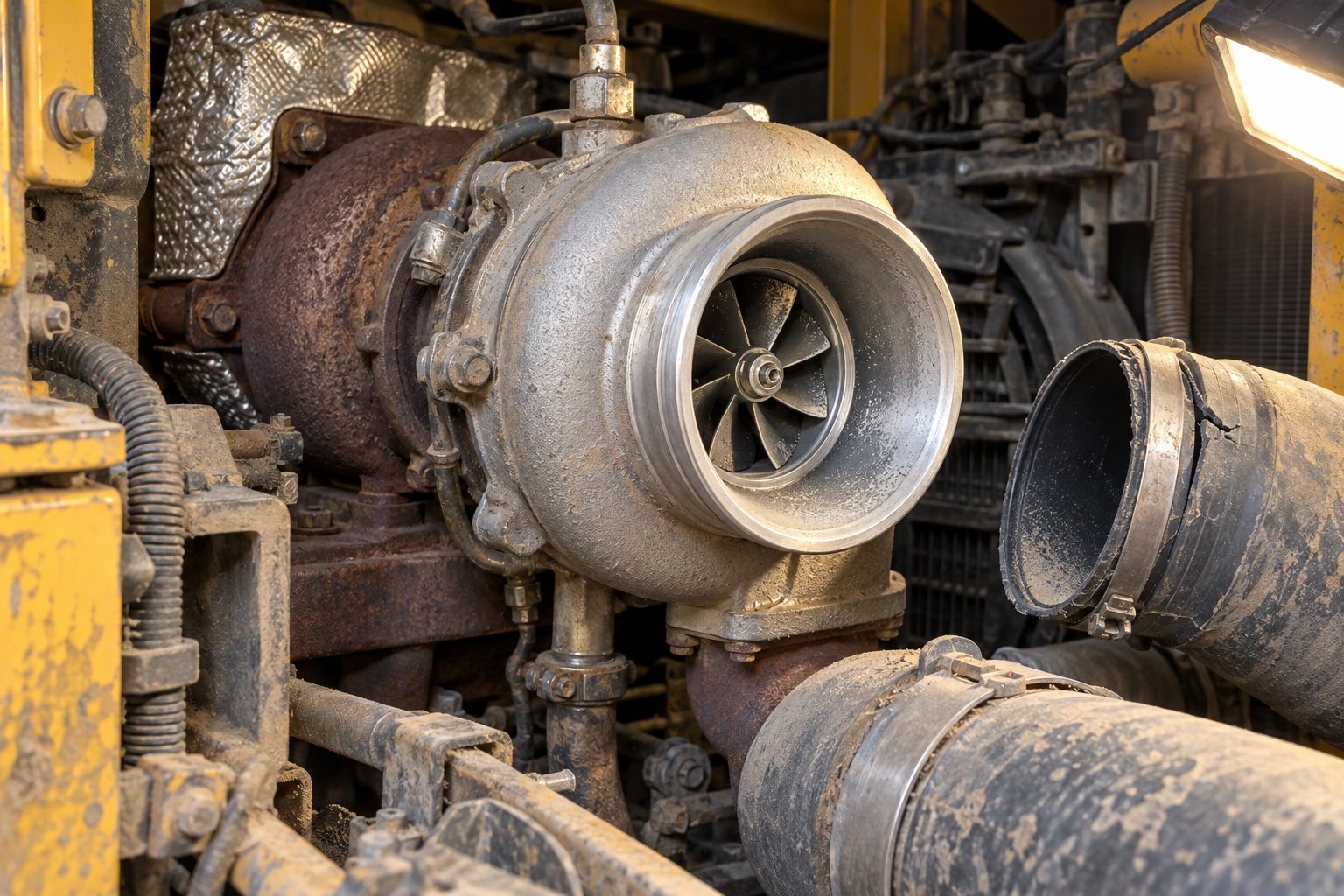
Most turbo failures on any diesel trace back to the oil supply, and mining duty makes that doubly true. Extended high-EGT operation cokes oil in the center section, and dust ingestion sandblasts the compressor wheel. Before you condemn a turbo, work through the basics.
- Oil feed and drain. A restricted drain backs oil up past the seals and leaks at both ends; a leaking drain gasket is an external leak. The drain must run downhill and enter the pan above the oil level.
- Air filtration. On a dusty site, a split boot or tired filter puts abrasive straight into the compressor. The inlet before the turbo is under suction, so a crack there draws dirt in, it does not leak boost.
- Shaft play. Some side-to-side rock is normal on a journal-bearing turbo. Condemn it for in-and-out play you can feel or for wheel contact with the housing, not for any movement at all.
- Charge-air cooler. After a compressor wheel sheds metal, replace the intercooler. Debris in the fins cannot be reliably flushed out and goes straight into the engine on restart.
On the variable-geometry machine engines, soot fouling of the nozzle or vanes shows up as sluggish response or boost faults. On a high-pressure-EGR engine, that soot comes from combustion; EGR gas never passes through the turbine from the vane side. For background on how these mechanisms work, the variable-geometry turbocharger overview is a solid primer.
New versus remanufactured for machine fleets
For mining fleets, the choice between a new unit and a quality reman usually comes down to lead time, core availability and spec. Both are legitimate paths when the work is done to the maker’s standard and balanced on a VSR rig.
| Factor | New turbo | Remanufactured turbo |
|---|---|---|
| Internals | All new components | New bearings, seals and thrust parts; inspected and balanced housings |
| Core | None required | Core return within 30 days (you pay return shipping) |
| Availability | Depends on the model | Often faster on common cores; most rebuilds ship in 3 days or less |
| Warranty | 12 months, unlimited mileage | 12 months, unlimited mileage |
We remanufacture in-house, stock new units, and keep common fleet cores on hand for operations that run the same machines. Fleet customers can arrange priority and rush turnaround by phone. For what a specific rebuild runs, see our turbo rebuild price list rather than a guessed figure, or read how our turbocharger rebuild service handles machine turbos start to finish.
Turbos we list for the S300, HX30 and HX35
Listings for the turbo models named in this guide that can be ordered online today. Several part numbers can fit one engine by year and rating, so match the number on your turbo’s tag, or call (909) 824-1020 and we will match it for you.
Frequently Asked Questions
How do I identify the turbo on a Cat or Komatsu machine engine?
Use the part number on the data plate on the compressor housing, not the engine serial and not the housing casting number. One casting serves many turbos, so the casting only narrows the search; wheel sizes and turbine housing A/R confirm it. Send us the number and we will match it.
Do Caterpillar machine engines use variable geometry turbos?
Only the 2007-and-later C7 and C9 use variable-vane turbos among Cat machine engines. The C13 and C15 never did, running single fixed or wastegated turbos on most machine ratings and series twin turbos on the uprated ACERT truck engines. Always confirm by the part number.
Is a Komatsu turbo always a Holset?
No. Komatsu’s smaller machines use Cummins engines with Holset turbos, such as the HX30 or HX35 on the 4BT/6BT-based units. Komatsu’s own larger engines, like the SAA6D125 and SAA6D140, carry Komatsu KTR-series turbos, and Tier 4 machines use Komatsu’s own hydraulically actuated variable-geometry units.
Need a Turbocharger?
PT Turbo has rebuilt and sold turbochargers since 1978. We stock remanufactured units for Cummins, Duramax, Power Stroke, Detroit Diesel, and more — backed by a 12-month unlimited mileage warranty. Units in stock at our shop in San Bernardino, CA ship the same day when ordered before 2 PM Pacific, Monday through Friday.
📞 (909) 824-1020 · 346 S I St. #3, San Bernardino, CA 92410 · [email protected]