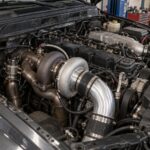
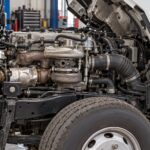
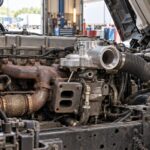
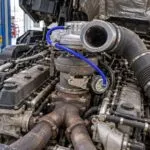
Perkins 2206 Turbocharger Guide: Large Industrial & Generator Set Applications
This Perkins 2206 turbocharger guide is for the technicians, rental fleet managers and facility engineers who keep large Perkins generator sets and industrial engines running. The 2206 family has been built in several generator set and industrial versions, and the turbo on one is not automatically the right part for another. Below: how to identify the exact unit, how generator duty wears it out, how to diagnose it on site, and how to fit a replacement without a repeat failure.
PT Turbo is a family-owned shop in San Bernardino, California, and has been rebuilding turbochargers since 1978. With more than 45 years in the business, our in-house rebuild service handles a generator set turbo the same way it handles any other. Each unit is torn down, inspected, rebuilt with new wear parts, balanced and checked before it ships.
Identify the Exact Turbo Before You Order
Order by the data plate on the turbo, not by the engine name. Turbo part numbers follow the engine version, rating and build. Two engines that both carry the 2206 name can use turbos that do not interchange, and a turbo that bolts on with the wrong housings or wheels will not deliver the airflow the rating was built around.
The plate identifies the turbo no matter who built it. Record these details before the turbo comes off:
- Turbo maker’s part number. Holset and BorgWarner put the plate on the compressor housing. Where Garrett places its plate varies by region and plant.
- Engine maker’s part number. Factory-fitted turbos usually carry the Perkins number as a separate field next to the turbo maker’s number.
- Turbo serial number. Keep it in the set’s maintenance records.
- Engine designation and serial number from the engine plate, so the turbo can be checked against the build.
Photograph the plate while you can still read it. Do not order by the casting numbers on the housings, because one casting serves many different turbos and a casting number only narrows the search. If the plate is missing, collect the Perkins part number, the engine serial number and clear photos of both housings, then contact PT Turbo or call (909) 824-1020.
With the number in hand, search our turbo catalog by the tag number. If it does not come up, call us. We can quote a replacement by part number or rebuild the turbo you have.
How Generator Set Duty Wears a Turbo
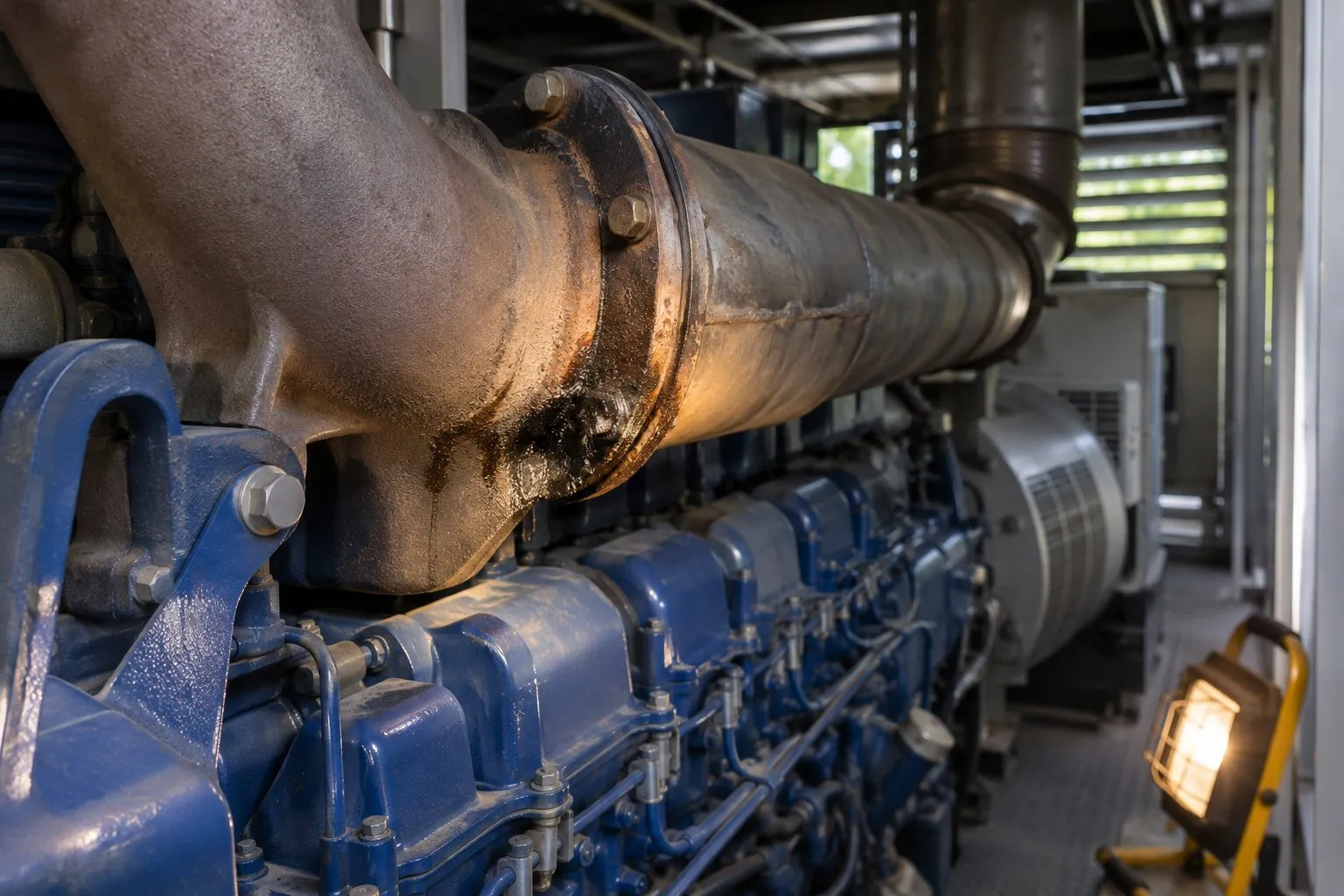
On a generator set the governor holds engine speed fixed to keep output frequency steady. The turbo’s work therefore follows the electrical load, not a throttle pedal. Steady load is easy on a turbo. Most damage comes from the extremes: long runs at little or no load, starts that go straight to heavy load, and shutdowns that skip the cool-down.
| Duty | What stresses the turbo | What shows up | What to check |
|---|---|---|---|
| Standby (emergency) set | Long idle periods, unloaded exercise runs, fast start and load pickup | Carbon in the turbine housing, oil weep at the turbine end, wet residue at exhaust joints | Exercise under real load or a load bank, coolant heater, oil level and condition |
| Prime or continuous power | Long hours under steady load, heat soak inside enclosures | Aging oil, loaded air filters, exhaust joint leaks | Oil and filters on the maker’s schedule, restriction indicator, exhaust manifold joints |
| Industrial or site use | Dust, vibration, shutdowns under load | Pitted compressor blades, chafed oil lines, coked bearing housings | Air filter sealing, intake piping, oil feed and drain lines, cool-down practice |
Light Load and Wet Stacking
A standby set that runs its exercise cycle with no load never reaches full operating temperature. Unburned fuel and soot collect in the exhaust, leave wet black residue at the joints and build carbon in the turbine housing. After long idle, oil shows up at the turbine end first and usually clears under load. A wet exhaust on a lightly loaded set does not prove a failed seal on its own.
The cure is load. Exercise the set under real building load or on a load bank so it reaches full temperature. Check the exhaust again after a loaded run before you pull the turbo.
Hot Shutdowns and the Cool-Down Timer
When the transfer switch returns the building to utility power, the generator controller normally runs the engine unloaded for a cool-down period before it stops. Keep that timer at the time Perkins gives for your engine, and do not shorten it to save fuel. A fault shutdown or emergency stop under heavy load skips the cool-down. Heat soaks into the center housing and the oil left in the bearing housing cokes. The damage comes from coking, not oil starvation, and it builds up with every hot shutdown.
Cold Starts and Fast Load Pickup
An emergency set may start and take load within seconds. Garrett lists hard acceleration from cold, blocked or leaking oil pipes, and no priming at fitting as triggers for oil starvation. A standby start puts the first of those on the turbo every time the utility drops. Keep the coolant heater working, keep the oil at the level and grade Perkins specifies, and check the feed and drain lines for kinks and chafing.
Dust and Air Filtration
Dust shows up as pitting on the compressor inlet blades. Bent or chipped blades mean something solid got in. The pipe between the air filter and the turbo is under suction, so a crack or loose clamp there pulls in dirt instead of leaking air out. Replace the filter when the restriction indicator calls for it, because a restricted inlet also pulls oil past the compressor-end seal.
Diagnosing Low Boost, Smoke and Oil Leaks
Start by reading the active and logged faults from the engine and generator controllers with the service tool for your engine. Then work from the outside in. Garrett states that more than 90 percent of turbo failures come from oil starvation or oil contamination, so whatever killed the old turbo is likely to kill the next one too.
| Symptom | Likely causes | Check first |
|---|---|---|
| Black or dark gray smoke, slow recovery when large loads switch on | Low boost: charge-air leak, exhaust leak before the turbine, restricted filter, damaged compressor | Charge-air boots and clamps, exhaust manifold and turbo inlet joints, restriction indicator |
| Blue-gray smoke | Oil being burned: engine wear, crankcase pressure, restricted drain, then turbo seals | Oil level, breather, drain routing, crankcase pressure against the service manual |
| White smoke | Coolant, or unburned fuel on a cold or lightly loaded engine | Coolant level and load history; not a turbo symptom |
| Whine or siren noise | Exhaust leak before the turbine, boost leak, wheel rubbing | Every joint first, then shaft play and wheel contact |
| Oil pooled in charge-air pipes | Restricted inlet, crankcase pressure, poor drain, compressor seal | Air filter, breather, drain; then the turbo |
| Oil at both ends of the turbo | Restricted drain or high crankcase pressure | Drain line for kinks, coking and slope |
A turbocharger is driven by exhaust flowing through its turbine. A leak at the manifold or turbo inlet therefore costs boost just as a charge-air leak does: slow spool, higher exhaust temperature and a set that struggles to pick up load. There is no universal healthy crankcase pressure, so compare your reading with the figure and test method in the engine service manual.
With the engine shut down and the intake removed, check the shaft by hand. Some side-to-side rock is normal on a journal-bearing turbo with no oil pressure. Condemn the turbo for in-and-out play you can feel, a wheel that touches its housing when rocked, or play beyond the maker’s limit for that unit.
Oil analysis adds one more clue. Turbo journal bearings are bronze, so a rising copper trend can point toward the turbo, although the engine has other copper sources. Compare the results with the set’s own baseline and the lab’s limits.
Replacing the Turbo Without a Second Failure
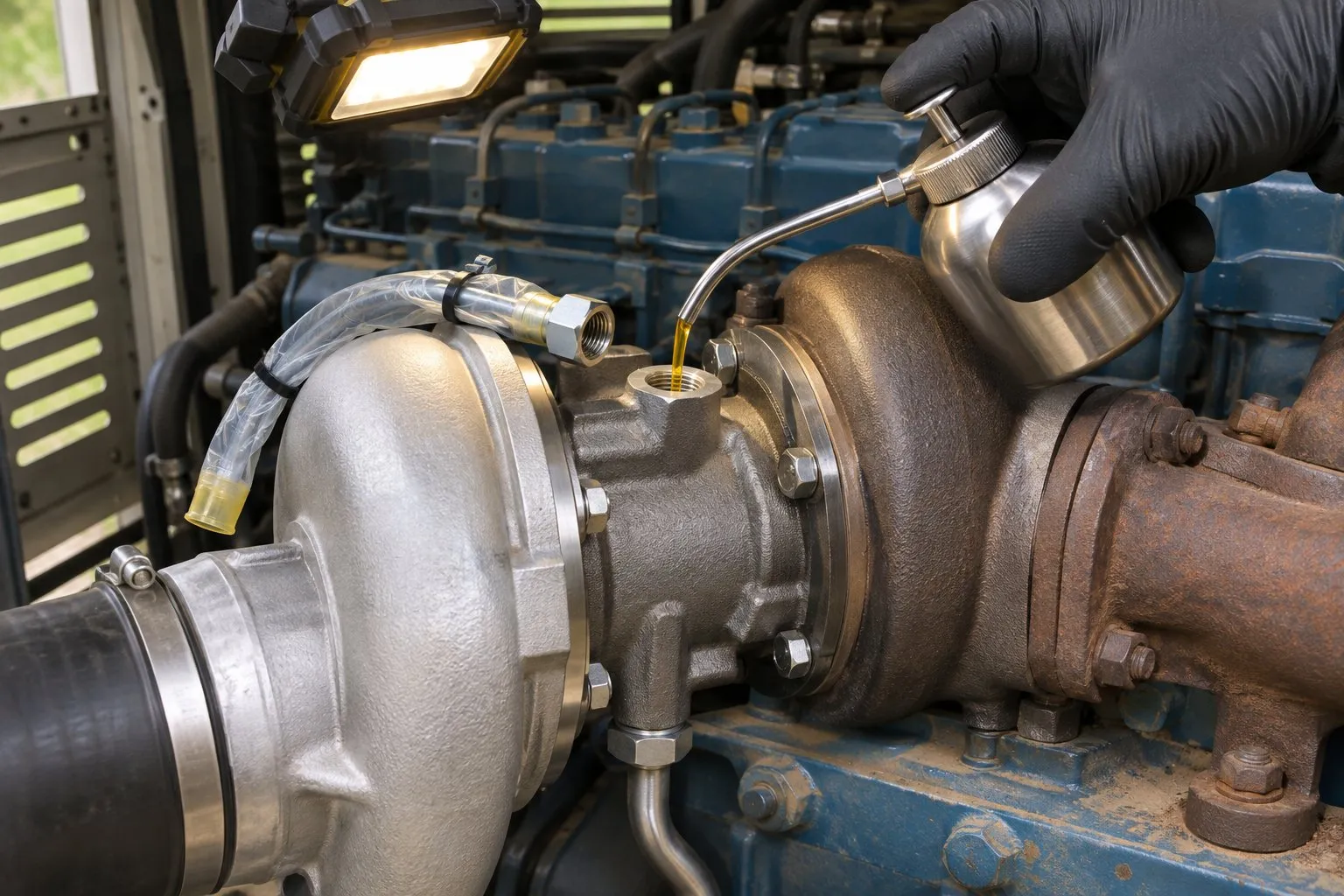
A new or rebuilt turbo will fail quickly if the cause of the last failure is still on the engine. Before it goes on:
- Fit a new oil feed line after a bearing failure or coked oil. Garrett recommends a new line, and Turbo Technics says to replace it whatever its condition.
- Confirm the drain is clear, runs downhill within about 15 to 20 degrees of straight down, and enters the pan above the oil level.
- Use new gaskets, with no sealant on the oil inlet or drain gaskets.
- Replace the charge air cooler if the old turbo shed compressor wheel metal. Metal in the fins cannot be flushed out reliably and goes on into the engine. Clean or replace the charge-air piping as well.
- Fix any exhaust leak at the manifold or turbo inlet, and change the oil and filters to Perkins’ specification.
Before the first start, fill the oil inlet with clean engine oil and turn the wheel by hand. Crank for 10 to 15 seconds without starting, with fueling disabled by the engine maker’s procedure. Then idle 3 to 4 minutes and check for oil, exhaust and air leaks, keeping the transfer switch from taking load until those checks are done. These steps follow Garrett’s installation guide.
Rebuild or Replace: Your Options at PT Turbo
Rebuilding the turbo that came off your engine keeps its original housings. Our in-house rebuild service replaces the bearings, seal rings and thrust parts. Every turbo we rebuild is VSR (Vibration Sorting Rig) balanced and gets a final quality inspection: a leak test, a visual inspection, and a function check of the actuator or wastegate where the turbo has one. Most rebuilds ship in 3 days or less, with inspection notes for the set’s maintenance file.
The rebuild price is confirmed after inspection and before work starts. Our turbo rebuild price list shows current prices by turbo, or you can call (909) 824-1020. Our rebuilds carry a 12-month warranty with unlimited mileage.
If your turbo is beyond rebuilding, or the set has to be back on line sooner, search the catalog by the tag number for a new replacement. You can also check our remanufactured turbochargers, although availability of an exchange unit for your number depends on core supply. Cores are due within 30 days, and the customer pays return shipping. If you need longer, call ahead and we can usually work with you.
Fleets running several 2206 sets can arrange priority and rush turnaround and have us stock their common cores by phone. For mixed fleets, our Cummins QSB turbocharger guide and Caterpillar C9 turbocharger guide cover those engines the same way.
Frequently Asked Questions
Can I use a turbo from another Perkins 2206?
Only if the part number on its tag matches yours or is listed as a direct cross-reference. Turbo numbers follow the engine version, rating and build, so two 2206 engines can carry turbos with different housings and wheels. Match the tag, not the engine name.
Why does my standby generator drip oil from the exhaust?
Long running at light or no load is a common cause. After long idle, oil appears at the turbine end first and usually clears under load. Check the oil level, breather and turbo drain, run the set under real load or a load bank, and look again before you condemn the turbo.
How long does a rebuild of a 2206 turbo take?
Most rebuilds ship in 3 days or less once the turbo reaches our shop. The price is confirmed after inspection and before work starts. Fleets can arrange priority or rush turnaround by calling (909) 824-1020.
Need a Turbocharger?
PT Turbo has rebuilt and sold turbochargers since 1978. We stock remanufactured units for Cummins, Duramax, Power Stroke, Detroit Diesel, and more — backed by a 12-month unlimited mileage warranty. Units in stock at our shop in San Bernardino, CA ship the same day when ordered before 2 PM Pacific, Monday through Friday.
📞 (909) 824-1020 · 346 S I St. #3, San Bernardino, CA 92410 · info@ptturbo.com