Garrett GT45 Turbocharger: High-Flow Diesel Applications & Sizing Reference
The Garrett GT45 Turbocharger sits in the large-frame class that owner-operators and diesel builders reach for when a stock-size charger simply runs out of air. It is a fixed-geometry, high-flow unit used on big-displacement diesels, pulling trucks, and heavily built Cummins, Duramax and Power Stroke engines chasing serious airflow. This guide explains what the “GT45” name actually tells you, how to size a charger of this class to a diesel, and how it compares with the other big Garrett frames PT Turbo stocks.
We have been rebuilding turbochargers since 1978, more than 45 years, and we stock both new and remanufactured big-frame units. Getting the sizing right matters more on a charger this large than on anything factory, because a wheel that is too big kills response and a wheel that is too small chokes the top end.
What the GT45 model name actually means
Garrett’s GT, GTX and GTB names follow a fixed rule. The first two digits are the frame size and the last two digits are the compressor wheel outer diameter in millimeters. Once the wheel passes 100 mm the leading 1 is dropped, so a GTX4202R carries a 102 mm compressor wheel on a 42-frame center section.
That is the key to decoding anything in this family. A GT45-class charger is a 45-frame unit, and the trailing digits of the model name tell you the compressor wheel it was built with (Garrett part numbers, such as 6 digits plus a 4-digit suffix, do not encode the wheel). An “R” on the end marks Garrett’s dual ball bearing cartridge; a plain GT name is usually a journal bearing unit. Always read the full model number off the nameplate rather than assuming, because one frame hosts several wheel and housing combinations.
Casting numbers stamped into the housings are not part numbers. One casting serves many turbos, so match the compressor-housing nameplate, not the iron.
Sizing a high-flow turbo for a diesel
A diesel needs roughly 0.11 to 0.14 lb/min of airflow per horsepower, noticeably more than the 0.10 figure used for gasoline engines. Garrett’s own worked examples land near the top of that band. Multiply your real power target by that figure to get the mass flow the compressor has to deliver, then pick a wheel that reaches that flow comfortably inside its efficient range rather than pinned at the edge of the map.
Oversizing is the mistake we see builders make most. A compressor too large for the engine’s airflow lives on the surge side of the map at low rpm, spools late, and can bark and shuttle. Compressor surge comes from a compressor that is too large for the engine’s demand, not from one that is too small. A charger that fits the power goal and the duty cycle beats a bigger one that looks impressive on paper.
Remember that altitude changes your math. At 5,000 ft you have about 12.2 psi of ambient pressure, and at 10,000 ft about 10.1 psi, a 31 percent drop in pressure and roughly 26 percent in air density. A charger sized tight at sea level has less margin on a mountain grade.
Where the Garrett GT45 Turbocharger fits against the other big frames
The GT45 class overlaps with several large Garrett families, and the right pick depends on whether you want quick response, raw top-end flow, or modern billet-wheel efficiency. PT Turbo stocks the whole big-frame spread. The table below compares the roles, not invented numbers, so you can match the family to the build.
| Family | Bearing system | Typical role |
|---|---|---|
| GT42R / GT4094R | Dual ball bearing | Big single on 5.9/6.7 Cummins and Duramax builds; quicker spool for a 40-frame |
| GT4508R / GT4594 | Ball bearing / journal by version | 45-frame top-end flow for high-power pulling and race diesels |
| GT4708 / GTX4718R | Journal / dual ball bearing | Largest frames for maximum airflow where response is secondary |
| GTX4202R / GTX4508R | Dual ball bearing | Billet compressor wheels for more flow and efficiency at the same frame |
| G30-770 / G42-1200 | Dual ceramic ball bearing | Current G-Series, named by horsepower rating rather than wheel size |
Note the G-Series naming change: in a name like G42-1200 the number after the dash is a horsepower rating, not a wheel size. Do not read it the same way as a GT or GTX name. You can confirm any current spec sheet directly at garrettmotion.com.
Bearing systems and how these turbos fail
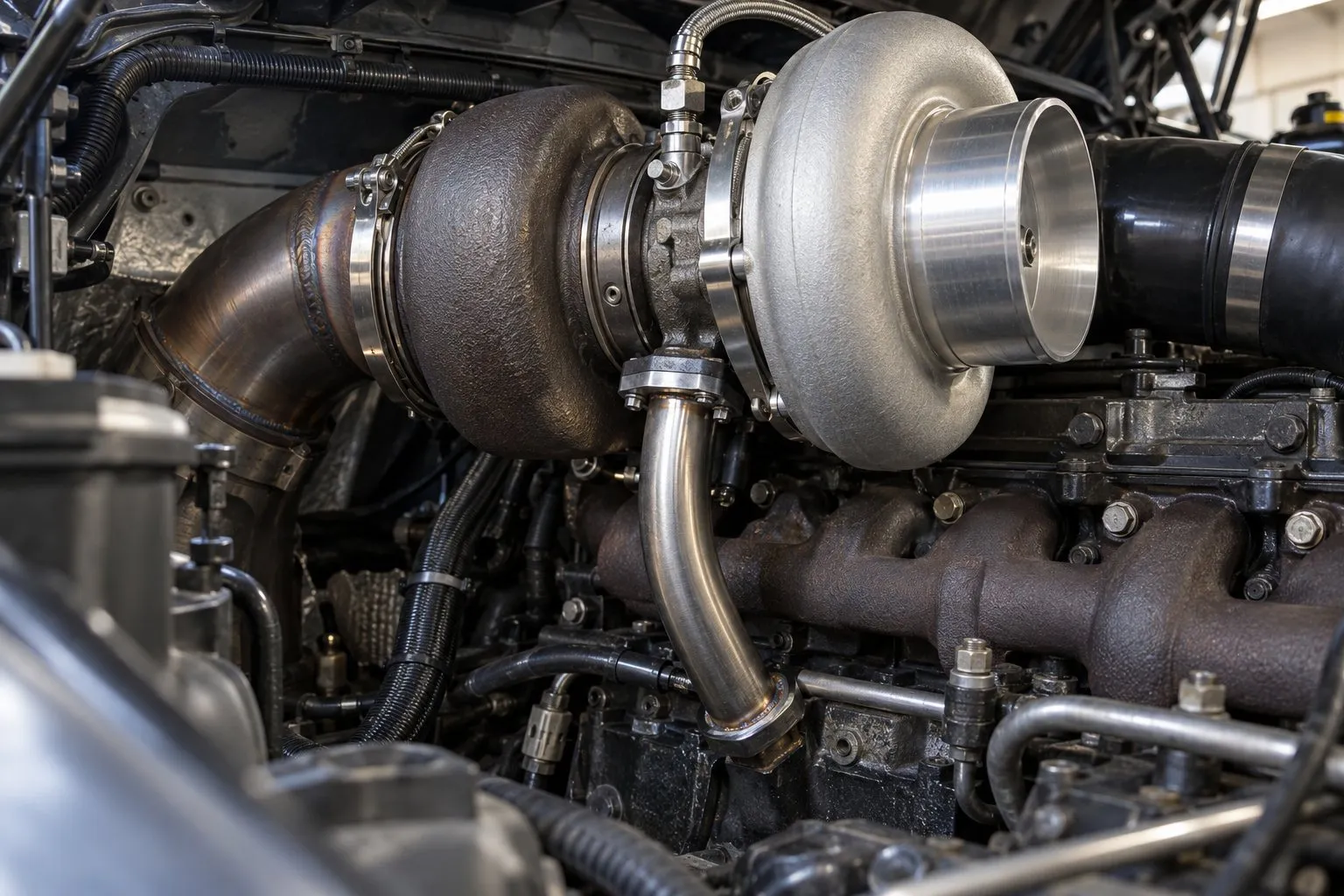
Most big-frame failures trace back to the oil supply, not to the wheels. Garrett states that the large majority of turbo failures are oil-related and under one percent are manufacturing defects. A ball bearing cartridge like the “R” units uses an oil restrictor; a journal bearing unit typically runs a larger feed bore with no restrictor. Match the feed to the cartridge you are installing.
When you check a used core, know what normal play feels like. Some side-to-side (radial) movement at the wheel nose is normal on a journal bearing turbo with no oil pressure, and axial (in-and-out) play is tight. Condemn a turbo for in-and-out play you can feel, for a wheel that contacts its housing when rocked, or for movement beyond the maker’s limit, never for any movement at all.
Watch where oil shows up. Oil in the charge pipes comes past the compressor-side seal; oil in the exhaust comes past the turbine-side seal. Before you blame either seal, check the breather, air filter, oil level and the drain, because a restricted or kinked oil drain backs oil up past the seals at both ends. The drain is a gravity return that must run downhill and enter the pan above the oil level, within about 15 to 20 degrees of straight down.
Debris damage on a turbine wheel shows on the leading edges and that wheel is replaced, not rebalanced. If the old turbo shed metal, replace the intercooler and clean the charge piping: metal trapped in the cooler cannot be reliably flushed out, and anything left there goes into the engine, since the intercooler sits after the compressor.
Installation and first start
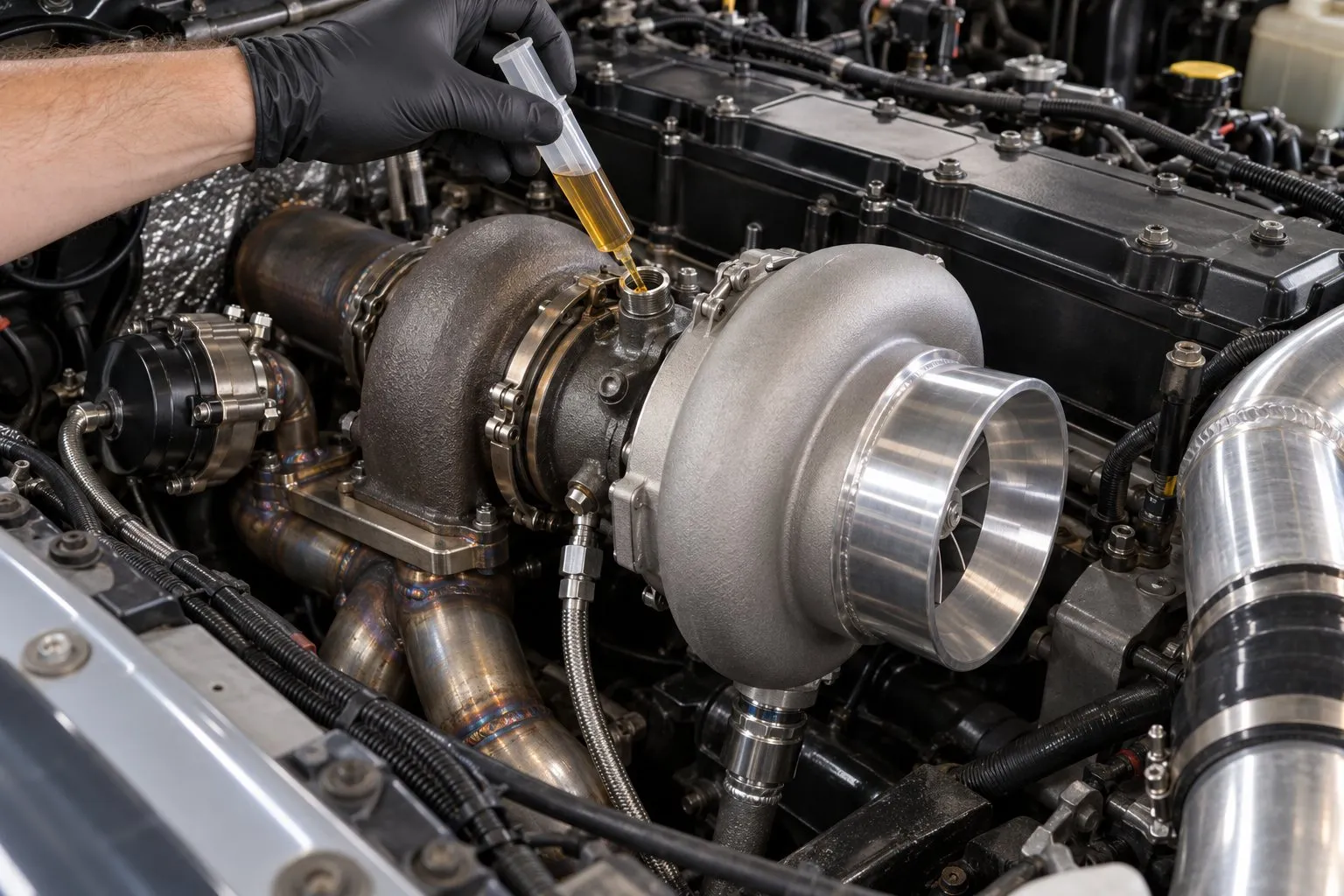
Big-frame chargers are not forgiving of a dry first start. Fill the oil inlet with clean engine oil, turn the wheel by hand, then crank without starting for a few seconds and idle three to four minutes before you load it. If the turbo came off a failure or coked oil, replace the oil feed line rather than reusing it. Use no sealant on the oil inlet or drain gaskets.
There is no break-in mileage schedule, no first-miles boost limit and no early oil change beyond the makers’ prime-and-idle advice. Give it a short cooldown idle after hard work, roughly one to three minutes after towing or pulling, so the center section does not heat-soak the oil in the bearing.
For background on how a fixed-geometry charger compresses intake air, the Wikipedia turbocharger overview is a solid primer. If your build instead calls for a factory replacement turbo, our guides to the Cummins 5.9L HX35 and HE351CW and the Cummins ISL HX40W, HE431V and HE400VG cover those by engine version.
New, remanufactured, or rebuild your core
PT Turbo stocks new big-frame Garrett units and carries a line of remanufactured turbochargers built in-house. If you already have a good housing set and want the cartridge brought back to spec, our turbo rebuild service balances the cartridge on a Vibration Sorting Rig and returns it ready to run.
Most rebuilds ship in three days or less, and the rebuild price is confirmed after inspection and before any work starts. For current numbers by model, see our turbo rebuild price list. Remanufactured units carry a 30-day core return and a 12-month, unlimited-mileage warranty. Not sure which frame suits your power target and duty cycle? Contact PT Turbo or call (909) 824-1020 with your real horsepower goal and we will size it with you.
Turbos we list for the GTX4202R and G42-1200
Listings for the turbo models named in this guide that can be ordered online today. Several part numbers can fit one engine by year and rating, so match the number on your turbo’s tag, or call (909) 824-1020 and we will match it for you.
Frequently Asked Questions
What size diesel engine is a GT45-frame turbo meant for?
There is no single answer, because the frame hosts several wheel and housing combinations. Size it by airflow: a diesel needs about 0.11 to 0.14 lb/min per horsepower, so multiply your real power target by that figure and pick a wheel that reaches that flow inside its efficient range. Call us with your engine and power goal and we will match it.
How do I read the numbers in a Garrett GT or GTX model name?
The first two digits are the frame size and the last two are the compressor wheel outer diameter in millimeters, with the leading 1 dropped above 100 mm, so a GTX4202R has a 102 mm wheel. G-Series names are different: the number after the dash is a horsepower rating, not a wheel size. Always read the full model off the compressor-housing nameplate.
Does PT Turbo sell new or remanufactured big-frame Garrett turbos?
Both. We stock new units and remanufacture cores in-house, and we can rebuild your existing core on our balancing rig. Pricing is on the product page or confirmed after inspection; call (909) 824-1020 for availability on a specific frame and wheel.
Need a Turbocharger?
PT Turbo has rebuilt and sold turbochargers since 1978. We stock remanufactured units for Cummins, Duramax, Power Stroke, Detroit Diesel, and more — backed by a 12-month unlimited mileage warranty. Units in stock at our shop in San Bernardino, CA ship the same day when ordered before 2 PM Pacific, Monday through Friday.
📞 (909) 824-1020 · 346 S I St. #3, San Bernardino, CA 92410 · [email protected]
More From PT Turbo
 Garrett GT1749V Turbocharger: VW TDI & Audi A4 Common Failure & Replacement
- Nissan YD25 2.5L Diesel Turbocharger Guide: Navara & Pathfinder Replacement
- BorgWarner Schwitzer Turbocharger Guide: S-Series, K-Series & KKK Reference
- Mitsubishi TD04 Turbocharger: Subaru, Volvo & Light Diesel Applications Guide