6.0L vs 6.7L Powerstroke Turbocharger Comparison: Reliability, Cost & Upgrade Path
If you own either generation of Super Duty diesel, a straight 6.0L vs 6.7L Powerstroke Turbocharger Comparison is the fastest way to understand why these two chargers behave so differently on the truck, on the scan tool, and on the bench. Both are Garrett variable geometry units, but the frame, the bearing system, and the way the vanes are moved changed several times across the model years. Getting those details right is the difference between ordering the correct part and chasing a code that was never there.
PT Turbo has been rebuilding turbochargers since 1978, and in more than 45 years of family-owned work we have handled both of these platforms many times. Below is the technical breakdown we give customers who call trying to decide whether to rebuild, replace, or step up to a larger charger.
Two VGT designs that are often confused
The 6.0L Power Stroke (2003-2007 Super Duty, 2003-2005 Excursion, and E-Series through 2010) uses a single Garrett GT3782VA turbocharger, an 82 mm compressor variable geometry unit that sits on a pedestal at the rear of the engine valley. Its vanes are moved by engine oil routed through a PCM-driven VGT control solenoid. There is no electric actuator and no vane position sensor on this turbo, which is why codes like P003A and P2563 do not apply to it.
The 6.7L Power Stroke is a different animal across its run. The 2011-2014 pickups carry a Garrett GT32 SST with a double-sided (double-entry) compressor wheel, where both sides of the wheel draw air in parallel into a single outlet. The 2015-2019 trucks moved to a larger single-sided Garrett GT37 (catalog name AVNT3788). On the 2011-2019 trucks the vanes are still moved by engine oil through a PCM-driven VGT solenoid, exactly like the 6.0L. Only from 2020 did the 6.7L gain a turbo with an electronic vane actuator and a position sensor, which requires a position learn after replacement.
One point worth settling: the 6.7L Power Stroke turbo was never a BorgWarner. BorgWarner built the compound pair on the 6.4L. If you want the full breakdown of that two-stage system, see our 6.4L Power Stroke twin turbo guide. For the fundamentals of how a variable geometry turbocharger changes effective housing area, that reference covers the theory well.
6.0L vs 6.7L Powerstroke Turbocharger Comparison by model year
Because the 6.7L turbo changed three times, you cannot order by engine name alone. Match the number on the turbo’s data plate. Here is how the platforms line up.
| Engine / Years | Turbo | Bearing type | Vane control | Notes |
|---|---|---|---|---|
| 6.0L (2003-2007) | Garrett GT3782VA | Journal | Engine oil via VGT solenoid | No electric actuator, no vane position sensor |
| 6.7L (2011-2014 pickup) | Garrett GT32 SST | Ball bearing | Engine oil via VGT solenoid, plus wastegate | Double-sided compressor; early ceramic balls, later steel |
| 6.7L (2015-2019 pickup) | Garrett GT37 (AVNT3788) | Journal | Engine oil via VGT solenoid | Larger single-sided compressor wheel |
| 6.7L (2020 on) | Garrett (electronic) | Per unit | Electronic vane actuator with position sensor | Position learn required after replacement |
Part numbers matter here. The 6.0L used Garrett 725390 (2003-2004), 743250-5024 (2004-2005 including Excursion and E-Series), and 743250-5025 (2005-2010 including E-350 and E-450). On the 6.7L pickups, 851824 covers 2011-2014, 892147 covers 2015-2016, and 888143 covers 2017-2019. Cab and chassis trucks run different single-compressor Garretts (854572 for 2011-2014, 888142 for 2017-2019), so do not cross a pickup number onto a chassis cab.
Reliability: how each one fails
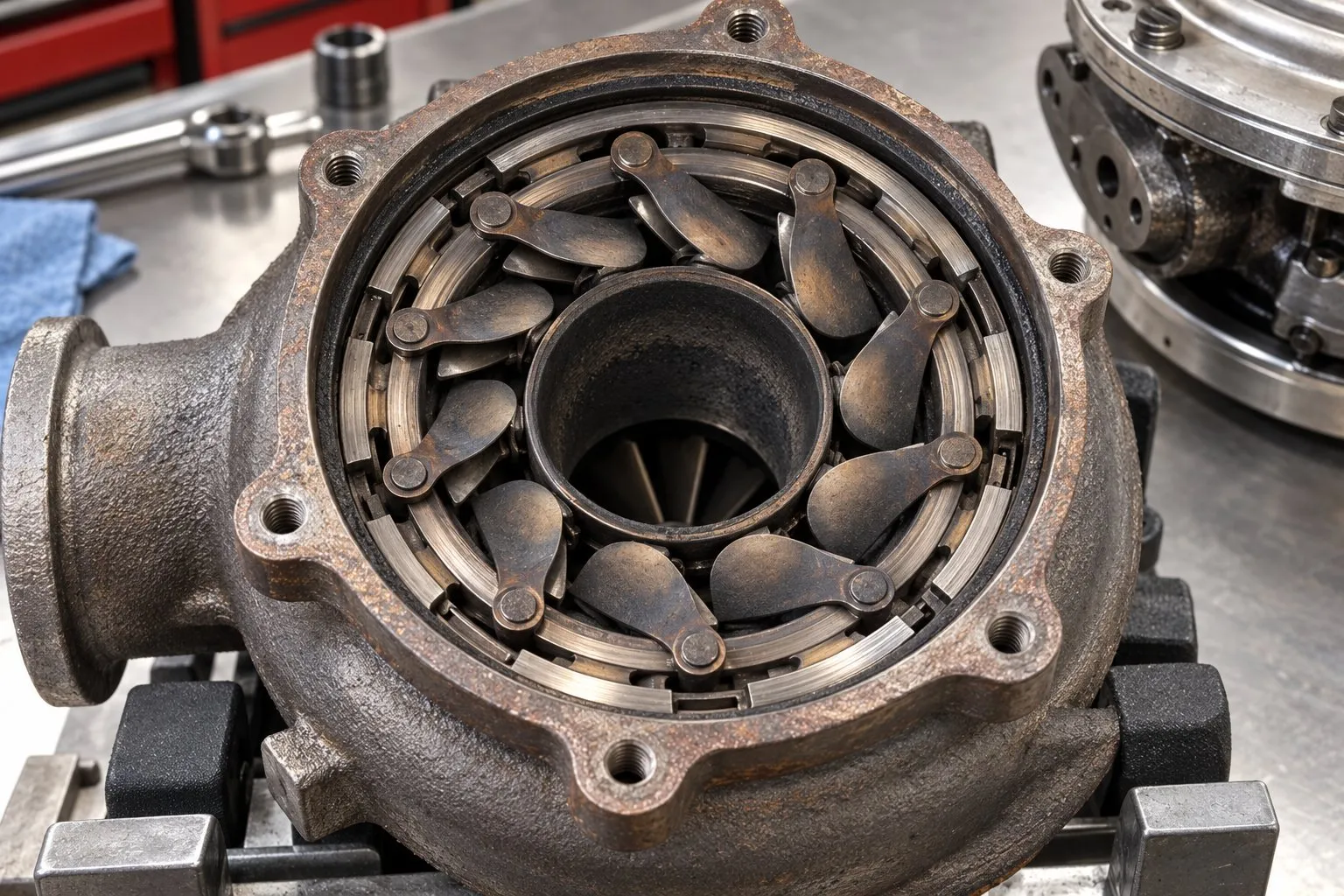
On the 6.0L, the two most common complaints we hear trace back to the oil-operated vane mechanism and to the oil supply itself. Soot and varnish build around the unison ring and vanes, which drags the mechanism and shows up as sluggish spool, surging, or low boost. Because the vanes are moved by oil, clean oil at the right level is not optional; most turbo failures on any engine trace back to the oil supply.
The 6.0L has no vane position sensor, so there is no commanded-versus-actual reading to chase. Ford sets P0299 on this engine from exhaust backpressure that drifts from the commanded value, while P2262 and P2263 are the boost (MAP) checks that confirm boost rises at high rpm. Our articles on 8 warning signs of 6.0L turbo failure and 6.0L failure symptoms and best options walk through the diagnosis in detail.
On the 6.7L, the story depends on the year. The 2011-2012 GT32 SST shipped with ceramic ball bearings that had a reputation for failing early; later GT32 SST production used steel ball bearings (sources differ on the exact changeover year). The 2015-on GT37 is a journal bearing turbo, so treat it like one: some side-to-side rock at the wheel is normal with no oil pressure, and the condemning tests are in-and-out play you can feel or wheel contact with the housing. Across all of the 2011-2019 trucks, the same soot-and-oil fouling of the vane mechanism applies, since that side still runs on engine oil. Note that all of these engines use high-pressure EGR, so exhaust gas is returned to the intake after the compressor; EGR soot fouls the vanes only through extra combustion soot, it does not pass back through the turbine.
Cost: rebuild versus replace
Both platforms are strong candidates for a quality rebuild because the cartridge, vanes, bearings, and seals are serviceable. A rebuilt unit returns the turbo to spec at a fraction of the cost of chasing a fault with guesswork. We confirm the rebuild price after inspection and before any work starts, and our published turbo rebuild price list shows what we charge by model.
| Factor | Remanufactured turbo | Rebuild your core |
|---|---|---|
| Downtime | Ships ready to bolt on | You send the core, we return it |
| Turnaround | In-stock ships same day before 2 PM Pacific | Most rebuilds ship in 3 days or less |
| Core | 30-day core return | Your own unit comes back |
| Warranty | 12 months, unlimited mileage | 12 months, unlimited mileage |
We stock both new and remanufactured parts for these platforms. Browse our remanufactured turbochargers or send us your core through our turbo rebuild service. For current pricing on a specific unit, check the product page or call (909) 824-1020.
Upgrade path
The 6.0L has a clean factory-style upgrade. Garrett sells a PowerMax GT3788VA turbocharger as a drop-in for the 6.0L (772441-5002S and 777469-5002S), which steps the compressor wheel up to 88 mm while keeping the oil-operated VGT architecture. It is a bolt-in path to more airflow without converting to an external actuator. Keep in mind Garrett states its performance kits are not legal for use on public roads.
On the 6.7L, the double-sided GT32 SST and the later GT37 both leave room to move up to a larger single charger or a compound arrangement depending on your fueling and intended use. Because every 6.7L year has its own part number and, from 2020, an electronic actuator that must be calibrated to the turbo, the right upgrade depends entirely on the exact truck. For a broader look at the frames involved, our BorgWarner fitment guide covers the common swap frames. You can also browse the full turbo store or contact PT Turbo with your build goals and we will match a charger to the airflow you actually need.
Turbos we list for the GT3782VA
Listings for the turbo models named in this guide that can be ordered online today. Several part numbers can fit one engine by year and rating, so match the number on your turbo’s tag, or call (909) 824-1020 and we will match it for you.
Frequently Asked Questions
Does the 6.0L Power Stroke turbo have an actuator to replace or calibrate?
No. The 6.0L GT3782VA moves its vanes with engine oil through a PCM-driven VGT solenoid. There is no electric actuator and no vane position sensor, so there is nothing to calibrate on the turbo itself. Keep the oil clean and the solenoid working, and address vane fouling at the cartridge.
Is the 6.7L Power Stroke turbo a BorgWarner?
No. Every 6.7L Power Stroke turbo is a Garrett: the GT32 SST on 2011-2014 trucks, the GT37 from 2015, and an electronically actuated Garrett from 2020. BorgWarner built the compound pair on the 6.4L, which is a different engine entirely.
How do I order the correct 6.7L turbo for my year?
Match the number stamped on the turbo’s data plate, not the engine name. Pickups and cab-and-chassis trucks use different units, and the 2011-2014, 2015-2016, 2017-2019, and 2020-on turbos all carry different part numbers. Send us the tag number and we will confirm the exact fit.
Need a Turbocharger?
PT Turbo has rebuilt and sold turbochargers since 1978. We stock remanufactured units for Cummins, Duramax, Power Stroke, Detroit Diesel, and more — backed by a 12-month unlimited mileage warranty. Units in stock at our shop in San Bernardino, CA ship the same day when ordered before 2 PM Pacific, Monday through Friday.
📞 (909) 824-1020 · 346 S I St. #3, San Bernardino, CA 92410 · [email protected]