Komatsu SA6D Series Engine Turbocharger Guide: Full Application Reference
This Komatsu SA6D series engine turbocharger guide maps each SA6D and SAA6D engine family to the turbo it carries, explains which engines are really Cummins designs under a Komatsu name, and shows where the Komatsu-built engines go their own way. If you run dozers, excavators or wheel loaders, the engine plate tells you a lot, but the number on the turbo tag settles the order. PT Turbo has rebuilt turbochargers since 1978, and getting heavy equipment fitment right is a large part of that work.
Reading the Komatsu Engine Designation
Komatsu engine names follow a pattern. The leading letters describe the induction: S marks a turbocharged engine, A marks aftercooling, and the double A on later engines generally marks air-to-air aftercooling. The digit gives the cylinder count, D means diesel, and the number after it identifies the engine series.
The series number matters more than the prefix when you hunt for a turbo. An SA6D125 and an SAA6D125E-5 share a family name but sit years apart in emissions level and turbo hardware. The suffix after the series (E, E-2, E-3, E-5 and so on) marks the generation, and the turbo can change between generations.
The other point to grasp early: several Komatsu engine series are Cummins engines. The 102, 107 and 114 series are Cummins B-series, QSB6.7 and C-series / QSL9 engines, so their turbos are Holset. The 125 and 140 series are Komatsu’s own designs and carry Komatsu KTR-series turbos on the later versions.
Turbochargers by Komatsu Engine Series
The table below sorts the SA6D and SAA6D families by engine origin and turbo type. It gives no wheel sizes or ratings because those change by part number. Use it to narrow the search, then confirm against the tag.
| Komatsu series | Engine origin | Turbo family | Turbine control | Typical machine class |
|---|---|---|---|---|
| S4D102 / S6D102 | Cummins 4BT / 6BT | Holset HX30 (4-cyl), HX35 (6-cyl) | Fixed geometry | Match by tag |
| SAA6D107E | Cummins QSB6.7 | Holset HX35W (Tier 3); sliding nozzle VGT on Tier 4 | Wastegate (Tier 3); variable geometry (Tier 4) | Match by tag |
| SAA6D114E | Cummins 8.3 / 8.9 (QSL9) | Holset; Komatsu KVGT on Tier 4 machines | Fixed or wastegated earlier; variable geometry (Tier 4) | Match by tag |
| 95 / 108 series (older) | Komatsu | BorgWarner S2B / S2D / S3A replacements | Fixed geometry | 108 series: PC300 class |
| SA6D125 / SAA6D125E-5 | Komatsu | KTR90 on SAA6D125E-5; S-series replacements on older 125 | By generation and tag | PC400 class |
| SAA6D140E-5 | Komatsu | KTR110 | By generation and tag | Match by tag |
Cummins-Built Series: 102, 107 and 114
The S4D102 and S6D102 are the Cummins 4BT and 6BT. The four-cylinder engine runs a Holset HX30 and the six-cylinder a Holset HX35, both fixed geometry. Many HX35 numbers exist for different ratings and housings, so a 6BT truck turbo is not automatically right for a Komatsu machine. Our Holset HX35 fitment guide covers how those numbers split.
The SAA6D107E is the Cummins QSB6.7. In Cummins’ industrial line the Tier 3 version carries a Holset HX35W, the W marking a wastegate. The Tier 4 industrial QSB6.7 moves to a single sliding nozzle variable geometry turbo, listed as the Holset HE300VG or the Holset HE341VE, both with an electronic actuator. No QSB6.7 runs a two-stage turbo.
The SAA6D114E is the Cummins 8.3 / 8.9 family, the SAA6D114E specifically matching the QSL9. Earlier engines in this family carry Holset turbos; in Holset’s own listings the 8.3L C-series is an Holset HX40 engine. Tier 4 Komatsu machines with this engine use Komatsu’s own variable geometry turbo, the KVGT, which Komatsu moves hydraulically rather than with an electronic or air actuator.
Komatsu-Built Series: 95, 108, 125 and 140
Komatsu’s own larger engines carry Komatsu KTR-series turbos on the E-5 generation: the KTR90 on the SAA6D125E-5 and the KTR110 on the SAA6D140E-5. These are not Holset units. If someone quotes you an HX55 for an SAA6D125, the quote is wrong.
For the older 95, 108 and 125 series, BorgWarner S-series turbos serve as replacements, including the BorgWarner S2B, BorgWarner S2D and BorgWarner S3A. The 108-series engine sits in the PC300 class of excavators and the 125 series in the PC400 class. Which S-frame fits depends on the engine version, so the tag decides.
Holset and BorgWarner are separate companies. Holset belongs to Cummins and has operated as Cummins Turbo Technologies since 2006; it was never part of BorgWarner. Any listing that reads “Holset (BorgWarner)” is mixing up two makers.
Turbos we list for the HX35, HX30 and HX35W
Listings for the turbo models named in this guide that can be ordered online today. Several part numbers can fit one engine by year and rating, so match the number on your turbo’s tag, or call (909) 824-1020 and we will match it for you.
Why Komatsu Machine Turbos Fail
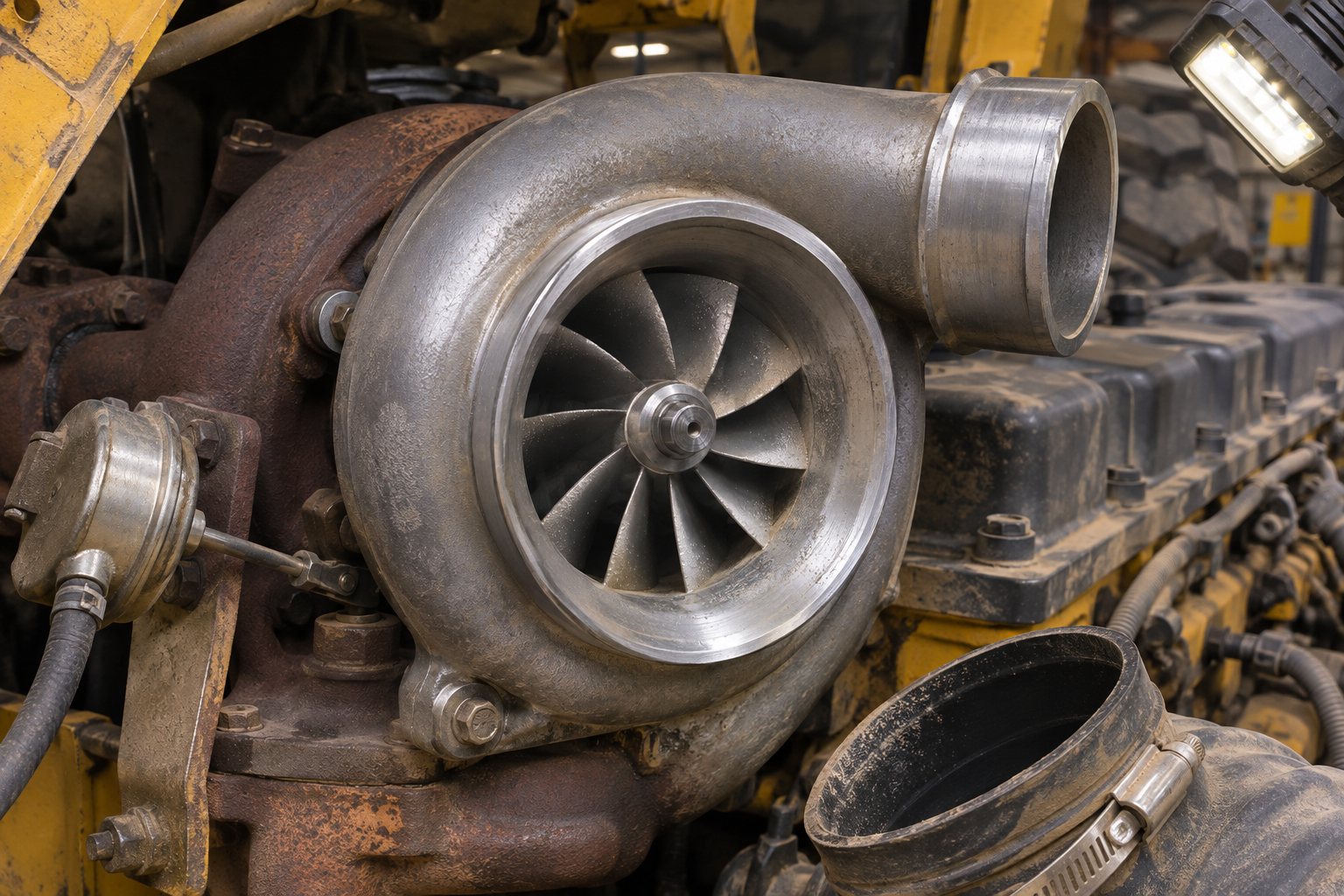
Heavy equipment turbos die the same ways highway turbos do, only with more dust and more idle time. Garrett states that more than 90 percent of turbo failures come from oil starvation or oil contamination, with foreign objects the third main cause. On a machine that works in dirt all day, the air side earns equal attention.
- Dust ingestion: fine dust shows up as pitting on the compressor inlet blades. The intake pipe ahead of the turbo is under suction, so a crack or loose clamp there pulls in unfiltered air rather than leaking boost. Replace the air filter when the restriction indicator says so, not by guesswork.
- Impact damage: bent or chipped compressor blades point to a solid object, often a piece of a failed filter element or hardware left in the intake.
- Oil starvation: low oil pressure, a blocked or leaking feed line, or a first start without priming. Hard acceleration from cold is another trigger.
- Contaminated oil: carbon, engine wear debris and dirt let in during service score the journal bearings. Copper in an oil report is the bearing wear metal to watch, compared against your own baseline and the lab’s limits.
- Hot shutdown: stopping a machine right after heavy work cokes oil in the center housing. Holset’s failure diagnosis poster calls for two to three minutes at idle before shutdown; where Komatsu’s operation manual gives its own figure, follow it.
- Restricted drain or crankcase pressure: a kinked drain or high blow-by pushes oil past the seals at both ends. The drain is gravity fed and must run downhill into the pan above the oil level.
Blue-gray smoke or oil in the charge pipes is usually not a failed seal. A light oil film from crankcase ventilation is normal; pooled oil is not. Check the breather, air filter restriction, oil level and drain before you condemn the turbo.
On Tier 4 variable geometry units, sticking from carbon and varnish shows up as boost faults and derates. Komatsu machines report through their own monitor and fault codes rather than OBD-II P-codes, so read the machine’s code list against the Komatsu shop manual. For background on how the vane and nozzle designs differ, the variable-geometry turbocharger overview is a useful primer.
Inspection and Installation Checks
Before you order, inspect what you have. Some side-to-side shaft movement is normal on a journal bearing turbo with no oil pressure. Condemn it for in-and-out play you can feel, a wheel that touches its housing, or play beyond the maker’s limit. Axial play on a journal bearing turbo typically runs 0.001 to 0.004 in.
When the new or rebuilt turbo goes on, follow the maker’s first-start steps:
- Replace the oil feed line after a bearing failure rather than flushing and reusing it.
- Use new gaskets on the oil inlet and drain, with no sealant.
- Fill the oil inlet with clean engine oil and turn the wheel by hand.
- Crank 10 to 15 seconds without starting, keeping the engine from firing by the procedure in Komatsu’s shop manual.
- Start and idle 3 to 4 minutes, checking for oil, air and exhaust leaks before putting load on it.
If the old compressor wheel broke up, replace the aftercooler. Metal in the fins cannot be flushed out reliably, and debris left in it goes straight into the engine. Inspect and clean or replace the charge piping at the same time.
Rebuild or Replace: Ordering by the Tag
The most reliable order starts with the data plate. Holset tags sit on the compressor housing and show the Holset assembly number and the customer number (Komatsu’s number on these machines) as separate fields. BorgWarner tags also sit on the compressor housing and carry the BorgWarner part number and serial. Casting numbers on the housings only narrow the search, because one casting serves many turbos.
The Komatsu listings in our catalog are new units. Search the PT Turbo store by the number on your tag; current pricing is on each product page, or call (909) 824-1020. For KTR-series turbos and anything not listed, send us the tag number through the contact page and we will quote by part number.
When a replacement is hard to source or the core is sound, our in-house turbocharger rebuild service is often the better path. Every turbo we rebuild is VSR balanced and gets a final quality inspection, including a leak test and an actuator or wastegate function check. Most rebuilds ship in 3 days or less, the price is confirmed after inspection and before work starts, and the turbo rebuild price list shows our rates by turbo. Rebuilds carry a 12 month warranty with unlimited mileage, and fleet and equipment customers can arrange priority turnaround by phone.
Family-owned in San Bernardino for more than 45 years, PT Turbo works on Holset, BorgWarner, Garrett and IHI units every day. Good oil, clean air and a careful install give any of these turbos the best chance at a long service life.
Frequently Asked Questions
Is the turbo on a Komatsu SAA6D125 a Holset HX55?
No. The SAA6D125E-5 carries a Komatsu KTR90, a Komatsu KTR-series turbo, not a Holset. Older 125-series engines are commonly serviced with BorgWarner S-series replacements such as the S2B, S2D or S3A, chosen by the number on the original tag.
Can I use a Cummins truck or industrial turbo on a Komatsu 107 or 114 engine?
The base engines are Cummins designs, but turbo part numbers differ by rating, housing and emissions level, and Tier 4 Komatsu machines with the 114 engine use Komatsu’s hydraulically moved KVGT. Do not assume a turbo from another Cummins application fits. Match the Holset assembly number or the Komatsu number on the tag.
How long should a Komatsu machine idle before shutdown?
Holset’s failure diagnosis guidance calls for two to three minutes at idle before shutdown after work. If your Komatsu operation manual gives a different cool-down figure, use the manual. Shutting down hot cokes oil in the center housing and shortens bearing life.
Need a Turbocharger?
PT Turbo has rebuilt and sold turbochargers since 1978. We stock remanufactured units for Cummins, Duramax, Power Stroke, Detroit Diesel, and more — backed by a 12-month unlimited mileage warranty. Units in stock at our shop in San Bernardino, CA ship the same day when ordered before 2 PM Pacific, Monday through Friday.
📞 (909) 824-1020 · 346 S I St. #3, San Bernardino, CA 92410 · info@ptturbo.com