Toyota 2KD-FTV 2.5L Turbocharger Guide: Hiace, Hilux & Fortuner Replacement
This Toyota 2KD-FTV 2.5L Turbocharger Guide covers everything a mechanic, fleet manager, or owner-operator needs to diagnose, service, and replace the turbocharger on Toyota’s popular 2.5-liter common-rail diesel. Fitted across the Hiace, Hilux, and Fortuner from the early 2000s onward, the 2KD-FTV has moved millions of vehicles across Asia, Africa, the Middle East, Australia, and beyond. When the turbo starts failing, downtime costs money, so getting the diagnosis and the part right the first time matters.
At PT Turbo we have been rebuilding and supplying turbochargers since 1978, more than 45 years of hands-on experience with exactly these small-frame diesel units. Below is the practical, no-nonsense breakdown of the 2KD-FTV turbo system, common failure points, and how to source the right replacement.
Toyota 2KD-FTV Engine and Turbo Overview
The 2KD-FTV is a 2.494-liter (2,494 cc) inline-four, common-rail direct-injection diesel with a belt-driven DOHC 16-valve head. Depending on market and model year, it produces roughly 66 to 107 kW (88 to 144 hp) and 192 to 343 Nm of torque.
Two distinct turbo strategies were used across the production run, and knowing which one you have is critical before ordering parts:
- Fixed-geometry turbo with wastegate – Early and lower-output 2KD-FTV variants used a conventional wastegated turbo, typically a Toyota CT16 unit. Boost is regulated by a pneumatic actuator against a spring.
- Variable-geometry turbo (VNT/VGT) – Higher-output D-4D versions used a variable-geometry turbocharger, sold under Toyota number 17201-0L070. Toyota documents an electric motor drive for the vanes on the 1KD-FTV; on a 2KD-FTV confirm the actuator on the turbo itself before ordering parts.
The fixed-geometry CT16 is simpler and more forgiving. The variable-geometry CT16V delivers better low-end response and cleaner emissions but is far more sensitive to soot buildup, oil quality, and actuator condition. Most of the failures we see in the shop are on the VNT units.
Common 2KD-FTV Turbocharger Failure Symptoms
The 2KD-FTV turbo rarely dies without warning. Catching the early signs saves the engine from a catastrophic bearing failure that can send debris through the intake. Here is how symptoms typically progress by severity.
| Severity | Symptom | Likely Cause |
|---|---|---|
| Early | Sluggish acceleration, delayed boost, mild power loss | Sticking VNT vanes from soot, actuator drift, boost leak |
| Early | Intermittent limp mode, boost pressure fault codes | Failing actuator, stuck vanes, faulty boost sensor |
| Moderate | Whistling or whining that changes with RPM | Compressor wheel damage, worn shaft bearings, leaking seals |
| Moderate | Blue smoke on acceleration, rising oil consumption | Turbo oil seal failure, oil passing into intake or exhaust |
| Severe | Loud grinding, excessive shaft play, oil in intercooler | Bearing failure, worn journal, imminent total failure |
| Severe | Complete loss of boost, heavy smoke, metal debris | Wheel contact, shaft breakage, catastrophic failure |
On VNT-equipped 2KD-FTV engines, many “turbo” complaints are actually stuck vanes or a tired actuator, not a failed cartridge. Before condemning a whole unit, check the actuator and vane movement. Replacing an actuator is far cheaper than a full turbo if the core is still healthy.
The Actuator: The Most Common Culprit
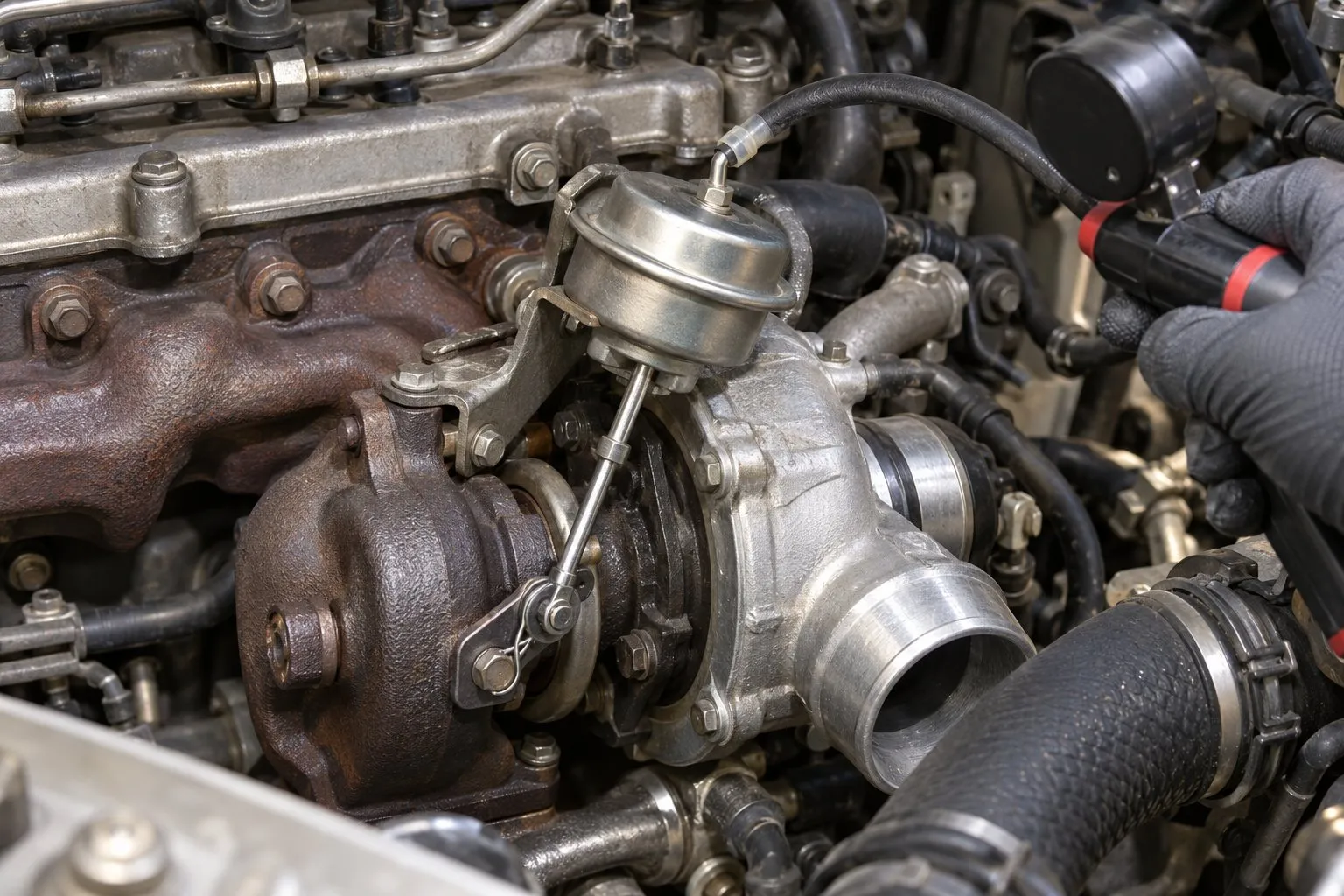
On the wastegated CT16, the pneumatic actuator sets wastegate position and takes constant heat cycling right next to the exhaust housing. Diaphragms fatigue, rods seize, and calibration drifts over time. On the variable nozzle CT16V the actuator and its position sensor fail instead. When either can no longer hold its position accurately, you get underboost, overboost, or limp mode, often with no internal turbo damage at all.
Send us the number on your turbo and we will check whether its actuator is available on its own. Matching the right actuator to your exact turbo part number is essential because the rod length, spring rate, and calibration must be correct.
If you are not sure which actuator matches your turbo, send us your turbo part number and we will confirm the correct part before you buy. Reach the team through the PT Turbo contact page.
What Causes 2KD-FTV Turbos to Fail
Understanding root cause prevents a repeat failure. Bolting on a new turbo without fixing the underlying problem is the fastest way to kill a second one.
Oil supply problems
Turbo bearings live and die on clean, pressurized oil. Extended oil intervals, cheap oil, or a partially blocked feed line cause the journal bearings to wear and the shaft to develop play. Coked oil in the center housing is a classic 2KD-FTV killer, especially when the engine is shut down hot without a brief cool-down.
Soot and carbon on VNT vanes
The variable-geometry mechanism relies on free-moving vanes. Carbon and soot from the exhaust and from EGR flow gradually gum up the vane ring until it sticks. This drives boost faults and, on markets fitted with a diesel particulate filter, worsens regeneration issues.
Foreign object damage
A torn air filter, a loose intake clamp, or debris left in the piping after service can shatter the compressor wheel. Always inspect the intake tract before fitting a replacement.
Overboost from a failing actuator or sensor
A leaking actuator diaphragm or a faulty boost sensor can push the turbo past its design limits, overspeeding the wheel and destroying the bearings. This ties directly back to keeping the actuator in good condition.
Replacement Options: New vs Remanufactured
When the core is genuinely finished, you have three routes: a brand-new turbo, a quality remanufactured unit, or a professional rebuild of your existing core. Each has a place depending on budget and downtime.
| Option | Typical Cost | Best For | Notes |
|---|---|---|---|
| New OEM turbo | Highest | Warranty-critical fleet vehicles | Longest life, highest upfront cost |
| Remanufactured turbo | Moderate | Best value for most owners | New wheels, bearings, seals; balanced and tested |
| Rebuild your core | Lowest | When your housing is in good shape | Keeps your original casting, fast turnaround |
| Actuator only | Very low | Core is healthy, actuator failed | Fixes many boost faults |
A properly remanufactured turbocharger from PT Turbo uses new bearings, seals, and wheels, and every unit is balanced and tested before it ships. For shops that want to keep the original core, our turbo rebuild service restores your unit to spec with a fast turnaround.
If your Toyota also runs the larger 3.0-liter diesel, our companion Toyota 1KD-FTV 3.0L turbocharger guide covers the Hilux, Land Cruiser Prado, Fortuner and HiAce applications in the same detail.
Installation and First-Start Tips for the Toyota 2KD-FTV 2.5L Turbocharger Guide
Getting a new or reman turbo installed correctly is half the battle. Follow these steps to protect your investment and avoid a warranty comeback.
Before anything bolts up, prime the new turbo with clean engine oil through the feed port and turn the shaft by hand to coat the bearings. Replace the oil feed line rather than reusing an old one, because coked debris in the original line will starve the new unit within minutes. Flush or renew the oil cooler and drain line as well, and always fit a fresh air filter and inspect the intake tract for debris before closing it up.
On first start, crank with fueling disabled until oil pressure registers, then idle the engine for three to five minutes to establish flow before touching the throttle. Watch for leaks at the oil and coolant connections and listen for any abnormal noise. Avoid hard loading until the engine is at full operating temperature; a new turbo needs no special break-in.
The single most important habit is a short cool-down before shutdown after hard running. Letting the turbo idle for a minute or two lets the oil carry heat away from the center housing and stops the coking that killed the unit you just replaced. On VNT engines, periodically exercising the vanes under load also helps keep soot from locking them up again.
Frequently Asked Questions
What are the common symptoms of a failing 2KD-FTV turbocharger?
Common signs include loss of power, excessive black or blue smoke, whistling or whining noises, and increased oil consumption. Boost pressure faults and limp mode are also frequent indicators.
Which Toyota models use the 2KD-FTV 2.5L turbocharged engine?
The 2KD-FTV is fitted across the Toyota Hiace, Hilux, and Fortuner from the early 2000s onward. It has been widely used in Asia, Africa, the Middle East, and Australia.
Can I replace the 2KD-FTV turbocharger myself?
Experienced mechanics can replace it with the right tools and precautions, such as priming the new turbo with oil. However, proper diagnosis of the root cause is essential to prevent repeat failures.
Need a Turbocharger?
PT Turbo has rebuilt and sold turbochargers since 1978. We stock remanufactured units for Cummins, Duramax, Power Stroke, Detroit Diesel, and more — backed by a 12-month unlimited mileage warranty. Units in stock at our shop in San Bernardino, CA ship the same day when ordered before 2 PM Pacific, Monday through Friday.
📞 (909) 824-1020 · 346 S I St. #3, San Bernardino, CA 92410 · [email protected]
More From PT Turbo
 Mitsubishi TD06 Turbocharger: Marine, Industrial & Performance Applications
- Mercedes OM651 Turbocharger Guide: Sprinter 2.1L CDI Failure Symptoms & Replacement
- Holset HE300VG Turbocharger: Variable Geometry Operation & Replacement Guide
- Borg Warner Turbochargers: Performance, Reliability & Fitment Guide