Stock vs Performance Turbocharger for 6.0L Powerstroke: Real-World Comparison
When you weigh a stock vs performance turbocharger for 6.0L Powerstroke, the honest answer depends on how you use the truck, what it tows, and whether you are chasing reliability or power. The factory unit and the common upgrade share the same basic design and bolt to the same pedestal, so the real differences come down to the compressor wheel, how hard you plan to push the engine, and what you are willing to manage downstream.
PT Turbo has been rebuilding turbochargers since 1978, and in that time the 6.0L Power Stroke has become one of the most familiar trucks on the bench. This guide breaks down what the stock charger is, what a performance charger actually buys you, and how to decide without wasting money on power you cannot use.
What the stock 6.0L Power Stroke turbo really is
The factory turbo on the 6.0L is a Garrett variable geometry unit cataloged as the GT3782VA (also listed as GT37VA). The last two digits in a Garrett GT name are the compressor wheel’s outer (exducer) diameter in millimeters, so the GT3782 carries an 82 mm compressor wheel.
Its vanes are moved by engine oil through a PCM-driven VGT control solenoid. There is no electric actuator and no vane position sensor on this turbo, which is why you will not see commanded-versus-actual vane position data or codes like P003A and P2563 on a 6.0L. When the vanes stick, it is almost always from carbon and oil varnish in the unison ring and cartridge, not from a failed actuator.
Ford used the GT3782VA across the 2003-2007 Super Duty, the 2003-2005 Excursion, and the 2004-2010 E-Series vans. The part number changed over the run:
- 725390 on 2003-2004 trucks
- 743250-5024 on 2004-2005 units, including Excursion and E-Series
- 743250-5025 on 2005-2010 units, including the E-350 and E-450
Because the numbers overlap by year and body, always match the number stamped on the data plate rather than ordering by model year alone. The casting numbers on the housings are not part numbers, so they only narrow the search.
What a performance turbo adds, and what it costs you
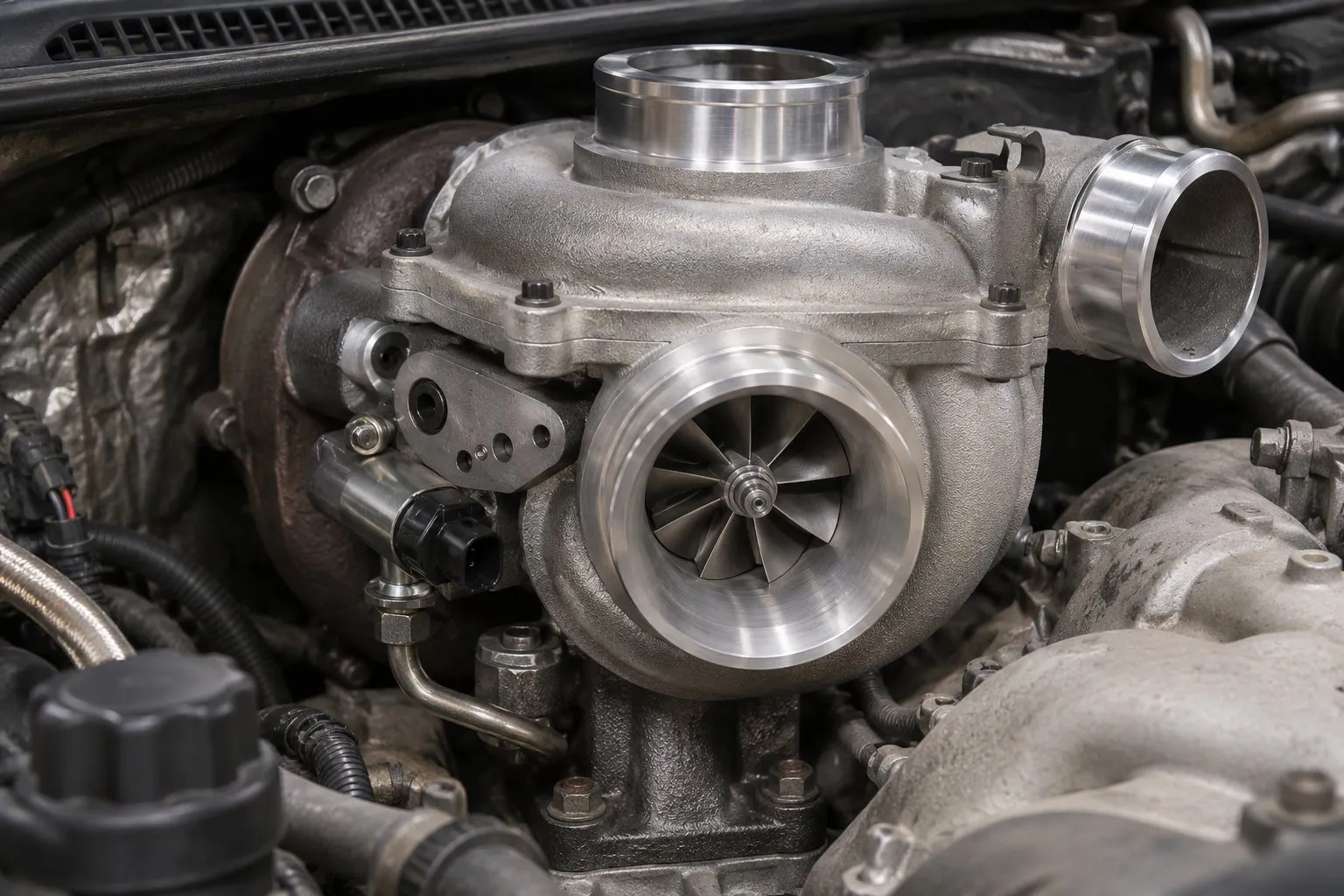
The most direct upgrade is Garrett’s PowerMax GT3788VA, offered under numbers 772441-5002S and 777469-5002S. The GT3788 name tells you the story: an 88 mm compressor wheel in place of the stock 82 mm. It keeps the same oil-driven variable geometry layout, so it responds and spools much like the factory charger while flowing more air up top.
That larger wheel moves more air at higher rpm, which supports more fuel without choking the engine or driving exhaust gas temperature through the roof. On a diesel, exhaust temperature rises with more fuel or less air, so adding airflow is exactly what lets you run bigger tunes and heavier loads with more headroom. For a complete look at how these variable geometry turbochargers work, the charger is only one piece of the system.
The trade-off is that a performance charger assumes the rest of the engine is sorted. Bigger airflow only pays off with supporting fuel, healthy injectors, a quality tune, and the usual 6.0L reliability work behind it. Dropping a larger turbo onto a tired engine does not fix the underlying problems, and it can expose them faster.
Stock and performance 6.0L turbos side by side
| Feature | Factory GT3782VA | PowerMax GT3788VA |
|---|---|---|
| Compressor wheel | 82 mm | 88 mm |
| Vane control | Engine oil via VGT solenoid | Engine oil via VGT solenoid |
| Vane position sensor | None | None |
| Best for | Stock to mild tune, daily use, towing at factory power | Larger tunes, heavier towing, more fuel supported |
| Spool feel | Quick, factory response | Near factory response, more top-end air |
| Supporting mods needed | Minimal | Fuel, tune, and 6.0L reliability work |
Note that the GT3794VA, with a 94 mm wheel, is not a Power Stroke turbo. The GT37 variable geometry family (GT3782VA, GT3788VA, GT3794VA) differs mainly by that compressor wheel, so stay inside the fitment that actually belongs on the 6.0L.
How they drive in the real world
For a stock or lightly tuned truck that tows at or near factory power, the GT3782VA is the right tool. The 6.0L left the factory at 325 hp and 560 lb-ft in 2003-2004, with torque bumped to 570 lb-ft from 2005, and the factory charger is sized for that. A clean, properly functioning stock unit spools fast, holds boost on grades, and keeps exhaust temperature in check for daily work.
Where owners feel the limits is under sustained heavy load with a more aggressive tune. Push enough fuel and the 82 mm wheel runs out of air, exhaust temperatures climb, and the truck feels like it is working harder than it should near the top of the rpm band. That is the point where the extra airflow of the 88 mm wheel starts to matter.
Both chargers depend on the same oil supply and the same VGT solenoid, so neither is a cure for vane sticking. If your truck is losing boost and building backpressure, the problem is often carbon locking the vanes, a lazy solenoid, or an EGR and cooler issue, not a wheel that is too small. Our guide on the 8 warning signs of 6.0L turbo failure walks through how to tell them apart.
Diagnosing before you upgrade
Before spending on a performance charger, confirm the stock one is actually the weak link. On the 6.0L, Ford sets P0299 from exhaust backpressure that drifts too far from the commanded value, while P2262 and P2263 are the MAP-based checks that boost rises at high rpm. Those codes point at the turbo, the EGR system, and the exhaust side together, so read them in context.
Low boost on a 6.0L usually traces back to sticking vanes, a weak VGT solenoid, worn turbo bearings, or leaks in the exhaust path ahead of the turbine. A leak in the up-pipes lets exhaust escape before the turbine, which gives low boost and slow spool without raising backpressure. None of that is fixed by a bigger wheel.
Keep in mind the 6.0L runs high-pressure EGR, so exhaust gas is returned to the intake after the compressor. EGR soot never passes the turbine or reaches the compressor wheel, and a leaking EGR cooler puts coolant into the intake and cylinders, showing as white smoke, and after shutdown it can also seep into the exhaust manifold and the turbo. If you want the background, the EGR system is a frequent culprit on these trucks and is worth checking before you blame the charger.
New, remanufactured, or rebuilt
Whichever path you choose, you have three ways to buy. PT Turbo stocks both new and remanufactured turbochargers and rebuilds in-house in San Bernardino, California.
- New: a factory-fresh GT3782VA or the PowerMax GT3788VA upgrade, ideal when you want zero question marks on condition.
- Remanufactured: a balanced, bench-finished unit at lower cost than new. See our remanufactured turbochargers, with a 30-day core return.
- Rebuilt: send us your core and we restore it. Our turbo rebuild service covers bearings, seals, and thrust parts, with most rebuilds shipping in 3 days or less.
For rebuild pricing by turbo model, check our turbo rebuild price list rather than guessing. New and PowerMax pricing is on each product page, or call us at (909) 824-1020. Every rebuild and reman carries a 12-month unlimited-mileage warranty.
Replacement notes that save you grief
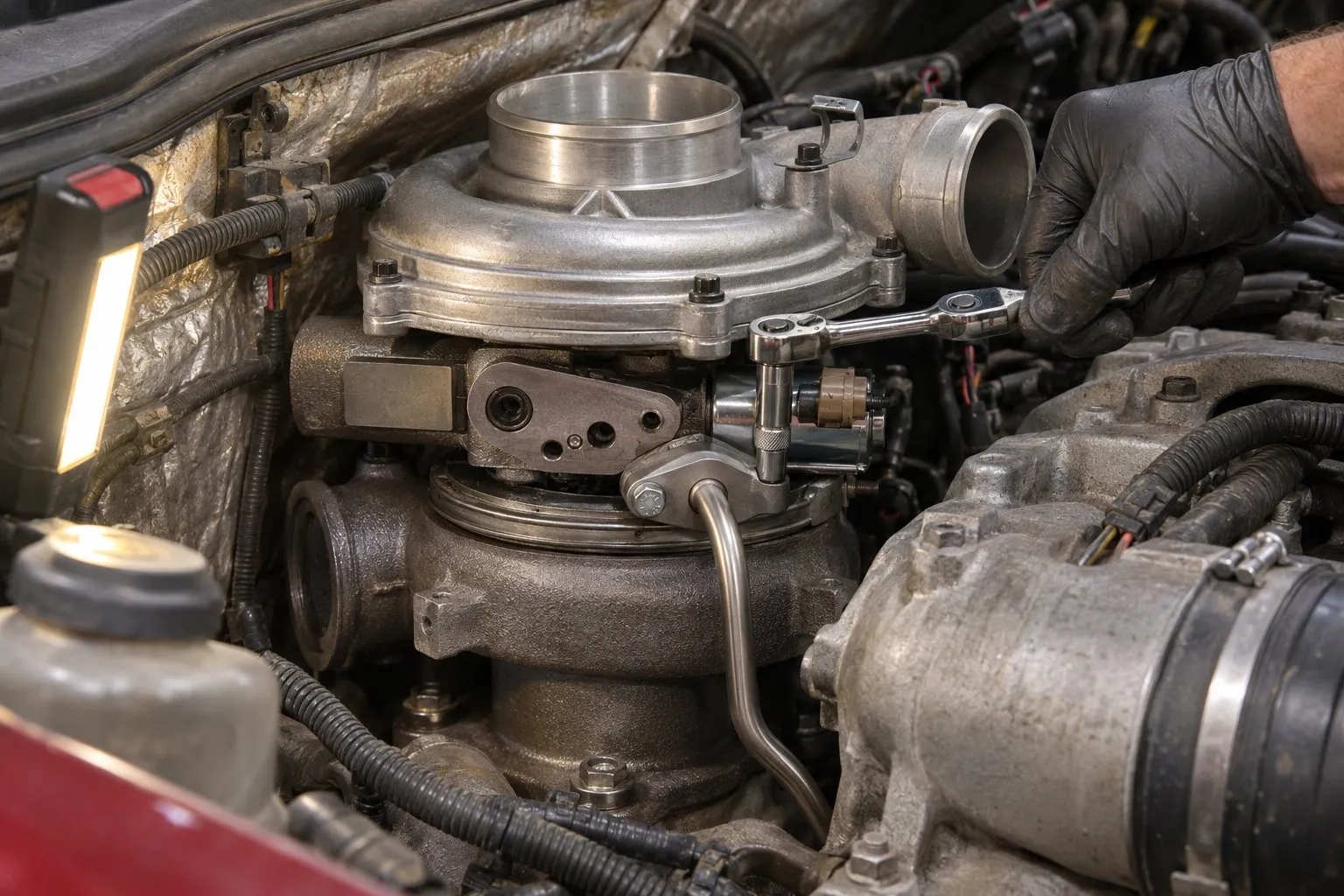
The 6.0L turbo sits on a pedestal at the rear of the engine valley, and the pedestal stays on the engine during removal. On reassembly, the three turbo-to-pedestal bolts are tightened to 28 ft-lbs, the oil feed tube bolts to 18 ft-lbs, and the V-band clamps to roughly 89 to 106 in-lbs depending on the source. The oil feed is a two-bolt flange, not a banjo fitting.
You will reach most of it with a 10 mm socket for the pedestal bolts and oil supply line, 11 mm for the clamps, and 8 mm for the degas bottle, with no Torx needed. Plan on new exhaust clamps, fresh drain tube O-rings, and a new oil feed gasket. After any bearing failure or coked oil, replace the oil feed line rather than reusing it.
For first start, follow the maker’s steps: fill the oil inlet with clean engine oil, turn the wheel by hand, then crank or idle a few minutes before putting it under load. There is no break-in mileage schedule and no first-miles boost limit to worry about. For deeper replacement detail, see our full write-up on 6.0L Power Stroke turbo failure, replacement, and best options.
Turbos we list for the GT3782VA and GT3788VA
Listings for the turbo models named in this guide that can be ordered online today. Several part numbers can fit one engine by year and rating, so match the number on your turbo’s tag, or call (909) 824-1020 and we will match it for you.
Frequently Asked Questions
Is a performance turbo worth it on a stock 6.0L?
If the truck is stock or lightly tuned and tows at factory power, the GT3782VA is the right size and a larger turbo buys you little. The PowerMax GT3788VA pays off once you add fuel and a tune and need more airflow to keep exhaust temperatures in check under heavy load.
Will a bigger turbo fix my low-boost problem?
Usually not. Low boost on a 6.0L is most often sticking vanes, a weak VGT solenoid, worn bearings, or an exhaust leak ahead of the turbine. Diagnose and correct the real cause first, because a larger wheel does not address any of those.
Do I need to match the exact part number for my year?
Yes. The 6.0L used 725390, 743250-5024, and 743250-5025 across overlapping years and body styles, so order by the number on the turbo’s data plate rather than the model year alone. If you are unsure, call us at (909) 824-1020 and we will match it.
Need a Turbocharger?
PT Turbo has rebuilt and sold turbochargers since 1978. We stock remanufactured units for Cummins, Duramax, Power Stroke, Detroit Diesel, and more — backed by a 12-month unlimited mileage warranty. Units in stock at our shop in San Bernardino, CA ship the same day when ordered before 2 PM Pacific, Monday through Friday.
📞 (909) 824-1020 · 346 S I St. #3, San Bernardino, CA 92410 · [email protected]
More From PT Turbo
 BMW B57 Turbocharger Guide: 530d, 730d & X5 40d Single, Twin and Quad Turbo Explained
- Hino J08 Turbocharger Guide: Medium Duty Truck Replacement & Common Failures
- BorgWarner S300 vs S400 vs S480: Which Turbocharger for Your Application?
- Holset HX40 Turbocharger: Specs, Cummins ISC Applications & Replacement