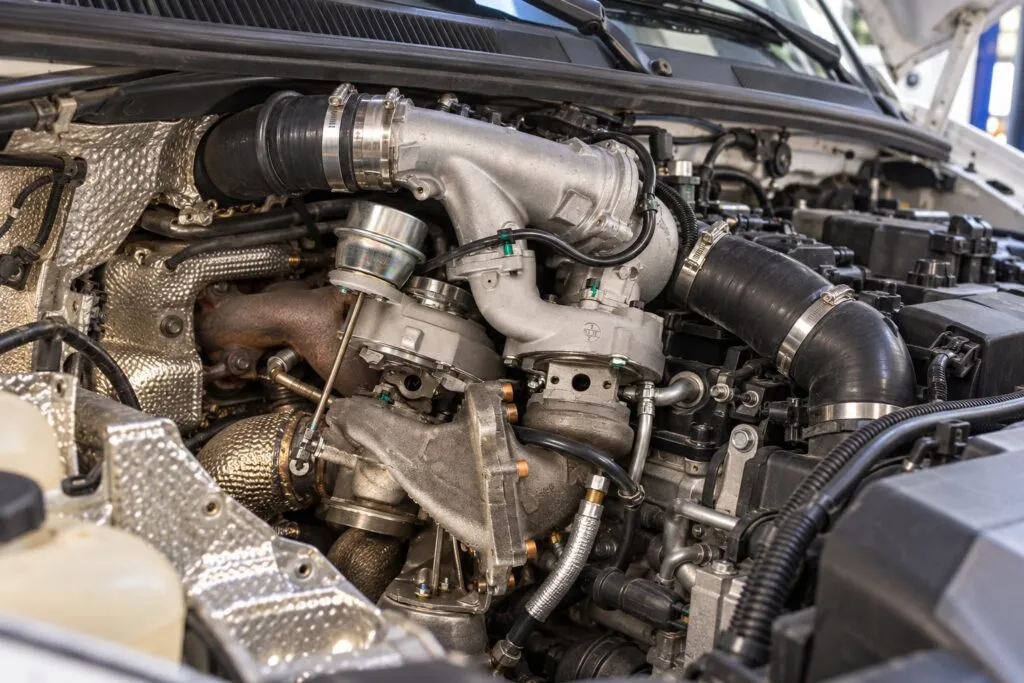
This Mercedes OM651 Turbocharger Guide covers everything a diesel tech or Sprinter owner needs to diagnose, source, and replace the turbo on the 2.1L CDI four-cylinder that powered millions of Mercedes-Benz vans and passenger cars from 2008 onward. The OM651 is a workhorse, but its turbocharging system and the actuators that control it fail in predictable ways once mileage climbs. Knowing the symptoms early saves you a tow, a ruined DPF, and in the worst case a scored cylinder wall from oil ingestion.
At PT Turbo we have been rebuilding and supplying turbochargers since 1978, more than 45 years of hands-on experience with exactly the kind of failures you are chasing on the bench. This guide breaks down the hardware, the failure modes, and your real replacement options.
OM651 Engine and Turbo Overview
The OM651 is a 2.143L inline-four common-rail diesel producing anywhere from roughly 95 hp in detuned commercial trim up to about 201 hp (204 PS) in twin-turbo passenger applications. In North America you will most commonly find it in the 2014-2018 Sprinter 4-cylinder (marketed as the 2.1L CDI), along with European C-Class, E-Class, GLK, Vito, and V-Class models.
Depending on the exact application, the OM651 runs either a single variable-geometry turbo or a two-stage sequential setup with a small high-pressure turbo and a larger low-pressure unit. The single-turbo versions use one turbocharger with a variable-geometry vane pack moved by an actuator.
The actuators, and on two-stage versions the control flaps they move, are the most common point of failure on these engines, which is why we cover it in detail below. If you are dealing with the larger V6 Sprinter, that is a different animal, see our companion Mercedes OM642 Turbocharger Guide instead.
Common OM651 Turbocharger Failure Symptoms
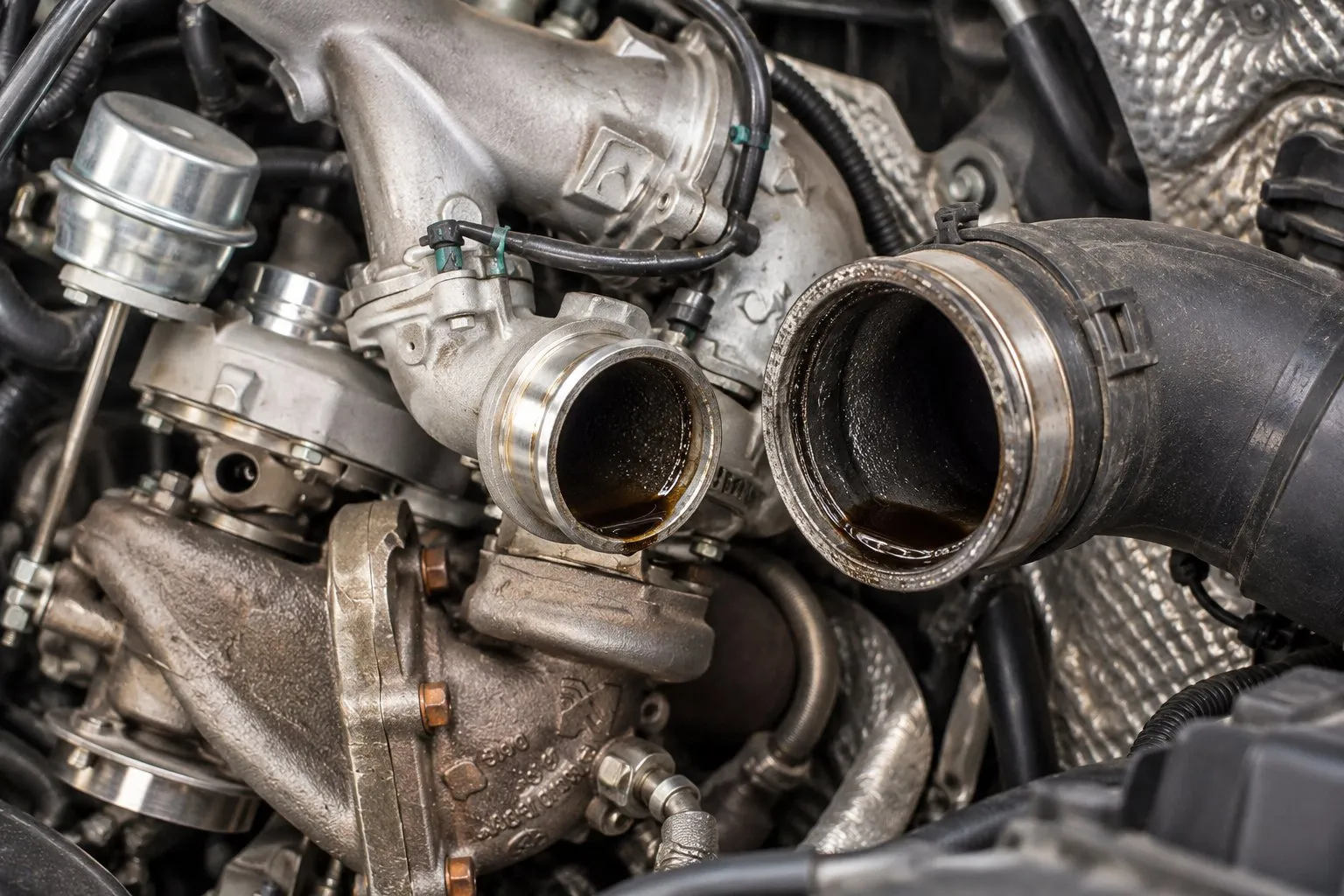
Turbo trouble on the OM651 rarely announces itself all at once. It creeps in as reduced boost, then limp mode, then a hard fault. Catch it in the early stages and you may only need an actuator. Ignore it and you are pulling the turbo.
Watch for these signs, roughly in order of severity:
- Sluggish acceleration and lost boost at highway speeds, especially under load on grades.
- Intermittent limp mode that clears after a restart, a classic sign of a sticking control flap or a lazy actuator, or of sticking VGT vanes on the single-turbo versions.
- Whistling or siren-like noise from the turbo that changes pitch with RPM, a sign of a compressor seal or bearing issue.
- Blue or black smoke under acceleration, oil past the seals or an over-fueling condition from bad boost feedback.
- Check-engine codes such as P0299 (underboost), P2564 (turbo boost control position sensor circuit low), and P0045 (turbo boost control circuit open).
- Oil in the intercooler piping or intake, indicating a failing compressor-side seal.
- Excessive engine oil consumption with no external leak, oil being drawn through the compressor.
Symptom Severity and Likely Cause
| Symptom | Severity | Most Likely Cause |
|---|---|---|
| Slight boost lag, no codes | Low | Sticking actuator or control flap; carboned vanes on single-turbo versions |
| Intermittent limp mode, P2564 | Moderate | Failing actuator or position sensor |
| Persistent P0299 underboost | Moderate to High | Stuck flap or vanes, actuator failure, boost leak |
| Whistle plus oil in piping | High | Worn center bearing, failing seals |
| Blue smoke, high oil use, noise | Critical | Shaft play, imminent turbo failure |
A boost leak or a plugged diesel particulate filter can mimic turbo faults, so smoke-test the charge system and check DPF differential pressure before condemning the turbo. On the OM651 a clogged EGR circuit will also drive underboost and soot complaints.
The Actuators: The Real Weak Point
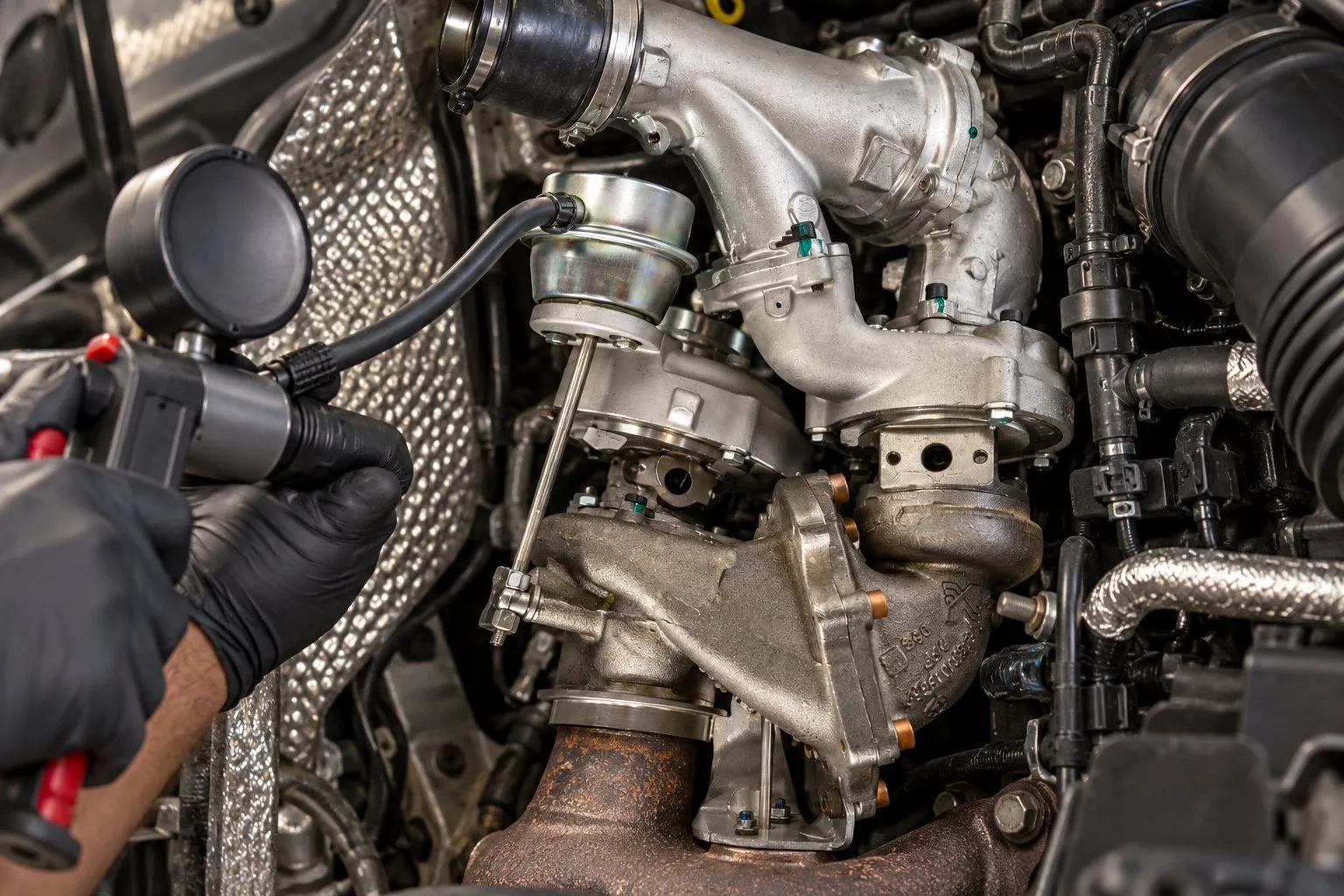
Very often, an OM651 in limp mode with a boost fault is telling you an actuator or a control flap has failed, not the turbo itself. On the two-stage versions, vacuum actuators move the flaps that switch between the small and the large turbo; on single-turbo versions the actuator drives the VGT vane ring. When a diaphragm cracks, a flap sticks, or the calibration drifts, the ECU can no longer command the correct boost and throws it into safe mode.
The good news is that replacing the actuator is far cheaper than replacing the whole turbo, provided the flap or vane mechanism it moves is not seized and the bearings are healthy. Always check that movement by hand before you order.
Matching the correct actuator to your specific turbo casting is critical.
A word of caution: any time you fit a new actuator to a variable-geometry turbo, it must be calibrated. The rod length and stroke set the vane closed and open positions, and getting it wrong will cause the exact underboost or overboost condition you are trying to fix. If you are not set up to bench-calibrate, our turbocharger rebuild service can install and calibrate the correct actuator for your unit.
Mercedes OM651 Turbocharger Guide to Replacement Options
When the actuator is not the culprit, or the center cartridge has shaft play and oil in the housings, you are looking at a full turbo replacement or rebuild. You have three realistic paths, each with a different cost and downtime profile.
| Option | Typical Cost Range | Best For | Notes |
|---|---|---|---|
| Actuator only | see actuator prices | Boost faults with healthy core | Cheapest fix, requires calibration |
| Remanufactured turbo | Quoted by part number | Worn core, best value | OEM core, new CHRA parts, warranty |
| Genuine new Mercedes turbo | Quoted by part number | Warranty-sensitive fleets | Highest cost, dealer only |
For most owner-operators and fleets, a properly remanufactured turbo is the sweet spot. A quality reman uses the original OEM housing and shaft geometry, fits new bearings, seals, a balanced CHRA and, on the variable-geometry versions, a reconditioned vane mechanism. Done right, it performs identically to new at a fraction of the price.
PT Turbo has been remanufacturing to OEM tolerance since 1978, and we stock both new and remanufactured units for the OM651 platform. Browse our remanufactured turbochargers or the full turbo catalog to match your part number. If you cannot find your exact casting, contact PT Turbo with your VIN and turbo number and we will source it.
OM651 Turbo Replacement Tips
Replacing the turbo on a transverse or longitudinal OM651 is not a trivial job, but a few practices separate a repair that lasts from one that fails again in 20,000 miles.
- Find the root cause first. If the turbo failed from oil starvation, replace the oil feed line and clean the drain. A blocked feed will kill your new turbo fast.
- Prime the new unit. Fill the oil feed port and turn the shaft by hand before the first start to avoid a dry spin.
- Replace the feed and return lines and gaskets. Carbon-clogged banjo filters and lines are a classic repeat-failure cause on these engines.
- Clean or replace the EGR and intake tract. Heavy soot loading raises exhaust backpressure and stresses the new turbo.
- Inspect the DPF and clear soot counters. If the old turbo was dumping oil, assume the DPF took a hit and check its differential pressure before you hand the van back.
- Run the boost control adaptation after install where the diagnostic tool offers it, so the ECU does not work from the old stored values.
Skip any one of these and you risk watching a good remanufactured unit fail for the same reason the first one did. The turbo is almost never the original sin on an OM651, it is the oil supply, the soot, or a drifting actuator that took it down. Fix the cause, prime the core, and verify your boost under load before the first customer run.
Frequently Asked Questions
What are the common symptoms of a failing OM651 turbocharger?
Typical signs include loss of power, excessive smoke, whistling or whining noises, and limp mode. These often result from a failing actuator or control flap, or on single-turbo versions from a worn variable-geometry mechanism.
At what mileage does the OM651 turbo typically fail?
The OM651 turbo often develops issues as mileage climbs, especially past 100,000 miles. The control flaps, the variable-geometry mechanism and their actuators are the most common failure points.
Can I replace the OM651 turbo myself?
Experienced diesel techs can replace the OM651 turbo with the right tools and torque specs. However, it requires careful handling of the actuator, oil lines, and exhaust components to avoid follow-up failures.
Need a Turbocharger?
PT Turbo has rebuilt and sold turbochargers since 1978. We stock remanufactured units for Cummins, Duramax, Power Stroke, Detroit Diesel, and more — backed by a 12-month unlimited mileage warranty and same-week shipping from San Bernardino, CA.
📞 (909) 824-1020 · 346 S I St. #3, San Bernardino, CA 92410 · [email protected]