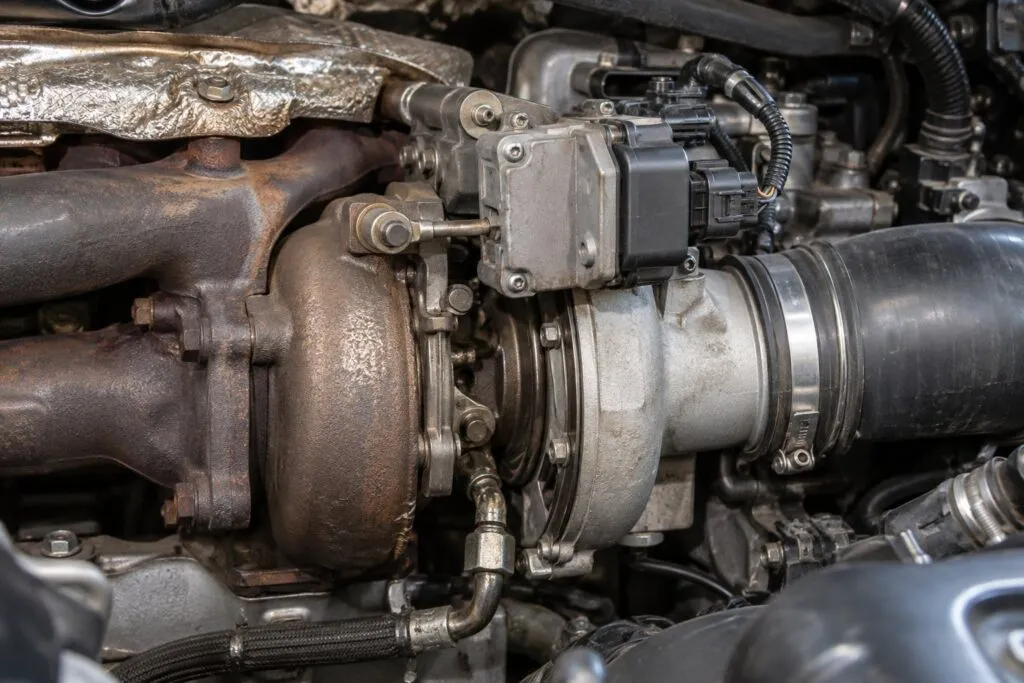
The P2564 Turbocharger Boost Control Position Sensor Low code sets when your ECM detects a voltage signal from the turbo boost control position sensor that falls below the expected calibrated range. In plain terms, the sensor that tells the computer where your turbo’s actuator or wastegate arm is sitting has dropped its signal to a value that can’t be right. When that happens, the ECM can no longer trust boost control, and it will often derate the engine to protect the turbo and driveline.
This is a common code on modern diesels running electronically controlled actuators, and it trips up a lot of techs because the fault lives at the intersection of mechanics, electronics, and boost management. At PT Turbo, we’ve been rebuilding and supplying turbochargers since 1978, more than 45 years, and we see P2564 cross the bench regularly. Here’s how to diagnose it right the first time.
What P2564 Actually Means
Every electronically controlled turbo actuator has a position feedback sensor built in. On a variable geometry turbo (VGT), that sensor reports vane position. On a wastegated setup with an electronic actuator, it reports wastegate arm position. The ECM commands a target position, then reads the feedback sensor to confirm the actuator got there.
P2564 specifically means the feedback voltage is low, typically only a few tenths of a volt on a 0 to 5V circuit, or sometimes below 10 percent of the sensor’s sweep range. The ECM interprets this as either a short to ground, an open reference or signal wire, or a failed sensor.
If you’re chasing a related boost problem, it’s worth reading our companion guides on the P0299 underboost code and the P0046 boost control circuit range/performance fault, since they frequently appear alongside P2564.
Common Symptoms of P2564 Turbocharger Boost Control Position Sensor Low
The way this code shows up depends heavily on how far out of range the signal has drifted. A momentary glitch feels different from a fully dead sensor. Here’s how symptoms typically scale with severity.
| Severity | What You’ll Notice | Drivability Impact |
|---|---|---|
| Mild / Intermittent | Check engine light comes and goes, minor hesitation under load | Slight power loss, boost occasionally soft |
| Moderate | Persistent CEL, noticeable turbo lag, poor throttle response | Reduced boost, sluggish acceleration, possible black smoke |
| Severe | Engine derate / limp mode, no boost control, hard start under load | Major power loss, cannot pull grades, safe-mode operation |
Because the ECM loses trust in boost feedback, it usually defaults the actuator to a fail-safe position. On many VGT platforms that means the vanes park open, giving you low boost and a truck that feels gutless. On wastegated engines, the gate may default open or closed depending on the calibration, which can cause either underboost or, less commonly, overboost. If you’re seeing high boost instead, check our P0234 overboost code guide.
Root Causes: What to Check Before Condemning the Turbo
The most expensive mistake with P2564 is replacing a whole turbocharger when the actual failure is an actuator or a chafed wire. Work through the causes in order of probability, not price.
- Failed position sensor inside the actuator. The Hall-effect or potentiometer element wears out or shorts internally. This is the single most common root cause.
- Damaged wiring or connector. Heat, vibration, and oil migration corrode the actuator connector. Look for green pins and broken locking tabs.
- Stuck or seized actuator linkage. Carbon and soot bind the vanes or wastegate arm so the actuator cannot move. On its own this sets a range or performance code such as P2563 rather than P2564, but the two often show up together, so check that the linkage moves freely.
- Open or shorted 5V reference / signal / ground. A pinched harness against the block or exhaust manifold will drag the signal low.
- ECM or connector ground fault. Rare, but a corroded ECM ground can skew every sensor reference.
On pickup and medium-duty diesels with a Holset variable geometry turbo, such as the Cummins ISB 6.7L, actuator and position faults are a known weak point. If you run that platform, our Cummins ISB 6.7L turbocharger guide covers the specifics.
Step-by-Step Diagnosis
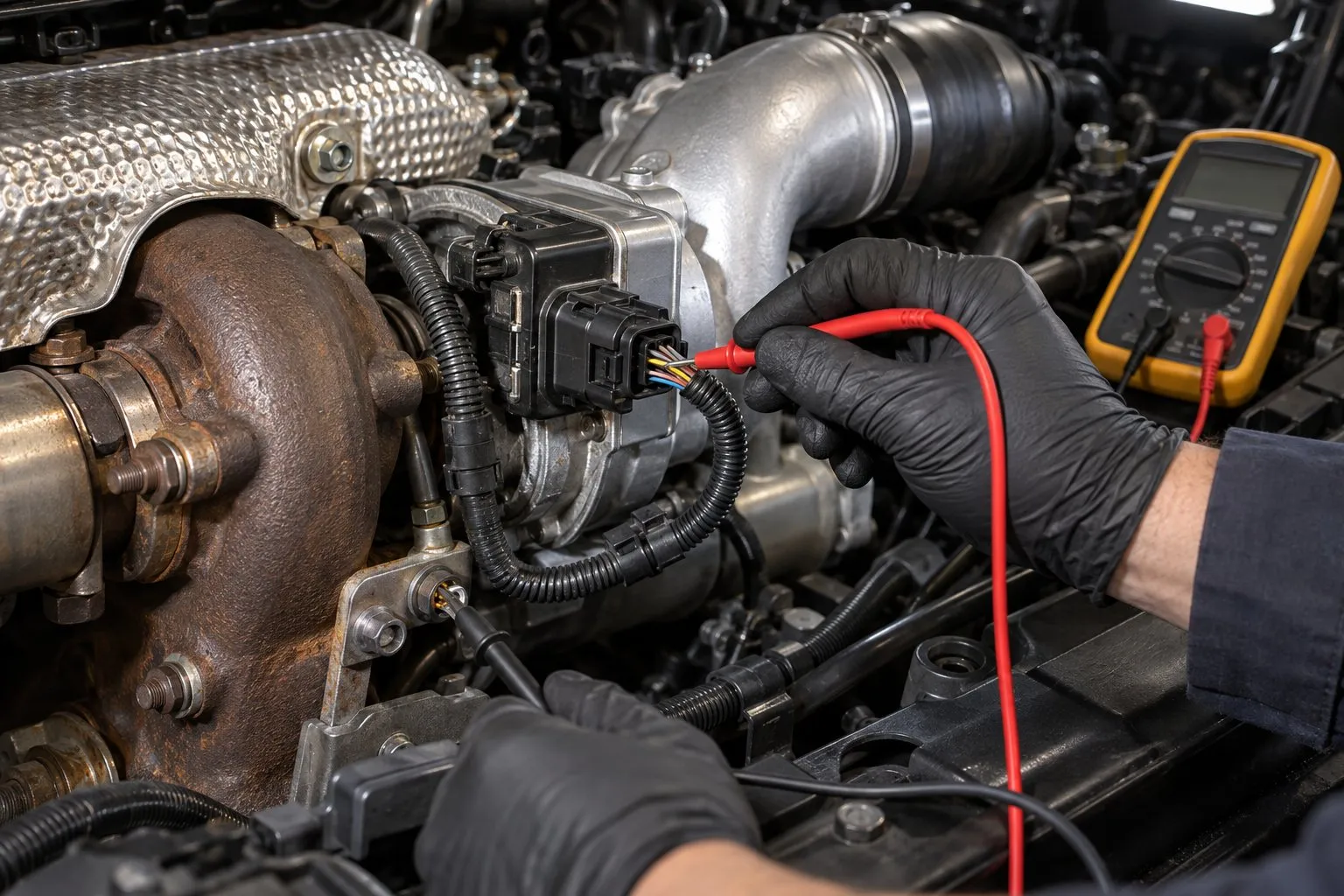
You’ll need a scan tool capable of reading actuator commanded vs actual position, a digital multimeter, and the wiring diagram for your specific engine. Don’t guess at pin assignments, confirm them.
1. Read Freeze Frame and Live Data
Pull the freeze frame to see the conditions when P2564 set. Then watch commanded position against actual position. If commanded sweeps but actual stays pinned low, you most likely have a dead sensor or a wiring fault; a stuck actuator on its own usually sets P2563 instead.
2. Inspect the Connector and Harness
Disconnect the actuator connector. Look for corrosion, spread pins, oil intrusion, and heat damage. Wiggle-test the harness while watching live data. Any flicker points to a wiring fault, not the sensor.
3. Verify Reference Voltage and Ground
Key on, engine off. Back-probe the connector. You should see the reference voltage the maker specifies (5V on most systems, battery voltage on some) on the reference wire and a clean ground under 0.1V drop. Missing reference voltage means the fault is upstream in the harness or ECM, not the actuator.
4. Test Actuator Movement
Command the actuator through its range with a bidirectional scan tool. Watch and listen. If it doesn’t move or moves roughly, the internal motor or linkage is failing. A binding VGT mechanism, per the principles of variable-geometry turbocharger design, will stall the actuator, which sets a range or performance code such as P2563 alongside P2564.
5. Check the Signal Sweep
Manually move the linkage by hand (engine off, actuator disconnected from load if possible) while monitoring the signal voltage. A healthy sensor sweeps smoothly from low to high. Dropouts, dead spots, or a signal stuck at a few tenths of a volt confirm a bad position sensor.
Repair Options: Actuator vs Complete Turbo
Once you’ve isolated the fault, you have three real paths: replace the pneumatic or electronic actuator, install a remanufactured turbo, or rebuild the unit you have. The right call depends on the condition of the center section and the vanes.
If the turbo spins freely, holds oil, and the only problem is the actuator or its integrated sensor, replace the actuator. It’s the fastest and cheapest fix.
If the vanes are carboned or the shaft has play, replacing the actuator alone won’t hold. In that case a remanufactured turbocharger or our full turbocharger rebuild service is the durable answer. Here’s how the options compare.
| Option | Best When | Relative Cost | Expected Life |
|---|---|---|---|
| Replace actuator only | Turbo core is healthy, sensor/actuator failed | $ | Full, if core is sound |
| Remanufactured turbo | Vanes carboned, shaft play, or high mileage | $$ | Like-new with warranty |
| Rebuild existing unit | OE core you want to keep, no reman available | $$ | Like-new with warranty |
| New OEM turbo | Warranty requirement or no reman core | $$$$ | Full factory life |
Preventing P2564 From Coming Back
A new actuator on a dirty turbo is a repeat failure waiting to happen. Address the underlying causes so the code stays gone.
- Fix the carbon source, not just the symptom. Soot binding the vanes usually traces back to extended idling, a leaking EGR system, or a failing injector running rich. Clean the vane mechanism during the repair and correct whatever is loading the exhaust with soot.
- Repair the harness properly. If you found chafe or corrosion, don’t just tape it. Re-pin the connector, seal it, and route the harness away from the manifold and any vibration contact point.
- Confirm the actuator calibrates after install. Many platforms require a learn or relearn so the ECM maps the new sensor sweep. Skip that step and you can set the same code on a good part.
Treat P2564 as a system fault, not a single bad part. When the wiring is clean, the vanes move freely, and the feedback sweep is verified end to end, the code stays gone and your boost control comes back the way the engine was built to run.
Looking for a different code? Our list of turbocharger fault codes gives the standard definition of every boost-related code and the kind of fault it points to.
Frequently Asked Questions
What does the P2564 code mean?
It means the ECM detected a voltage signal from the turbo boost control position sensor that fell below the expected calibrated range. This sensor reports the position of your turbo’s actuator or wastegate arm.
What are common causes of a P2564 code?
Common causes include a faulty boost control position sensor, damaged wiring or connectors, short circuits to ground, and issues with the turbo actuator itself. Corrosion or loose connections can also trigger the code.
Can I drive with a P2564 code?
You can typically drive short distances, but you may notice reduced power, limp mode, or poor performance. It’s best to diagnose and repair the issue promptly to avoid further turbo or engine damage.
Need a Turbocharger?
PT Turbo has rebuilt and sold turbochargers since 1978. We stock remanufactured units for Cummins, Duramax, Power Stroke, Detroit Diesel, and more — backed by a 12-month unlimited mileage warranty and same-week shipping from San Bernardino, CA.
📞 (909) 824-1020 · 346 S I St. #3, San Bernardino, CA 92410 · [email protected]
More From PT Turbo
 P0101 Mass Air Flow Sensor Code and Turbocharger: Understanding the Connection
- Excessive Turbo Lag on a Diesel: Causes, Diagnosis & Whether to Repair or Replace
- P0046 Turbocharger Boost Control Circuit Range/Performance: What It Means & How to Fix It
- Turbo Whine vs Normal Turbo Noise: How to Tell if Your Turbocharger Is Failing