2020 Ford 6.7L Powerstroke Turbocharger Guide: Gen 3 Changes & What to Know
This 2020 Ford 6.7L Powerstroke turbocharger guide covers the single biggest change in the engine’s charging system: for the 2020 model year Ford moved the 6.7L to a Garrett variable-geometry turbo with an electronic vane actuator and a vane position sensor, replacing the oil-controlled setup that ran from 2011 through 2019. If you have worked on earlier Super Duty trucks, that one change rewrites how you diagnose, replace, and calibrate the turbo.
Owners call these later trucks “Gen 3”, and the hardware backs up the name. Below is what actually changed, how the turbo works now, what fails, and how to replace it without guessing. PT Turbo has been rebuilding turbochargers since 1978, and we stock both new and remanufactured units for the Power Stroke platform.
What Changed on the 2020 Super Duty Turbo
On 2011-2019 pickups the 6.7L turbo had no electric vane actuator at all. The PCM drove a VGT solenoid, and engine oil pressure moved the variable vanes, the same basic method used on the 6.0L Power Stroke and the 2004.5-2016 Duramax. There was no vane position sensor on those trucks, so there was no “commanded versus actual” vane reading and no vane position learn after a swap.
From 2020 the turbo carries an electronic vane actuator with a position sensor built into the control loop. That means the actuator reports where the vanes actually are, and a position learn is required after the turbo or actuator is replaced. This is the defining difference for anyone diagnosing a Gen 3 truck: you now have a real vane feedback signal and a calibration step that the 2011-2019 trucks never had.
The 6.7L Power Stroke turbo has always been a Garrett unit, never a BorgWarner. BorgWarner built the compound pair on the 6.4L Power Stroke, which is a different animal entirely. If you are cross-shopping older platforms, our 6.4L twin turbo guide and the 6.0L turbo replacement guide explain how those systems differ from the single-turbo 6.7L.
6.7L Power Stroke Turbo by Model Year
Knowing which turbo your truck left the factory with matters, because the control method and the correct replacement part change across the generations. Go by the part number on the turbo’s data plate, not by the body style or the brochure.
| Model years (pickup) | Garrett turbo | Vanes controlled by | Vane position sensor |
|---|---|---|---|
| 2011-2014 | GT32 SST (double-sided compressor wheel) | Engine oil via PCM-driven VGT solenoid | No |
| 2015-2019 | GT37 (single compressor wheel, AVNT3788) | Engine oil via PCM-driven VGT solenoid | No |
| 2020 on | Garrett VGT with electronic actuator | Electronic vane actuator | Yes |
Cab and chassis trucks carry different turbos from the pickups across these years, so a cab-chassis part number will not match a pickup. The two sides of the 2011-2014 GT32 SST compressor wheel work in parallel, feeding one outlet, not as two stages, which is a point that confuses a lot of first-time buyers.
Turbos we list for the 2020-on Ford 6.7L Power Stroke
Listings matched to the 2020-on Ford 6.7L Power Stroke by their fitment data or their part number, orderable online today. Several part numbers fit one engine by year, rating and vehicle, so match the number on your turbo’s tag, or call (909) 824-1020 and we will match it for you.
How the Gen 3 Variable-Geometry Turbo Works
The Garrett turbo on the 6.7L uses pivoting vanes on a unison ring to vary the effective turbine housing area. At low rpm the vanes close down to speed exhaust gas across the turbine and build boost quickly; at high rpm they open to flow more and keep drive pressure in check. That is the whole point of a variable-geometry turbocharger.
On the 2020-on truck, the electronic actuator positions those vanes and reports position back to the control module. Never move the arm of an electronic actuator by hand. The internal gears are self-locking and will break; sweep it with a scan tool or the maker’s tester instead.
One thing that does not change across generations: this is a high-pressure EGR engine. Exhaust is taken before the turbine and routed back to the intake after the compressor, so EGR gas never passes through the turbine vanes. Heavy soot loading from combustion is what fouls the vanes over time, not EGR flowing across them. If you want the background on how EGR fits into a diesel, Wikipedia has a solid overview of exhaust gas recirculation.
Common Failure Modes and Symptoms
Most turbo failures on any Power Stroke trace back to the oil supply. Dirty oil, a restricted feed, long hot shutdowns that coke the bearings, or a start without oil reaching the turbo will all shorten its life. The center housing bearings live on a clean, steady oil film.
On the variable-geometry side, carbon and soot build up on the vanes and unison ring. When the vanes stick, you get boost that is off target in one direction or the other: vanes stuck closed give overboost and high drive pressure, vanes stuck open give low boost and sluggish spool.
- Low or slow boost, dark gray or black smoke: too little air for the fuel being delivered. Check for intake and charge-air leaks before condemning the turbo.
- Overboost codes: often sticking vanes holding the nozzle too closed.
- Oil in the charge pipes: a light film is normal crankcase vapor; pooled oil is a reason to look closer. Check the breather, air filter, oil level, and drain before blaming the compressor seal.
- Actuator and position faults (2020 on): with a vane position sensor in the loop, the Gen 3 truck will flag a learning or position problem the older trucks could not.
- Noise: a siren or whistle is often an exhaust leak before the turbine or a boost leak, not the turbo itself. Check every joint first.
A loaded or regenerating diesel particulate filter sits downstream of the turbine, so soot in the DPF is not a turbo fault. Let an active regen finish as the vehicle directs rather than shutting the truck down mid-cycle.
Replacement, Calibration, and First Start
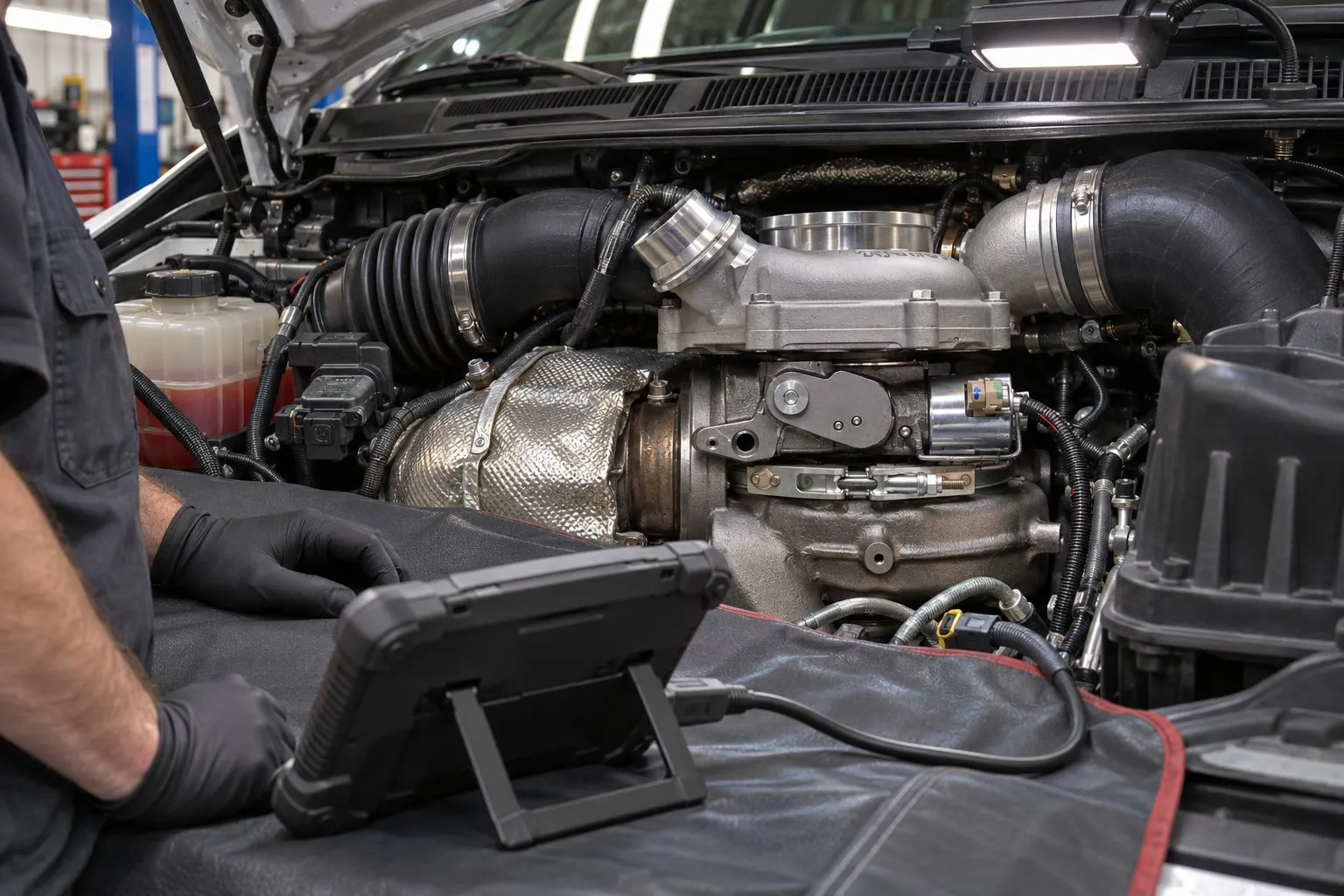
Match the new or remanufactured turbo to your exact truck by the number on the data plate. Across these years the pickup and cab-chassis part numbers differ, and the 2020-on units are their own parts, so a wrong number is worse than no number.
On the 2020-on truck, run the vane position learn with a scan tool after the turbo or actuator is installed. The 2011-2019 trucks have no vane position sensor and no learn step; on those you verify operation by commanding the VGT solenoid and watching boost and backpressure respond.
Follow the maker’s first-start steps on any turbo you fit: prime the oil inlet with clean engine oil, turn the wheel by hand, crank or idle to establish oil pressure, then idle a few minutes and check for oil, exhaust, and air leaks before putting it under load. There is no break-in mileage schedule and no early oil change to chase; drive it gently until warm and let it idle a few minutes after a hard pull or towing so the bearings cool.
New vs Remanufactured for the 6.7L
You can buy a new turbo or a properly remanufactured one. Both have their place, and the right choice usually comes down to availability, budget, and whether you want the original casting back on the truck.
| Consideration | New turbo | Remanufactured turbo |
|---|---|---|
| Cost | Higher | Lower |
| Core | None | Core return within 30 days |
| Internals | All new | New bearings, seals, and thrust parts; balanced cartridge |
| Warranty at PT Turbo | 12 months, unlimited mileage | 12 months, unlimited mileage |
If you still have your original turbo, our in-house turbo rebuild service restores the cartridge with new bearings, seals, and thrust parts and balances it on our VSR equipment, and most rebuilds ship in three days or less. You can see what your exact model costs on our turbo rebuild price list. If you would rather swap in a ready-to-run unit, browse our remanufactured turbochargers.
PT Turbo is a family-owned shop in San Bernardino, California, with more than 45 years of turbo work behind it. Call us at (909) 824-1020 or contact us with your part number and we will match the right unit to your truck.
Frequently Asked Questions
Does the 2020 6.7L Power Stroke turbo need a calibration after replacement?
Yes. From the 2020 model year the turbo has an electronic vane actuator with a position sensor, so a vane position learn with a scan tool is required after the turbo or actuator is installed. The 2011-2019 trucks do not have this step because their vanes are moved by engine oil and have no position sensor.
Is the 6.7L Power Stroke turbo a BorgWarner?
No. Every 6.7L Power Stroke turbo has been a Garrett unit. BorgWarner built the compound twin-turbo system on the 6.4L Power Stroke, which is a completely different setup.
How do I know which turbo my truck has?
Go by the part number on the turbo’s data plate, not by the year or body style alone. Pickup and cab-chassis trucks use different turbos across these years, and the 2020-on units are their own parts, so matching the tag number is the only reliable way. Send us the number and we will confirm the correct replacement.
Need a Turbocharger?
PT Turbo has rebuilt and sold turbochargers since 1978. We stock remanufactured units for Cummins, Duramax, Power Stroke, Detroit Diesel, and more — backed by a 12-month unlimited mileage warranty. Units in stock at our shop in San Bernardino, CA ship the same day when ordered before 2 PM Pacific, Monday through Friday.
📞 (909) 824-1020 · 346 S I St. #3, San Bernardino, CA 92410 · info@ptturbo.com
More From PT Turbo
 International T444E Turbocharger Guide: Ford 7.3L Powerstroke Connection Explained
- Mack Granite Turbocharger Guide: MP7 & MP8 Vocational Applications
- Ram 2500/3500 5.9L Cummins Turbocharger Guide: HX35, HY35 & HE351CW Explained
- Ford 6.7L Powerstroke Turbocharger: Problems, Symptoms and Replacement Guide