Kenworth W900 Turbocharger Guide: Cummins ISX & Cat C15 Applications by Year
This Kenworth W900 Turbocharger Guide exists because the W900 has carried two very different diesel families over its long life, and the turbo under the cab depends entirely on which engine and which emissions era you are working on. A W900 spec’d with a Cummins ISX wears a Holset; one spec’d with a Caterpillar C15 wears a Garrett or a BorgWarner. Get the engine and the year right and the rest of the job falls into place. Get it wrong and you are chasing the wrong actuator, the wrong housing, and the wrong part number.
PT Turbo has been rebuilding turbochargers since 1978, and in that time the heavy-duty on-highway market has moved from simple wastegated fixed-geometry units to air-operated variable nozzles to fully electronic variable-geometry turbos. We stock both new and remanufactured units for these engines and rebuild in-house. Below is how the W900 turbos break down by engine and year, what controls each one, and what to check before you order.
Cummins ISX turbos in the W900, by emissions era
The Cummins ISX (14.9 L, later badged X15) is the most common engine you will find in a W900, and its turbo changed with each round of emissions rules. The actuator type changed along with it, which is the single most important thing to identify before buying.
Before EGR, up to 2002, the ISX used a fixed-geometry wastegated Holset. Depending on rating that is a Holset HX55 turbocharger or HX60 (HX55W / HX60W on wastegated versions). These have no vanes, no nozzle, and no actuator calibration. The wastegate and the data plate on the compressor housing tell you what you have.
From 2003 to 2007 under CM870 controls, the ISX moved to the Holset HE551V, a variable-geometry turbo with a sliding nozzle. This one is air-operated: truck air works the actuator through a turbocharger control valve. There is no electronic actuator and no actuator calibration on the HE551V. If you are diagnosing low boost on one of these, the air supply and the control valve are part of the circuit, not an electronic position learn.
The 2007 emissions engines (CM871, roughly 2007 to 2010) switched to an electronic actuator. These carry the Holset HE561VE, with the HE551VE on some ratings. The VE suffix is the tell: V with no E is air-operated, VE and VG models have an electronic actuator that must be calibrated to the turbo.
The ISX15 from 2010 (CM2250, CM2350) and the later X15 use the Holset HE451VE or the HE400VG, both with an electronic actuator. The two look alike but do not interchange: the compressor cover and actuator differ, and later engines carry the HE400VG. Go by the number on the turbo’s data plate, not by the year alone.
| ISX era | Turbo | Type | Actuator |
|---|---|---|---|
| Pre-EGR (to 2002) | HX55W / HX60W | Fixed geometry, wastegated | None (wastegate) |
| 2003-2007 (CM870) | HE551V | Variable, sliding nozzle | Air-operated via control valve |
| 2007-2010 (CM871) | HE561VE / HE551VE | Variable, sliding nozzle | Electronic (calibrated to turbo) |
| ISX15 / X15 (2010 on) | HE451VE / HE400VG | Variable, sliding nozzle | Electronic (calibrated to turbo) |
One note on naming: Holset variable turbos move a sliding nozzle ring, not pivoting vanes on a unison ring. When a shop manual or a parts clerk says “vane angle” on a Holset, they are using a Garrett term loosely. The function is the same, but the hardware is different.
Caterpillar C15 turbos in the W900, by rating
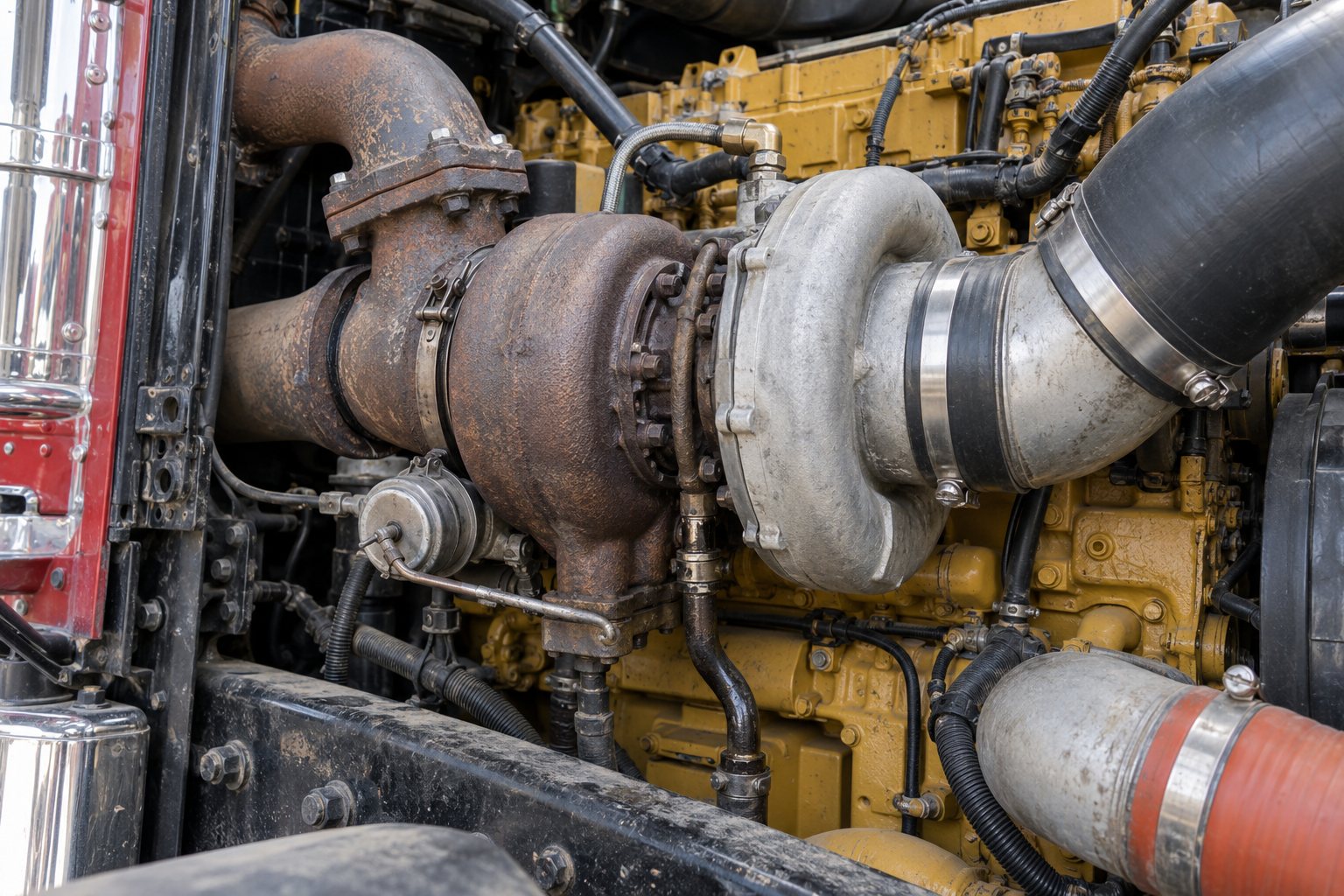
Before Caterpillar left the on-highway market, the C15 was a very common W900 engine, and it came in two very different turbo arrangements. Cat does not build its own turbos; Garrett and BorgWarner supply them.
The single-turbo C-15 (serial prefixes 6NZ and MBN, usually given as 14.6 L) uses a single fixed-geometry turbo: a Garrett GTA4702 or a BorgWarner S410-family unit depending on rating. These are the turbos most owner-operators think of when they picture a classic “6NZ Cat.” No vanes, no VGT, just a wastegate by rating.
The C15 ACERT (15.2 L, serial prefixes BXS, MXS, NXS and SDP) is a completely different animal. It uses two turbos in series, a low-pressure and a high-pressure unit, with the wastegate on the high-pressure turbo. The ACERT low-pressure turbo is a Garrett GTA5518. The C15 never used a variable-geometry turbo in any year, so if someone offers you a “VGT for your C15,” that is the wrong part.
Because the 2007-on Cat ACERT engines use Clean Gas Induction, a low-pressure loop that feeds filtered exhaust in ahead of the compressor, the diagnostics differ from a high-pressure-EGR engine. Soot and flow faults on an ACERT C15 live in that loop and the series-turbo wastegate, not in a nozzle.
| C15 version | Serial prefixes | Arrangement | Turbo(s) |
|---|---|---|---|
| Single-turbo C-15 | 6NZ, MBN | Single, fixed geometry | Garrett GTA4702 or BorgWarner S410 |
| C15 ACERT | BXS, MXS, NXS, SDP | Two turbos in series | Low-pressure Garrett GTA5518 + high-pressure (wastegated) |
How to identify the right W900 turbocharger before you order
A wrong turbo is worse than no turbo, and on a truck as long-lived as the W900 the only sure way to buy correctly is the part number. Here is the order of what to confirm.
- Engine family first. Cummins ISX/X15, or Caterpillar C15. They never share a turbo.
- Emissions era. Pre-EGR, CM870, CM871, or CM2250/2350 on the Cummins side; single-turbo versus ACERT on the Cat side.
- The data plate. Holset tags carry the Holset assembly number and the engine maker’s number as separate fields; Garrett numbers are a six-digit base plus a suffix. The plate sits on the compressor housing.
- Wheel sizes and A/R. Use these to confirm when the plate is worn. Casting numbers only narrow the search; one casting serves many turbos, so never order by a casting number alone.
Variable-geometry theory is covered well in this overview of the variable-geometry turbocharger, and the broader turbocharger entry is a solid primer if you are new to how these units spool. For the electronic Holset units, the actuator is calibrated to its own turbo with Cummins INSITE after fitting, never forced by hand.
Common failures and what to check
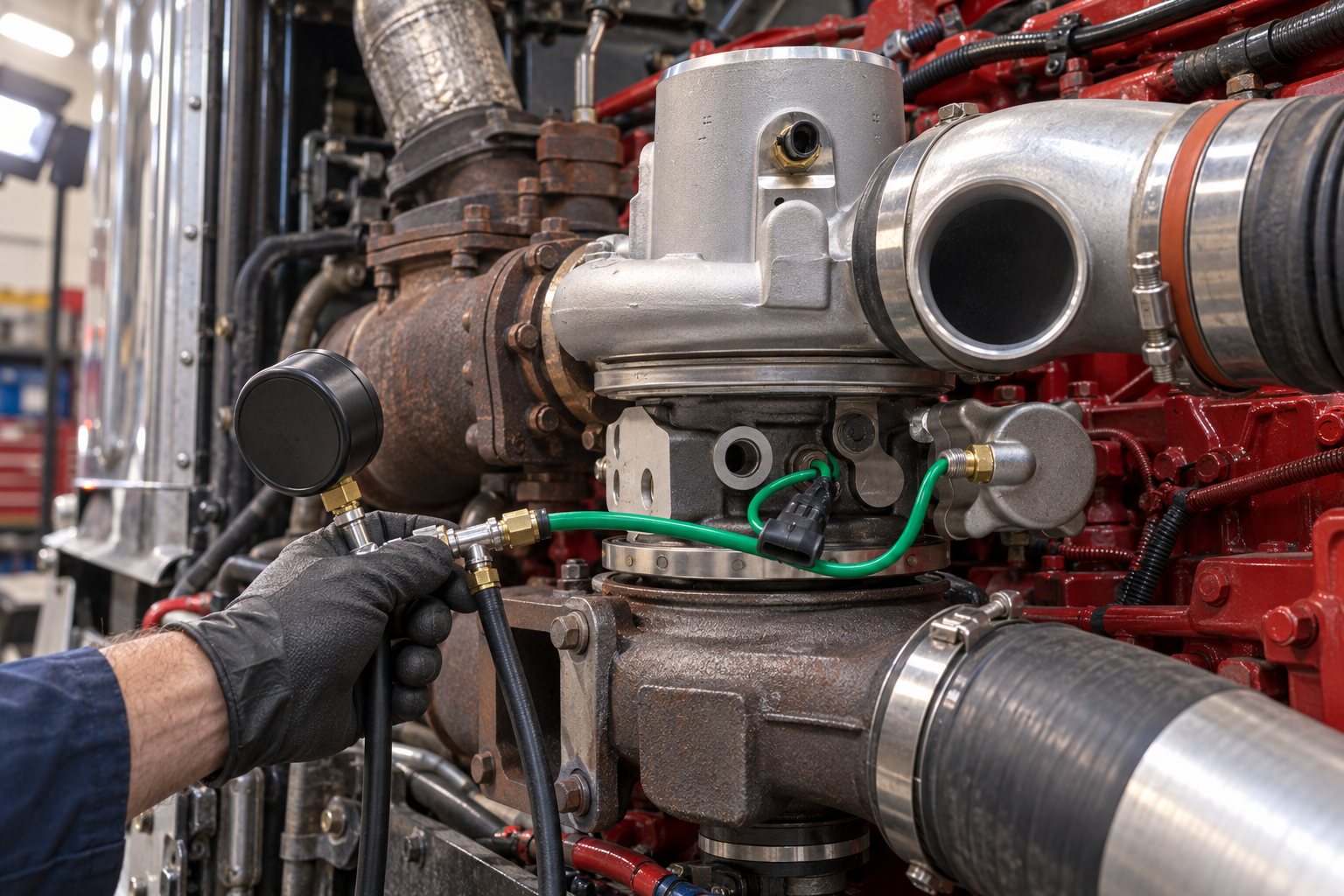
Most turbo failures on these engines trace back to the oil supply, so before condemning a unit, check the oil feed, the drain, the oil level, and the air filter. A restricted drain backs oil up past the seals; a leaking drain gasket is an external leak. Some side-to-side shaft play is normal on a journal-bearing turbo with no oil pressure. Condemn a turbo for in-and-out play you can feel, for wheel contact with the housing, or for play beyond the maker’s limit, not for any movement at all.
- Low boost, slow spool, high exhaust temperature: look for a leak in the up-pipes or manifold letting exhaust escape before the turbine. It does not raise backpressure.
- Overboost and high drive pressure: a variable nozzle stuck closed. Stuck open gives low boost.
- Actuator faults on VE/VG Holsets: electronic actuators are calibrated with a service tool, not tested with a vacuum pump. On these heavy-truck engines a VGT actuator fault shows as a Cummins or Cat fault code with its SPN / FMI, not a generic P-code; read it with the maker service tool before replacing parts.
- Oil in the charge pipes: a light film is normal with closed crankcase ventilation. Check the breather and drain before blaming the compressor seal.
On the air-operated HE551V, remember truck air only moves the nozzle actuator through the control valve; exhaust energy still drives the turbo. Low boost there can be an air supply problem rather than a bad turbo. For background on how variable-geometry units manage flow on EGR engines, our Cummins ISB 6.7L turbocharger guide walks through sliding-nozzle operation and the same failure patterns on a smaller Cummins.
New, remanufactured, and rebuilt options for the W900
PT Turbo is family-owned and has been in business more than 45 years. For W900 turbos you have three paths: a new unit, a remanufactured turbocharger, or sending your own core in for our turbo rebuild service. Most rebuilds ship in three days or less, and the rebuild price is confirmed after inspection and before any work starts.
For current rebuild pricing by model, see our turbo rebuild price list. Remanufactured units carry a 30-day core return, and every rebuilt or replacement turbo is backed by a 12-month unlimited-mileage warranty. Fleet customers can call to arrange priority turnaround and core stocking.
| Option | Best for | Core required | Warranty |
|---|---|---|---|
| New | No usable core, want factory-new | No | 12 months, unlimited miles |
| Remanufactured | Fast turnaround, exchange | Yes (30-day return) | 12 months, unlimited miles |
| Rebuild your core | Keep your exact unit | Your own | 12 months, unlimited miles |
If you are unsure which turbo your W900 carries, send us the number off the data plate and we will match it. You can reach us through the contact page or call (909) 824-1020. Browse everything we stock in the online store.
Turbos we list for the HE551V, HE400VG and HE561VE
Listings for the turbo models named in this guide that can be ordered online today. Several part numbers can fit one engine by year and rating, so match the number on your turbo’s tag, or call (909) 824-1020 and we will match it for you.
All HE551V listings · All HE400VG listings · All HE561VE listings
Frequently Asked Questions
Does a Kenworth W900 use a Cummins or a Cat turbocharger?
It depends on how the truck was spec’d. A W900 with a Cummins ISX or X15 uses a Holset turbo, while one with a Caterpillar C15 uses a Garrett or BorgWarner unit. Confirm the engine first, then the emissions era, then match the number on the turbo’s data plate.
Is the C15 turbo a variable-geometry turbo like the ISX?
No. The Caterpillar C15 never used a variable-geometry turbo in any year. Single-turbo C-15 engines (6NZ, MBN) use one fixed-geometry turbo, and the C15 ACERT uses two fixed-geometry turbos in series with a wastegate on the high-pressure unit. The variable nozzle belongs to the Cummins ISX side of the W900.
How do I know if my ISX turbo is air-operated or electronic?
Read the Holset model name. A V with no E, like the HE551V on 2003-2007 CM870 engines, is air-operated through a turbocharger control valve. A VE or VG model, like the HE561VE, HE451VE, or HE400VG, has an electronic actuator that must be calibrated to the turbo after fitting. Call us with the part number if you are not sure.
Need a Turbocharger?
PT Turbo has rebuilt and sold turbochargers since 1978. We stock remanufactured units for Cummins, Duramax, Power Stroke, Detroit Diesel, and more — backed by a 12-month unlimited mileage warranty. Units in stock at our shop in San Bernardino, CA ship the same day when ordered before 2 PM Pacific, Monday through Friday.
📞 (909) 824-1020 · 346 S I St. #3, San Bernardino, CA 92410 · [email protected]