Cummins ISX Overboost: VGT, Boost Sensor and Fault Code Diagnosis
A Cummins ISX Overboost fault is the ECM telling you that measured intake manifold pressure climbed higher than it commanded, and on these engines the checks come down to the variable geometry turbo, its actuator, and the pressure sensor the ECM trusts. Overboost is not a nuisance light. High boost comes with high drive pressure across the turbine, and left alone it hammers head gaskets, EGR components, and the turbo bearings themselves. This guide walks through how the ISX turbo makes boost, why a sliding nozzle that will not open drives pressure up, and how to separate a sensor fault from a mechanical one before you buy parts.
PT Turbo has been rebuilding turbochargers in San Bernardino since 1978. Everything below reflects how these Holset units work and fail.
ISX Turbos by Engine Generation
The first step in any overboost call is knowing which turbo you have, because the actuator type and the diagnosis change by generation. The ISX and ISX15 (14.9 L) ran several distinct Holset designs. Match the number on the turbo’s data plate, not the engine name, before you order anything.
| Engine / controls | Turbo | Type | Actuator |
|---|---|---|---|
| Pre-EGR ISX (to 2002) | HX55W / HX60W | Fixed geometry, wastegated | Wastegate actuator (no VGT actuator) |
| 2003-2007 (CM870) | HE551V | Variable geometry, sliding nozzle | Air-operated |
| 2007 emissions-2010 (CM871) | HE561VE, HE551VE on some | Variable geometry, sliding nozzle | Electronic |
| ISX15 from 2010 (CM2250/CM2350), X15 | HE451VE, later HE400VG | Variable geometry, sliding nozzle | Electronic |
On the ISX15, the HE451VE sat between the earlier HE561VE and the later HE400VG; the HE500VG shows up as a later replacement model for several numbers. The HE451VE and HE400VG look similar but do not interchange: the compressor cover and actuator differ, so go by the part number.
Why a Sliding Nozzle Causes Overboost
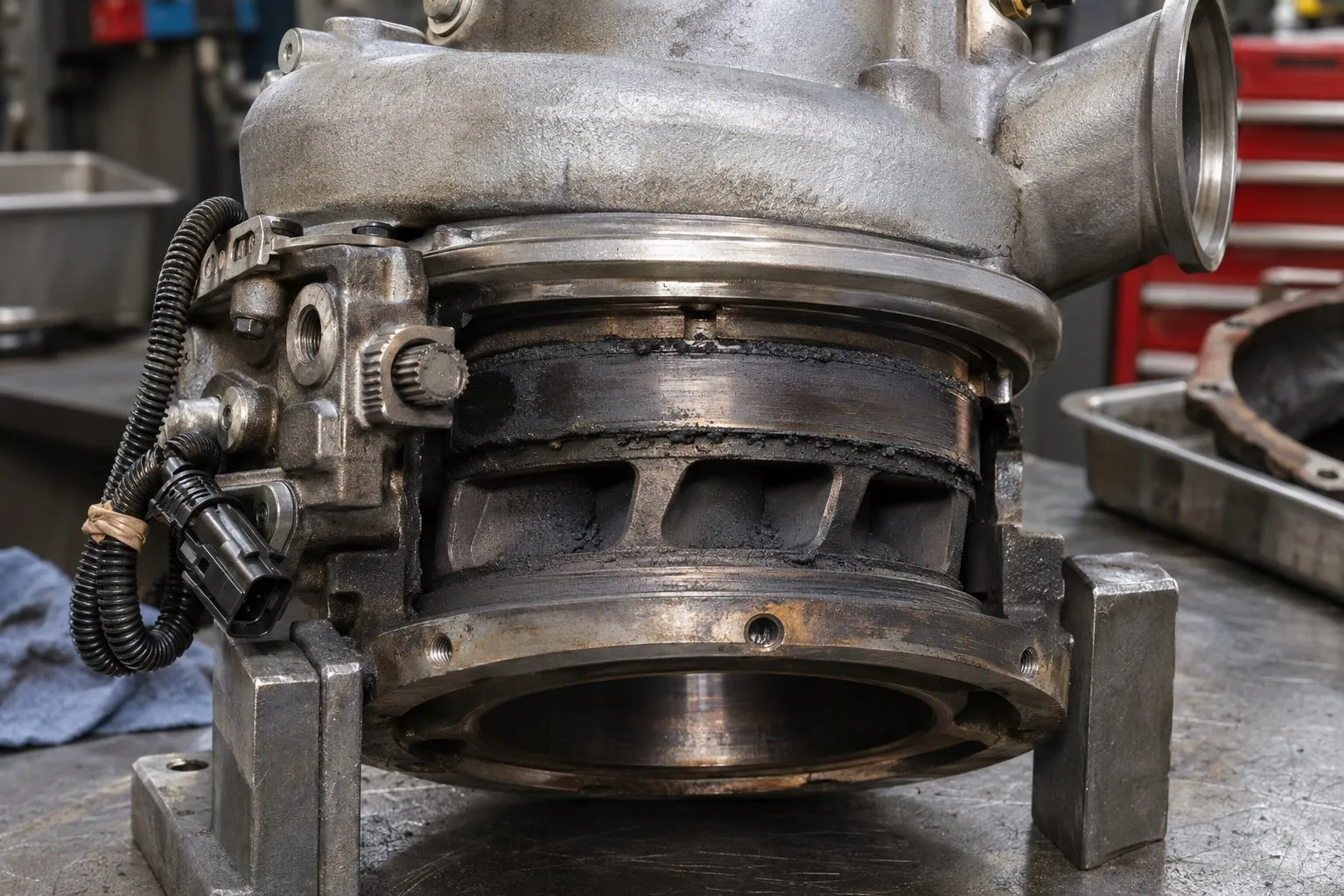
Holset variable geometry turbos do not use pivoting vanes on a unison ring. They use a sliding nozzle that moves to change the effective area the exhaust hits on the turbine wheel. Close the nozzle and exhaust velocity rises, spinning the turbine harder and building boost fast at low rpm. Open it and gas flows more freely, dropping boost.
That geometry is where the mechanical side of overboost on these engines starts. A nozzle stuck toward the closed position keeps exhaust energy high when the ECM is asking for less, so boost and drive pressure climb past target. A common reason is carbon and soot binding the sliding ring so it cannot track the commanded position. A nozzle stuck toward open gives the opposite problem, low boost, so the direction of the fault tells you something before you ever pull the turbo.
On the 2003-2007 HE551V the nozzle is moved by truck air through a turbocharger control valve. There is no electronic actuator to calibrate on that generation, so overboost diagnosis centers on the air supply, the control valve, and the nozzle mechanism itself. On the 2007-and-later VE and VG turbos an electronic actuator drives the nozzle and the diagnosis adds actuator position feedback.
Turbos we list for the HE561VE, HE451VE and HE400VG
Listings for the turbo models named in this guide that can be ordered online today. Several part numbers can fit one engine by year and rating, so match the number on your turbo’s tag, or call (909) 824-1020 and we will match it for you.
All HE561VE listings · All HE451VE listings · All HE400VG listings
Reading the Fault Codes: SPN and FMI, Not P0234
Light-duty diesels throw generic OBD-II codes like P0234 for overboost. Heavy-duty Cummins ECMs do not. The ISX reports through SPN and FMI numbers, so you will not see a clean “overboost” P-code on a scan tool reading these engines.
Intake manifold pressure is SPN 102. The FMI tells you what kind of fault the ECM saw:
- SPN 102 FMI 0 – data valid but above normal operating range, most severe. This is the true overboost indication.
- SPN 102 FMI 16 – above normal operating range, moderately severe. A milder overpressure reading.
- SPN 102 FMI 2 (Cummins fault code 2973) – the pressure signal is erratic, intermittent, or incorrect. This is a sensor or signal fault, not overboost, and chasing it as a boost problem wastes a day.
On the actuator side, the ECM logs its own Cummins VGT actuator fault codes (they include 2387, SPN 641 FMI 7, as well as 2449 and 2634). Those are a different problem from an overboost reading: check the actuator and the nozzle it drives. Pull the full freeze-frame data with Cummins INSITE so you see commanded versus measured boost at the moment the fault set.
Boost Sensor vs VGT: Isolating the Fault
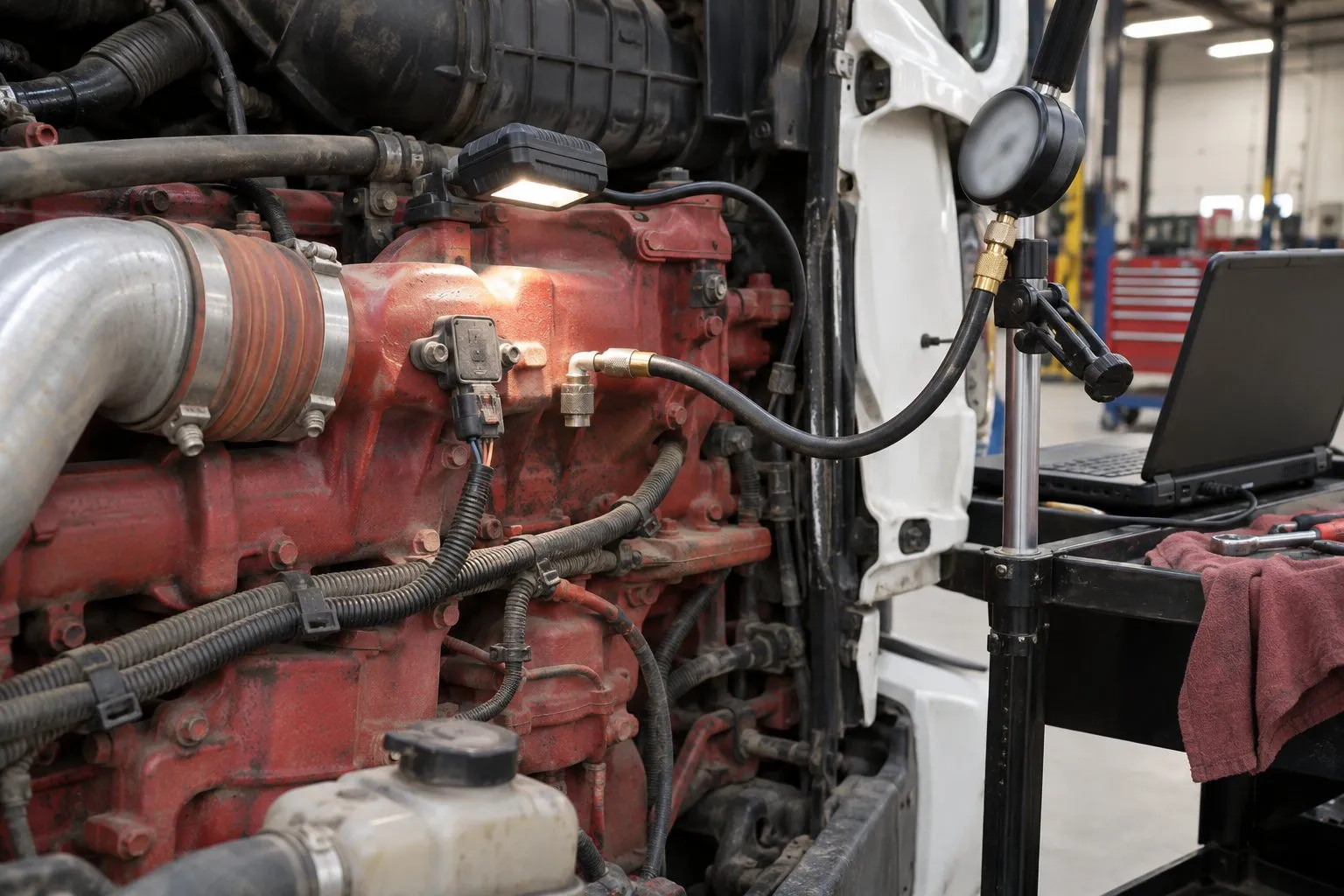
Before condemning a turbo, confirm the ECM is reading real pressure. An intake manifold pressure sensor that reads high, or a signal fault on that circuit, makes the ECM believe boost is too high when it is not. That is exactly the SPN 102 FMI 2 territory above. Compare the sensor’s reading against a known-good gauge, and inspect the connector and wiring for the usual corrosion and chafe.
If the sensor and its signal check out, move to the VGT. On the electronic-actuator turbos, watch commanded versus actual nozzle position in INSITE while the engine is running. A nozzle that will not track command, or that reaches a hard stop short of where it should go, is a bound sliding ring or a failing actuator. Carbon on the nozzle mechanism can cause both overboost and actuator faults.
Work the checks in order so you do not replace good parts:
- Verify the intake manifold pressure sensor and its circuit against a gauge.
- Check commanded versus measured boost in freeze-frame and live data.
- On VE/VG turbos, compare commanded versus actual actuator position.
- On the HE551V, check truck air supply and the turbocharger control valve.
- Inspect the sliding nozzle for carbon binding and the turbine for debris or wheel contact.
Cummins does not publish a ranked list of overboost causes or a trigger threshold in psi, so treat any single “most common cause” claim with suspicion and let the data on the specific truck lead you. Soot loading in the exhaust after a stopped regeneration ends up in the diesel particulate filter, which sits downstream of the turbine, so that is a separate conversation from a bound nozzle.
Actuator Replacement and Calibration
The HE-series electronic actuator is calibrated to its own turbo, not to the ECM in a generic sense. If you are replacing the actuator, it has to be calibrated to the turbo with Cummins INSITE (or Holset’s eTool) after fitting; follow the step order in the instructions that come with the actuator. Skip the calibration and the actuator will not control the nozzle correctly and sets a fault.
Never move an electronic actuator’s arm by hand. The gear train is self-locking and forcing it breaks the gears. Sweep it with the service tool instead, and torque the mounting screws to the figure in the actuator’s install instructions.
If the actuator calibrates and tracks correctly but boost still runs high, the fault is mechanical, and the nozzle or the full cartridge is the next step.
Replacement and Rebuild Options
Once you have confirmed the turbo is at fault, you have a decision to make: new, remanufactured, or a rebuild of your own core. A bound or worn ISX VGT often cleans up and comes back to spec with new bearings, seals, and a freed nozzle, which is where our in-house rebuild service earns its keep. Every unit we rebuild is VSR balanced before it leaves the bench.
These Holset VGTs are heavy, serialized units with an electronic actuator that has to match the turbo, so match the data-plate number and plan the actuator calibration into the job. For what a rebuild on your specific turbo runs, see our turbo rebuild price list; the price is confirmed after inspection and before any work starts. Most rebuilds ship in 3 days or less.
If you would rather drop in a replacement, we also stock remanufactured turbochargers and new units; availability on a given ISX number depends on core supply, so use the model pages above or send us the number on your tag through the contact page or at (909) 824-1020. Fleet customers can arrange priority turnaround and core stocking by phone.
For a closer look at how the same sliding-nozzle design behaves on the pickup side of the Cummins family, our Cummins ISB 6.7L turbocharger guide covers variable geometry operation and the common failure modes in plain terms.
Frequently Asked Questions
Why does my ISX show an overboost condition but no P0234?
Heavy-duty Cummins engines report through SPN and FMI numbers rather than generic OBD-II P-codes. An overboost on intake manifold pressure shows as SPN 102 FMI 0 (above normal, most severe) or FMI 16 (moderately severe). Read the fault with Cummins INSITE to see the SPN/FMI pair and the freeze-frame data.
Can a bad boost sensor cause an overboost fault?
Yes. An intake manifold pressure sensor that reads high, or a signal that is erratic or intermittent (SPN 102 FMI 2, Cummins code 2973), makes the ECM believe boost is too high when the real pressure may be normal. Verify the sensor against a known-good gauge and inspect its circuit before touching the turbo.
Do I have to recalibrate the turbo after replacing the actuator?
On the VE and VG electronic-actuator turbos, yes. The actuator is calibrated to its own turbo with Cummins INSITE (or Holset’s eTool) after fitting; follow the step order in the actuator’s instructions. Skipping the calibration can set an actuator fault code.
Need a Turbocharger?
PT Turbo has rebuilt and sold turbochargers since 1978. We stock remanufactured units for Cummins, Duramax, Power Stroke, Detroit Diesel, and more — backed by a 12-month unlimited mileage warranty. Units in stock at our shop in San Bernardino, CA ship the same day when ordered before 2 PM Pacific, Monday through Friday.
📞 (909) 824-1020 · 346 S I St. #3, San Bernardino, CA 92410 · info@ptturbo.com