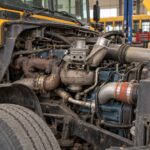
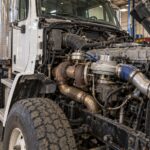
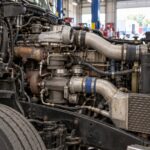
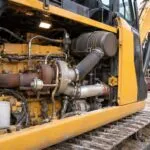
Caterpillar 966 Wheel Loader Turbocharger: C11 & C9.3 Engine Application Guide
Ordering a Caterpillar 966 wheel loader turbocharger starts with a question that has nothing to do with the turbo itself: which engine is in the machine? The 966 has been built in several series, and the two engines this guide covers, the C11 and the C9.3, carry different turbos that do not interchange just because both sit in a 966. PT Turbo has been rebuilding turbochargers since 1978. The most reliable way to get the right unit is to read the plates on the engine and on the turbo before anyone orders a part.
Identify the Engine and the Turbo Before You Order
Start at the engine information plate. It gives the engine model and serial number, and that is what you need when you look up parts for one particular build. A work order that only says “966” is not enough to order a turbo.
Then read the turbo. Caterpillar does not make its own turbochargers. BorgWarner and Garrett supply them, and each maker fixes a nameplate to the turbo. A BorgWarner tag sits on the compressor housing and shows the BorgWarner part number, a serial number and, on factory-fitted turbos, the engine maker’s part number. Garrett plates on factory units also carry the vehicle maker’s number, but where the plate sits varies by region and plant.
Order by the part number on that tag. Casting numbers on the housings are not part numbers, because one casting serves many turbos. They can narrow a search, but they cannot confirm a match. If the tag is burned off or unreadable, call (909) 824-1020 with the engine serial number and photos of the turbo.
C11 Turbocharger Application
The Garrett GTA4502 turbocharger is listed as a C11 turbo. It is a Garrett 45-frame unit, and the same model name also turns up on C13 and Detroit Series 60 applications. That overlap causes wrong orders. A GTA4502 built for a highway C13 and one built for a loader C11 are not the same part number, and sharing a model name does not make them interchangeable.
Garrett marks variable nozzle turbos with a V in the model name. A C11 tag that reads GTA4502 with no V is a fixed geometry turbo, so there are no vanes, unison ring or vane actuator to diagnose. If your C11 carries a turbo from another maker or with a different model name, follow the tag, not this guide.
Most Caterpillar machine engines run a single turbo, but arrangements vary by rating. Confirm yours in the parts book for your engine serial number. If you also work on highway C13s, our Caterpillar C13 turbocharger guide covers that engine’s turbos and failure patterns.
Turbos we list for the GTA4502
Listings for the turbo models named in this guide that can be ordered online today. Several part numbers can fit one engine by year and rating, so match the number on your turbo’s tag, or call (909) 824-1020 and we will match it for you.
C9.3 Turbocharger Application
The C9.3 is a single-turbo engine and never runs two turbos in series. Beyond that, the turbo model depends on the rating and build, so the tag decides which unit you need.
The engine name invites a shortcut that causes trouble. Most C9 ratings are listed with BorgWarner S310 family turbos (S310G080, S310CG080, S310G116, S310G122), and the 2007-on C9 truck engines use a variable-vane turbo. None of that carries over to a C9.3 automatically. Do not order a C9 turbo for a C9.3 because the engine names look close. Match the part number on the nameplate. Our Caterpillar C9 turbocharger guide covers the S310 family in detail.
Whether a given C9.3 turbo has a wastegate is also something the tag tells you. Call with the number and we can tell you what it cross-references to and whether rebuilding your core makes more sense than buying a replacement.
| Item | C11 | C9.3 |
|---|---|---|
| Turbo arrangement | Single turbo on most Cat machine ratings; confirm by serial number | Single turbo, never series |
| Turbo listed | Garrett GTA4502 (45 frame) | No single model for every build; read the tag |
| Variable geometry | None if the tag reads GTA4502 with no V | Do not assume; read the tag |
| Common ordering mistake | GTA4502 numbers meant for a C13 or Series 60 | C9 or S310 numbers ordered for a C9.3 |
| What to order by | Part number on the turbo nameplate | Part number on the turbo nameplate |
How Turbos Fail in Wheel Loader Duty
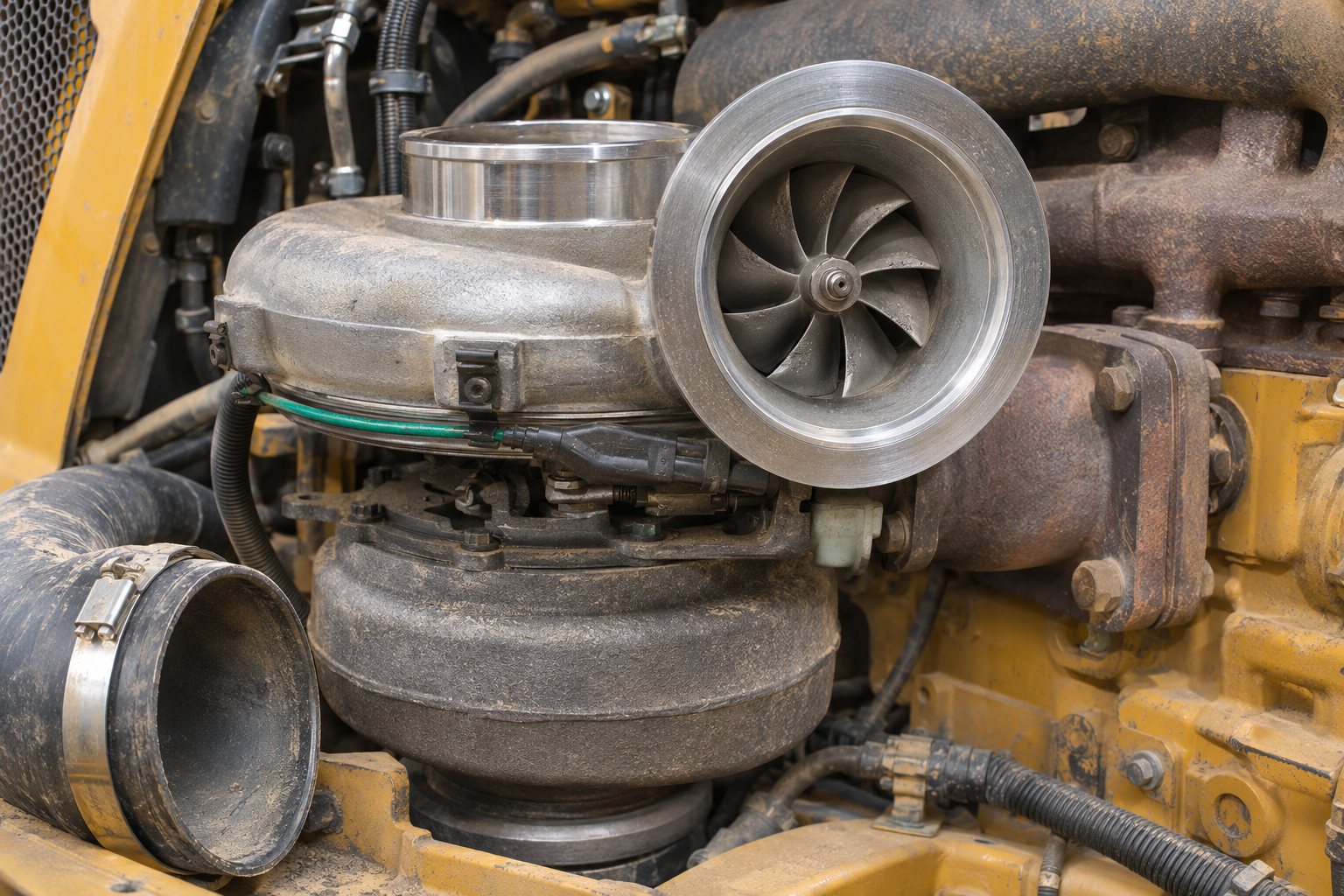
A 966 works in dust, loads hard in short bursts and spends long stretches at idle. Each of those conditions leaves its own marks on the turbo.
Oil supply and oil quality
Garrett states that more than 90 percent of turbo failures come from oil starvation or oil contamination. Starvation means low oil pressure, a blocked or leaking feed, hard throttle on a cold start before oil reaches the bearings, or a turbo fitted without priming. Contamination means carbon, engine wear debris, dirt let in during service, a faulty filter bypass or degraded oil scoring the bearings. Change oil and filters on the maker’s schedule, or on its severe-service schedule when the machine works in dust or idles a lot.
Dust
Dust that gets past the air filter leaves pitting on the compressor inlet blades. Bent or chipped blades mean something larger hit the wheel. Replace the filter when the restriction indicator calls for it, and check every joint between the filter housing and the compressor inlet. That pipe is under suction, so a crack there pulls dirt in rather than leaking boost.
Heat at shutdown
If you shut a loader down hot right after a heavy cycle, oil cooks in the center housing. Coked oil then restricts the feed and the drain. After hard work, idle the engine for the cool-down time Cat gives in the operation manual. On a cold start, wait until oil pressure shows before putting the bucket to work.
Oil at the seals
Oil in the intake or at the turbine outlet does not prove a seal has failed. Turbo seals are piston rings, and pressure in the housing normally keeps the oil in. A restricted air inlet can pull oil past the compressor end, and a restricted drain or high crankcase pressure pushes it out at both ends. A light film in the charge piping is normal crankcase vapor on engines with closed crankcase ventilation. Pooled oil is not.
| Symptom | What it points to | Check first |
|---|---|---|
| Low power, black or dark gray smoke | Too little air: boost leak, restricted filter, exhaust leak before the turbine, worn turbo | Restriction indicator, charge air piping and cooler, exhaust manifold joints |
| Blue-gray smoke | Oil burning, from the turbo or from engine wear | Breather, drain, oil level, air filter, then shaft play |
| Whine or siren noise | Exhaust leak before the turbine, boost leak, or a wheel rubbing | Every joint first, then wheel contact with the housing |
| Pitting on compressor blades | Dust getting past the filter | Filter element and seal, inlet pipe, clamps |
| Wheel touches housing when rocked | Journal bearing wear | Rebuild or replace, then fix the oil cause |
| Oil on the outside of the center housing | Gasket or line leak, not seals | Feed and drain gaskets, line fittings |
| Copper rising in oil analysis | Possible bearing wear (turbo journal bearings are bronze) | Compare with your own baseline and the lab’s limits |
The 966 reports faults as Caterpillar diagnostic codes, not the generic P-codes you read about in pickup articles. Read them with Cat’s service software and follow the troubleshooting for that code. Work on the intake side before you blame the turbo.
Inspecting and Fitting a Replacement
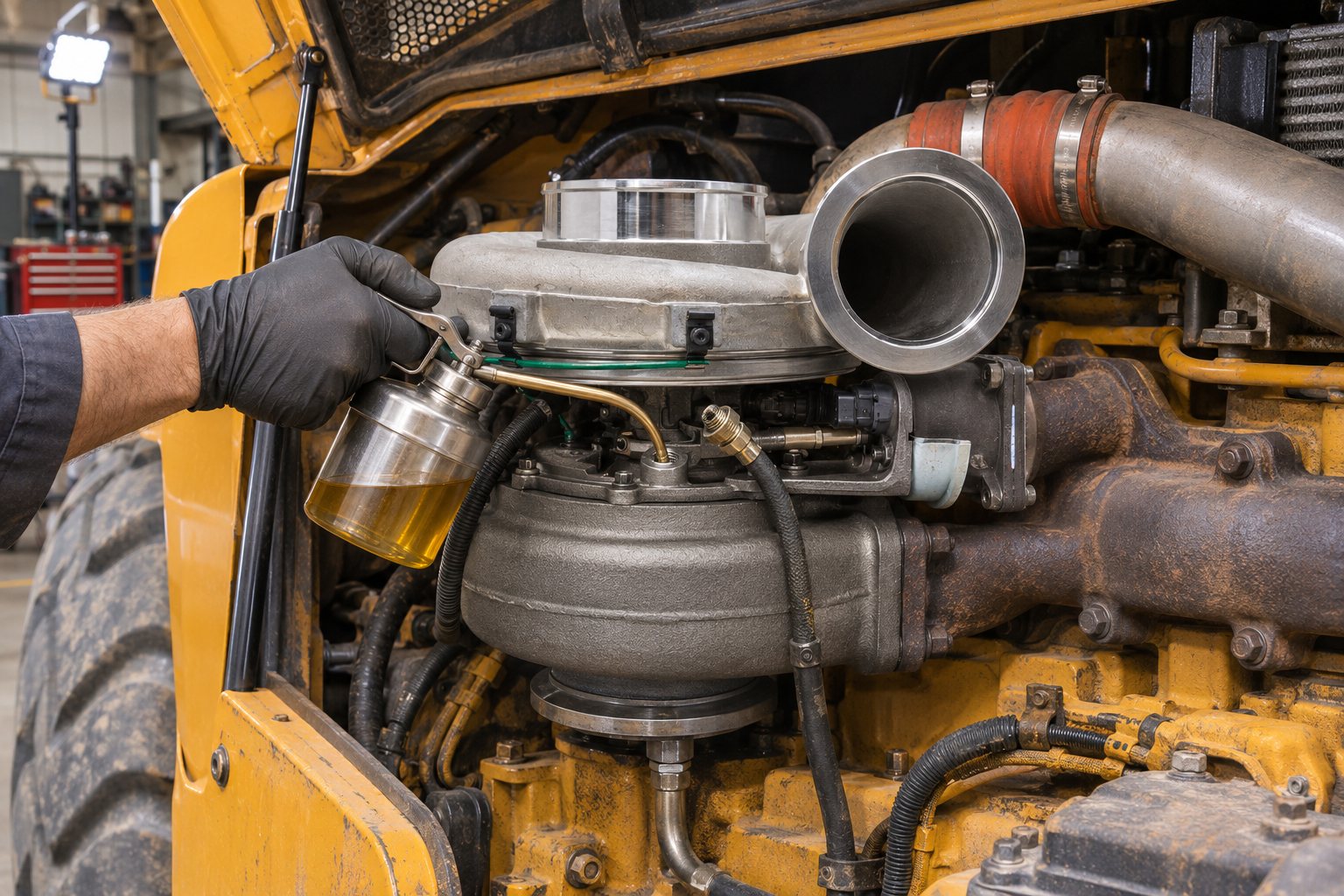
With the intake and exhaust off, check shaft play. Some side-to-side rock at the wheel is normal on a journal-bearing turbo. Condemn the turbo for in-and-out play you can feel, a wheel that touches its housing, or play beyond the maker’s limit. Axial play on a journal-bearing turbo typically runs 0.001 to 0.004 in, but the maker’s figure for your unit is the one that counts.
Look at the turbine wheel too. Debris damage shows on the inlet edges of the blades. A wheel with blade damage is replaced, never rebalanced and reused.
When the replacement goes on, follow this order:
- Find and fix the cause first: oil supply, air filtration, drain routing or crankcase pressure.
- Fit a new oil feed line after a bearing failure or coked oil instead of flushing and reusing the old one.
- If the compressor wheel shed metal, replace the charge air cooler. Metal in the fins cannot be flushed out reliably, and whatever stays in the cooler goes into the engine. Inspect the charge piping as well.
- Route the drain downhill, within about 15 to 20 degrees of straight down, with no kinks, and make sure it enters the crankcase above the oil level.
- Use new gaskets and no sealant on the oil inlet or drain gaskets.
- Fill the oil inlet with clean engine oil and turn the wheel by hand.
- Crank for 10 to 15 seconds without starting, disabling fueling by Cat’s procedure. Then idle 3 to 4 minutes and check for oil, exhaust and air leaks before putting the machine under load.
New, Remanufactured or Rebuilt
We do not have a listing specific to the 966, so start with the number on your tag. Search it in our turbo store or browse our remanufactured turbochargers. What is in stock changes daily, so call to confirm what is available for your number. Current pricing is on each product page, or call (909) 824-1020.
Often the faster route is to rebuild your own turbo. PT Turbo is family-owned and has spent more than 45 years rebuilding turbochargers in San Bernardino, California, and our in-house rebuild service handles Garrett and BorgWarner machine turbos. Every turbo we rebuild is VSR balanced and gets a final quality inspection: a leak test, a visual inspection and, where fitted, an actuator or wastegate function check.
- Most rebuilds ship in 3 days or less.
- The rebuild price is confirmed after inspection and before any work starts. See the turbo rebuild price list for our listed prices by turbo.
- Warranty: 12 months with unlimited hours or mileage.
- Remanufactured units take a core return within 30 days, and the customer pays return shipping. If you need longer, call ahead and we can usually work with you.
- Fleets and contractors can arrange priority or rush turnaround and stocking of their common cores by phone.
A properly rebuilt turbo performs like new. Clean oil, a sealed intake and a correct installation give it the best chance of a long service life. For anything not covered here, contact PT Turbo with your tag number.
Frequently Asked Questions
Will a C9 turbo fit the C9.3 in my 966?
Do not assume it will. Most C9 ratings are listed with BorgWarner S310 family turbos, but that listing does not carry over to the C9.3. The C9.3 runs a single turbo, and the right replacement is whatever matches the part number on its nameplate.
Can a 966 loader turbo be rebuilt instead of replaced?
Usually, yes, as long as the housings are sound. Damaged wheels are replaced as part of the rebuild, since a wheel with blade damage is never rebalanced and reused. PT Turbo confirms the rebuild price after inspection and before work starts, and most rebuilds ship in 3 days or less.
How long should a 966 idle before shutdown?
Idle it for the cool-down time Cat gives in the machine’s operation manual, especially after heavy loading. Shutting down hot cooks oil in the turbo’s center housing, and the resulting carbon restricts the feed and the drain. On a cold start, wait until oil pressure shows, then work the machine gently until it is warm.
Need a Turbocharger?
PT Turbo has rebuilt and sold turbochargers since 1978. We stock remanufactured units for Cummins, Duramax, Power Stroke, Detroit Diesel, and more — backed by a 12-month unlimited mileage warranty. Units in stock at our shop in San Bernardino, CA ship the same day when ordered before 2 PM Pacific, Monday through Friday.
📞 (909) 824-1020 · 346 S I St. #3, San Bernardino, CA 92410 · info@ptturbo.com
More From PT Turbo
 International DT466 Turbocharger Guide: School Bus & Medium Duty Applications
- Freightliner 114SD & 122SD Vocational Turbocharger Guide: DD13 & DD15 Applications
- International MaxxForce 13 Turbocharger: Common Failures & Best Replacements
- Caterpillar 320 Excavator Turbocharger Guide: C7.1 Engine Application & Replacement