Freightliner 114SD & 122SD Vocational Turbocharger Guide: DD13 & DD15 Applications
Diesel techs searching for a Freightliner 114SD & 122SD Vocational Turbocharger Guide need accurate fitment, not guesswork, because a wrong turbo on a Detroit-powered work truck costs you a day and a core charge. These severe-duty Freightliners are spec’d for dump, mixer, roll-off, crane and other vocational work, and when they carry a Detroit DD13 or DD15 the charging system is very specific to the engine family and emissions year. This guide walks through what those turbos are, how they are controlled, how they fail, and how to get the right one the first time.
PT Turbo has been rebuilding turbochargers since 1978, more than 45 years, and we stock both new and remanufactured units along with in-house rebuild service. The one rule that never changes on these trucks: go by the number on the turbo’s data plate, not the engine badge on the hood.
Reading This Freightliner 114SD & 122SD Vocational Turbocharger Guide by Engine
The single most important fact for a Detroit truck owner is this: the DD13, DD15 and DD16 never used a variable geometry turbocharger. There are no sliding vanes, no unison ring and no VGT actuator to calibrate on any of these engines. Anyone who tells you a DD13 turbo “needs its vanes relearned” is describing the wrong engine.
Instead, Detroit used fixed geometry turbos, an asymmetric turbo design, and on the larger engines a turbo-compound power turbine. What you have depends entirely on which engine and which emissions era your 114SD or 122SD was built to.
DD13 Turbocharger: Asymmetric Fixed Geometry
The Detroit DD13 is a 12.8L inline-six, currently rated from 370 to 525 hp and 1,250 to 1,850 lb-ft. It has used an asymmetric fixed geometry turbocharger from the BorgWarner B3G family since its 2009 launch.
Asymmetric means the turbine housing is split so that exhaust from one group of cylinders is kept at a higher pressure to drive the high-pressure EGR loop, while the rest drives the turbine. It is still a fixed geometry wheel and housing with no vanes. You can read the basics of how exhaust gas recirculation loads a turbine on these engines.
Through roughly the GHG14 era (to about model year 2016), the DD13 asymmetric turbo carried an air-operated wastegate worked by a solenoid and truck air. From GHG17 on, Detroit dropped the wastegate and the asymmetric turbo runs without one. That difference matters when you are chasing a boost complaint, because an air-leaking wastegate circuit only exists on the earlier trucks. We stock parts for the BorgWarner B03G turbochargers used on these engines.
DD15 Turbocharger: Holset HX55, Turbo-Compound, and the Asymmetric AT
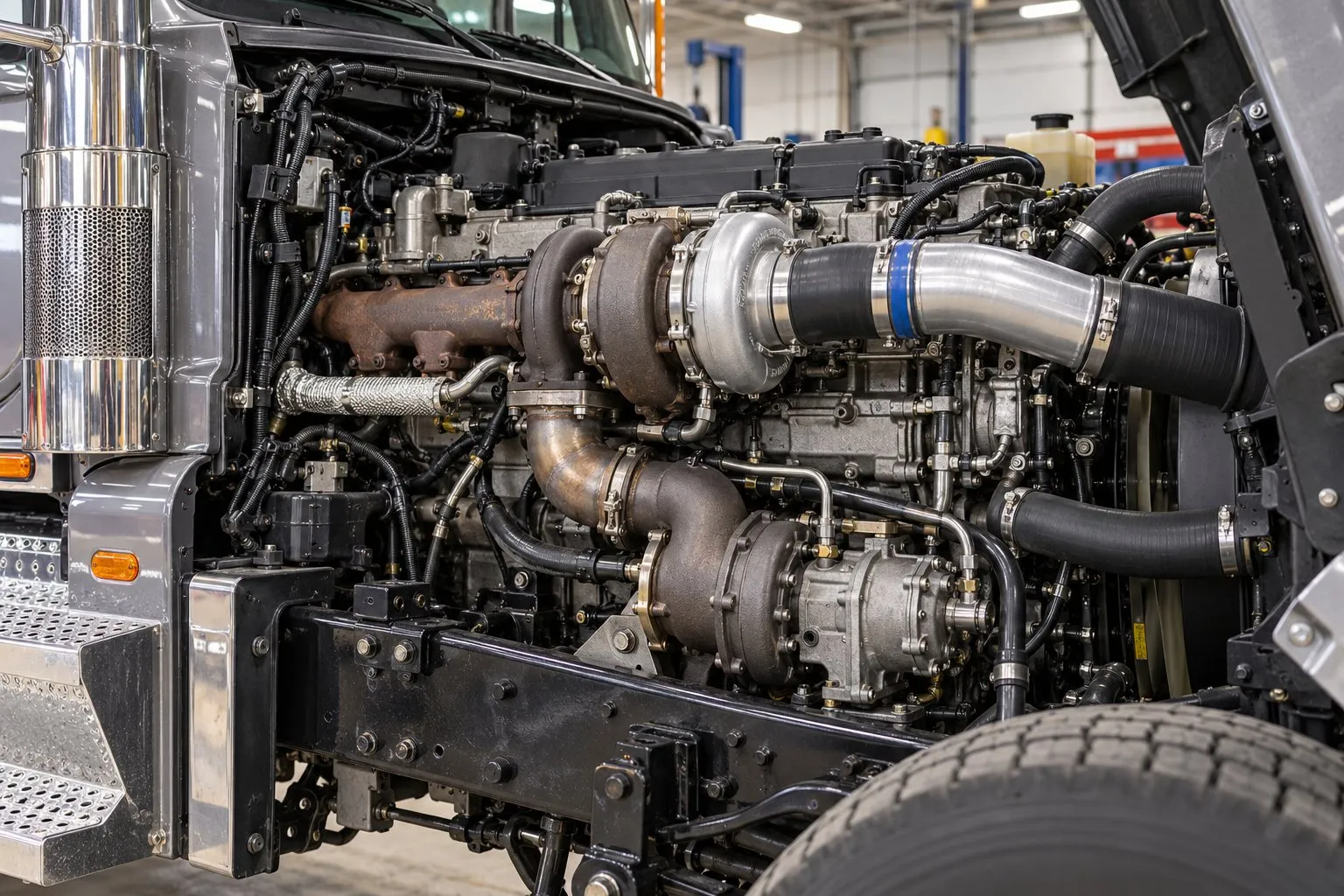
The DD15 is the larger Detroit, launched in the 2008 Cascadia from 455 to 560 hp and running currently from 425 to 505 hp. Its turbo story changed across emissions generations, so this is where most misorders happen.
EPA07 and EPA10 DD15 engines use a fixed geometry Holset HX55-type turbocharger with no wastegate, followed by a turbo-compound power turbine geared to the crankshaft that recovers exhaust energy and feeds it back mechanically. The Garrett GT4594S replaces the same Holset numbers on these engines. We list parts for both the Holset HX55 turbochargers and the Garrett GT4594 turbochargers.
From GHG14 (2013), the DD15 AT (Advanced Technology) version moved to the same kind of asymmetric turbo with an air-operated wastegate, while the DD15 TC variant kept the turbo-compound setup. GHG17 DD15 engines run the asymmetric turbo with no wastegate. None of these are variable geometry, and none use a DPF-related vane actuator.
What PT Turbo Stocks for the DD15
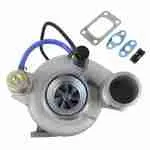
Our DD15 listings include BorgWarner S410 part number 57889882400 (2017-2022), BorgWarner 57909882500, and the Garrett GT4594S 887393-5005S. These S410-family numbers are replacement units for the DD15, not the original factory turbo and not a bolt-on power upgrade. Treat them as service replacements and confirm against your tag. You can see what we stock for the BorgWarner S410 turbochargers.
DD13 vs DD15 Turbo Setup by Emissions Era
| Engine / Era | Turbo type | Wastegate | Turbo-compound |
|---|---|---|---|
| DD13 (2009-GHG14) | Asymmetric fixed geometry (B3G) | Air-operated, solenoid controlled | No |
| DD13 (GHG17 on) | Asymmetric fixed geometry | None | No |
| DD15 (EPA07 / EPA10) | Fixed geometry Holset HX55 type | None | Yes (geared power turbine) |
| DD15 AT (GHG14) | Asymmetric fixed geometry | Air-operated | DD15 TC variant only |
| DD15 (GHG17 on) | Asymmetric fixed geometry | None | Varies by variant |
No Detroit turbo in this table has vanes, a unison ring or a VGT actuator. If your diagnosis leads you to “stuck vanes,” you are on the wrong engine family. For background on how a variable-geometry turbocharger differs, note that none of that applies here.
Common Failure Modes and What to Check First
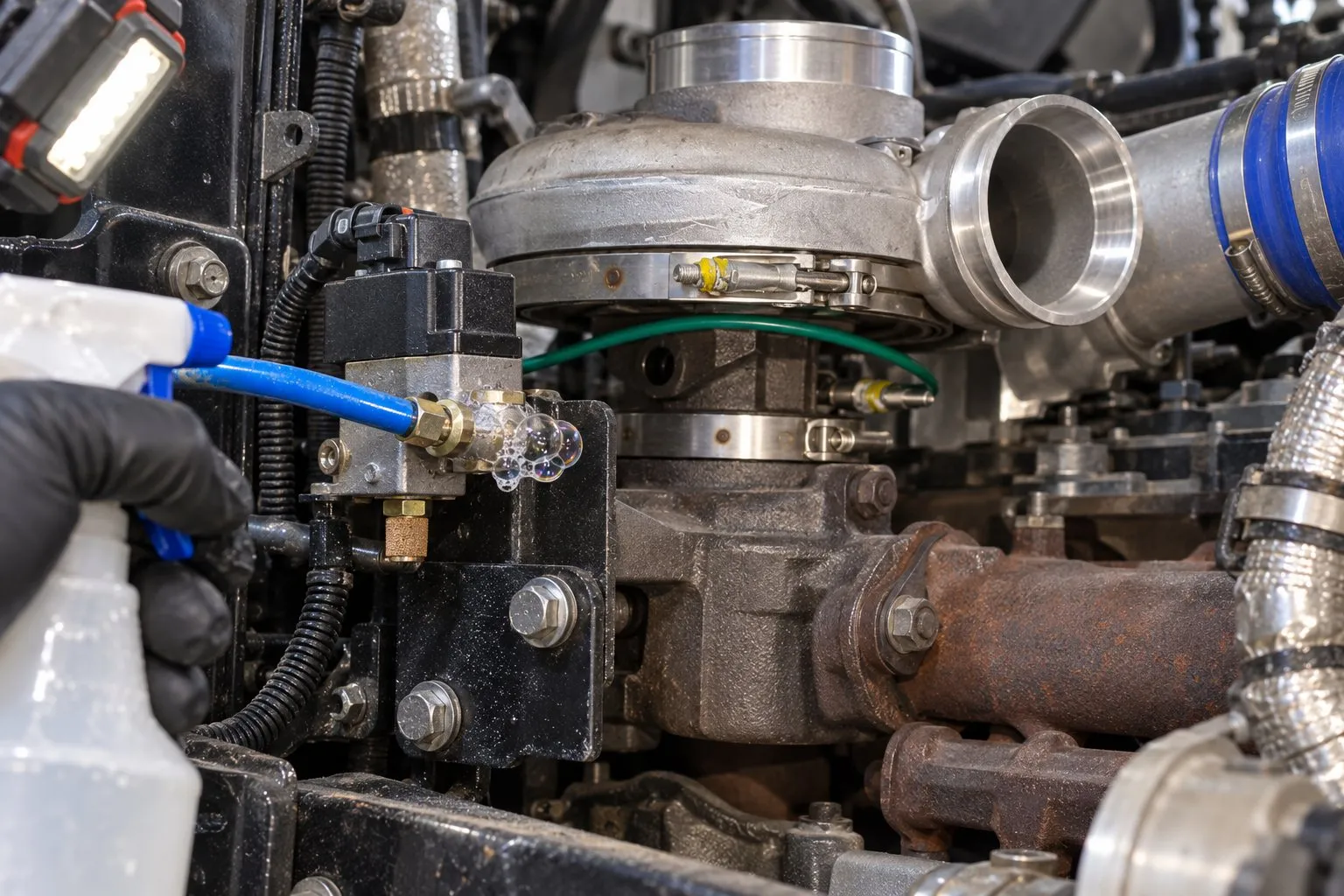
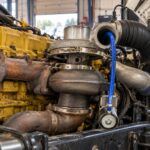
Most turbo failures on any engine trace back to the oil supply, so before you condemn the turbo, check oil level, the feed line, the drain and the air filter. On these Detroit turbos the center housing is cast iron and the shaft rides on journal bearings, so some side-to-side rock is normal with no oil pressure. Condemn the unit for in-and-out play you can feel, wheel contact with the housing, or play beyond Detroit’s limit, never for any movement at all.
- Low boost, slow spool: Look for leaks in the charge piping, the intake and the exhaust before the turbine. On the wastegated trucks, a wastegate solenoid that sticks open or leaks air through to the actuator can hold the gate off its seat (a leak in the actuator or its own air line does the opposite: the gate cannot open and boost can run high). Detroit reports these through SPN/FMI codes, not P-codes, so pull the Detroit faults with a service tool.
- Air-side oil film: A light film in the charge pipes is normal with closed crankcase ventilation. Check the breather and oil level before blaming the compressor seal.
- Turbine-side smoke: Blue-gray oil smoke points to a seal, but confirm the drain is clear and runs downhill into the pan above the oil level. A restricted drain backs oil past the seals.
- Wheel damage: Debris nicks show on the leading edges. A compressor wheel that has shed metal means the charge air cooler should be replaced, because metal in the fins cannot be reliably flushed out.
Because these trucks work hard, cool-down matters. Give the engine a few minutes of idle after a loaded pull or a long grade before shutdown so the bearing housing is not heat-soaking on a dead oil film.
New, Remanufactured, or Rebuild Your Core
You have three sensible paths on a 114SD or 122SD turbo, and the right one depends on downtime and whether you have a good core.
| Option | Best when | Notes |
|---|---|---|
| New turbo | No usable core, want fastest turnkey install | We stock new units; match the tag number |
| Remanufactured | Need a dependable unit without the wait | 12-month unlimited-mileage warranty; 30-day core return |
| Rebuild your core | You have the original and want it back | Most rebuilds ship in 3 days or less |
Our remanufactured turbochargers are balanced and bench-checked, and our turbocharger rebuild service returns your exact unit. For what a rebuild runs on your specific model, see our turbo rebuild price list rather than relying on a number from memory. If you are unsure which turbo you have, send us the data plate number through our contact page or call (909) 824-1020.
If your fleet also runs mid-range Cummins power, our guides on the Cummins ISL turbocharger options and the Caterpillar C9 turbocharger lineup cover the same careful, tag-first approach.
Turbos we list for the HX55 and S410
Listings for the turbo models named in this guide that can be ordered online today. Several part numbers can fit one engine by year and rating, so match the number on your turbo’s tag, or call (909) 824-1020 and we will match it for you.
Frequently Asked Questions
Does the DD13 or DD15 use a variable geometry turbo?
No. The DD13, DD15 and DD16 never used a variable geometry turbocharger. They run fixed geometry or asymmetric fixed geometry turbos, and the DD15 adds a turbo-compound power turbine on many ratings. There are no vanes to relearn on any of them.
How do I know which turbo my 114SD or 122SD needs?
Go by the part number on the turbo’s data plate on the housing, not by the engine badge. Fitment changes with the emissions era (EPA07/10, GHG14, GHG17) and with the DD15 AT versus TC variant, so the tag is the only reliable match. Send us the number and we will confirm it.
Why won’t my DD13 build boost after a wastegate complaint?
On the earlier wastegated DD13 and DD15 AT turbos, the gate is opened by truck air through a solenoid, so a solenoid that sticks open or leaks air through to the actuator can leave the gate unseated and cost you boost, while a leak in the actuator or its air line keeps the gate from opening. Detroit flags this through SPN/FMI faults, so pull them with a Detroit service tool and check the air line and solenoid. GHG17 trucks have no wastegate, so that path does not apply.
Need a Turbocharger?
PT Turbo has rebuilt and sold turbochargers since 1978. We stock remanufactured units for Cummins, Duramax, Power Stroke, Detroit Diesel, and more — backed by a 12-month unlimited mileage warranty. Units in stock at our shop in San Bernardino, CA ship the same day when ordered before 2 PM Pacific, Monday through Friday.
📞 (909) 824-1020 · 346 S I St. #3, San Bernardino, CA 92410 · [email protected]
More From PT Turbo
 Caterpillar C9 Turbocharger Guide: BorgWarner S310 for Machine & Truck Applications
- Ram 2500/3500 5.9L Cummins Turbocharger Guide: HX35, HY35 & HE351CW Explained
- Kenworth T680 Turbocharger Guide: PACCAR MX-13 Replacement & Maintenance
- Caterpillar C15 Turbocharger Guide: Common Failures, Replacement Parts & Cost