Fendt 900 Series Tractor Turbocharger Guide: Deutz & MAN Engine Applications
This Fendt 900 Series tractor turbocharger guide is for the mechanics, dealers and owner-operators who keep these big Vario tractors working. It covers how to identify the turbo on the Deutz and MAN engines Fendt has used in the line, how tractor turbos fail in field work, and how to install a replacement so it lasts. The rule behind all of it: the engine name will not tell you which turbo to order, but the number on the turbo’s tag will.
PT Turbo has been rebuilding turbochargers since 1978, more than 45 years, from our shop in San Bernardino, California. Where a figure depends on your exact engine and rating, this guide tells you where to find it instead of printing a number that may not match your unit.
Deutz and MAN Engines in the Fendt 900 Series
Depending on the generation, a Fendt 900 Series tractor has either a Deutz or a MAN diesel. Within each engine family the turbo can change with the power rating, the emissions stage the tractor was built to, and running changes during production. Two tractors that look identical on the yard can carry turbos that do not interchange.
Deutz and MAN both supply engines for many other machines, and one engine family name often appears with different turbos in different applications. This is normal across off-highway engines. Our Caterpillar C9 turbocharger guide shows one engine family carrying different BorgWarner frames depending on the rating. Use the engine name as a starting point and the turbo tag as the answer.
Before you call anyone about a part, write down three things: the full part number from the turbo tag, the engine serial number from the engine plate, and the tractor model and serial number. With those, a replacement can be matched exactly. Without the turbo number, anyone quoting you a “Fendt 900 turbo” is guessing.
Reading the Turbo Tag
The tag, or data plate, is the only reliable way to identify the turbo. Casting numbers on the housings are not part numbers. One casting is used on many turbos, so a casting number can narrow a search but cannot confirm a match.
| Maker | Part number format | Where to look | What else the tag shows |
|---|---|---|---|
| Holset (Cummins Turbo Technologies) | Seven digits plus a letter suffix | Data plate on the compressor housing | Holset assembly number and the engine maker’s (customer) number as separate fields |
| BorgWarner | Six digits (older S-series) or eleven digits | Tag on the compressor housing | Serial number and, on factory-fitted units, the engine maker’s part number |
| KKK / 3K | Written in 4-3-4 groups, for example 5331-970-7101 | Nameplate on the compressor housing | KKK and 3K are the same company, now part of BorgWarner |
| Garrett | Six digits, a dash, four digits, often a closing S | Nameplate on a housing; position varies by region and plant | First digit after the dash: 0 original equipment, 5 new aftermarket, 9 remanufactured |
The model name on the tag also tells you how boost is controlled, which you need to know before you start testing. On a Holset, a W marks a wastegated unit. A Holset variable geometry model ending in V with no E has an air-operated actuator, and VE and VG models have an electronic actuator. In Garrett GT and GTB names a V marks a variable nozzle turbine. Read the type off the tag before you assume anything about your tractor’s turbo.
Wastegated or Variable Geometry: What to Check
How you diagnose a boost problem depends on the turbo type. A test that suits one type can damage another.
- Fixed geometry, no wastegate: boost follows exhaust flow and there is nothing external to adjust. Faults come from the bearings, wheels and seals, or from the air and oil supply feeding them.
- Wastegated: on a boost-opened pneumatic actuator, a leaking diaphragm makes the gate open late, which gives overboost. A flapper that does not seat lets exhaust bypass the turbine, which gives low boost and slow spool. Pneumatic actuators are tested with a hand vacuum or pressure pump, and the rod is set to the maker’s figure.
- Variable geometry: Garrett and BorgWarner units use pivoting vanes on a unison ring. Holset uses a sliding nozzle. Carbon makes either type stick. A nozzle or vane set stuck closed gives overboost and high drive pressure, and one stuck open gives low boost. You can read more on the principle in this overview of variable-geometry turbochargers.
If your unit has an electronic actuator, never force its arm by hand, because the gearbox is self-locking and the gears break. Unbolt the actuator and move the turbo’s own lever to check for free travel. A replacement electronic actuator is calibrated to its own turbo with a service tool after fitting, following the engine maker’s procedure.
Tractor engine controllers do not report the generic OBD-II underboost and overboost codes used on road vehicles. Read the stored fault codes with the dealer diagnostic tool, and compare commanded and actual boost where the tool shows both. That comparison tells you more than any single code.
How Tractor Turbos Fail in Field Work
Garrett states that more than 90 percent of turbo failures come from oil starvation or oil contamination. Change the oil on the maker’s schedule, or on its severe-service schedule when the tractor works in dust or idles for long periods. Starvation also comes from hard load on a cold engine, blocked or leaking oil pipes, and a turbo that was not primed when it was fitted.
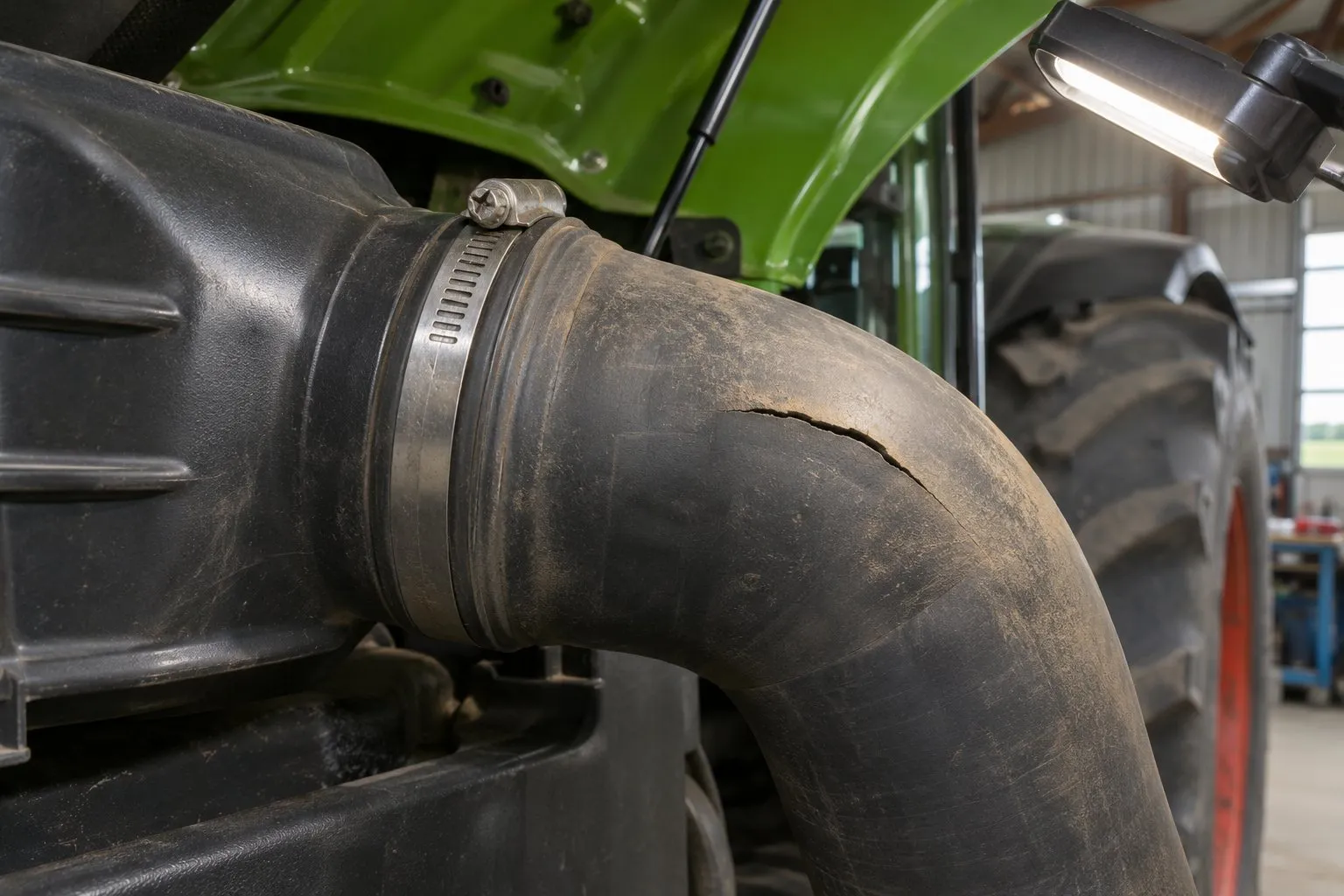
Dust is the other big killer on farm equipment. The pipe between the air filter and the turbo is under suction, so a crack or a loose clamp there pulls unfiltered dirt straight into the compressor. Dust shows up as pitting on the compressor inlet blades. Bent or chipped blades point to impact from a solid object. Replace the filter when the restriction indicator says so, and check every duct and clamp on the clean side at each service.
Heat causes trouble at shutdown. Stopping a hot engine straight after full-load work leaves oil sitting in the hot center housing, where it cokes into carbon that wears the bearings and seals. Long stretches at idle can show oil at the turbine end first, and this usually clears once the engine works under load. On tractors with exhaust aftertreatment, the particulate filter and SCR sit after the turbo. DEF is dosed downstream and cannot foul the turbo.
| Symptom | Likely causes | Check first |
|---|---|---|
| Low power, black or dark gray smoke | Low boost: restricted air filter, charge-air leak, exhaust leak before the turbine (also raises exhaust temperature), wastegate not seating, variable geometry stuck open | Restriction indicator, charge-air pressure test at the engine maker’s test pressure, soot at manifold and turbo flanges |
| Overboost or boost faults under load | Wastegate opening late (leaking diaphragm on a boost-opened actuator, seized linkage), nozzle or vanes stuck closed | Actuator test suited to its type, linkage travel, carbon in the nozzle or vanes |
| Blue-gray smoke, pooled oil in the charge pipes | Crankcase ventilation, restricted air inlet, high oil level, restricted drain, then the turbo seals | Breather, air filter, oil level, drain routing, crankcase pressure against the service manual |
| Whine or siren under load | Exhaust leaks before the turbine, boost leaks, wheel rubbing, bent blades | Every exhaust and charge-air joint, then wheel contact |
| Oil leaking at both ends of the turbo | Restricted drain or high crankcase pressure | Drain tube angle, kinks, entry into the pan above oil level |
| Wheel touches the housing, or in-and-out play you can feel | Bearing failure | Rebuild or replace, then find the oil or air cause |
A light oil film in the intake is normal crankcase vapor. Pooled oil is the warning sign. When you check shaft play, expect some side-to-side movement on a journal bearing turbo with no oil pressure. Condemn it for in-and-out play you can feel, for wheel contact with the housing, or for play beyond the maker’s limit.
Installing the Replacement So It Lasts
A new or rebuilt turbo installed on top of the fault that killed the old one will fail the same way. Find the cause first, then fit the unit carefully. Turbocharger bearings run on a thin oil supply, and most of the steps below protect that supply.
- Fit a new oil feed line after a bearing failure or coked oil. Flushing and reusing the old line risks feeding debris into the new bearings.
- Replace the charge air cooler if the old compressor wheel shed metal. Metal caught in the fins cannot be flushed out reliably. Inspect and clean or replace the charge piping as well.
- Route the drain downhill, within about 15 to 20 degrees of straight down (Garrett), into the pan above the oil level. A restricted drain backs oil up past the seals.
- Use new gaskets, and put no sealant on the oil inlet or drain gaskets.
- Prime the turbo. Fill the oil inlet with clean engine oil and turn the wheel by hand. Crank for 10 to 15 seconds without starting, disabling fueling by the engine maker’s procedure. Then idle for 3 to 4 minutes and check for oil, exhaust and air leaks (Garrett’s installation steps).
- If the turbo has an electronic actuator, run the calibration the engine maker specifies with the service tool.
A turbo does not need a break-in. Once it idles clean with no leaks, warm the engine gently as your operator’s manual describes, then put it to work.
Sourcing a 900 Series Turbo from PT Turbo
The fastest route to a replacement is to search our store and our remanufactured turbochargers by the part number on your turbo’s tag, not by tractor model. Availability for any given number depends on stock and core supply, and current pricing is on each product page. Remanufactured turbos we sell are tested, flow-tested and have their actuators calibrated before they ship.
If the number does not come up, or a replacement is hard to source, our turbocharger rebuild service can rebuild your original in-house. Every turbo we rebuild is balanced on a VSR (Vibration Sorting Rig) and gets a final quality inspection, including a leak test, a visual inspection and a check of the actuator or wastegate function. Most rebuilds ship in 3 days or less. The rebuild price is confirmed after inspection and before work starts, and our turbo rebuild price list shows rates by turbo.
Our turbos carry a 12-month warranty with unlimited mileage. Cores for remanufactured units are returned within 30 days at the customer’s shipping cost. If you need more time, call ahead and we can usually work with you. Operations running several machines can arrange priority or rush turnaround, and stocking of their common cores, by phone. Reach us through the contact page or at (909) 824-1020.
Frequently Asked Questions
Which turbocharger does a Fendt 900 Series tractor use?
There is no single 900 Series turbo. The unit depends on the generation, whether the tractor has a Deutz or a MAN engine, the power rating and the emissions stage. Read the full part number from the tag on the turbo and match that number exactly. Casting numbers only narrow the search. If the tag is missing or unreadable, call (909) 824-1020 with the engine serial number and the tractor serial number.
Is it worth rebuilding the original turbo instead of replacing it?
A rebuild makes sense when the housings are reusable and the damage is limited to the rotating assembly and bearings. A turbine wheel with blade damage is replaced, never rebalanced and reused. At PT Turbo every in-house rebuild is VSR balanced and gets a final quality inspection, the price is confirmed after inspection and before work starts, and most rebuilds ship in 3 days or less.
How long should I idle the tractor before shutting down after heavy work?
Use the cool-down time given in your tractor’s operator’s manual. The time depends on how hard the engine was working, and makers call for less, or none, after light work. The reason for the cool-down is that shutting down hot after full load leaves oil in the hot center housing, where it cokes into carbon that wears the bearings and seals.
Need a Turbocharger?
PT Turbo has rebuilt and sold turbochargers since 1978. We stock remanufactured units for Cummins, Duramax, Power Stroke, Detroit Diesel, and more — backed by a 12-month unlimited mileage warranty. Units in stock at our shop in San Bernardino, CA ship the same day when ordered before 2 PM Pacific, Monday through Friday.
📞 (909) 824-1020 · 346 S I St. #3, San Bernardino, CA 92410 · info@ptturbo.com
More From PT Turbo
 BorgWarner Schwitzer Turbocharger Guide: S-Series, K-Series & KKK Reference
- Turbocharger Boost Pressure: What Numbers Are Normal for Your Diesel
- Mercedes Sprinter Turbocharger Replacement Guide: 2.1L & 3.0L CDI Applications by Year
- Stock vs Performance Turbocharger for 6.0L Powerstroke: Real-World Comparison