
2003-2007 Ram 5.9L Cummins Turbocharger Guide: HY35W, HE341CW & HE351CW
This 2003-2007 Ram 5.9L Cummins Turbocharger Guide covers the factory turbochargers Dodge fitted to the 5.9L 24-valve Cummins in these years, how to tell which one came on your truck, how each is controlled, and what to check before you condemn one. Every turbo in this range is a wastegated, fixed-geometry Holset. The 5.9L Ram never received a variable-geometry turbo, so if someone tries to sell you a VGT for a 2003-2007 5.9L, the fitment is wrong.
PT Turbo has been rebuilding turbochargers since 1978, more than 45 years, and we stock both new and remanufactured turbochargers for these trucks. Before you order anything, the single most important step is to read the number stamped on the data plate on the compressor housing. The engine year narrows it down, but the plate is the final word.
Which turbo did your 2003-2007 Ram come with?
The split in this generation falls right in the middle of the 2004 model year. Early 2003 to early 2004 trucks carry the Holset HY35W, which many sellers list as the HE341CW. From 2004.5 forward, the 5.9L uses the Holset HE351CW, which stayed on the engine until the 5.9L was phased out.
Factory output tracks with the turbo change. The 2003-2004 trucks were rated 235 or 250 hp in standard tune and 305 hp in High Output form. From 2004.5 the rating climbed to 325 hp, which is the HE351CW era.
| Model year | Factory turbo | Geometry | Wastegate control |
|---|---|---|---|
| 2003 to early 2004 | HY35W (also sold as HE341CW) | Fixed, wastegated | Pneumatic wastegate actuator |
| 2004.5 to 2007 | HE351CW | Fixed, wastegated | Pneumatic wastegate actuator; an electronic solenoid valve controls its boost signal |
One common part-number trap: the HE341VE and HE351VE are variable-geometry turbos and do not belong on the 5.9L. The HE341VE was never a Ram turbo, and the HE351VE arrived with the 6.7L Cummins in 2007.5. For that engine, see our 6.7L Cummins turbocharger guide.
The HY35W and the HX-family roots
The HY35W is a wastegated member of the HX35 family running a smaller turbine housing. That smaller housing spools quicker off idle, which is why Dodge fitted the HY35W to 2000-2002 automatic trucks before it became the turbo on all 2003 to early 2004 trucks.
Despite the “W” in the name, the HY35W is not water-cooled. The “W” on these Holset 5.9L turbos means wastegated, and the center section is oil-cooled with no coolant lines. If you are quoting one, check the plate: the HY designation alone does not guarantee a wastegate on every Holset, but on the 5.9L Ram these are wastegated units.
Its wastegate uses a pneumatic actuator with a diaphragm and a rod. You can test that actuator with a hand pressure pump and confirm the rod strokes and the arm moves the flapper. A boost-opened wastegate with a leaking diaphragm opens late, which shows up as overboost, not a soft, lazy top end.
The HE341CW name
Many sellers list the 2003 to early 2004 turbo as the HE341CW; DieselHub calls that name a misidentification of the HY35W, the same fixed-geometry, wastegated Holset. Because both names are used for this window, do not assume the one in the parts book matches the one bolted to your engine. Pull the plate number and match it.
If your early truck needs a replacement and you want help confirming the exact unit, send us the number off the compressor housing. Our team can cross it against what we stock rather than guessing from the model year alone.
The HE351CW: 2004.5-2007 workhorse
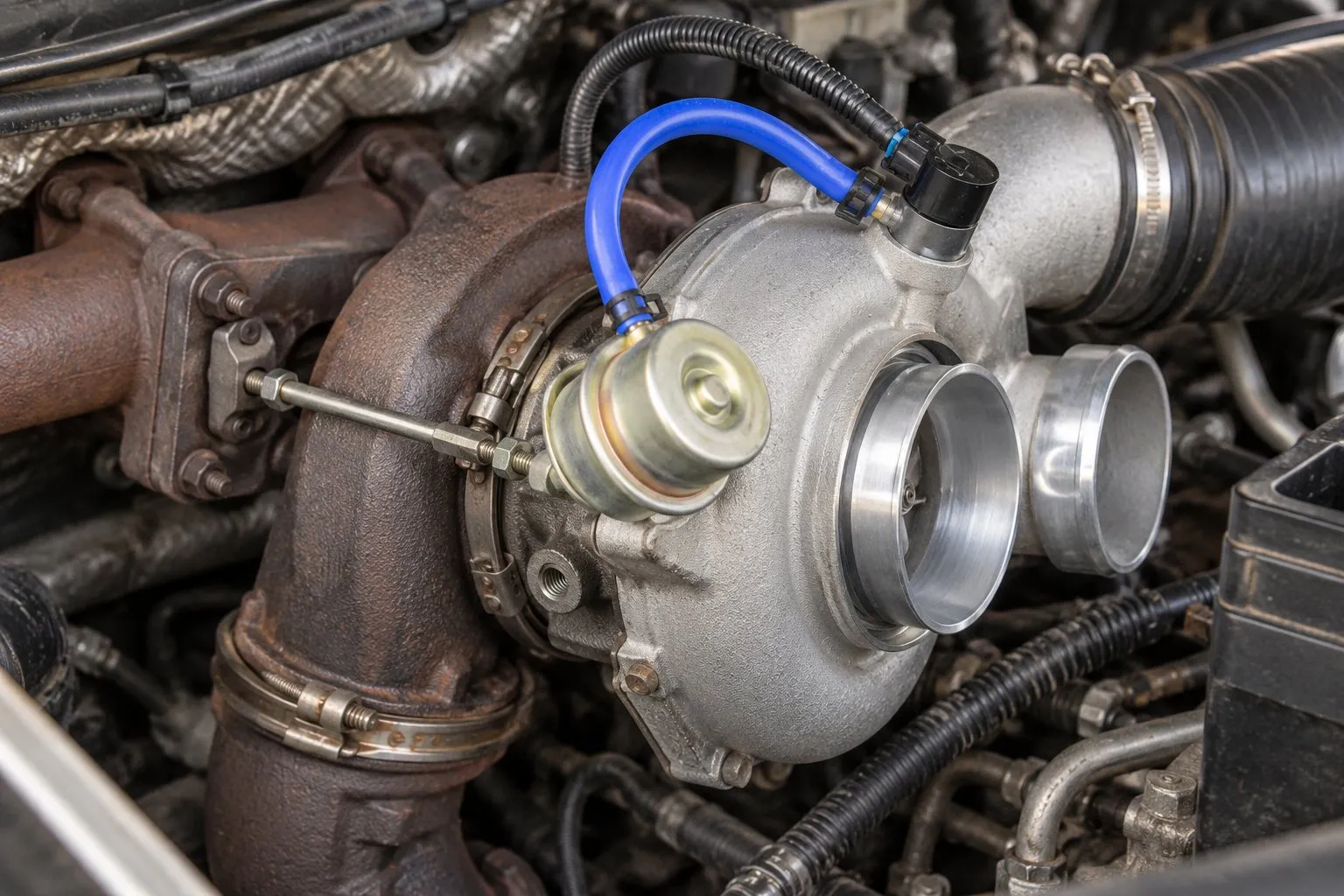
The HE351CW is the turbo most 2003-2007 5.9L owners are searching for, because it covers the biggest slice of production. It is a fixed-geometry Holset with a wastegate, and unlike the earlier pneumatic unit, its wastegate is electronically controlled. That lets the ECM manage boost more precisely across the rev range.
The HE351CW is oil-cooled with no coolant lines, so a swap on this engine does not involve coolant plumbing at the turbo. The turbo bolts to the exhaust manifold with a four-fastener flange in the usual Cummins location, the exhaust outlet uses a V-band clamp and the oil drain a two-bolt flange. For a broader walk-through of these three turbos together, our HX35, HY35 and HE351CW guide lays out the family side by side.
Because the HE351CW is fixed-geometry, there is no vane pack, no unison ring, and no sticking-vane complaint the way you get with a VGT. Its failures are the classic bearing, seal, and wheel-damage story that applies to any wastegated turbo. If you want the full picture of how a turbocharger works, this overview is a solid primer.
Common failures and what to check first
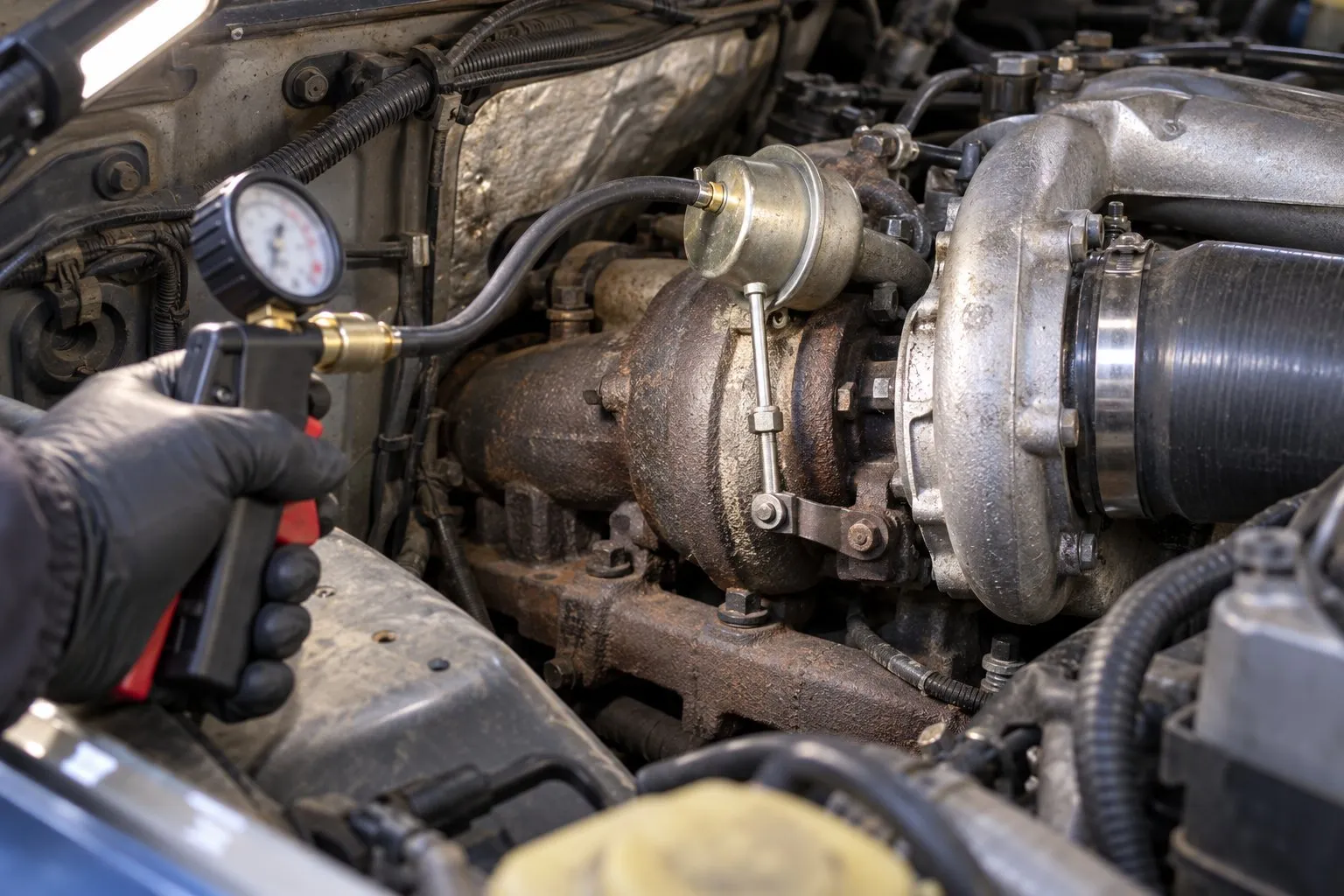
Most turbo failures on these trucks trace back to the oil supply, not to a defect in the turbo. A coked feed line, extended oil-change intervals, or debris in the oil will take out the bearings long before the wheels wear out. When you replace a turbo after a bearing failure, replace the oil feed line too, never reuse it.
Use this table to sort symptoms before you pull anything:
| Symptom | Likely cause | Check before blaming the turbo |
|---|---|---|
| Low boost, slow spool, black smoke | Boost leak, wastegate not seating, or intake restriction | Charge pipes, clamps, air filter, wastegate flapper |
| Overboost | Wastegate opening late, leaking actuator diaphragm (pneumatic units) | Actuator rod travel, wastegate linkage |
| Oil film in charge pipes | Often normal crankcase ventilation, sometimes compressor seal | Breather, air filter, oil level, drain before the seal |
| Blue-gray smoke | Oil past a seal, or engine wear | Drain line, crankcase pressure, oil consumption |
| Rattle or felt in-and-out shaft play | Worn thrust or journal bearings | Wheel contact with housing (the real test) |
Some side-to-side play at the wheel nose is normal on a journal-bearing turbo, especially with no oil pressure. Condemn the unit for in-and-out play you can feel, for wheel contact with the housing, or for play beyond Holset’s limit, not for any movement at all. If a compressor wheel has shed metal into the charge system, replace the intercooler as well, because that debris cannot be reliably flushed out of the fins.
New, remanufactured, or rebuild your core?
You have three good paths on a 2003-2007 5.9L turbo, and the right one depends on your downtime and your core. A new turbo gets you a fresh unit with no core hassle. A remanufactured unit returns your truck to service for less while your old turbo becomes the core. Rebuilding your exact core keeps your original housings and matching.
- New: fresh unit, no core to return, quickest to drop in.
- Remanufactured: balanced on a VSR, new bearings and seals, core return within 30 days (you pay return shipping).
- Rebuild your core: we restore your own turbo through our turbo rebuild service; most rebuilds ship in 3 days or less.
We do not list rebuild prices in text because our catalog is the source of truth, and the rebuild price is confirmed after inspection and before any work starts. See the current numbers on our turbo rebuild price list, or call us at (909) 824-1020. Every rebuild and reman carries our 12-month, unlimited-mileage warranty, and fleet customers can arrange priority turnaround by phone.
Whatever route you choose, send us the plate number first. On a quick call we can confirm HY35W, HE341CW, or HE351CW and ship the right part the first time.
More on the 2003-2007 Ram 5.9L Cummins Turbocharger Guide
If you are considering a VGT swap or stepping up to the 6.7L platform, understand the hardware difference first. The 5.9L turbos here are all fixed-geometry and wastegated; the 6.7L moved to variable-geometry with an electronic actuator that must be calibrated to the turbo. That is a different install and a different troubleshooting process entirely.
For most 2003-2007 owners, the smart move is to stay with the correct factory-style turbo for the build, feed it clean oil, and keep the oil feed and drain lines honest. Do that and these Holset units run a long time.
Turbos we list for the HY35W and HE351CW
Listings for the turbo models named in this guide that can be ordered online today. Several part numbers can fit one engine by year and rating, so match the number on your turbo’s tag, or call (909) 824-1020 and we will match it for you.
Frequently Asked Questions
Is the 2003-2007 Ram 5.9L Cummins turbo a VGT?
No. Every factory turbo on the 2003-2007 5.9L is a fixed-geometry, wastegated Holset: the HE341CW or HY35W on early trucks and the HE351CW from 2004.5 on. The variable-geometry HE341VE and HE351VE do not belong on this engine, so verify the number on the data plate before you order.
How do I know whether I have an HY35W, HE341CW, or HE351CW?
Go by the number stamped on the data plate on the compressor housing, not just the model year. The early-2003 to early-2004 window used the HY35W (many sellers list it as the HE341CW), while 2004.5 through 2007 trucks used the HE351CW. If you are unsure, read us the plate number at (909) 824-1020 and we will confirm it.
Do these 5.9L Cummins turbos use coolant lines?
No. The HY35W, HE341CW, and HE351CW on the 5.9L Ram are oil-cooled with no coolant lines, so a replacement does not involve coolant plumbing at the turbo. The 6.7L HE351VE and HE300VG, by contrast, do have coolant lines for their electronic actuators.
Shopping by part number?
Every part number we stock for the Holset HY35W and Holset HE351CW is on one page, with live prices and stock: Holset HY35W turbos and parts · Holset HE351CW turbos and parts.
Need a Turbocharger?
PT Turbo has rebuilt and sold turbochargers since 1978. We stock remanufactured units for Cummins, Duramax, Power Stroke, Detroit Diesel, and more — backed by a 12-month unlimited mileage warranty. Units in stock at our shop in San Bernardino, CA ship the same day when ordered before 2 PM Pacific, Monday through Friday.
📞 (909) 824-1020 · 346 S I St. #3, San Bernardino, CA 92410 · [email protected]