P2263 on Ford 6.7L Powerstroke: Turbo Boost System Performance Fix
If your truck has thrown P2263 on Ford 6.7L Powerstroke, the code is telling you that the turbo boost system is not performing the way the PCM commanded, meaning actual boost has drifted too far from the target the computer expected. P2263 is the generic “Turbo/Supercharger Boost System Performance” code, and on the 6.7L it points you toward the turbocharger, the charge-air plumbing, and the exhaust side rather than any single failed part. This guide walks through what the code means on this engine, which model years actually set it, what to check in order, and when a variable-geometry turbo needs cleaning, rebuilding, or replacement.
PT Turbo has been rebuilding turbochargers since 1978, more than 45 years, and stocks both new and remanufactured diesel turbo parts. The goal here is to help you diagnose before you spend, because a boost performance code is almost never the turbo’s fault alone.
What P2263 Actually Means on the 6.7L
P2263 is a boost system performance fault, not a sensor circuit fault and not a hard overboost or underboost code. The PCM compares the boost it asked for against the boost (manifold pressure) it measured, and when the difference stays outside its window long enough, it sets P2263.
Because it is a performance code, the cause can live anywhere in the air path: a leak after the compressor, a restriction, a lazy variable-geometry nozzle, or an exhaust leak ahead of the turbine that slows spool. The code does not name the part for you. On a 6.7L Power Stroke, the common related codes are the real diagnostic signposts, and they differ by model year.
One thing to get straight up front: the 6.7L is a high-pressure common-rail engine. It has no ICP sensor and no IPR valve. Those belong to the HEUI fuel system on the older 6.0L Power Stroke. If a chart or a forum tells you to check an ICP sensor for a 6.7L boost code, that advice is for the wrong engine.
Which 6.7L Trucks Set P2263
Here is a detail most write-ups miss. Ford’s own OBD system operation summaries for the 2011 and 2016 model-year 6.7L do not list P2263 at all. On those earlier trucks the boost-related codes Ford documents are different. The 2023 summary does list P2263 as “Turbocharger ‘A’ Boost System Performance,” which ties the code to the later trucks that use the electronically actuated turbo.
So if you are chasing a boost complaint on a 2011-2016 truck, expect the codes Ford lists for it rather than P2263. If you are on a later truck, P2263 belongs in the picture. Match the code you actually have to your model year before you start throwing parts at it.
| 6.7L model years | Factory turbo | VGT control | Documented boost-related codes |
|---|---|---|---|
| 2011-2014 (pickup) | Garrett GT32 SST (double-sided compressor) | Engine oil moves the vanes through a PCM-driven VGT solenoid; no electric vane actuator, no vane position sensor | P0299, P0234, P1247, P132B, P026A |
| 2015-2016 (pickup) | Garrett GT37 (AVNT3788) | Oil-moved vanes through a PCM-driven VGT solenoid; no vane position sensor | P0299, P0234, P1247, P132B, P026A |
| Later trucks (electronic actuator) | Garrett with electronic vane actuator and position sensor | Electronic vane actuator; a vane position learn is required after replacement | P2263, P0234, P0299, P026A and related |
The change from oil-operated vanes to an electronic actuator happened from the 2020 model year. If your truck has the electronic actuator, a position learn with a capable scan tool is part of any turbo or actuator service. On the 2011-2019 oil-operated trucks there is no electric vane actuator to replace and no “commanded versus actual vane position” to read, because those trucks have no vane position sensor.
How the 6.7L Variable-Geometry Turbo Works
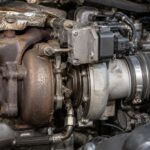
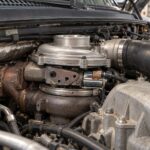
The Garrett turbo on the 6.7L is a variable-geometry turbocharger. A ring of movable nozzle vanes changes the angle of exhaust gas hitting the turbine wheel, which lets one turbo behave small for quick spool at low rpm and open up for airflow up top.
On 2011-2019 trucks the PCM commands a VGT solenoid, and engine oil pressure moves a piston inside the turbo that swings the vanes. There is no external electric actuator on those years. From 2020 an electronic actuator positions the vanes and reports back through a position sensor. Either way, when the vanes do not move to the commanded position, measured boost will not match the target, and a performance code follows.
Soot and carbon on the vanes and unison ring are a common cause of sticking. On a high-pressure-EGR engine like this one, EGR gas is routed back to the intake downstream of the compressor, so EGR carbon cannot land on the compressor wheel. What it does do is add soot to combustion, and the exhaust side of a hard-working diesel will gum the vanes over time.
Diagnosing P2263: Check These Before You Condemn the Turbo
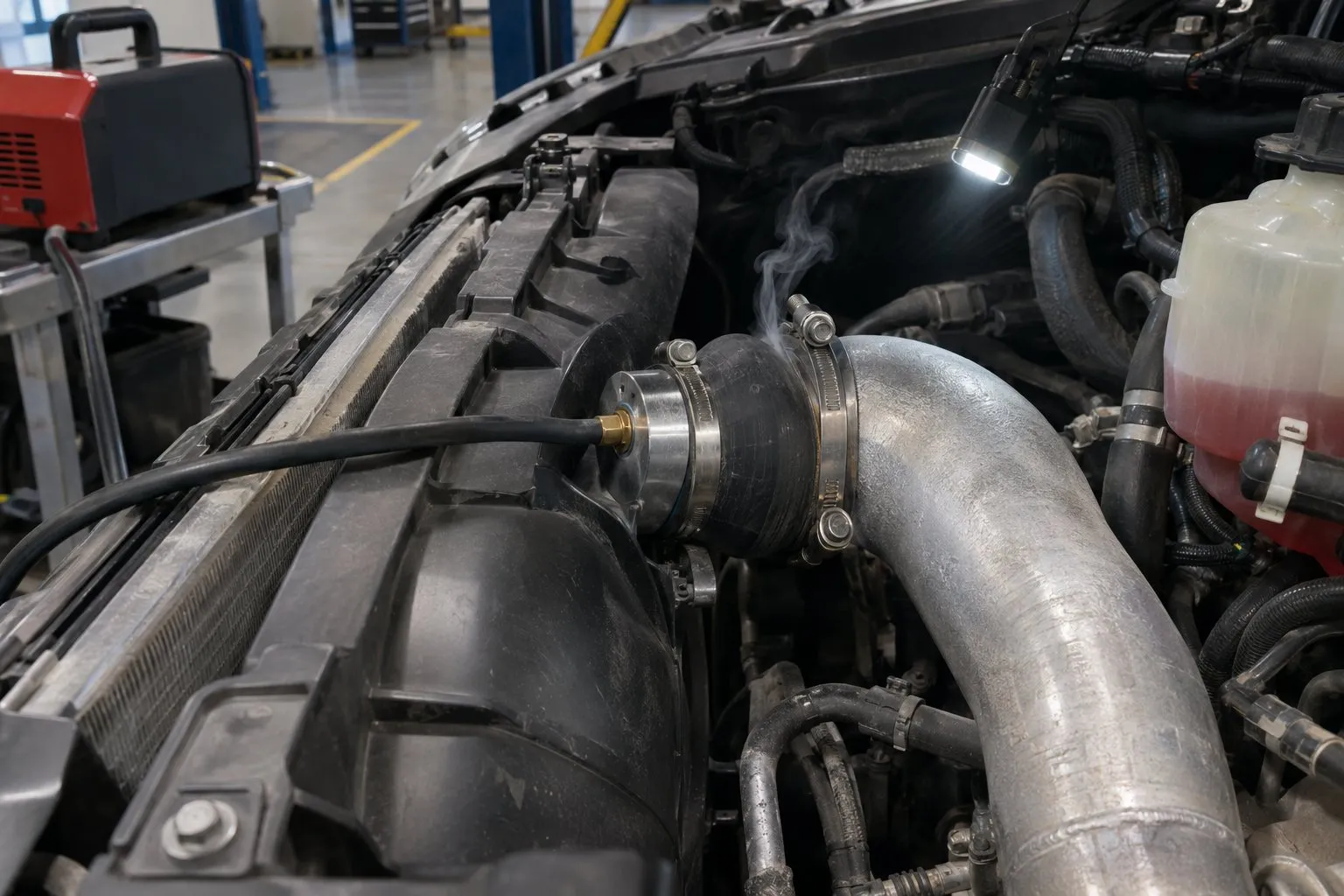
Work the air path from easy to hard. Most boost performance faults are leaks and restrictions, not a dead turbo. Garrett states that more than 90 percent of turbo failures trace back to oil starvation or oil contamination, so the turbo itself is usually not the first thing wrong.
- Boost versus commanded: Log desired boost and actual boost on a scan tool. A steady gap is your starting point. Do not chase a published “stock PSI” number; no maker publishes one, and the useful measurement is desired versus actual on your truck.
- Charge-air leaks: Inspect every intercooler boot, clamp, and charge pipe. A leak after the compressor makes the turbo spin harder to reach target and can still miss it. Boots are fitted clean and dry; oil-soaked or spongy boots blow off under boost.
- Exhaust leaks ahead of the turbine: A leak in the up-pipes or at the manifold lets exhaust escape before the turbine, which slows spool and lowers boost. It does not raise backpressure; it bleeds energy away from the turbine.
- Exhaust backpressure and the VGT: Read exhaust backpressure and command the VGT through its range. Vanes stuck closed give high drive pressure and overboost; stuck open give low boost. Sluggish response points at carbon, the solenoid or actuator, or the oil supply on the earlier trucks.
- Charge air cooler: A cracked or leaking cooler drops manifold boost across the core. If the turbo ever shed metal into it, the cooler should be replaced, because debris in the fins cannot be reliably flushed out and goes straight into the engine.
Ford has no published bulletin that gives a P2263 trigger threshold on the 6.7L, so do not expect an exact PSI or time window for the code. Treat it as a direction to investigate the air path, and let the live data tell you which side is wrong.
Cleaning, Rebuilding, or Replacing the Turbo
If the vanes are sticking from carbon and the bearings are sound, cleaning the nozzle ring can restore normal response. Wet the vanes and unison ring with the cleaner the maker specifies and keep solvent out of the center bearing housing. On the electronic-actuator trucks, never move the actuator arm by hand; the gears are self-locking and break. Sweep it with a scan tool instead.
If you find shaft play beyond the maker’s limit or wheel contact with the housing, the cartridge is worn and the turbo needs a rebuild or replacement. Oil in the charge pipes alone does not prove a failed compressor seal: check the crankcase breather, air filter, oil level and oil drain first. Some side-to-side rock is normal on a journal-bearing turbo with no oil pressure; condemn it for in-and-out play you can feel, wheel contact, or play past the limit, not for any movement at all.
When you replace the turbo, fit a new oil feed line after any bearing failure or coked oil rather than flushing and reusing the old one, and never add sealant to the oil inlet or drain gaskets. For a comparison of restoring your core versus buying a unit outright, see the differences below.
| Option | What you get | Best when |
|---|---|---|
| In-house rebuild of your turbo | Your core restored with new bearings, seals and thrust parts, VSR balanced before it ships | Your housings are good and you want to keep your original unit |
| Remanufactured turbo | A ready-to-fit reman unit with a 30-day core return and a 12-month unlimited-mileage warranty | You need the truck back fast and have a core to send |
| New turbo | A new unit, no core to return | You want new, or no usable core exists |
Most rebuilds ship in 3 days or less, and the rebuild price is confirmed after inspection and before any work starts. For real numbers by model, see our turbo rebuild price list or read more about the rebuild service. For current pricing on a specific unit, check its product page or call (909) 824-1020.
The 6.7L turbo was never a BorgWarner; it has been a Garrett in every year. The BorgWarner compound pair belonged to the earlier 6.4L Power Stroke. If you need to confirm what sits on your truck, go by the part number on the turbo’s data plate, not a casting number or a forum chart.
Turbos we list for the Ford 6.7L Power Stroke
Listings whose own fitment data names the Ford 6.7L Power Stroke, orderable online today. Several part numbers fit one engine by year, rating and vehicle, so match the number on your turbo’s tag, or call (909) 824-1020 and we will match it for you.
Frequently Asked Questions
Does P2263 mean my 6.7L turbo is bad?
Not by itself. P2263 says boost did not meet the commanded target, which can come from a charge-air leak, an exhaust leak ahead of the turbine, a restricted or leaking intercooler, or sticking VGT vanes. Log desired versus actual boost and inspect the air path before you condemn the turbo.
Why don’t my 2011-2016 scans show P2263?
Ford’s OBD summaries for the 2011 and 2016 6.7L do not list P2263. On those years you are more likely to see codes such as P0299, P0234, P1247, P132B or P026A. P2263 is documented on the later trucks with the electronic vane actuator, so match the code to your model year.
Do I need to calibrate the turbo after replacement?
It depends on the year. On 2011-2019 trucks the vanes are moved by engine oil through a PCM-driven solenoid, with no electric actuator or vane position sensor to calibrate. From 2020 the turbo has an electronic actuator with a position sensor, and a vane position learn with a capable scan tool is required after the turbo or actuator is replaced.
Need a Turbocharger?
PT Turbo has rebuilt and sold turbochargers since 1978. We stock remanufactured units for Cummins, Duramax, Power Stroke, Detroit Diesel, and more — backed by a 12-month unlimited mileage warranty. Units in stock at our shop in San Bernardino, CA ship the same day when ordered before 2 PM Pacific, Monday through Friday.
📞 (909) 824-1020 · 346 S I St. #3, San Bernardino, CA 92410 · [email protected]