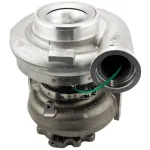
The Detroit DD13 turbocharger is a fixed geometry turbo, and that shapes everything about how it fails and how it is diagnosed. The 12.8L DD13 in a Freightliner Cascadia, M2, 114SD or Western Star has never used a variable geometry turbo, so there are no vanes to stick and no VGT actuator to replace. What it has instead is Detroit’s asymmetric turbo, which is built around the EGR system. That is why so many DD13 “turbo” complaints turn out to be EGR, charge air or wastegate problems.
This guide covers how the DD13 turbo works, the symptoms of a failing one, how the EGR system and the turbo affect each other, and the replacement and rebuild options.
How the DD13 Turbocharger Works
The DD13 uses one turbocharger and, unlike some versions of its larger sibling the DD15, no turbo-compound unit. The turbo changed with the emissions generations:
| DD13 generation | Turbocharger | Boost control |
|---|---|---|
| EPA10 | Detroit asymmetric turbo, fixed geometry | No moving vanes; wastegate moved by air pressure |
| GHG14 (2013 on) | Detroit asymmetric turbo (BorgWarner B3G) | Wastegate moved by air pressure through a control solenoid |
| GHG17 | Detroit asymmetric turbo | No wastegate |
| Gen 5 | Asymmetric fixed geometry turbo, with a ball bearing version for on-highway ratings | Fixed geometry |
“Asymmetric” describes the turbine housing. It has two passages of different size. Half of the cylinders feed the smaller passage, which backs up enough exhaust pressure to push EGR gas into the intake. The other cylinders feed the larger passage and breathe freely. The design gives the engine the EGR flow it needs without the moving vanes of a variable geometry turbo, which is the reason Detroit chose it.
DD13 Turbocharger Failure Symptoms
| Symptom | Likely cause | Stage |
|---|---|---|
| Low power, slow to build boost | Boost leak, wastegate held open (GHG14), EGR valve stuck open | Early |
| Low intake manifold pressure code (SPN 102) under load | Wastegate air leak or solenoid (GHG14), charge air leak, worn turbo | Early to moderate |
| Black smoke under load | Too little boost for the fuel delivered | Moderate |
| Derate | Boost out of range, EGR or aftertreatment fault | Moderate to severe |
| Whistle, whine or siren | Boost leak, or wheel clearance closing up as the bearings wear | Severe |
| Blue smoke, oil in the charge pipes | Worn bearings and seals, restricted oil drain | Severe |
| Grinding, shaft play you can feel | Bearing failure, wheel contact with the housing | Stop running it |
The code that sends most DD13 turbos to the bench is the low-boost version of SPN 102. On a GHG14 engine Detroit’s own procedure for it checks the air filter, the intake piping, the pressure sensors and the charge air cooler first, then goes to the wastegate: the linkage, the actuator, the solenoid that controls it and the air line that feeds it. An air leak there holds the gate off its seat and keeps boost low with nothing wrong inside the turbo. Detroit issued a service bulletin on it because good wastegate solenoids were being replaced for what was an air leak.
The EGR Connection
The DD13 runs cooled, high-pressure EGR: exhaust is taken off ahead of the turbine, cooled, and fed into the intake. The asymmetric turbine housing exists to drive that flow. So the two systems share exhaust pressure, and a fault in one shows up in the other.
- An EGR valve stuck open takes exhaust energy away from the turbine and fills the intake with exhaust. Boost drops, smoke rises, and the truck feels like it has a weak turbo.
- A plugged EGR cooler cuts EGR flow; the engine sets EGR flow faults and derates, which is often read as a turbo problem.
- A leaking EGR cooler lets coolant into the gas stream, which is hard on the turbine and on the aftertreatment.
- Soot from poor combustion or failed regenerations loads the diesel particulate filter. Backpressure rises, turbine temperature rises, and bearing and seal life falls.
This is why a DD13 turbo should not be replaced before the EGR valve, the EGR cooler and DPF pressure have been checked. Our guides on how a failed EGR system damages a turbocharger and EGR cooler failure and turbo damage cover the mechanisms in detail.
Replacement Options: New, Remanufactured or Rebuild
| Option | Price at PT Turbo | Best for |
|---|---|---|
| New turbocharger | $1,249 to $3,814 (2 listings) | Trucks that cannot wait, or cores too damaged to rebuild |
| Remanufactured turbocharger | $3,283 to $3,284 (2 listings), including a refundable core deposit | Out-of-warranty trucks with a core to return |
| Rebuild of your own turbo | From $575 (price list) | A sound core with worn bearings and seals |
Prices are read from the live catalog and the shop price list. DD13 turbos PT Turbo lists today:
- Detroit Diesel remanufactured turbocharger RA4710907280 (Cascadia, 122SD, Western Star 4800, 4900 and 5700).
- Detroit Diesel remanufactured turbocharger RA4710907180 (M2, 114SD, Western Star 4700).
- Detroit Diesel turbocharger EA4710962199 for the DD13 471901 in the Cascadia.
- BorgWarner B3G 13879880047 and 13879880050, the BorgWarner numbers for the asymmetric DD13 turbo.
The versions do not interchange, so order by the number on the turbo tag. If it cannot be read, contact PT Turbo with the engine serial number and we will confirm the part.
For a rebuild, our turbocharger rebuild service inspects the core and confirms the price before any work starts. Every rebuild is VSR balanced and carries a 12-month unlimited-mileage warranty; turnaround is 3 to 5 business days after inspection. See the Detroit Diesel turbo rebuild page.
Installation Parts
Reused gaskets and a dirty oil feed line are the usual reasons a fresh turbo comes back. Installation kits are listed by turbo part number (the two Detroit Diesel kits in the catalog, 172-784-0439 and 172-784-0438, are for DD15 turbos): send us the number on your DD13 turbo and we will match the kit. Prime the turbo with clean oil at the feed port before the first start, and make sure the drain is clear and not kinked.
Diagnostic Checklist Before You Replace
- Read active and stored codes with DiagnosticLink and note each SPN and FMI.
- Pressure test the charge air system: pipes, clamps and the charge air cooler. Our boost leak test guide shows how.
- On a GHG14 engine, check the wastegate actuator, its solenoid and the air line for leaks, and confirm the gate moves.
- Check the turbo shaft for play by hand and look at both wheels for contact marks, chipped blades or oil.
- Confirm the oil feed line is clear and the drain is not restricted.
- Test the EGR valve and check the EGR cooler for plugging or coolant loss.
- Confirm the truck completes regenerations and DPF pressure is in range.
Work the list in order and rule out the cheap faults first. The turbo is done when the shaft, the wheels or the housings say so, not when a boost code does. For the rest of the Detroit range in the same truck, see our Freightliner Cascadia turbocharger guide.
Price ranges in this article are general estimates to help with budgeting, not PT Turbo quotes. Our current prices are on each product listing, and our rebuild prices are on the turbo rebuild price list.
Frequently Asked Questions
Does the Detroit DD13 have a variable geometry turbo?
No. The DD13 uses a fixed geometry turbocharger. It is Detroit’s asymmetric turbo, with an air-operated wastegate on EPA10 and GHG14 engines and none on GHG17 engines. There are no moving vanes and no VGT actuator.
What are the symptoms of a failing Detroit DD13 turbocharger?
Loss of power under load, black or blue smoke, a whine or grinding noise from the turbo, oil in the charge pipes, derates and low intake manifold pressure codes. Boost leaks, wastegate air leaks on GHG14 engines and EGR faults cause the same symptoms and should be ruled out first.
How does the DD13 turbocharger interact with the EGR system?
The asymmetric turbine housing is built to drive EGR flow: half of the cylinders feed a smaller passage that backs up exhaust pressure for the EGR system. Because the two share exhaust pressure, an EGR valve stuck open lowers boost, and exhaust restriction shortens turbo life.
What are the replacement options for a Detroit DD13 turbocharger?
A new turbocharger, a remanufactured unit with a refundable core deposit, or a rebuild of your own turbo. A rebuild is the lowest cost when the housings and wheels are sound.
Further reading: Learn more about exhaust gas recirculation.
Need a Turbocharger?
PT Turbo has rebuilt and sold turbochargers since 1978. We stock remanufactured units for Cummins, Duramax, Power Stroke, Detroit Diesel, and more — backed by a 12-month unlimited mileage warranty and same-week shipping from San Bernardino, CA.
📞 (909) 824-1020 · 346 S I St. #3, San Bernardino, CA 92410 · [email protected]
More From PT Turbo
 Detroit DD15 Turbocharger: Failure Signs, Common Problems & Best Replacements
- Caterpillar C15 Turbocharger Guide: Common Failures, Replacement Parts & Cost
- Cummins ISL Turbocharger Guide: HX40W, HE431V & HE400VG by Engine Version
- Caterpillar C9 Turbocharger Guide: BorgWarner S310 for Machine & Truck Applications