Cummins ISX vs Detroit DD15 Turbocharger Reliability: Fleet Comparison
Any honest look at Cummins ISX vs Detroit DD15 turbocharger reliability has to start with one basic fact: these two engines take opposite approaches to boosting a 15-liter diesel, and that single design choice drives most of what a fleet will ever spend on turbo repairs. The ISX leans on a variable geometry Holset that changes its own flow with a sliding nozzle. The DD15 runs a fixed geometry turbo and, for most of its life, backs it up with a turbo-compound power turbine instead of variable vanes.
Understanding which parts move, which parts wear, and which codes point at the turbo is what keeps a truck out of a derate. PT Turbo has been rebuilding turbochargers since 1978, more than 45 years, and stocks both new and remanufactured units for both platforms. Here is how the two systems compare on the bench and in service.
How the Cummins ISX turbocharger evolved
The ISX (14.9L, later X15) went through several turbo generations as emissions rules tightened. Before EGR, through 2002, the engine used a fixed geometry wastegated Holset, either the Holset HX55 family or the HX60. These are simple, robust units with few moving parts beyond the wastegate.
With the CM870 controls of 2003 to 2007, Cummins went variable geometry with the Holset HE551V. This is an important one to get right: the HE551V uses a sliding nozzle moved by an air-operated actuator, fed by truck air through a turbocharger control valve. There is no electronic actuator and no calibration routine on this turbo.
The 2007 emissions engines (CM871) moved to an electronic actuator with the HE561VE and the HE551VE on some ratings. From 2010, the ISX15 and X15 (CM2250, CM2350) carry the HE451VE or the later HE400VG. The two look alike but do not interchange: they have different compressor covers and actuators. Always go by the number on the turbo’s data plate, not by the engine name.
How the Detroit DD15 turbocharger differs
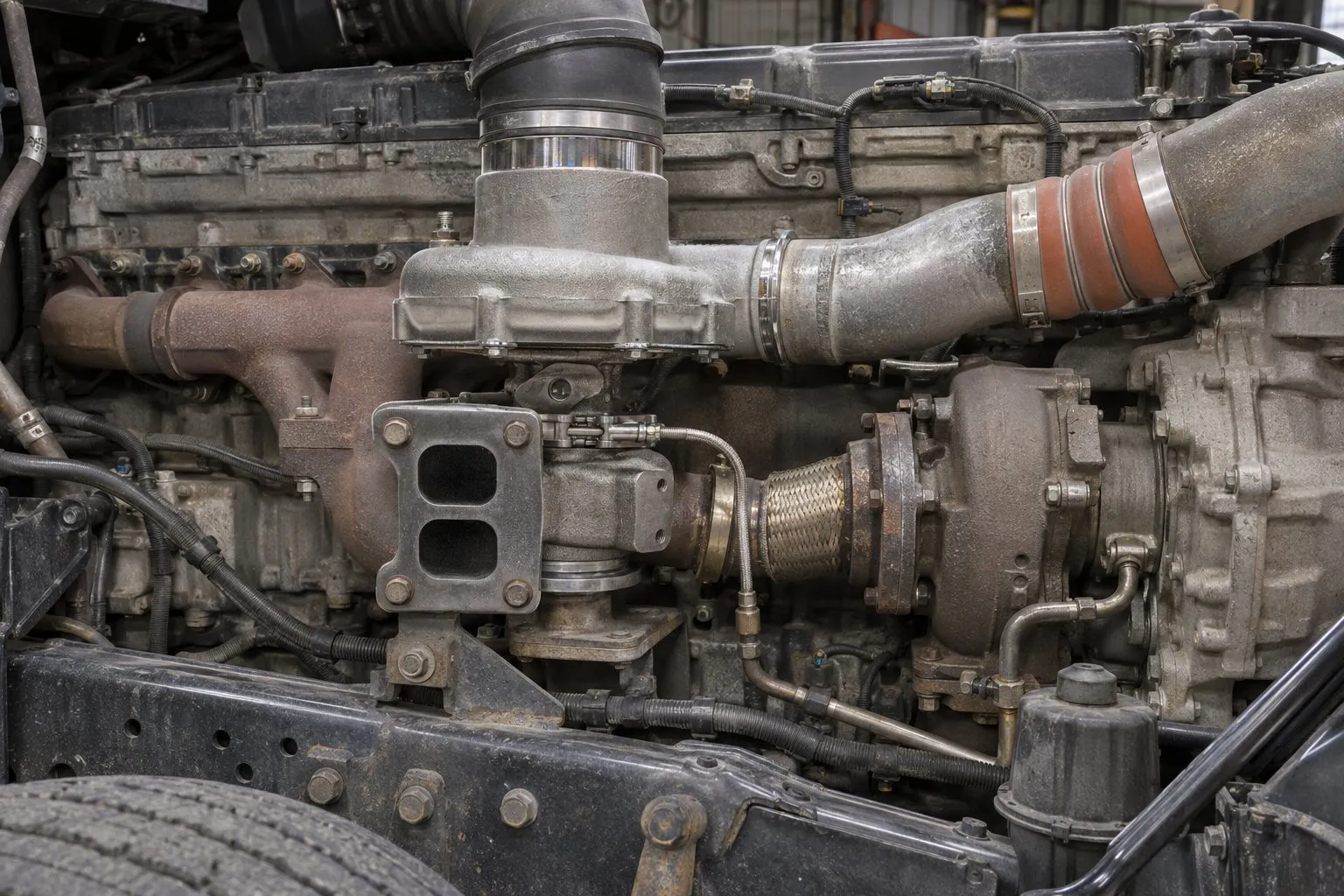
The DD15 never used a variable geometry turbo. There are no vanes, no unison ring, and no VGT actuator anywhere on this engine. Detroit chose a fixed geometry turbocharger and solved the low-end response problem a different way.
On EPA07 and EPA10 DD15 engines, the turbo is a fixed geometry Holset HX55-type unit with no wastegate, paired with a turbo-compound power turbine geared back to the crankshaft. That power turbine recovers exhaust energy that a conventional engine throws away. The Garrett GT4594S replaces the same Holset numbers on these engines.
From GHG14 (2013), the DD15 AT (Advantage) adopted an asymmetric fixed geometry turbo with an air-operated wastegate, while the DD15 TC kept turbo-compound. GHG17 engines run the asymmetric turbo with no wastegate. For replacement, PT Turbo lists BorgWarner S410 57889882400 (2017-2022), BorgWarner 57909882500, and the Garrett GT4594S 887393-5005S. These S410-family numbers are replacement units, not the factory part and not a performance upgrade.
One caution for anyone cross-shopping parts: the variable geometry Detroit turbos (Garrett GTA4502V, Holset HE531VE) belong to the EGR-era Series 60, not the DD15. Do not fit a Series 60 VGT to a DD15.
Side-by-side turbo comparison
| Feature | Cummins ISX / X15 | Detroit DD15 |
|---|---|---|
| Turbine control | Variable geometry (sliding nozzle) on EGR engines; fixed/wastegated before EGR | Fixed geometry; wastegate on GHG14 AT, none on EPA07/EPA10 and GHG17 |
| Energy recovery | None (VGT only) | Turbo-compound power turbine on many ratings |
| Actuator type | Air-operated (HE551V); electronic on VE/VG models | Air-operated wastegate actuator, its air supplied through an electric solenoid (GHG14 AT); none on others |
| Moving parts to fail | Nozzle ring, actuator, control valve | Wastegate linkage/solenoid, plus power turbine gear train where fitted |
| Calibration after service | Required on electronic actuators (INSITE) | Not required (fixed geometry) |
Cummins ISX vs Detroit DD15 turbocharger reliability in the field
The reliability tradeoff comes down to complexity versus simplicity. The ISX’s variable geometry turbo gives excellent response and controls backpressure for EGR, but the sliding nozzle and its actuator are extra things that can stick or fail. Soot buildup can slow nozzle movement, and the electronic actuator on VE and VG units is a wear item.
On an EGR engine, remember that high-pressure EGR is taken before the turbine and returned to the intake; it does not pass back through the vanes. Extra EGR only loads the nozzle indirectly, through additional combustion soot in the exhaust stream. Keeping EGR flow correct helps keep the nozzle clean.
The DD15’s fixed geometry turbo has fewer moving parts and no vanes to carbon up, which is a genuine durability advantage. The complexity instead lives in the turbo-compound power turbine and its gear train, and in the air-operated wastegate on GHG14 engines. Detroit has published bulletins on wastegate solenoid air leaks, which show up as boost and air-system fault codes rather than a dead turbo.
Across both engines, most turbo failures still trace back to the oil supply, not the turbine design. A coked feed line, delayed oil at startup, or contaminated oil kills bearings regardless of brand. The center housing on either turbo is cast iron, and the bearings need clean, pressurized oil every time the shaft spins.
Diagnosing and servicing each turbo
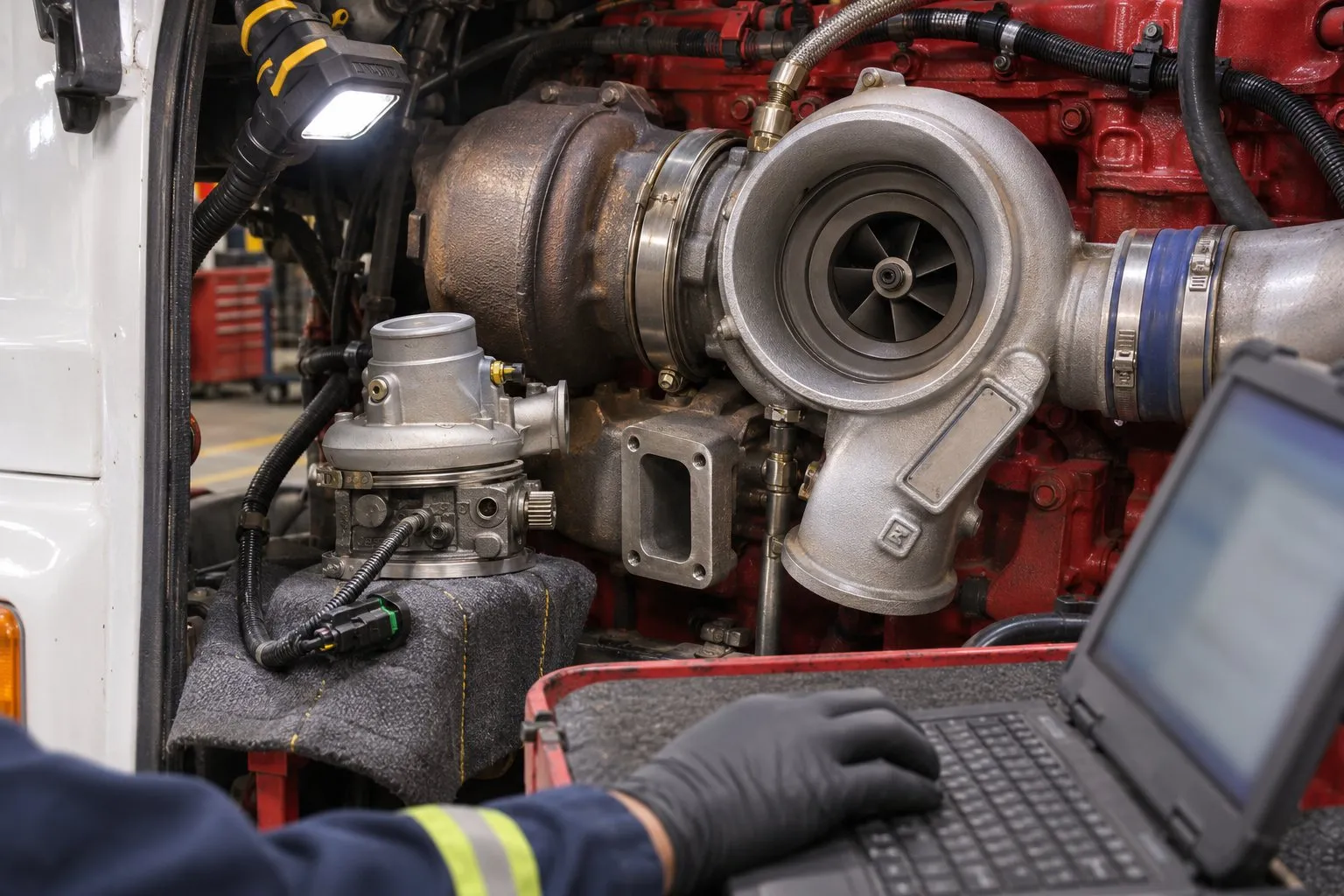
Both engines report through SPN/FMI and manufacturer fault codes, not generic P0299-style light-duty codes. On a Cummins, VGT actuator faults include codes such as 2387, 2449, and 2634. On a DD15, low boost typically shows as SPN 102 FMI 18 on GHG14 engines and SPN 3563 on GHG17 engines.
Actuator service is where the two platforms differ most. The DD15’s fixed geometry turbo needs no vane calibration. The ISX electronic actuator does: with Cummins INSITE, you run the install routine with the new actuator plugged in but not yet bolted to the turbo, then mount it and calibrate without cycling the key. P003A means the position exceeded the learning limit.
A few shop rules apply to both:
- Never force an electronic actuator’s arm by hand. The self-locking gears break. Unbolt it and move the vane lever instead.
- Some side-to-side shaft play is normal on a journal-bearing turbo. Condemn it for in-and-out play you can feel, for wheel contact with the housing, or for play beyond the maker’s limit.
- Fit a new oil feed line after a bearing failure rather than flushing and reusing the old one.
- For first start, follow the maker’s steps: fill the oil inlet with clean engine oil, turn the wheel by hand, and crank or idle a few minutes before load.
The air-operated HE551V (2003-2007 ISX) is tested differently again: its actuator works on truck air through a control valve, so a weak or leaking air signal, not a dead motor, is often the cause of sluggish nozzle movement.
New, remanufactured, or rebuilt for a fleet
For fleet budgeting, the question is usually new versus reman versus a rebuild of the core you already have. A fixed geometry DD15 turbo is a straightforward rebuild. A variable geometry ISX unit adds the nozzle ring and, on VE/VG models, actuator work and calibration, so it is worth comparing a quality reman against a rebuild of your own core.
PT Turbo stocks new and remanufactured turbochargers for both platforms and remanufactures in house. For current pricing on a turbo rebuild, see the rebuild price list by turbo model, where the real figure is confirmed after inspection and before work starts. Most rebuilds ship in 3 days or less, and reman units carry a 12-month, unlimited-mileage warranty with a 30-day core return.
Fleet customers can arrange priority turnaround and have PT Turbo stock their common cores. Because the DD15 shipped with Holset, Garrett, and BorgWarner numbers depending on year, and the ISX changed turbos several times, the single most useful thing you can do is read the number off the data plate before ordering. If you want help matching a core, contact PT Turbo or call (909) 824-1020.
Turbos we list for the HE551V, HX55 and HE451VE
Listings for the turbo models named in this guide that can be ordered online today. Several part numbers can fit one engine by year and rating, so match the number on your turbo’s tag, or call (909) 824-1020 and we will match it for you.
All HE551V listings · All HX55 listings · All HE451VE listings
Frequently Asked Questions
Does the Detroit DD15 use a variable geometry turbo like the ISX?
No. The DD15 uses a fixed geometry turbocharger with no vanes or VGT actuator. On most ratings it pairs that turbo with a turbo-compound power turbine, and GHG14 Advantage engines add an air-operated wastegate. The variable geometry Detroit turbos belong to the older Series 60.
Which turbo does my ISX have?
It depends on the emissions generation. Pre-EGR engines used a fixed geometry HX55 or HX60, 2003-2007 CM870 engines the air-operated HE551V, 2007-2010 engines the HE561VE or HE551VE, and ISX15/X15 engines the HE451VE or later HE400VG. The HE451VE and HE400VG look alike but do not interchange, so confirm the number on the turbo’s data plate.
Do I need to calibrate the turbo after replacement?
Only on the electronic-actuator ISX units. Run the Cummins INSITE install routine with the new actuator plugged in but not yet bolted to the turbo, then mount it and calibrate. The DD15’s fixed geometry turbo and the air-operated HE551V require no vane calibration.
Need a Turbocharger?
PT Turbo has rebuilt and sold turbochargers since 1978. We stock remanufactured units for Cummins, Duramax, Power Stroke, Detroit Diesel, and more — backed by a 12-month unlimited mileage warranty. Units in stock at our shop in San Bernardino, CA ship the same day when ordered before 2 PM Pacific, Monday through Friday.
📞 (909) 824-1020 · 346 S I St. #3, San Bernardino, CA 92410 · [email protected]
More From PT Turbo
 Ford 6.7L Powerstroke Turbocharger: Problems, Symptoms and Replacement Guide
- Cummins ISC Turbocharger Guide: HX40 & Replacement Options for Medium Duty Trucks
- Isuzu NPR/NQR Turbocharger Replacement: Step-by-Step Guide & Cost
- International ProStar Turbocharger Guide: MaxxForce 13 Replacement & Upgrade Options