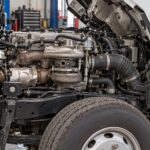
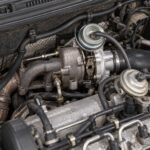
The BorgWarner S300 turbocharger is the workhorse of the medium and heavy-duty diesel world. If you’ve spun a wrench on an International DT466, a John Deere 6068 or a CAT 3126E, or built a 5.9L Cummins for more power, you’ve had your hands on an S300 or one of its close cousins. This frame family has powered everything from farm tractors to over-the-road trucks for decades because it hits the sweet spot: durable center housing, huge selection of compressor and turbine wheel combinations, and a T3/T4 mounting flange that bolts up to an enormous range of applications. At PT Turbo, we’ve been rebuilding and stocking S300 units since long before “billet wheel” was a marketing buzzword, and this guide breaks down exactly how the S300 fits Cummins, CAT, and Detroit engines.
What the BorgWarner S300 Actually Is
Most S300 turbos are fixed-geometry (non-VGT) units (the S300V on the 2004-on International DT466 is the variable geometry exception) built on a 60mm-class bearing housing. The S300 uses journal bearings, a T3 or T4 turbine inlet flange, and a wide range of compressor covers and turbine housings identified by A/R ratio. The naming convention tells you a lot once you learn to read it. An “S366” for example runs roughly a 66mm inducer compressor wheel; an “S362” runs a 62mm inducer. The turbine side is defined by the exhaust housing A/R, commonly 0.88, 0.91, or 1.00 for T4 units.
Key hardware you’ll deal with on an S300:
- Compressor wheels: inducer sizes commonly 57mm to 72mm, cast or billet
- Turbine wheels: matched to the housing A/R for the target flow
- Turbine housings: T3 open, T4 open, or T4 divided (twin-scroll)
- Bearing system: journal bearings and a standard thrust bearing (the 360-degree thrust bearing is an upgrade, and standard on the SX-E), oil-cooled
- Actuation: internal or external wastegate depending on the build
Because the S300 shares a physical footprint across so many builds, it’s one of the most swappable frames on the market. That’s exactly why it dominates the aftermarket and why upgrading from a stock turbo to an S300 is one of the most popular moves in the diesel performance world.
S300 on Cummins Engines
The S300 has deep roots in the Cummins world as the go-to upgrade. Cummins itself fits Holset turbos at the factory. On the 5.9L 12-valve and 24-valve engines, the factory Holset HX35 and HY35 are the units most owners are replacing, but the S300 frame is the standard performance step up. If you’re running a 5.9L and weighing your options, our Ram 2500/3500 5.9L Cummins Turbocharger Guide covering the HX35, HY35 and HE351CW lays out the stock hardware before you go S300.
Common S300 sizing for Cummins builds:
| S300 Build | Compressor Inducer | Best For | Approx. Airflow / Power |
|---|---|---|---|
| S363 | 63mm | Daily driver / towing | About 78 lb/min; 500-700 hp |
| S366 | 66mm | Street / tow / light race | About 90 lb/min |
| S369 | 69mm | High-output street/strip | About 98 lb/min |
| S372 SXE | 72mm | Race / sled pull | 700+ hp |
The industrial and agricultural Cummins engines like the 6BT and QSB also leave the factory with Holset turbos; on them an S300 with a T4 divided housing is an upgrade, not original equipment. On the newer common-rail trucks, most factory setups moved to variable geometry, which changes the game entirely. If you’re comparing fixed-geometry S300 logic against modern VGT hardware, the Cummins ISB 6.7L Turbocharger Guide on variable geometry operation and common failures is worth a read, and our 6.7L HE351VE vs HE300VG guide covers the factory VGT replacement side.
S300 on Caterpillar Engines
Caterpillar used BorgWarner S300-family turbos across a broad range of on-highway and off-highway engines. The 3126B and 3126E, some C7 ratings and various industrial CAT engines ran S300 variants (other C7 ratings and the 3116 use the smaller S200 frame, and the C9, C10 and C12 mostly the S310, so go by the part number), often with the T4 turbine flange and internally or externally wastegated housings depending on emissions calibration and application.
What matters most on CAT applications:
- Wastegate actuation: Many CAT S300 units rely on a pneumatic actuator to control boost. A worn or leaking actuator is one of the most common failure points and often gets misdiagnosed as a bad turbo.
- Turbine housing A/R: CAT specs the A/R tightly for their target torque curve, so a replacement housing needs to match to avoid drivability and EGT problems.
- Oil supply and drain: CAT engines are sensitive to restricted drains. A slow drain builds crankcase pressure into the center housing and pushes oil past the seals.
If your CAT S300 is fighting a boost control issue, the fix is frequently the actuator rather than the whole unit. Verify the correct part against your engine data plate before ordering, or send us your unit and we’ll match it.
S300 on Detroit Diesel Engines
Detroit Diesel Series 40, Series 50, and various industrial engines used S300-frame turbochargers, particularly in medium-duty and vocational trucks. On these engines the S300 is prized for its serviceability. Because it’s a journal-bearing, fixed-geometry design, a rebuild is straightforward compared to the variable geometry units on the EGR-era Series 60.
When diagnosing an S300 on a Detroit, work through the fundamentals first:
- Check the compressor wheel for contact rub against the cover, which indicates worn bearings or a bent shaft
- Measure shaft play. Axial play should be minimal; radial play with light wheel contact usually means the cartridge is done
- Inspect the turbine wheel for erosion, cracks, or missing blade tips from FOD
- Confirm the oil feed line is clean and not coked, which is the number one killer of any turbo bearing system
New vs Remanufactured S300: The Real Cost Decision
The S300 is one of the best candidates for remanufacturing in the entire diesel world. The castings are robust, the parts are widely available, and a properly rebuilt unit performs identically to new. Here’s how the options stack up.
| Option | Typical Cost | Warranty | Best For |
|---|---|---|---|
| New BorgWarner S300 | $820 to $1,698 (23 listings) at PT Turbo | Full manufacturer | New builds, warranty-critical fleets |
| Remanufactured S300 | $997 to $1,093 (3 listings) at PT Turbo | Rebuilder warranty | Most repairs, best value |
| Rebuild your existing core | $475 at PT Turbo for the S300 (price list) | On the rebuild work | Matched-spec OEM restoration |
| Cheap import unit | $300 to $500 (estimate) | Limited or none | Not recommended for working trucks |
PT Turbo has been in business for over 45 years, and we stock both new and remanufactured S300 units. Our remanufactured turbochargers are built to OEM tolerances with new bearings, seals, and balanced rotating assemblies, then flow-tested before they ship. If you’d rather keep your original housing and matched hardware, our turbo rebuild service restores your core to spec with a fast turnaround. Either way you avoid the gamble that comes with unbranded import units that show up unbalanced and out of tolerance.
Common S300 Failure Symptoms and What They Mean
Diagnosing an S300 is straightforward once you know the pattern. Here’s how symptoms map to root cause by severity.
| Symptom | Severity | Likely Cause |
|---|---|---|
| Blue smoke at idle, oil at compressor | Moderate | Worn seals, restricted oil drain, or high crankcase pressure |
| Whistling or siren noise | Moderate | Boost leak, or early bearing wear |
| Low boost / high EGT | High | Wastegate actuator failure, cracked housing, or worn wheels |
| Grinding or metal contact noise | Critical | Bearing failure, shaft play, wheel contact. Stop driving |
| Sudden power loss with debris in intake | Critical | Wheel failure or FOD. Inspect entire intake before restart |
The single most preventable failure is oil starvation from a coked feed line or a delayed oil supply on a fresh install.
Prime every fresh S300 before you load it. Crank the engine with the fuel shut off until you see oil pressure, or pre-fill the center housing through the feed port and spin the shaft by hand so the bearings have a film before the first fire. Skipping that step on a dry cartridge can wipe the journals in the first few seconds, long before the symptom ever shows up on a gauge.
The other half of the equation is the feed line itself. Replace it, don’t reuse it, and never clear a coked line with a torch or a pick that leaves scale behind. A clean supply, a free-flowing drain, and a few seconds of patience on startup will outlast the rest of the engine.
Not sure the S300 is the right frame? See BorgWarner S300 vs S400 vs S480.
Price ranges in this article are general estimates to help with budgeting, not PT Turbo quotes. Our current prices are on each product listing, and our rebuild prices are on the turbo rebuild price list.
Frequently Asked Questions
What engines use the BorgWarner S300 turbocharger?
The S300 frame family powers a wide range of medium and heavy-duty diesels, including the International DT466, John Deere 6068 and CAT 3126E, and it is the standard upgrade for the 5.9L Cummins. It’s also common in farm tractors and over-the-road trucks.
Why is the BorgWarner S300 so popular?
The S300 hits the sweet spot with a durable center housing, a huge selection of compressor and turbine wheel options, and broad application fitment. This versatility makes it a workhorse across many diesel platforms.
Can I upgrade my stock turbo to a BorgWarner S300?
Yes, the S300 is a popular upgrade choice thanks to its wide range of wheel and housing configurations. Proper fitment depends on matching the frame size and specs to your specific engine and performance goals.
Further reading: Learn more about BorgWarner.
Shopping by part number?
Every part number we stock for the BorgWarner S300 is on one page, with live prices and stock: BorgWarner S300 turbos and parts.
Need a Turbocharger?
PT Turbo has rebuilt and sold turbochargers since 1978. We stock remanufactured units for Cummins, Duramax, Power Stroke, Detroit Diesel, and more — backed by a 12-month unlimited mileage warranty and same-week shipping from San Bernardino, CA.
📞 (909) 824-1020 · 346 S I St. #3, San Bernardino, CA 92410 · [email protected]