PT Turbo rebuild prices: most turbos cost $450 to $975 to rebuild at our shop. See the turbo rebuild price list for yours.
When a turbocharger failed on a fresh engine rebuild, it is almost never because the turbo was defective out of the box. After 45+ years rebuilding and supplying turbochargers, we can tell you the failure is usually a symptom of something the rebuild missed, not the cause. The turbo is the first component to show distress because it spins at over 100,000 RPM on a film of oil thinner than a human hair, and it lives downstream of every mistake made in the long block, the oiling system, and the plumbing.
This guide walks through the real reasons freshly installed turbos fail, how to diagnose the root cause before you bolt on a replacement, and what to inspect so you do not grenade the second unit the same way you lost the first.
Why a Turbocharger Failed on a Fresh Engine Rebuild
A turbo needs three things to survive: clean oil at the right pressure, clean air through the compressor, and a drain that lets oil escape freely. A rebuild disturbs all three. New gaskets, new seals, fresh assembly lube, machining debris, and re-routed lines all create opportunities for contamination and starvation.
The center housing rotating assembly (CHRA) is the victim. The thrust bearing and journal bearings cannot tolerate dry starts, abrasive particles, or back-pressure in the drain. When one of those conditions exists after a rebuild, the turbo fails within minutes to a few hundred miles, long before the engine itself shows any problem.
Here is how the most common root causes break down by how quickly they kill a turbo:
| Root Cause | Typical Failure Window | Primary Damage |
|---|---|---|
| Dry start / delayed oil priming | Seconds to minutes | Scored journal bearings, blued shaft |
| Oil contamination / machining debris | Minutes to hours | Scratched bearings, worn thrust |
| Restricted or kinked oil drain | Hours to days | Seal leakage, oil in compressor/turbine |
| Foreign object through intake | Instant | Shattered compressor/turbine wheel |
| Over-speed from tuning / wrong size | Minutes to weeks | Burst wheel, fatigue cracks |
Oil Starvation and Dry Starts: The Number One Killer
Oil starvation is the most common cause of early turbo failure. On a fresh rebuild, the oil galleries are empty, the filter is dry, and the pump has to refill the entire system before pressure reaches the turbo feed port. If the engine fires and revs before that oil arrives, the bearings run dry.
Before the first start, prime the system. Crank the engine with the fuel shut off or injectors disabled until you see oil pressure on the gauge. On many engines you can pre-fill the oil feed line to the turbo and fill the bearing housing with clean engine oil through the feed port.
- Pre-fill the oil filter before installing it.
- Prime the turbo feed line with clean engine oil.
- Confirm oil pressure on the gauge before you let the engine rev.
- Idle for the first few minutes, do not blip the throttle on a cold fresh build.
A turbo that was starved shows a distinctive signature: a blued or discolored shaft, scored journal bearings, and sometimes a wheel that no longer spins freely by hand. If you pull a failed unit and see that, the engine oiling system is your suspect, not the turbo.
Contaminated Oil and Leftover Debris
Rebuilds generate debris. Honing grit, gasket sealant squeeze-out, casting sand, thread locker, and metal shavings all end up in the oil if the block was not cleaned to a surgical standard. That debris goes straight through the turbo bearings and acts like sandpaper.
Silicone sealant is a quiet killer. An over-application on the oil pan or a pickup tube gasket can shed into the sump, get drawn into the pickup, and lodge in the turbo feed restrictor. Use sealant sparingly and let it cure before adding oil.
We recommend a fresh oil and filter change at the first few hundred miles after any rebuild specifically to flush the break-in debris. The journal bearings in a turbo have clearances measured in thousandths of an inch, so even fine grit does measurable damage. If you are installing one of our remanufactured turbochargers, protecting those new bearings with clean oil is the single best thing you can do for longevity.
Oil Drain Restrictions and Seal Failures
People obsess over the oil feed and forget the drain. The turbo drain is a low-pressure, gravity-fed return to the crankcase, and it must flow freely or oil backs up in the center housing. When that happens, oil pushes past the piston-ring seals into the compressor and turbine, and you chase a “leaking turbo” that is actually a plumbing problem.
Common drain mistakes on a fresh build include:
- A drain line with a sag or low loop that traps oil.
- A drain hose that is too small or kinked against a new accessory.
- A blocked crankcase breather or PCV, raising crankcase pressure.
- Reused drain gaskets with hardened sealant partially blocking the port.
- Mounting the turbo so the drain exits more than about 15 to 20 degrees off straight down.
If you see blue smoke and oil in the intercooler piping on a new install, check crankcase pressure and drain routing before you condemn the turbo seals. Usually the seals are fine and the drain is the problem.
Foreign Object Damage and Compressor Ingestion
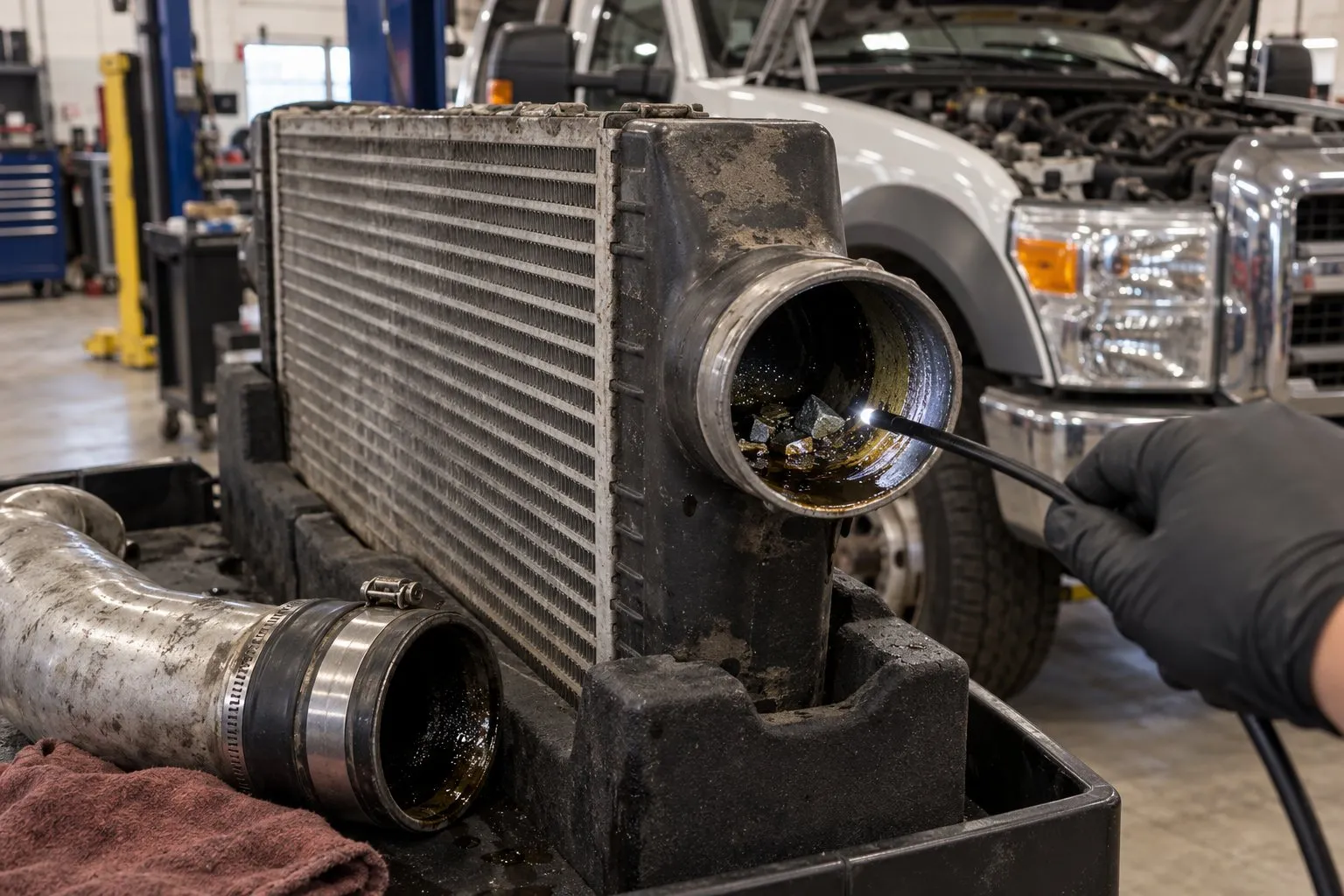
Fresh builds mean open intake tracts, new intercooler piping, and a shop floor full of hardware. A dropped bolt, a forgotten shop rag, a loose hose clamp, or debris left in the intake tract gets sucked into the compressor wheel and destroys it instantly. The blades are aluminum spinning at six figures of RPM, and they do not survive contact.
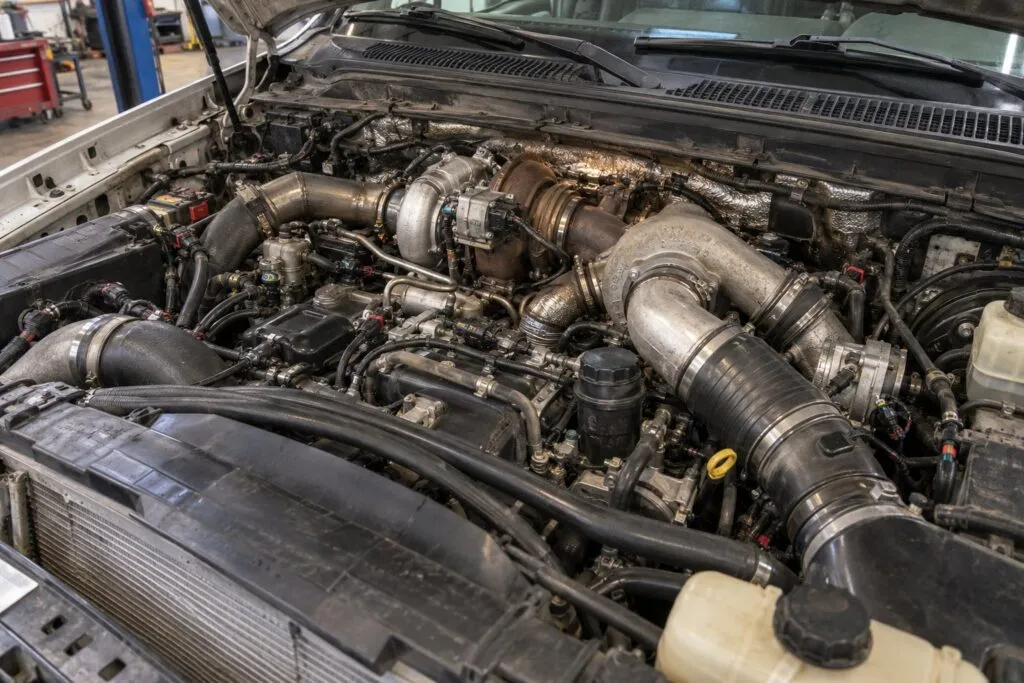
On the turbine side, debris from the head or exhaust manifold, a broken glow plug tip, or a valve fragment from a failed injector event can shatter the turbine wheel. On 6.4L Powerstroke twin-turbo setups, debris passing between the high and low pressure units is a documented failure path.
Before you connect the intake, inspect the entire tract. Clean the intercooler thoroughly if the previous turbo failed, because aluminum shards and oil pool in the intercooler and get carried on into the engine the moment you build boost. Debris left there after a turbo failure is a common cause of engine damage in the days that follow.
- Flush and inspect the intercooler and all charge piping.
- Verify the air filter is seated and the housing is sealed.
- Count your tools and hardware before closing up the intake.
- Confirm no compressor-side gasket material is hanging into the airflow.
Wrong Turbo, Over-Speed, and Tuning Mistakes
Matching matters. If the rebuild came with a different cam, injectors, or a tune, the old turbo may no longer be in its efficiency range. Running a compressor past its map drives it into over-speed, where the wheel exceeds its burst limit and fails from fatigue or outright comes apart.
Variable geometry turbos add another layer. If the VGT actuator, unison ring, or vanes are sticking after a rebuild due to soot or corrosion, the turbo can spike boost and over-speed, or build no boost at all. Garrett and BorgWarner both publish guidance on correct actuator calibration; see the Garrett Motion and BorgWarner resources for your specific unit. For a deeper look at VGT behavior, our Cummins ISB 6.7L turbocharger guide breaks down how variable geometry actually operates. You can also read the basics of variable-geometry turbocharger design.
Holset units like the HX35 and HX40 are common swap targets, and installing the wrong wheel or housing combo for your fuel setup will over-speed the compressor fast. If you are stepping up power, verify the frame can handle it rather than assuming the old part number still fits your new build.
A Pre-Start Checklist That Saves Turbos
Run this list before the first key turn on any fresh build. It takes fifteen minutes and prevents the most expensive mistakes.
| Step | What You Are Confirming |
|---|---|
| Pre-fill filter and feed line | No dry start on first crank |
| Crank to oil pressure, fuel off | Galleries primed before combustion |
| Inspect and flush intercooler | No residual debris from prior failure |
| Check drain routing and clearance | Free gravity return, no kinks |
| Verify crankcase breather flow | No pressure pushing oil past seals |
| Confirm VGT actuator sweep | Vanes move freely, no sticking |
| Idle several minutes before load | Bearings fully oiled before boost |
If your turbo failed and you need it brought back to spec rather than replaced, our turbo rebuild service handles everything from the CHRA up. Pricing varies by model and is listed on our turbo rebuild price list. We stock both new and remanufactured parts across hundreds of models, so you can also shop all turbos if a replacement makes more sense. Not sure what killed yours? Contact PT Turbo at (909) 824-1020 and we will help you read the failure.
Price ranges in this article are general estimates to help with budgeting, not PT Turbo quotes. Our current prices are on each product listing, and our rebuild prices are on the turbo rebuild price list.
Frequently Asked Questions
How long should I idle a fresh engine before driving it?
Let it idle long enough to confirm stable oil pressure and reach operating temperature, typically several minutes, before applying any load. Avoid revving a cold fresh build, because the turbo bearings need a full oil film before you ask for boost. The first drive should be gentle, with a warm-down idle after.
Can I reuse the oil feed and drain lines from the old turbo?
Replace the feed line; the drain line can stay only after inspecting and cleaning it thoroughly. Feed lines collect carbon and sludge that restricts oil flow, and the small banjo filter screens some turbos use can clog completely. A restricted feed will starve a new turbo the same way it may have killed the old one; if there is any doubt about the drain line, replace it as well.
My replacement turbo failed too. What did I miss?
Repeat failures almost always trace to a root cause that was never corrected: debris left in the intake tract ahead of the turbo, a restricted oil drain, high crankcase pressure, or an oiling system problem feeding dirty or low-pressure oil. Pull the failed unit, read the bearing and shaft condition, and fix the underlying cause before installing a third turbo. Call us with what you are seeing and we will help you pinpoint it.
Need a Turbocharger?
PT Turbo has rebuilt and sold turbochargers since 1978. We stock remanufactured units for Cummins, Duramax, Power Stroke, Detroit Diesel, and more — backed by a 12-month unlimited mileage warranty and same-week shipping from San Bernardino, CA.
📞 (909) 824-1020 · 346 S I St. #3, San Bernardino, CA 92410 · [email protected]