Transit Bus Turbocharger Guide: Cummins & Detroit Applications
This Transit Bus Turbocharger Guide covers the Cummins and Detroit turbochargers that keep municipal, shuttle, and school fleets rolling, and it is built to help you match the exact unit on your engine before you order. Transit buses live a punishing duty cycle: long idle, constant stop-and-go, full load off every stop, and emissions hardware that makes the turbo work harder than a highway truck ever does. Getting the right turbo the first time matters, because a wrong model for the application is worse than no part at all.
PT Turbo has been rebuilding turbochargers since 1978, more than 45 years, and stocks both new and remanufactured units for these engines. Below we break down the Cummins and Detroit applications by engine, how their turbos are controlled, what fails first in bus service, and how to confirm the right part by the number on the tag.
Why Transit Bus Turbos Work Harder
A transit bus accelerates from a stop under a full passenger load dozens of times per route, then sits and idles at the curb. That mix of high load and long idle is tough on a variable geometry turbocharger, because carbon and soot build up on the moving nozzle components while idling, then the mechanism is asked to swing quickly the next time the operator rolls on throttle.
Most of these engines also carry high-pressure EGR. The exhaust gas is pulled off before the turbine and returned to the intake after the compressor, so it never passes back through the compressor wheel. What EGR does add is more soot through the combustion side, and that soot is the main reason bus VGT nozzles and sliding rings foul over time. If you want the background on how a variable nozzle works, Garrett and Wikipedia both have good references on variable-geometry turbochargers.
Cummins Applications: B-Series and ISL/ISL9
Cummins powers the majority of transit buses in North America, and the turbo depends on the engine and its emissions generation. The B-series (ISB) covers smaller shuttles and cutaways, while the larger ISL/ISL9 8.9L covers full-size low-floor transit buses.
On the Cummins ISB 6.7L, the factory variable geometry turbo is the Holset HE351VE from the 2007.5 to 2012 engines, and the Holset HE300VG from 2013 onward. Both use a sliding nozzle and an electronic actuator in every year. They do not interchange directly: the actuators and wiring differ, so go by the part number on the data plate. Our deep-dive on these two units lives in the Cummins ISB 6.7L turbocharger guide.
Four-cylinder B-series city bus engines (such as the 4ISBe) use a smaller wastegated Holset, the Holset HE221W. Our supplier lists the HE221W across Cummins 4-cylinder B-series engines in trucks, coaches, and city buses. Some sellers also list it for 3.9L versions, but confirm by the tag number.
The larger ISL 8.9L spans several turbos by rating and emissions level. Earlier ISL, ISLe, and QSL engines ran the wastegated Holset HX40W. The 2007 emissions engines moved to the variable geometry Holset HE431VE, and later ratings carry the Holset HE400VG and HE300VG.
| Cummins Engine | Turbo | Geometry / Control |
|---|---|---|
| 4-cyl B-series / 4ISBe (city bus) | Holset HE221W | Fixed geometry, wastegated |
| ISB 6.7L (2007.5-2012) | Holset HE351VE | Variable, sliding nozzle, electronic actuator |
| ISB 6.7L (2013 on) | Holset HE300VG | Variable, sliding nozzle, electronic actuator |
| ISL 8.9L (pre-2007 ratings) | Holset HX40W | Fixed geometry, wastegated |
| ISL 8.9L (2007 emissions) | Holset HE431VE | Variable, sliding nozzle, electronic actuator |
| ISL9 (later ratings) | Holset HE400VG / HE300VG | Variable, sliding nozzle, electronic actuator |
One important point on all of these Holset VGTs: they use a sliding nozzle ring, not pivoting vanes, and their actuators are electronic. The actuator is calibrated to its own turbo with the Cummins service tool, not moved by vacuum or air. Never force the actuator arm by hand, because the internal gears are self-locking and will break.
Detroit Applications: Series 60 and the DD Family
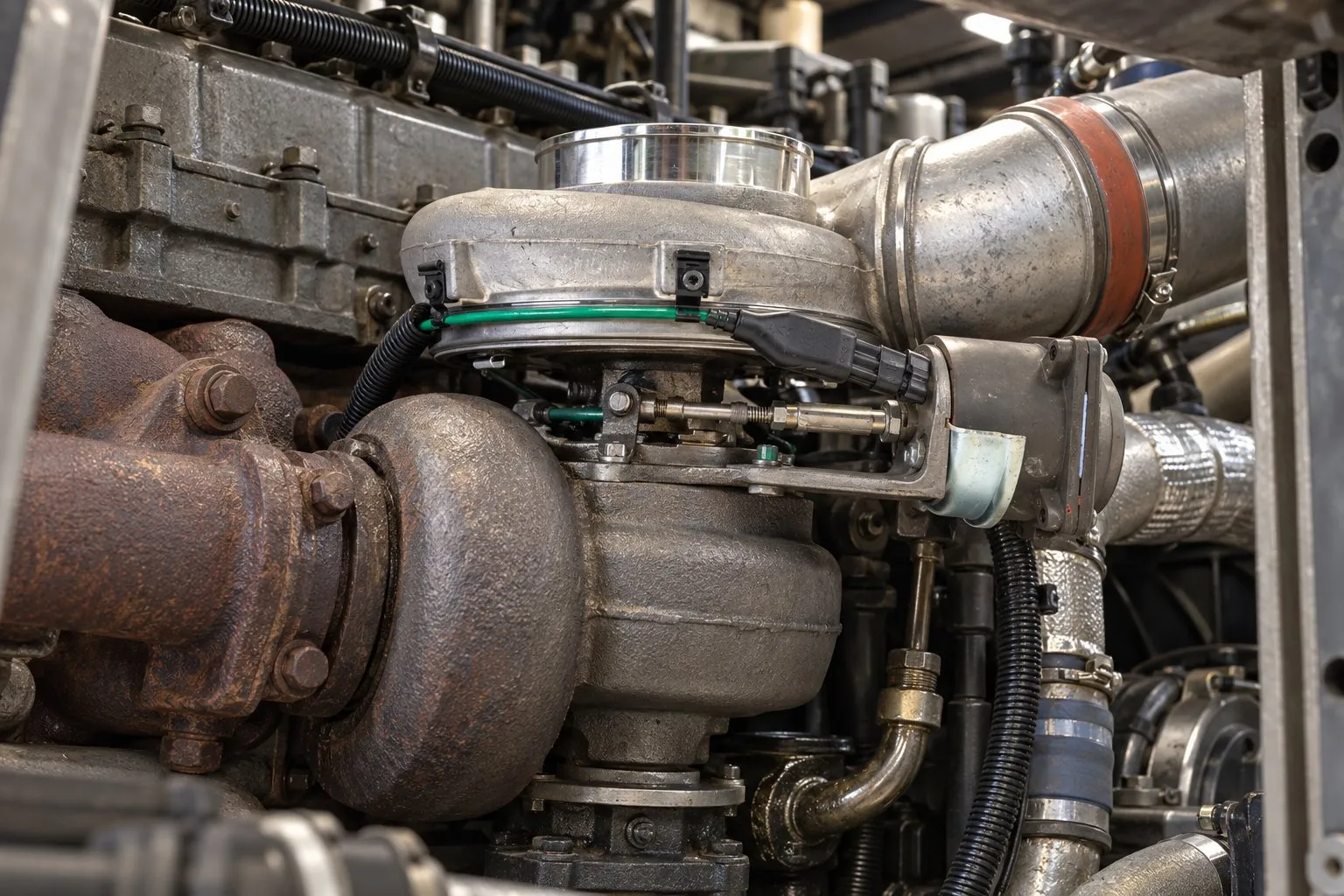
Older transit buses and many motorcoaches ran the Detroit Diesel Series 60. The turbo depends on whether the engine is pre-EGR, EGR-era, or the later DDEC VI generation.
Pre-EGR Series 60 engines used the fixed geometry Garrett GTA4294. The EGR engines introduced a variable nozzle Garrett, the GTA4502V, and later Series 60 engines also used the Holset HE531VE. On the 2002-2006 EGR Series 60, the Garrett VNT nozzle is moved by air, not by an electronic actuator, and those engines have no particulate filter. The 2007-2010 DDEC VI engines added the DPF and used the electronically actuated Holset HE531VE.
If you have a newer DD-series Detroit in a coach or bus, know that the DD13, DD15, and DD16 never use a variable geometry turbo. There are no vanes, no nozzle ring, and no VGT actuator. The DD15 uses a fixed geometry turbo with turbo-compound on the earlier engines and an asymmetric fixed geometry turbo later: GHG14 engines (from 2013) carry an air-operated wastegate, GHG17 engines have no wastegate. The DD13 is an asymmetric fixed geometry turbo from launch, and the DD16 is fixed geometry with turbo-compound.
Common Failures in Bus Service
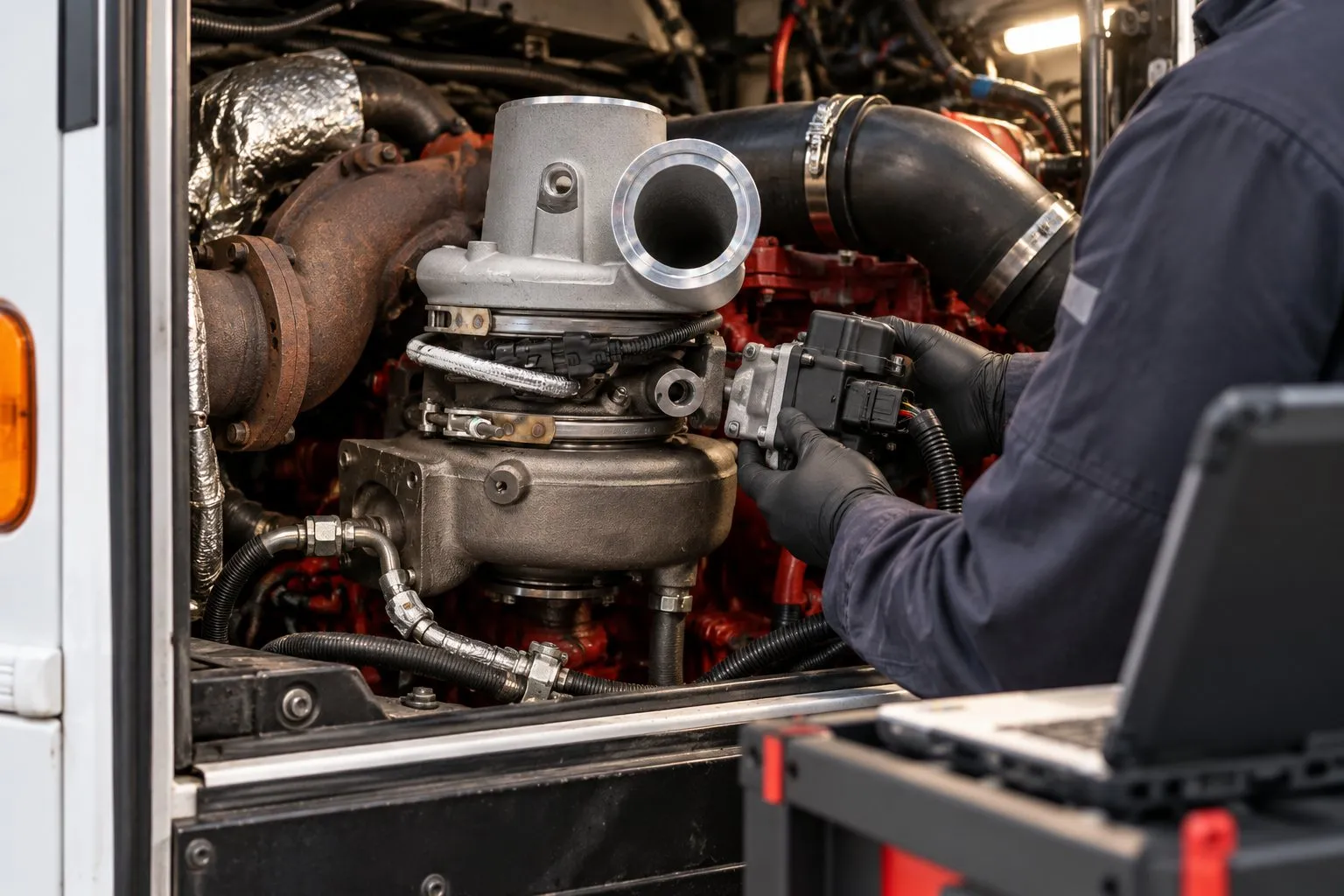
Most turbo failures on any of these engines trace back to the oil supply. Coked oil, a failed feed line, or extended drain intervals wear the bearings, and the symptoms show up as shaft wobble, noise, and oil carryover. When a bearing has failed, the oil feed line should be replaced rather than reused.
On the variable geometry units, the stop-and-go bus duty cycle brings its own failure modes. Here is how the big three sort out by component:
- Sticking nozzle (Cummins HE-series, Detroit HE531VE): soot buildup on the sliding ring from heavy idle and EGR, leading to slow spool, low boost, or overboost depending on where it sticks.
- Electronic actuator faults: a stuck or failed actuator can set position and boost codes. Cummins replacement calls for the INSITE install routine with the new actuator plugged in but not yet bolted to the turbo, then mounting and calibrating without cycling the key.
- Wastegate turbos (HE221W, HX40W): a flapper that does not seat lets exhaust past the turbine, giving low boost and slow spool.
A nozzle stuck closed gives overboost and high drive pressure; stuck open gives low boost. On a 6.7L Cummins pickup, P003A means the actuator position exceeded its learning limit. Bus and other heavy-duty engines report through J1939 SPN and FMI codes and the engine maker fault codes instead, so look up the exact code your service tool shows in the maker service information. For the shared DPF background that drives a lot of this soot loading, see diesel particulate filter.
Blue-gray smoke and oil in the charge piping are not automatically a failed turbo. Check the crankcase breather, air filter, oil level, and the oil drain first, because a light oil film from closed crankcase ventilation is normal and a restricted drain backs oil up past the seals.
New vs Remanufactured, and Using This Transit Bus Turbocharger Guide to Order
Fleet budgets and downtime both matter, so the new-versus-reman choice comes up on every work order. Here is the practical difference:
| Consideration | New Turbo | Remanufactured Turbo |
|---|---|---|
| Core charge | None | Core return within 30 days, customer pays return shipping |
| Actuator | New, calibrated to the turbo | Tested and calibrated to the turbo |
| Availability | Stocked and supplier warehouse | Rebuilt in-house, most ship in 3 days or less |
| Warranty | 12 months, unlimited mileage | 12 months, unlimited mileage |
PT Turbo stocks new turbos and remanufactured turbochargers, and remanufactures in-house through our turbo rebuild service. For rebuild cost on your exact unit, see the turbo rebuild price list rather than a guessed figure, and for anything not listed, the price is on the product page or by phone at (909) 824-1020.
Whatever route you take, order by the part number on the turbo’s data plate, which sits on the compressor housing. Casting numbers on the housings are not part numbers; one casting serves many turbos. Fleet customers can arrange priority and rush turnaround and have us stock their common cores by calling the shop. For side-by-side Cummins comparisons that apply to bus engines too, the HE351VE vs HE300VG comparison is a useful companion piece.
Turbos we list for the HE300VG, HE351VE and HE221W
Listings for the turbo models named in this guide that can be ordered online today. Several part numbers can fit one engine by year and rating, so match the number on your turbo’s tag, or call (909) 824-1020 and we will match it for you.
All HE300VG listings · All HE351VE listings · All HE221W listings
Frequently Asked Questions
How do I know if my transit bus has a variable geometry turbo?
Check the engine and emissions generation, then confirm the number on the turbo’s data plate. Cummins ISB 6.7L engines from 2007.5 and ISL 8.9L engines from the 2007 emissions standard use variable geometry Holset units with electronic actuators, while older ISL and the 4-cylinder city bus engines use wastegated fixed geometry turbos. Detroit Series 60 EGR and DDEC VI engines used variable units, but the DD13, DD15, and DD16 never did.
Can I swap an HE351VE for an HE300VG on a bus engine?
Not directly. The actuators and wiring differ between the two, and the mounting and calibration are not the same, so the units do not interchange without the correct harness. Match the exact part number on your tag, and run the Cummins service tool to install and calibrate the actuator to the turbo.
How long does a turbo rebuild take for a fleet?
Most rebuilds ship in 3 days or less, and the rebuild price is confirmed after inspection and before any work starts. Fleet customers can arrange priority and rush turnaround and have the shop stock their common cores by calling ahead. Call (909) 824-1020 to set up fleet handling.
Need a Turbocharger?
PT Turbo has rebuilt and sold turbochargers since 1978. We stock remanufactured units for Cummins, Duramax, Power Stroke, Detroit Diesel, and more — backed by a 12-month unlimited mileage warranty. Units in stock at our shop in San Bernardino, CA ship the same day when ordered before 2 PM Pacific, Monday through Friday.
📞 (909) 824-1020 · 346 S I St. #3, San Bernardino, CA 92410 · [email protected]
More From PT Turbo
 OEM vs Aftermarket Turbocharger: What Is the Difference and Which Is Worth It?
- Turbocharger Lead Times: Why Some Parts Take Weeks and How to Plan Ahead
- Exhaust Back Pressure and Turbocharger Performance: The Relationship Explained
- Coach and Tour Bus Turbocharger Guide: Detroit DD13 & Cummins ISX Applications