
Natural Gas Engine Turbochargers: How They Differ from Diesel & What to Know
If you run a stoichiometric natural gas fleet, you already know that natural gas engine turbochargers face a different operating world than the diesel units most of this industry grew up on. The hardware looks familiar, a compressor wheel, a turbine wheel, a shaft on bearings, but the combustion feeding that turbine is completely different, and that changes how the turbo is specified, how hard it works, and what fails first. This guide breaks down those differences in plain shop terms so you order the right part and know what to inspect.
PT Turbo has been rebuilding turbochargers since 1978, more than 45 years, and we stock both new and remanufactured units for diesel and spark-ignited heavy-duty engines. The principles below apply whether you spin wrenches on a transit bus, a refuse truck, or a stationary genset.
Diesel vs natural gas: what the engine does differently
A diesel is a compression-ignition engine that runs lean. It pulls in all the air it can and controls power with fuel, so there is always excess air in the cylinder. That is why the diesel airflow rule of thumb sits around 0.11 to 0.14 lb/min per horsepower, higher than the gasoline figure.
Most heavy-duty natural gas engines are spark-ignited and run stoichiometric, meaning the air-fuel ratio is held near the chemically correct point so a three-way catalyst can clean up the exhaust. Power is controlled with a throttle, like a gasoline engine, not purely with fuel. That single change ripples through everything the turbo sees.
Natural gas also burns clean. There is essentially no soot, so you do not get the carbon loading on variable geometry vanes that fouls diesel VGTs. The trade is heat: a stoichiometric burn with the throttle open tends to send hotter gas to the turbine than a lean diesel burn at the same load.
| Characteristic | Diesel engine | Stoichiometric natural gas engine |
|---|---|---|
| Ignition | Compression | Spark |
| Load control | Fuel quantity | Throttle (air-fuel held near stoichiometric) |
| Normal mixture | Lean (excess air) | Stoichiometric |
| Soot in exhaust | Yes (DPF territory) | Essentially none |
| Aftertreatment | DOC, DPF, often SCR | Three-way catalyst |
| Turbine inlet heat | Lower at a given load | Tends to run hotter |
| Common turbo control | VGT or wastegate | Wastegate (fixed geometry) is common |
How Natural Gas Engine Turbochargers Handle Heat
Heat is the headline difference. Because the burn is stoichiometric rather than lean, the turbine side on a gas engine deals with sustained high exhaust temperature, and that drives the material and design choices. Where a diesel might use a cast turbine housing rated for its own lean exhaust, a gas application often calls for a housing and wheel validated for the higher thermal load.
This is why you cannot assume a diesel turbo and its natural gas counterpart are interchangeable just because the engine block is shared. Several heavy-duty natural gas engines are derived from diesel platforms, but the turbocharger, housing alloy, wheel, and bearing system can be specified differently for the gas rating. Always match the number on the data plate, not the engine family.
The clean exhaust has one real benefit for the turbine side: no soot means a variable nozzle is far less likely to carbon up and stick. Diesel VGT vanes gum with soot over time; gas engines are spared most of that fouling, yet many stoichiometric gas engines still use a simple wastegated fixed-geometry turbo. A wastegate is a straightforward way to cap boost.
Turbo architecture and control differences
On the diesel side you will find both families. Light-duty pickups lean on oil-operated or electronically actuated VGTs, while heavy-duty platforms run everything from fixed-geometry wastegated Holsets to electronically actuated sliding-nozzle units. If you want the diesel reference points, our pages for Holset HX55 turbochargers (fixed geometry; the HX55W adds a wastegate) and the Holset HE300VG (variable geometry, electronic actuator) show the two architectures side by side.
Natural gas applications most often favor the fixed-geometry wastegated route for the heat and simplicity reasons above. The wastegate itself may be opened by a boost-pressure actuator or controlled electronically through a solenoid, depending on the exact turbo. Those are not interchangeable control methods, so verify how your specific unit is set up before you order an actuator or wastegate part.
A couple of mechanical truths carry straight over from diesel work, and they matter more here because of the heat:
- A wastegate flapper that will not seat lets exhaust slip past the turbine. That gives low boost and slow spool, not boost creep.
- A variable nozzle stuck closed gives overboost and high drive pressure; stuck open gives low boost. Clean-burning gas makes the stuck-open scenario less common, but a mechanical bind can still do it.
- Compressor surge comes from too little airflow for the boost the compressor is asked to make, most often a compressor sized too large for the engine’s airflow or a restriction in the intake or charge-air path, not from an undersized turbo.
One thing worth noting on EGR: many stoichiometric natural gas engines use cooled exhaust gas recirculation to manage combustion temperature and knock. As on high-pressure EGR diesels, that gas is returned to the intake and does not pass through the turbine on its way back. Our write-up on EGR system and turbocharger health covers how a leaking cooler or stuck valve shows up, and the same logic applies to a gas engine’s loop.
What fails, and what to check first
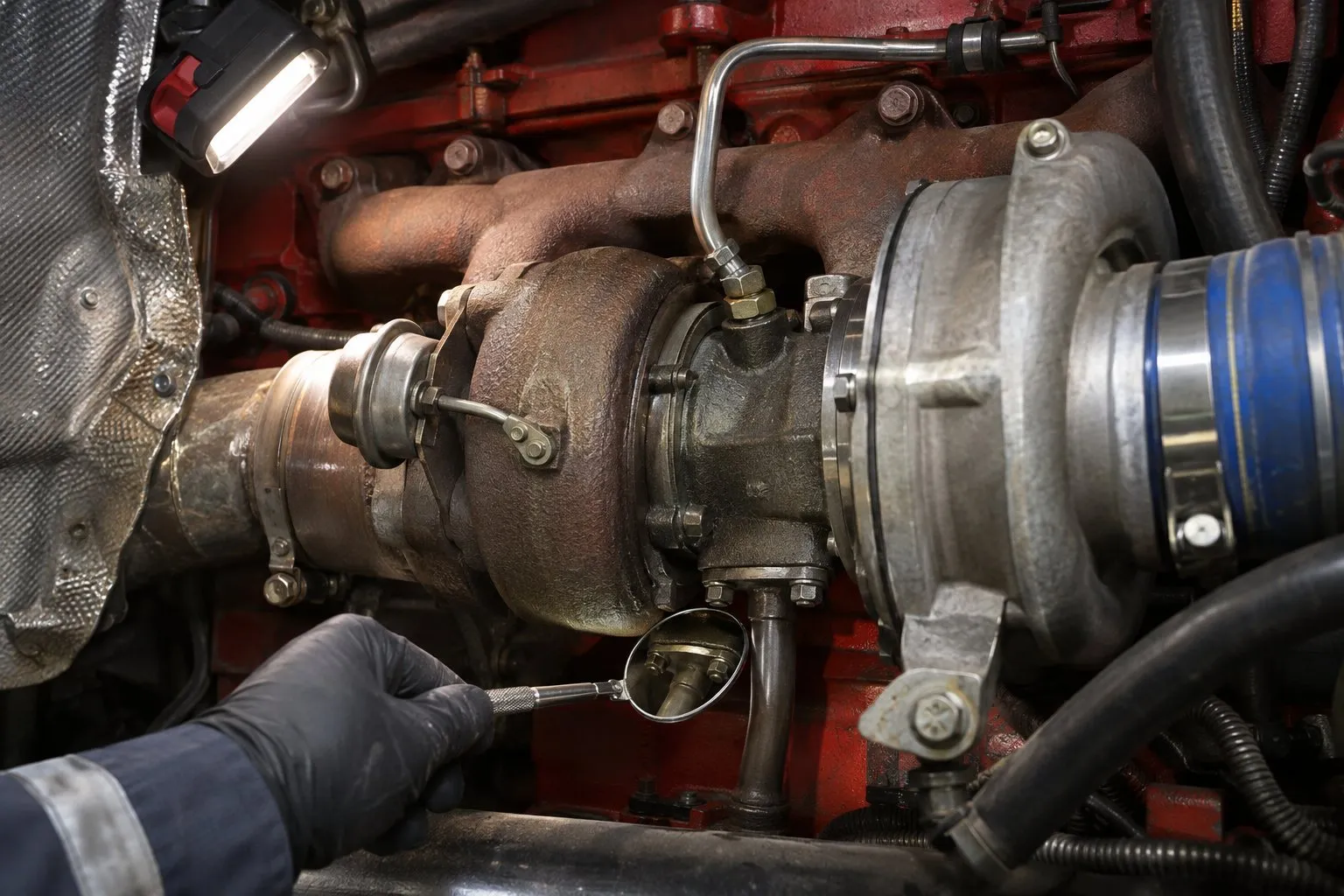
Turbo failures on natural gas engines trace back to the same root causes as diesel failures. Most of them come back to the oil supply, so before you condemn a turbo, confirm the oil feed is clean and unrestricted, the drain runs downhill into the pan above the oil level, and the oil itself is the right grade and not overdue.
The heat load does push a few failure modes to the front on gas engines. Thermal cycling is hard on turbine housings and wheels, and sustained high turbine inlet temperature stresses the bearing system if cooldown is skipped. A few minutes of idle after a hard pull or heavy load lets the center section shed heat instead of coking the oil at the bearings.
| Symptom | Likely area | Check first |
|---|---|---|
| Low boost, slow spool | Wastegate not seating, exhaust leak before turbine | Wastegate seat and linkage, up-pipe and manifold joints |
| Overboost / high drive pressure | Wastegate stuck shut or VGT nozzle bound | Actuator function, linkage freedom |
| Oil in charge pipe | Compressor-side seal, or normal crankcase vapor | Breather, air filter, oil level, drain before the turbo |
| Blue-gray smoke | Oil past a seal | Drain restriction, crankcase pressure, engine wear |
| Felt in-and-out shaft play / wheel contact | Bearing failure | Replace or rebuild the cartridge |
On the shaft-play test, some side-to-side rock at the wheel is normal on a journal-bearing turbo. Condemn a unit for in-and-out play you can feel, for wheel contact with the housing, or for play beyond the maker’s limit, not for any movement at all.
If a compressor wheel has come apart, do not reuse the charge air cooler. Metal shed into the fins cannot be reliably flushed out and will travel on into the engine intake. Our article on intercooler and turbocharger performance explains why the cooler and the charge piping get inspected together.
New, remanufactured, and getting the right part
Because gas-engine turbos see hard thermal duty, a properly rebuilt unit has to go back together with correct clearances and a balanced cartridge, not just new seals. PT Turbo remanufactures in-house and stocks new units as well. For high-use fleet cores, a quality remanufactured turbocharger keeps a truck earning while holding to the right spec.
| New unit | Remanufactured unit | |
|---|---|---|
| Core charge | None | Yes; return within 30 days |
| Internals | All new | New bearings, seals, thrust parts; inspected housings and wheels |
| Balancing | Factory | Cartridge balanced on a VSR |
| Warranty | 12 months, unlimited miles | 12 months, unlimited miles |
| Turnaround on a rebuild | N/A | Most rebuilds ship in 3 days or less |
The single most important step is matching the number on the turbo’s tag. Casting numbers on the housings only narrow the search, since one casting serves many turbos; the part number on the data plate, confirmed with wheel sizes and A/R, is what identifies your exact unit. Send us that number and we will match it.
If you are weighing a rebuild against a replacement, our turbocharger rebuild service page explains the process, and the turbo rebuild price list shows real pricing by model. For a specific new or reman unit, current pricing is on the product page, or call (909) 824-1020 and we will pull your fitment. You can also contact PT Turbo with the tag number and engine serial. For background on how turbochargers work in general, the turbocharger overview and variable-geometry turbocharger references are solid primers.
Frequently Asked Questions
Can I use a diesel turbo on a natural gas version of the same engine?
Not safely by assumption. Even when the block is shared, the gas rating can call for a different turbine housing alloy, wheel, or control method to handle the higher sustained exhaust temperature. Match the number on the data plate for the gas engine, not the diesel engine family, and call us if you are unsure.
Why do many natural gas engines use a wastegated turbo instead of a VGT?
Natural gas burns essentially soot-free, so there is little carbon to foul a variable nozzle. A fixed-geometry turbo with a wastegate is a simpler, robust way to cap boost, and it stands up well to the heat a stoichiometric burn produces. Some gas platforms still use variable geometry, so verify what your unit actually has.
Does a natural gas turbo need more frequent service than a diesel one?
Service intervals follow the engine maker’s schedule, but the heavy thermal duty on a gas engine rewards clean oil, an unrestricted oil feed and drain, and a proper cooldown idle after hard work. Those habits, plus catching wastegate or actuator problems early, are what keep any turbo, diesel or gas, from an early failure.
Need a Turbocharger?
PT Turbo has rebuilt and sold turbochargers since 1978. We stock remanufactured units for Cummins, Duramax, Power Stroke, Detroit Diesel, and more — backed by a 12-month unlimited mileage warranty. Units in stock at our shop in San Bernardino, CA ship the same day when ordered before 2 PM Pacific, Monday through Friday.
📞 (909) 824-1020 · 346 S I St. #3, San Bernardino, CA 92410 · info@ptturbo.com