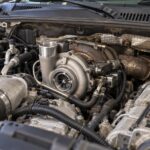
Understanding what a CHRA is starts with a simple question that lands on our bench almost every day: What Is a CHRA, and why can replacing just this one component save you hundreds of dollars over a complete turbocharger? CHRA stands for Center Housing Rotating Assembly, and it is the heart of every turbocharger ever built. At PT Turbo we have been rebuilding, testing, and stocking these cores since 1978, so let’s break down exactly what this part does and when a cartridge swap is the right call.
The CHRA Defined: The Beating Heart of Your Turbo
The CHRA, also called the cartridge or core, is the central section of the turbocharger that houses all the moving parts. Everything that actually spins, wears, and eventually fails lives inside this assembly.
A complete turbocharger is really three sections bolted together: the turbine housing (hot side), the compressor housing (cold side), and the center cartridge that connects them. The CHRA is that middle piece.
Inside a typical CHRA you will find:
- The shaft and turbine wheel as one welded assembly, driven by exhaust gas
- The compressor wheel, held on the opposite end of the shaft by a nut (or threaded onto it)
- Journal bearings or a ball bearing cartridge that support the shaft at up to 150,000+ RPM
- The center housing with oil galleys and often coolant passages
- The thrust bearing, seal plate, piston rings, and oil deflector
If you want the deep background on how these components work together, the Wikipedia turbocharger entry covers the physics well. But the practical takeaway is this: when a turbo fails, it is almost always the CHRA that failed, not the cast housings.
What Is a CHRA Replacement and When Do You Need One?
A CHRA replacement means swapping out only the center cartridge while reusing your existing turbine and compressor housings. Because the housings rarely wear out, you often only need to replace the spinning core.
This is where cartridge replacement shines financially. A balanced, ready-to-install CHRA costs far less than a complete new turbocharger, and installation is straightforward for any competent diesel mechanic.
Here are the classic symptoms that point to a failing core:
| Symptom | Likely CHRA Cause | Severity |
|---|---|---|
| Blue smoke on startup or acceleration | Worn seals or bearings leaking oil into exhaust/intake | Moderate |
| Whining or siren noise that changes with boost | Bearing wear, shaft play | Moderate to High |
| Oil in the intake or intercooler piping | Compressor-side seal failure | Moderate |
| Excessive shaft play (radial or axial) | Failed journal or thrust bearings | High |
| Metal-on-metal grinding, no boost | Wheel contact, catastrophic bearing failure | Critical, stop driving |
Before you condemn the core, check the basics. Restricted oil supply, a clogged drain line, or a plugged air filter can mimic CHRA failure and will destroy a new cartridge just as fast.
CHRA vs Complete Turbocharger vs Rebuild
You generally have three paths when a turbo goes down. Each has a place depending on the condition of your housings, your budget, and your downtime tolerance.
| Option | What You Get | Relative Cost | Best For |
|---|---|---|---|
| New complete turbo | Everything new, housings included | $$$$ | Damaged housings, warranty priority |
| Remanufactured turbo | Fully rebuilt, tested, new core internals | $$$ | Best value, reused good housings |
| CHRA cartridge only | Balanced center core, reuse your housings | $$ | Good housings, DIY-capable shops |
| Rebuild your existing unit | Your turbo torn down and rebuilt | $$ | OEM-matched, no core exchange hassle |
If your housings are cracked, warped from heat, or the turbine housing has eroded vanes, a cartridge alone will not fix it. In those cases a remanufactured turbocharger is the smarter buy.
When your housings are clean and true but the core is shot, our turbocharger rebuild service can restore your exact unit with new bearings, seals, and a precision-balanced shaft assembly. After 45 plus years in this business, we stock both new and remanufactured parts so you are never forced into the wrong repair.
The Actuator: The Part People Forget During a CHRA Swap
Here is a mistake we see constantly. A mechanic replaces the cartridge but reuses a tired old actuator, then chases boost problems for weeks afterward.
On wastegated and variable geometry turbos, the actuator controls boost pressure or vane position. A CHRA replacement is the perfect time to inspect and replace a weak or seized actuator, because if the core was contaminated or overheated, the actuator likely took abuse too.
Pneumatic actuators are calibrated to open at a specific pressure, and a drifting or leaking diaphragm throws off your entire boost curve.
Match the actuator to your exact turbo model and calibration. An actuator off the wrong unit will either overboost the engine or leave you flat with no power. If you are unsure which one fits, contact PT Turbo with your turbo part number and we will pull the correct piece.
Why Balancing Is Non-Negotiable
The single most important thing about a quality CHRA is balance. A turbine shaft spinning past 100,000 RPM will self-destruct if it is even slightly out of balance.
Cheap cartridges assembled without proper VSR (Vibration Sorting Rig) balancing are a gamble. The wheels may spin, but micro-vibration wipes out bearings and seals in short order, sometimes within weeks.
Every core we build or supply is balanced as a complete rotating assembly, not just component by component. This two-stage approach, balancing the shaft group and then the full cartridge at operating speed, is what separates a reliable repair from a repeat failure.
Manufacturers like Garrett Motion and BorgWarner hold tight balancing tolerances at the factory, and any replacement core should meet that same standard.
Variable Geometry vs Wastegated Cores
Not all cartridges are created equal. Modern diesels increasingly use variable geometry turbochargers (VGT), which add moving vanes inside the turbine housing to control exhaust flow across the RPM range.
On a VGT, the CHRA and the vane assembly work as a matched system, and soot buildup from EGR and DPF equipped engines is a leading cause of failure. When vanes stick, the actuator strains and the core suffers.
Simpler wastegated turbos, common on older platforms, use an external or integral wastegate and a fixed turbine housing. These are typically easier and cheaper to cartridge-swap.
If you are working on specific platforms, our model-specific guides go deeper. See our breakdowns for the Ford 7.3L Powerstroke turbos, the 5.9L Cummins HX35 and HY35, and the Cummins ISX variable geometry units. There is also a helpful overview of the International T444E connection to the 7.3L Powerstroke.
The bottom line on VGT versus wastegated is that the added complexity changes your repair math. A sticking vane mechanism or a heat-soaked VGT cartridge often needs the actuator and vane pack addressed together, while a clean wastegated core is one of the easiest swaps you can do on a bench.
Whichever design you are dealing with, the decision always comes back to the condition of your housings and the quality of the core going in. Verify your oil supply, confirm the housings are true, and insist on a properly balanced cartridge. Get those three right and a CHRA swap will run as long as the original turbo did.
One step up from a bare CHRA is the supercore; see What Is a Turbocharger SuperCore? for when that option makes sense.
Frequently Asked Questions
What does CHRA stand for?
CHRA stands for Center Housing Rotating Assembly, the central core of a turbocharger that houses the rotating shaft, turbine, and compressor wheels.
Can I replace just the CHRA instead of the whole turbocharger?
Yes, in many cases you can replace only the CHRA core, which can save hundreds of dollars compared to buying a complete turbocharger.
What are signs that my CHRA needs replacing?
Common symptoms include excessive smoke, oil leaks, whining noises, and loss of boost, all of which point to worn bearings or damaged wheels in the CHRA.
Need a Turbocharger?
PT Turbo has rebuilt and sold turbochargers since 1978. We stock remanufactured units for Cummins, Duramax, Power Stroke, Detroit Diesel, and more — backed by a 12-month unlimited mileage warranty and same-week shipping from San Bernardino, CA.
📞 (909) 824-1020 · 346 S I St. #3, San Bernardino, CA 92410 · [email protected]