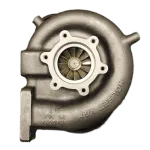
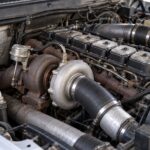
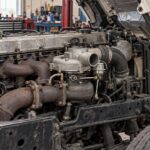
The Garrett GT3788VA is the variable-geometry turbocharger bolted to the back of every LBZ and LMM Duramax that rolled out of GM’s plants from 2006 through 2010. If you’ve got a 6.6L Duramax that’s lost top-end power, throws a P003A code, or surges because its vanes are not following commands, this is the unit you’re dealing with. The GT3788VA is a solid piece of engineering, but the vane control parts and the soot-prone unison ring are what put these turbos on the bench. This guide breaks down the application, the failure modes, the part numbers you need, and what it costs to make it right.
GT3788VA Overview: What It Is and Where It Lives
The GT3788VA is a variable nozzle turbine (VNT) turbocharger. Instead of a wastegate, it uses movable vanes inside the turbine housing to change the effective A/R ratio on the fly. At low RPM the vanes close down to spool the turbo fast and kill lag. At high RPM they open up to flow big air without choking the engine. On the LBZ and LMM, GM moves those vanes with engine oil pressure: the ECM drives a VGT solenoid on the turbo’s center housing, the solenoid meters oil to a piston, and the piston turns the unison ring. A vane position sensor reports the result back to the ECM.
Here’s where a lot of guys get tripped up: the LLY, LBZ, and LMM all run a GT3788VA family turbo, but the control strategy and calibration changed across those model years. The LLY (2004.5-2005) and LBZ (2006-2007) share a lot of DNA, while the LMM (2007.5-2010) added a diesel particulate filter (DPF) and adjusted the vane control to handle regeneration events. If you’re chasing an LLY-specific issue, our Duramax LLY turbocharger guide covers that platform in detail.
Engine Applications at a Glance
| Engine | Model Years | Turbo | Emissions Setup | Horsepower (stock) |
|---|---|---|---|---|
| LLY | 2004.5-2005 | GT3788VA | EGR, no DPF | 310 hp |
| LBZ | 2006-2007 | GT3788VA | EGR, no DPF | 360 hp |
| LMM | 2007.5-2010 | GT3788VA | EGR + DPF | 365 hp |
The LBZ is widely considered the strongest Duramax variant because it lacks a DPF and has a stout bottom end. The LMM is nearly identical mechanically but the DPF and its regen cycles put extra thermal load on the turbo. For an LBZ-specific deep dive, see our LBZ turbocharger guide. For the emissions-era LMM, the LMM variable geometry failure guide is the one to read.
Common GT3788VA Failure Symptoms
Most often, a failing GT3788VA is not a blown center section. It’s the variable geometry system gumming up or the control parts losing their ability to move the vanes. Soot and carbon build up around the unison ring and vanes, especially on high-mileage LMM trucks that see a lot of regen cycles. Here’s how the symptoms usually present, from mild to it’s-not-moving-anymore.
| Severity | Symptom | Likely Cause |
|---|---|---|
| Mild | Slight lag off the line, minor loss of low-end response | Early vane carbon buildup |
| Moderate | P003A code, boost slightly under commanded target, hesitation | Sticky unison ring, worn vane position sensor |
| Moderate | Failed regen, frequent DPF regen on LMM | Vanes not modulating for exhaust temp control |
| Severe | Overboost or underboost limp mode, no top-end power | Seized vanes or failed VGT solenoid |
| Critical | Shaft play, oil in intake, whining or grinding | Worn bearings, damaged CHRA |
The classic code you’ll pull is P003A, which is set when the turbocharger boost control position exceeds its learning limit. In plain terms, the ECM commanded the vanes to a position and the feedback didn’t match. On the LBZ and LMM that points first to a sticking unison ring, then to the vane position sensor or the solenoid. Before you condemn the whole turbo, check with a scan tool that the vanes actually follow commands.
The Vane Position Sensor and VGT Solenoid: The Serviceable Parts
There is no vacuum can on a GT3788VA. Two small parts do the control work, and both can be changed with the turbo in place. The vane position sensor screws into the turbo and follows a cam on the vane mechanism; when it wears or sticks, the ECM gets the wrong vane angle and sets P2563 or P003A. The VGT solenoid meters the oil that moves the vanes; when its coil fails or its valve sticks, the vanes stop responding and you get boost errors with P0045 or P0046.
The good news: you don’t always need a whole new turbo. If the center section is healthy and the vanes still move freely, a sensor or a solenoid can bring the unit back to full function for a fraction of the cost of a complete turbo.
One important note: after either part is replaced, the ECM has to relearn vane position, with a scan tool or over normal driving. And if the vanes themselves are sticking, neither part will cure it. If you’re unsure, reach out to PT Turbo and we’ll talk it through.
Repair vs. Replace: Making the Call
Before you drop money on a new turbo, diagnose whether the problem is confined to the control system or if the whole unit is toast. Grab the shaft and check for excessive radial and axial play. Look for oil in the compressor housing or intake piping. Listen for bearing noise. If the CHRA is solid and the vanes move, you’re likely looking at a sensor, a solenoid or a clean-and-rebuild job. If there’s shaft play, oil contamination, or seized vanes, the turbo needs a rebuild or replacement.
| Condition Found | Recommended Fix | Typical Cost Range |
|---|---|---|
| Bad sensor or solenoid, healthy CHRA and vanes | Replace the vane position sensor or VGT solenoid, relearn vane position | Small next to the price of a turbo |
| Sticky vanes, carbon buildup, no shaft play | Rebuild / clean and recalibrate | $595 |
| Shaft play, oil leakage, worn bearings | Remanufactured or new turbo | Remanufactured $1,339 (1 listing); new $1,863 to $1,966 (2 listings) |
| Vanes seized, housing damage | Full replacement | $1,863 to $1,966 (2 listings) |
Price ranges in this article are general estimates to help with budgeting, not PT Turbo quotes. Our current prices are on each product listing, and our rebuild prices are on the turbo rebuild price list.
PT Turbo has been in the turbocharger business for over 45 years, and one thing we’ve learned is that a lot of GT3788VA units get thrown away when all they needed was a proper cleaning of the vane mechanism and a sensor or solenoid. If your core is worth saving, our turbo rebuild service can restore it to OEM spec with new bearings, seals, and a balanced, blueprinted assembly. If you need a turnkey unit, our remanufactured turbochargers ship ready to bolt on and calibrated.
New vs. Remanufactured GT3788VA: What’s the Difference
A brand new Garrett GT3788VA carries the highest price, and for a fleet running critical routes, the peace of mind is worth it. A quality remanufactured unit, however, uses your rebuildable core or an exchange core, gets new wear components, and is tested and calibrated before it ships. The performance difference on the truck is negligible when the reman is done right.
| New Garrett | Remanufactured | |
|---|---|---|
| Price | $1,863 to $1,966 (2 listings) at PT Turbo | $1,339 (1 listing) at PT Turbo |
Beyond price, the decision usually comes down to downtime and core availability. A new Garrett turbo is on the shelf and ready, with no core to surrender and no exchange to coordinate. A remanufactured unit trades a little lead time for real savings, and when the vanes, bearings, and seals are replaced and the assembly is balanced and calibrated, it holds boost just like new on the LBZ and LMM.
For most owner-operators and fleets, a properly remanufactured GT3788VA is the smart money. The one place we’d steer you toward new is a truck that can’t afford to sit waiting on a core or a mission-critical unit where you want zero question marks on day one. Either way, make sure the vane mechanism on whatever you bolt on moves freely and that vane position is relearned after the install, because that is what keeps the P003A code from coming right back.
Frequently Asked Questions
What years and engines use the Garrett GT3788VA turbocharger?
The GT3788VA family is the variable-geometry turbocharger used on the LLY, LBZ and LMM 6.6L Duramax engines from 2004.5 through 2010; this guide covers the 2006 through 2010 LBZ and LMM. It came factory-installed on GM trucks during those model years.
What causes a P003A code on the GT3788VA turbo?
A P003A code means the vanes are not where the ECM commanded them. On the GT3788VA the usual causes are carbon binding the unison ring, a worn vane position sensor or a sticking VGT solenoid.
What are the symptoms of a failing GT3788VA turbocharger?
Common symptoms include lost top-end power, a P003A trouble code, and surging or lazy boost response. These issues usually point to problems with the variable-geometry vane control system.
Further reading: Learn more about Garrett Motion.
Shopping by part number?
Every part number we stock for the Garrett GT3788VA is on one page, with live prices and stock: Garrett GT3788VA turbos and parts.
Need a Turbocharger?
PT Turbo has rebuilt and sold turbochargers since 1978. We stock remanufactured units for Cummins, Duramax, Power Stroke, Detroit Diesel, and more — backed by a 12-month unlimited mileage warranty and same-week shipping from San Bernardino, CA.
📞 (909) 824-1020 · 346 S I St. #3, San Bernardino, CA 92410 · [email protected]
More From PT Turbo
 Holset HE531VE Turbocharger: PACCAR MX-13 & Detroit Series 60 Application Guide
- Holset HX35W Turbocharger: Wastegate Version for Cummins 5.9L Explained
- Land Rover TDV6 3.0L Turbocharger Guide: Discovery, Range Rover & Sport Applications
- UD/Nissan FE6 Turbocharger Guide: Medium Duty Truck Applications & Replacement