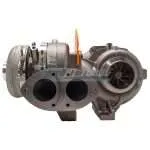
If you run a Freightliner Cascadia or a Volvo VNL, the Volvo D13 turbocharger is either keeping your truck making boost or it’s the reason your loaded trailer is crawling up the grade. This 12.8-liter inline-six is one of the most common engines on North American highways, and when the turbo goes, downtime costs real money. This guide breaks down how the D13 turbo system works, the failure symptoms to watch, your real replacement options, and where the variable geometry actuator fits into the whole picture.
PT Turbo has been rebuilding and supplying heavy-duty turbochargers since 1978. That’s 45-plus years of hands-on experience with exactly these units, and we stock both new and remanufactured parts for the D13 platform. Here’s what you actually need to know.
How the Volvo D13 Turbocharger System Works
The Volvo D13, and its near-identical Mack MP8 sibling, uses a variable geometry turbocharger (VGT) on most model years. Instead of a fixed A/R housing or a wastegate, the VGT uses movable vanes inside the turbine housing that change the effective flow area. At low RPM the vanes close down to speed up exhaust flow and spool the turbo fast. At high RPM they open to prevent overspeed and control backpressure.
On the D13, that vane movement is managed by an actuator. Depending on the model year and configuration, you’ll see either an electronic actuator commanded by the engine ECM or a pneumatic actuator driven by regulated air pressure. The pneumatic setups are common on Holset and Mitsubishi-based units found across the Volvo and Mack medium-heavy range. When the actuator sticks or loses signal, the vanes freeze, and you get the classic symptoms of low power, poor spool, or a check engine light throwing VGT position faults.
The VGT also plays directly with the EGR system. Backpressure generated by the turbine vanes is what drives exhaust gas back through the EGR circuit. That tight coupling is the same reason the Detroit DD13 turbocharger interacts so heavily with EGR, and it’s worth understanding because a VGT problem often masquerades as an EGR fault and vice versa.
Common D13 Turbocharger Failure Symptoms
D13 turbos rarely just grenade without warning. The VGT mechanism and the actuator tend to telegraph problems long before the center section fails. Here’s how the symptoms break down by severity so you can triage before you pull the truck out of service.
| Severity | Symptom | Likely Cause |
|---|---|---|
| Early | Sluggish throttle response, slow spool | Sticking VGT vanes, soot buildup |
| Early | Occasional VGT position fault codes | Actuator drift or weak signal |
| Moderate | Low boost, derate under load | Stuck vanes, failing actuator |
| Moderate | Black smoke, poor fuel economy | VGT not closing, EGR imbalance |
| Severe | Whining or grinding from turbo | Worn shaft bearings, wheel contact |
| Severe | Oil in the charge pipe, blue smoke | Failed seals, center section wear |
| Critical | No boost, metal in the intake | Compressor or turbine wheel failure |
The single most common driver of D13 turbo complaints is not the bearings, it’s the VGT vanes and actuator. Soot and carbon accumulate on the vane mechanism, the movement gets sticky, and the actuator can’t hold commanded position. That triggers derates and codes. In a lot of cases you can restore performance by addressing the actuator and cleaning the mechanism rather than replacing the entire turbo.
The Actuator: Fix This Before You Buy a Whole Turbo
Before you spend a few thousand dollars on a complete turbocharger, check the actuator. On many D13, Mack MP8, and related Mitsubishi-based units, a failing pneumatic actuator is the actual root cause of the low-boost, VGT-fault complaints. The actuator diaphragm cracks, the internal linkage wears, or the unit loses its ability to hold vacuum, and the vanes stop responding correctly.
The Mitsubishi Pneumatic Actuator, part number 4918918935, is a direct replacement for these applications and is available from PT Turbo for $83.99, view the Mitsubishi Pneumatic Actuator 4918918935 here. At that price against a full turbo replacement, it’s the first component to rule in or out. Swapping the actuator, verifying it holds pressure, and confirming the vanes move freely will resolve a large share of D13 VGT complaints without touching the center cartridge.
When you install a replacement actuator, do these three things:
- Inspect and clean the vane mechanism while you have access. A new actuator won’t fix vanes that are carboned solid.
- Verify the calibration rod length matches the original so the vanes hit full travel at both endpoints.
- Check the air supply line and regulator. A weak signal to the actuator produces the same symptoms as a bad actuator.
Replacement Options: New vs Remanufactured
When the turbo itself is done, meaning worn bearings, damaged wheels, or a scored housing, you’ve got three real paths: a new OEM unit, a quality remanufactured turbo, or a full rebuild of your existing core. Each has a place depending on your budget and how long you plan to keep the truck.
| Option | Typical Cost Range | Lead Time | Best For |
|---|---|---|---|
| New OEM turbo | $2,500 to $4,000+ | In stock to several days | New trucks, warranty-sensitive fleets |
| Remanufactured turbo | $1,200 to $2,200 | In stock, same day ship | Most owner-operators and fleets |
| Rebuild your core | $800 to $1,500 | 2 to 5 days | Numbers-matching, unusual configs |
| Actuator only | $83.99 and up | In stock | VGT faults with healthy center section |
Price ranges in this article are general estimates to help with budgeting, not PT Turbo quotes. Our current prices are on each product listing, and our rebuild prices are on the turbo rebuild price list.
For most Freightliner Cascadia and Volvo VNL owners, a quality remanufactured turbocharger is the sweet spot. A properly reman’d D13 unit is torn down to the core, gets new bearings, seals, and thrust components, and is balanced on a VSR machine to OEM tolerance. You get near-new reliability at a meaningful discount, and reputable rebuilders back them with a real warranty.
If you want to keep your original casting or you’re running a specific VGT calibration, our turbo rebuild service restores your core to spec. Send us the unit, we tear it down, replace everything worn, balance it, and send it back ready to bolt on. Browse the full lineup on our turbo shop page or reach out if you need help matching a part number.
D13 Turbo Identification and Cross-Reference
The D13 went through several emissions eras, and the turbo configuration changed with them. Getting the right part starts with reading the tag on the compressor housing and matching the engine’s model year and emissions setup.
- Pre-2010 (EPA 2007) D13: VGT with a specific actuator style, tighter tolerances on backpressure control for the EGR-heavy calibration.
- 2010 to 2016 (EPA 2010) D13: Revised VGT and actuator, integrated with SCR and DEF systems for lower NOx.
- 2017-plus D13TC: The turbo-compound variant on some VNL configs adds a second turbine downstream for fuel efficiency, a very different animal from the standard D13.
Always cross-reference the actuator and turbo part numbers against your tag before ordering. Mack MP8 units often share components with the D13, which widens your sourcing options, but the calibration rod and vane travel must match your application. If you’re cross-shopping medium-duty platforms, our Cummins ISC and HX40 guide covers a related fixed-geometry approach, and our Ford 6.0L Powerstroke turbo guide is a useful reference on VGT failure patterns in a lighter-duty context.
Not sure which unit you have? Send us the numbers off the tag and we’ll match it. Contact PT Turbo here and we’ll get you the right part the first time.
Installation Tips to Prevent a Repeat Failure
A new or reman turbo that fails early almost always failed because of something the tech missed on install. Protect your investment:
- Prime the oil supply. Pre-fill the center section with clean engine oil and crank without starting to build pressure before first fire.
- Replace the oil feed line. Coked or restricted feed lines starve the bearings and are the number one cause of premature turbo death.
- Clear the intake and charge air cooler. If the old turbo threw debris, that debris will kill the new one. Flush the CAC and inspect all piping.
- Check the air filter and intake tract for leaks. A dirty filter or a loose clamp downstream lets grit into the compressor wheel, and even fine dust erodes the blades over time.
- Confirm the EGR system is healthy before you button up. Since the VGT and EGR circuit work together on the D13, a stuck EGR valve or plugged cooler loads the new turbo the same way it loaded the old one.
Spend the extra half hour on these checks and your replacement turbo will go the distance instead of coming back on the bench in a few months. Most repeat failures on the D13 are not a parts quality problem, they are an install or a root-cause problem that got skipped under time pressure. Fix the cause, not just the symptom, and the unit will last.
Frequently Asked Questions
What are the symptoms of a failing Volvo D13 turbocharger?
Common signs include loss of boost, sluggish acceleration under load, excessive exhaust smoke, whining noises, and increased fuel consumption. You may also notice reduced power when climbing grades.
Which trucks use the Volvo D13 engine and turbocharger?
The Volvo D13 is a 12.8-liter inline-six found in the Volvo VNL and the Freightliner Cascadia, making it one of the most common engines on North American highways.
How much does it cost to replace a Volvo D13 turbocharger?
Replacement costs vary based on parts and labor, but choosing between OEM and quality aftermarket options can significantly impact the total price and reduce costly downtime.
Cross-Reference & Superseded Part Numbers
The turbochargers covered in this article match or supersede the following OEM and manufacturer part numbers. If you are searching by part number, these are the units stocked by PT Turbo for this application:
13879880018 • 13879880047 • 13879880050 • 172-784-0008 • 172-784-0043 • 172-784-0095 • 172-784-0101 • 172-784-0438 • 172-784-0439 • 172-784-0447 • 172-784-0448 • 319368 • 319372 • 319700 • 3528709H • 3534922H • 3536915H • 3538545HX • 3595340H • 4027298H • 4033240H • 4033656H • 4033671H • 4033813H • 4034111 • 4034112 • 4034114 • 4034194H • 4034207H • 4034214H • 4034324H • 4034326H • 4034328H • 4034453H • 4034456H • 4034459H • 4044184H • 4918918935 • 49S8908506 • 53169880057 • 53269886091 • 53269886094 • 53269886290 • 53269886492 • 53269886496 • 53269886497 • 53269886750 • 53269886751 • 53269887200 • 53269987105 • 53269987700 • 53279880020 • 53279886491 • 53279886798 • 53279886800 • 53279887090 • 53279887118 • 53279887206 • 53279986531 • 53279986723 • 53279986745 • 53279986786 • 53279987194 • 53279987500 • 53279987501 • 53289886490 • 53299986913 • 53299986914 • 53299986922 • 53319986719 • 53319987122 • 53319987130 • 53369886785 • 5457506H • 5499741H • 5499741HX • 5499748H • 5499748HX • 56209880006 • 56209880007 • 56209880014 • 56209880017 • 56209880023 • 56509880000 • 57909882500 • 709197-5010S • 712922-5006S • 712922-5018S • 712922-5019S • 887393-5005S • A4720901480-RMN • B58CND-S0066C • EA4710962199 • F41CAD-S0083B • JT10523 • JTC11070 • JTC11076 • JTC11095 • JTC11137 • JTC11142 • JTC11146 • JTC11151 • JTC11170 • JTC11186 • JTC11212 • JTC11232 • JTC11233 • JTC11272 • JTC11283 • JTC11288 • JTC11306 • JTC11307 • JTC11379 • JTC11381 • JTC11383 • JTC11523 • JTC11637 • JTC11888 • JTC11927 • JTC11928 • JTC12149 • JTC12159 • JTC12172 • JTC12388 • PTT-C30-004 • PTT-C30-020 • PTT-C30-025 • PTT-S60-002 • RA4710907180 • RA4710907280
Can’t find your number above? Contact PT Turbo — our team has been matching part numbers since 1978.
Further reading: Learn more about turbocharger technology.
Need a Turbocharger?
PT Turbo has rebuilt and sold turbochargers since 1978. We stock remanufactured units for Cummins, Duramax, Power Stroke, Detroit Diesel, and more — backed by a 12-month unlimited mileage warranty and same-week shipping from San Bernardino, CA.
📞 (909) 824-1020 · 346 S I St. #3, San Bernardino, CA 92410 · [email protected]
More From PT Turbo
 Ford 7.3L Powerstroke Turbocharger Guide: TP38, E99 & GTP38 Models Explained
- Ford 6.4L Powerstroke Twin Turbo Guide: Common Problems & Replacement Parts
- Caterpillar C7 Turbocharger: Common Failures, Part Numbers & Replacement Guide
- PACCAR MX-11 Turbocharger Guide: Replacement Cost & Kenworth/Peterbilt Fitment