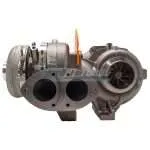
Volvo D12 Turbocharger Guide: Holset HX52, HX55 & Garrett GT4594 by Engine Version
This Volvo D12 turbocharger guide starts with the question most owners actually have: which turbo is on my engine? The D12 was built for more than a decade in several versions, and Volvo fitted different turbochargers to them, from Holset and from Garrett. Order by the engine version on the data plate and the number on the turbo’s tag, never by “D12” alone. Below is what fits what, how these turbos fail, and what a replacement or rebuild costs.
Which Turbo Is on a Volvo D12
The Volvo D12 is a 12.1-liter inline six that powered VN, VNL, VNM and VHD trucks in North America and the FH12 and FM12 elsewhere, with ratings from about 345 to 465 horsepower in North American trucks (up to 500 in Europe). These are the turbochargers PT Turbo lists for it, with the engine version each is listed for.
| Engine version | Turbo | Part numbers |
|---|---|---|
| D12A, 420 hp (also FH12, FL12) | Holset HX55 | 4049337H |
| D12C | Holset HX55 | 4031143H |
| D12C | Holset HX52 | 4031148H, 4031147H |
| D12, 435-465 hp | Holset HX52 | 3786675H, 3786676H |
| D12C, 425-465 hp | Garrett GT4594 and GTA4594BN | 712922-5006S, 712922-5019S |
| D12D, 440 and 480 hp | Holset HX55 | 4033139H, 4033576H |
| D12F | Holset HE531VE (variable geometry) | 4031005H |
| D12M (Volvo Penta marine) | BorgWarner S500WG | 56509880000 |
More numbers are listed on the Holset HX55, Holset HX52 and Garrett GT4594 model pages. If your number is not there, send us the tag numbers and we will cross it.
One name that gets attached to this engine by mistake is the BorgWarner K31. The K31 is a different turbo for MAN, Mercedes-Benz and Volvo Penta engines; our BorgWarner K31 guide covers it.
Fixed Geometry or Variable Geometry
Most D12 turbos are fixed geometry. The HX55, HX52 and GT4594 have no moving vanes: exhaust drives the turbine, the compressor feeds the charge air cooler, and that is the whole mechanism. Versions with a W in the name add a wastegate.
The exception in the table is the Holset HE531VE on the D12F. Holset variable geometry turbos use a sliding nozzle driven by an electronic actuator, which gives fast boost at low speed and engine braking, and adds two things to maintain: the nozzle, which soot can bind, and the actuator. For how that hardware behaves, see our Volvo D13 turbocharger guide. For the operating principle, the variable-geometry turbocharger overview is a good primer.
Symptoms of a Failing D12 Turbocharger
| Symptom | Likely cause | Check first |
|---|---|---|
| Low power, slow boost build, black smoke under load | Boost leak, restricted air filter, worn turbo | Charge air cooler and piping for leaks |
| Blue or gray smoke, oil in the charge piping | Worn bearings and seals, or a restricted oil drain | Shaft play and the drain line |
| Whine, siren or grinding noise | Bearing wear, wheel contact with the housing | Compressor wheel for rub marks |
| Oil at the compressor outlet with good shaft play | Crankcase pressure or a blocked air filter pulling oil past the seal | Air filter restriction and crankcase breather |
Check shaft play by hand before you order anything, and pressure-test the charge air system. A turbo that is not building boost is often a leaking boot or cooler, not a failed turbo.
Replacement and Rebuild Options
| Option | Price | Notes |
|---|---|---|
| New Holset HX55 for the D12 | $849 to $1,992 (6 listings) at PT Turbo | Match the part number to the engine version |
| New Holset HX52 for the D12 | $1,386 to $1,643 (4 listings) at PT Turbo | D12C and the 435-465 hp ratings |
| New Garrett GT4594 for the D12C | $1,390 to $1,531 (4 listings) at PT Turbo | 425-465 hp ratings |
| Rebuild your own turbo | From $575 at PT Turbo (price list) | For a unit with sound housings and wheels |
Price ranges in this article are general estimates to help with budgeting, not PT Turbo quotes. Our current prices are on each product listing, and our rebuild prices are on the turbo rebuild price list.
Our turbocharger rebuild service is a mail-in service. We inspect the turbo and confirm the price before any work starts, VSR balance every rebuild, and back it with a 12-month unlimited-mileage warranty; most rebuilds ship in 3 days or less. PT Turbo has been in the turbocharger business since 1978 and stocks both new and remanufactured turbochargers.
Installation Tips for the D12
- Find out why the old turbo failed. Oil starvation, a restricted drain, debris and overspeed each leave their own marks. Fit a new turbo without fixing the cause and it fails the same way.
- Replace or clean the oil feed and drain lines. On a high-mileage engine a new feed line is cheap insurance.
- Change the oil and filter and prime the turbo with clean oil before the first start.
- Clean the charge air cooler. If the old turbo passed oil or shed metal, the cooler is holding it.
- Use new gaskets and check the exhaust manifold for cracks and warped flanges.
- Idle the engine for a minute before loading it so oil reaches the bearings.
Running other iron in your fleet? Our full list of turbo guides covers the Volvo D11 and D13, the Cummins ISM and ISX, the Detroit Series 60 and more.
Turbos we list for the HX52, HX55 and GT4594
Listings for the turbo models named in this guide that can be ordered online today. Several part numbers can fit one engine by year and rating, so match the number on your turbo’s tag, or call (909) 824-1020 and we will match it for you.
Frequently Asked Questions
What turbocharger does the Volvo D12 use?
It depends on the engine version. PT Turbo lists the Holset HX55 for the D12A, D12C and D12D, the Holset HX52 for the D12C and the 435-465 hp ratings, the Garrett GT4594 for D12C ratings of 425 to 465 hp, and the Holset HE531VE variable geometry turbo for the D12F. Match the number on your turbo’s tag.
Is the BorgWarner K31 the Volvo D12 turbo?
No. The K31 is a BorgWarner turbo for MAN, Mercedes-Benz and Volvo Penta engines. The D12 truck engines use Holset HX52 and HX55 and Garrett GT4594 turbos.
Can a Volvo D12 turbo be rebuilt?
Yes, when the housings and wheels are sound. A rebuild renews the bearings and seals and balances the rotating assembly. Rebuild prices are on PT Turbo’s price list, and the price is confirmed after inspection, before any work starts.
Further reading: Learn more about turbocharger technology.
Shopping by part number?
Every part number we stock for the Holset HX52, Holset HX55 and Garrett GT4594 is on one page, with live prices and stock: Holset HX52 turbos and parts · Holset HX55 turbos and parts · Garrett GT4594 turbos and parts.
Need a Turbocharger?
PT Turbo has rebuilt and sold turbochargers since 1978. We stock remanufactured units for Cummins, Duramax, Power Stroke, Detroit Diesel, and more — backed by a 12-month unlimited mileage warranty. Units in stock at our shop in San Bernardino, CA ship the same day when ordered before 2 PM Pacific, Monday through Friday.
📞 (909) 824-1020 · 346 S I St. #3, San Bernardino, CA 92410 · [email protected]
More From PT Turbo
 Ford 6.7L Powerstroke Turbocharger Guide: GT32 Failures, Symptoms & Replacement Cost
- Detroit DD13 Turbocharger: Failure Symptoms, EGR Interaction & Replacement Options
- Detroit Diesel Series 60 Turbocharger Guide: Garrett & BorgWarner S400 Replacement & Cost
- Duramax LMM Turbocharger Guide: Variable Geometry Failure & Replacement