New Holland Diesel Turbocharger Guide: Tractor & Harvester Applications
This New Holland Diesel Turbocharger Guide is written for the owners, operators, and shop techs who keep tractors, combines, and self-propelled harvesters in the field, where a turbo problem in the middle of planting or harvest costs real money. New Holland equipment runs a wide spread of diesel engines over the decades, from compact-tractor fours to large harvester sixes, so the single most important rule is this: order by the number stamped on the turbo’s tag, never by the tractor model alone. The same chassis can leave the factory with different engine and emissions configurations, and each one can carry a different turbocharger.
PT Turbo has been rebuilding turbochargers since 1978, more than 45 years, and stocks both new and remanufactured units for agricultural diesels. This guide covers how to identify the right turbo, the turbo types you will run into, how they fail in dusty high-hour service, and how to decide between a new and a reman unit.
How to use this New Holland Diesel Turbocharger Guide
New Holland (and the older Ford / New Holland and Case IH family it overlaps with) sources engines from several places, including FPT/Iveco, Cummins-based units on some larger machines, and Shibaura on compact tractors. The verified example techs see every day: the New Holland TC55DA runs a Shibaura N844L turbo engine, not a Perkins, which is exactly why guessing by badge gets people the wrong part.
Before you order anything, find the data plate on the compressor housing and read it with the plate left in place. That nameplate carries the turbo maker’s part number and, on factory-fitted units, the engine maker’s number as well. Casting numbers on the housings are not part numbers because one casting serves many turbos, so use the casting number only to narrow the search and confirm with the tag number, wheel sizes, and A/R.
- Find the engine family first (FPT/Iveco NEF or Cursor, Cummins-based, Shibaura, etc.) and the emissions tier.
- Read the turbo tag on the compressor housing and record the full part number and suffix.
- Note the actuator type: no actuator (fixed), a pressure-operated wastegate actuator (some add a control solenoid), or an electronic actuator (variable geometry).
- Send us those numbers so the unit you get matches your machine exactly.
Turbo types across New Holland tractors and harvesters
Agricultural diesels use three broad turbo setups, and knowing which one you have tells you what can fail and what to check. A turbocharger on an older or lower-emissions engine is usually fixed geometry, with or without a wastegate. Tier 4 engines commonly moved to a variable-geometry turbocharger with an electronic actuator to broaden the torque curve and support aftertreatment.
| Type | How it controls boost | Typical use | What fails first |
|---|---|---|---|
| Fixed geometry | No moving boost control; sized for the rating | Older and lower-rated ag engines | Bearings and seals from oil supply issues |
| Fixed geometry, wastegated | Wastegate bleeds exhaust past the turbine | Many mid-range ag and industrial engines | Wastegate linkage sticking; bearings |
| Variable geometry (VGT) | Moving nozzle/vanes with an electronic actuator | Tier 4 tractors and harvesters | Vanes fouled with soot; actuator and calibration |
One important point on a stuck wastegate: a flapper that does not seat lets exhaust slip past the turbine, giving low boost and slow spool, not boost creep. On a VGT, a nozzle stuck closed gives overboost and high drive pressure, while stuck open gives low boost. Those symptoms point you to the right repair instead of a parts-swap guess.
Common turbo families on agricultural diesels
Across agricultural and industrial diesels, BorgWarner’s S-frame turbos are among the most common you will meet. The BorgWarner S200 turbochargers family (inducers roughly 46 to 57 mm) covers smaller ratings, while the S300 family (inducers about 57 to 72 mm) covers mid-range power. Both appear in fixed-geometry form on earlier engines.
For Tier 4 variable-geometry service, BorgWarner lists variable-geometry turbos for agricultural engines in the 4.5 L, 6.8 L, and 9.0 L classes, including the S300BV and the B2UV, both with an electronic actuator. You can read more about the maker’s ranges at BorgWarner. On larger harvesters and high-horsepower tractors you may also run into Cummins/Holset turbos such as the HX35 and HX40 families on Cummins-based ratings.
Because the engine family and tier decide which of these you actually have, treat the list above as a map of what is possible, not a lookup by tractor model. If your machine carries a Cummins-based engine, our Cummins QSB turbocharger guide and Cummins ISL turbocharger guide break down those turbos by engine version. When in doubt, send us the tag number and we will match it.
How agricultural turbos fail, and what to check
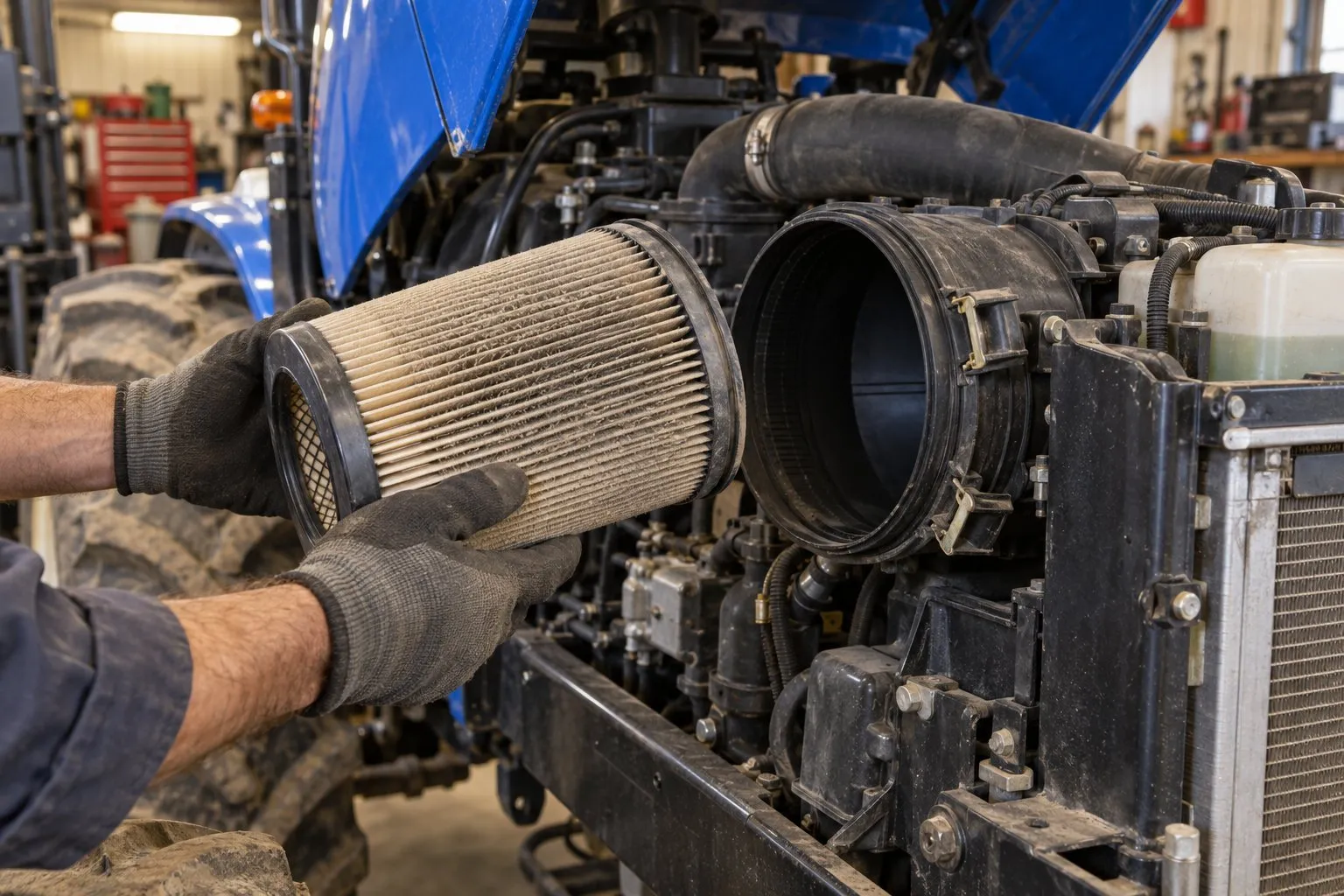
Farm turbos live a hard life: long hours, heavy loads, dust, and plenty of idling. Most turbo failures trace back to the oil supply, not to the turbo itself. Before you condemn a unit, work through the basics.
- Oil feed: after any bearing failure or coked oil, fit a new oil feed line rather than flushing and reusing it. Debris from the old line kills the new turbo fast.
- Oil drain: the gravity drain must run downhill (within about 15 to 20 degrees of straight down) and enter the pan above the oil level. A restricted drain backs oil up past the seals and cokes the center section; a leaking drain gasket leaks oil externally.
- Air inlet: a plugged or restricted inlet pulls oil past the compressor seal. On a dusty combine, service the air filter before blaming the turbo.
- Shaft play: some side-to-side rock is normal on a journal-bearing turbo with no oil pressure. Condemn it for in-and-out play you can feel, wheel contact with the housing, or play beyond the maker’s limit, not for any movement at all.
- Soot on VGT vanes: on variable-geometry units, carbon buildup on the nozzle slows response and sets boost faults. Check the EGR and intake condition when you find fouled vanes.
A few myths worth clearing up for diagnosis: low boost makes black or gray smoke from a rich mixture, not white smoke (white is coolant or unburned fuel). Oil film in the charge pipes is normal on an engine with closed crankcase ventilation, so check the breather, air filter, oil level, and drain before pulling the turbo. And metal shed from a failed compressor wheel cannot be reliably flushed out of a charge air cooler, so replace that cooler when you install the new turbo, and inspect the charge piping and replace it as needed.
New versus remanufactured turbochargers
For most agricultural turbos, a quality remanufactured unit or an in-house rebuild gets you back in the field at lower cost than a new unit, with the same balance and clearance standards. PT Turbo stocks new turbos and remanufactures in-house, so you can choose what fits your downtime and budget.
| Consideration | New turbo | Remanufactured / rebuilt |
|---|---|---|
| Core required | No | Yes, return within 30 days (customer pays return shipping) |
| Availability | Depends on model | Broad coverage across ag turbo families |
| Turnaround on a rebuild | In stock ships same day before 2 PM Pacific | Most rebuilds ship in 3 days or less |
| Warranty | 12 months, unlimited mileage | 12 months, unlimited mileage |
On pricing, our catalog is the source of truth: current pricing is on each product page, and for rebuild cost by model see the turbo rebuild price list. You can browse our remanufactured turbochargers, read about our turbo rebuild service, or contact PT Turbo with your tag number. Fleet and large-farm operations can call for priority turnaround and core stocking.
Frequently Asked Questions
How do I know which turbocharger my New Holland machine uses?
Read the data plate on the compressor housing and record the full part number and suffix, then confirm the engine family and emissions tier. The tractor or combine model alone is not enough because the same machine can be built with different engine and turbo configurations. Send the tag number to the shop and it will be matched exactly.
Can a variable-geometry ag turbo just be cleaned instead of replaced?
Sometimes light soot on the nozzle can be freed up, but a worn actuator, damaged vanes, or failed bearings mean the unit needs rebuilding or replacing. Never force an electronic actuator’s arm by hand because the self-locking gears break. If you are chasing boost faults, verify the air, EGR, and oil systems before condemning the turbo.
What do I do before first start after installing the turbo?
Follow the maker’s first-start steps: fill the oil inlet with clean engine oil, turn the wheel by hand, and crank or idle a few minutes before putting it under load so the bearings get oil. There is no break-in mileage schedule and no early oil change required. Just be sure the oil feed line is new or clean and the drain runs freely.
Need a Turbocharger?
PT Turbo has rebuilt and sold turbochargers since 1978. We stock remanufactured units for Cummins, Duramax, Power Stroke, Detroit Diesel, and more — backed by a 12-month unlimited mileage warranty. Units in stock at our shop in San Bernardino, CA ship the same day when ordered before 2 PM Pacific, Monday through Friday.
📞 (909) 824-1020 · 346 S I St. #3, San Bernardino, CA 92410 · [email protected]