Case & CNH Industrial Turbocharger Guide: Loader, Excavator & Tractor Applications
This Case & CNH Industrial Turbocharger Guide is built for the techs, owner-operators, and farm and fleet managers who keep Case IH, Case Construction, and New Holland machines earning their keep. CNH Industrial equipment runs a mix of FPT (Fiat Powertrain) and Cummins diesels, and that means the turbo on your loader, excavator, or tractor could be a simple wastegated unit or a modern variable-geometry charger with an electronic actuator. The wrong part number costs you a day you do not have, so the goal here is to help you identify the right turbo by the number on the tag, understand how it works, and know what fails first.
PT Turbo has been rebuilding turbochargers since 1978, and in more than 45 years we have handled the full range of Holset and BorgWarner units that turn up on CNH iron. We stock both new and remanufactured turbos and remanufacture in-house, so once you have your number, we can usually get you moving fast.
How CNH Industrial engines are turbocharged
CNH Industrial covers three equipment lines you will recognize on a jobsite or in a field: Case IH agriculture, Case Construction, and New Holland. Under the hood, most of that equipment runs one of two engine families.
- FPT (Fiat Powertrain) engines power a large share of modern Case IH and New Holland machines, from the smaller NEF four- and six-cylinder engines up to the big Cursor blocks in high-horsepower tractors.
- Cummins engines appear across many Case Construction and older agricultural machines, using Holset (Cummins Turbo Technologies) chargers that will be familiar to anyone who has worked on a QSB, QSC, or QSL.
Smaller compact equipment is its own story. A New Holland TC55DA, for example, uses a Shibaura N844L turbo engine, not the Perkins unit people sometimes assume. That is exactly why tag identification matters more than guessing by brand.
Fixed, wastegated, and variable-geometry turbos
Before you shop, know which of three turbo types you are dealing with, because they fail and get serviced differently. You can read a plain-English primer on how turbochargers work and on the variable-geometry design if you want the background.
- Fixed geometry. No wastegate, no vanes. Common on older Tier 3 and earlier machine engines. Boost is set by the compressor and turbine sizing alone.
- Wastegated. A flapper bleeds exhaust around the turbine to cap boost. If the gate does not seat, you get low boost and slow spool, not boost creep.
- Variable geometry (VGT). Moving nozzle hardware changes effective turbine flow across the rev range. On later Tier 4 CNH machines these carry an electronic actuator that must be calibrated to the turbo.
On a Holset VGT the actuator is electronic and the nozzle is a sliding ring, not pivoting vanes. Never try to move an electronic actuator’s arm by hand, as the self-locking gears will break. Calibration is done with the maker’s service tool, to the turbo, not to the ECM.
Cummins-powered Case and New Holland machines
Where a CNH machine runs a Cummins engine, you are into well-documented Holset territory. The same families show up in trucks, so cross-references are easy once you have the tag number.
On Cummins QSB6.7-class engines, Tier 3 machines typically carry a wastegated Holset HX35W, while Tier 4 ratings move to a single sliding-nozzle VGT such as the HE300VG or HE341VE. There is no two-stage turbo on the QSB6.7. Our Cummins QSB turbocharger guide breaks that family down further.
Larger Cummins ISC 8.3L and ISL/QSL 8.9L engines used a wastegated HX40W on earlier ratings, then moved to Holset variable-geometry chargers such as the HE431VE and, on later ratings, the HE400VG, once the 2007 emissions engines arrived. If your machine is on one of these, our Cummins ISL turbocharger guide covers the version-by-version changes in detail.
FPT-powered Case IH and New Holland tractors
The higher-horsepower Case IH and New Holland tractors built on FPT Cursor engines use Holset HX-family turbos sized to displacement. The HX50, HX52, and HX55 all appear on Cursor-class engines depending on the exact rating. Because a single Cursor family can carry more than one charger across ratings and emissions levels, there is no shortcut here: go by the part number on the turbo’s data plate.
BorgWarner also makes variable-geometry turbos for farm engines, including the S300BV and B2UV families with an electronic actuator, but that does not tell you which turbo a given FPT engine carries, so check the data plate. If the plate does show an electronic VGT, treat it like any other: calibrate with the service tool, never pry the arm.
The casting numbers on the housings will narrow a search, but they are not part numbers, since one casting serves many turbos. Confirm with the number on the tag, the wheel sizes, and the turbine housing A/R.
What fails, and what to check first
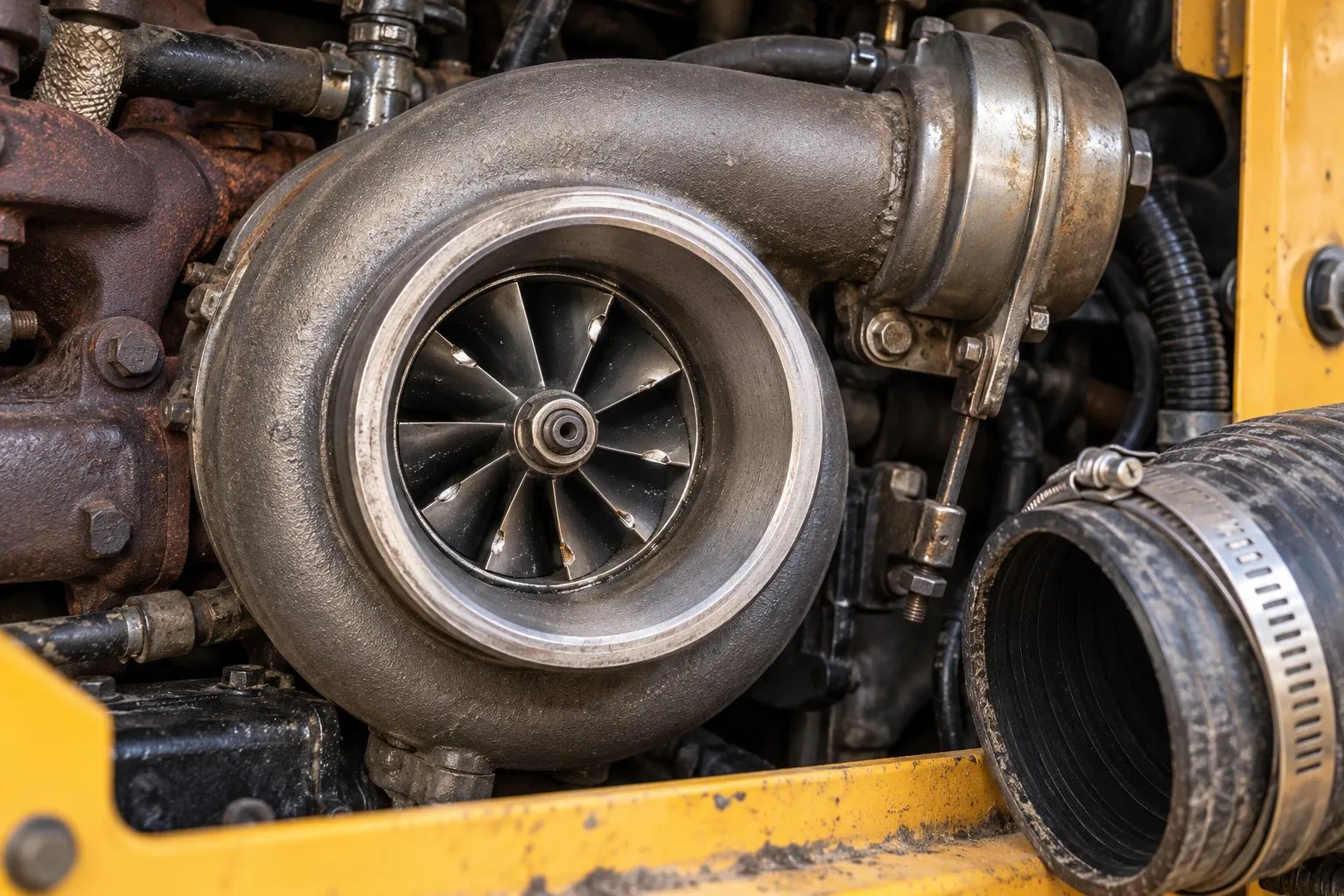
Most turbo failures trace back to the oil supply, not to a defect in the turbo. On hard-working machine engines running long duty cycles and dusty intakes, that is doubly true. Before condemning a charger, work through the basics.
- Oil feed and drain. A restricted drain backs oil up past the seals; a leaking drain gasket is an external leak. After any bearing failure or coked oil, replace the oil feed line rather than reusing it.
- Air intake. A plugged filter or ingested dirt kills wheels fast. Debris damage shows on the leading edges of the turbine or on the compressor inducer.
- Shaft play. Some side-to-side rock is normal on a journal-bearing turbo. Condemn it for in-and-out play you can feel, for wheel contact with the housing, or for play beyond the maker’s limit, never for any movement at all.
- Oil in the charge piping. A light film is normal crankcase vapor. Pooled oil is the warning sign, so check the breather, air filter, oil level, and drain before blaming a seal.
On high-pressure EGR engines, EGR gas is routed back to the intake after the compressor and never passes the turbine. Soot on a VGT nozzle comes from combustion fouling, and a cooler leak puts coolant into the intake, showing as white smoke, not as hot gas hitting the turbine. If a compressor wheel sheds metal, replace the charge air cooler too, because that debris cannot be reliably flushed from the fins.
New versus remanufactured turbochargers for your machine
For most CNH machine owners, the real question is new or reman. Both have their place, and we stock both. Here is how they compare.
| Factor | New turbocharger | Remanufactured turbocharger |
|---|---|---|
| Availability | Depends on current stock and supplier lead time | Often in stock; core-based program |
| Core return | None required | Within 30 days; customer pays return shipping |
| Balancing | Factory-balanced | VSR-balanced cartridge in-house |
| Warranty | 12 months, unlimited mileage | 12 months, unlimited mileage |
| Best for | Latest VGT units with electronic actuators | Proven fixed and wastegated units, cost-conscious repairs |
If your core is good, rebuilding it is often the smart call. Our turbo rebuild service covers the Holset and BorgWarner units found on CNH equipment, and most rebuilds ship in 3 days or less. For what a specific model costs, see our turbo rebuild price list rather than guessing from a number you saw elsewhere. If you would rather swap in a finished unit, browse our remanufactured turbochargers.
Fleet operators running mixed CNH equipment can arrange priority turnaround and have us stock their common cores. Call us and we will set it up.
Frequently Asked Questions
How do I find the right turbo for my Case or New Holland machine?
Go by the part number on the data plate on the turbo’s compressor housing, not by the engine or machine name alone. One CNH engine family can carry several different chargers across ratings and emissions levels. Send us that number, along with the wheel sizes and turbine housing A/R if you have them, and we will match it exactly. You can also contact PT Turbo or call (909) 824-1020.
Does a variable-geometry turbo on my Tier 4 machine need calibration after replacement?
Yes. A Holset or BorgWarner VGT with an electronic actuator must be calibrated to its own turbo using the maker’s service tool after it is fitted. Do not force the actuator arm by hand, because the self-locking gears break. Follow the engine maker’s first-start steps: fill the oil inlet with clean engine oil, turn the wheel by hand, and crank or idle a few minutes before putting it under load.
Can you rebuild my existing turbo instead of selling me a new one?
In most cases, yes, if the core is serviceable. We remanufacture in-house, VSR-balance every cartridge, and back the work with a 12-month, unlimited-mileage warranty. Send us the unit or the part number and we will confirm the rebuild price after inspection and before any work starts.
Need a Turbocharger?
PT Turbo has rebuilt and sold turbochargers since 1978. We stock remanufactured units for Cummins, Duramax, Power Stroke, Detroit Diesel, and more — backed by a 12-month unlimited mileage warranty. Units in stock at our shop in San Bernardino, CA ship the same day when ordered before 2 PM Pacific, Monday through Friday.
📞 (909) 824-1020 · 346 S I St. #3, San Bernardino, CA 92410 · [email protected]