IHI RHB5 Turbocharger: Small Diesel & Marine Application Guide
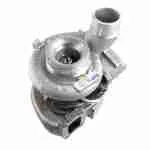
If you run a small diesel or a marine auxiliary, the IHI RHB5 Turbocharger is one of the compact chargers you are most likely to find on the exhaust manifold of a light industrial, agricultural, or boat engine. It belongs to IHI’s older RHB series, and in the IHI naming system the letter after RH marks the series while the number is the frame size, so the RHB5 sits at the larger end of the small-frame IHI family. This guide walks through what the unit is, how to confirm the one on your engine, how it fails, and what your options are when it is tired.
PT Turbo has been rebuilding turbochargers since 1978, more than 45 years, and we stock both new and remanufactured units along with in-house rebuild service. The information below is meant to help you identify the right part before you order, because on a small turbo the wrong number is worse than no number at all.
What the IHI RHB5 Is and Where It Lands in the IHI Lineup
IHI (Ishikawajima-Harima Heavy Industries) builds turbochargers across several series. The RHB series is the older design generation, and the RHF series that followed it carries a newer aerodynamic package. Within a series, the trailing number steps up with frame size: an RHB5 is larger than an RHB31, and in the newer series an RHF5 is larger than an RHF4.
The RHB5 is a small, simple charger built for engines in the roughly two to four liter class, the kind of displacement you find in compact tractors, skid steers, gensets, forklifts, and marine auxiliary and propulsion engines. You can compare it on our site against its close relatives, the IHI RHB5 turbochargers we list, the RHB31 at the smaller end, and the newer RHF5 that superseded a lot of this work.
Because one casting serves many turbos, the numbers stamped into the compressor or turbine housing are casting numbers, not the part number. The part identity comes from the data tag on the compressor housing. Match that number, not the engine name, before you buy.
Marine and Small Diesel Applications for the IHI RHB5 Turbocharger
IHI is the factory turbo supplier for a long list of marine diesels, which is why you see these small IHI units on so many boats. On the Yanmar side, for example, the RHB52 is the charger on turbocharged 4JH engines (the series also includes naturally aspirated versions), and other IHI models cover the larger Yanmar blocks. The RHB5 family lands on the smaller end of that marine world, feeding compact auxiliary and light propulsion engines.
On land, the same frame shows up on industrial and agricultural diesels where a modest, reliable boost pressure is all the engine needs. These are not high-horsepower chargers. They are built to spool early on a small displacement and to live a long service life behind a clean air filter and a healthy oil supply.
We will not guess the exact engine your RHB5 came from, because small-frame IHI turbos were fitted across many brands with different wheel trims and housings. If you are not sure, read the tag and call us with the number. For marine diesels in particular, our Cummins QSB turbocharger guide covers how marine duty cycles and salt-air corrosion change the way a charger ages, and the same principles apply to an IHI unit.
How to Confirm the Exact Unit on Your Engine
Work off the data plate on the compressor housing. IHI part numbers and the engine maker’s number live there; the raised numbers cast into the housings do not identify the complete turbo on their own. If the tag is painted over, corroded, or missing, measure the inducer and exducer on both wheels, note the turbine housing outlet, and send us photos. For a marine unit, also tell us whether it is seawater or keel cooled, because that changes the housing and the drain arrangement.
How the RHB5 Works and How It Fails
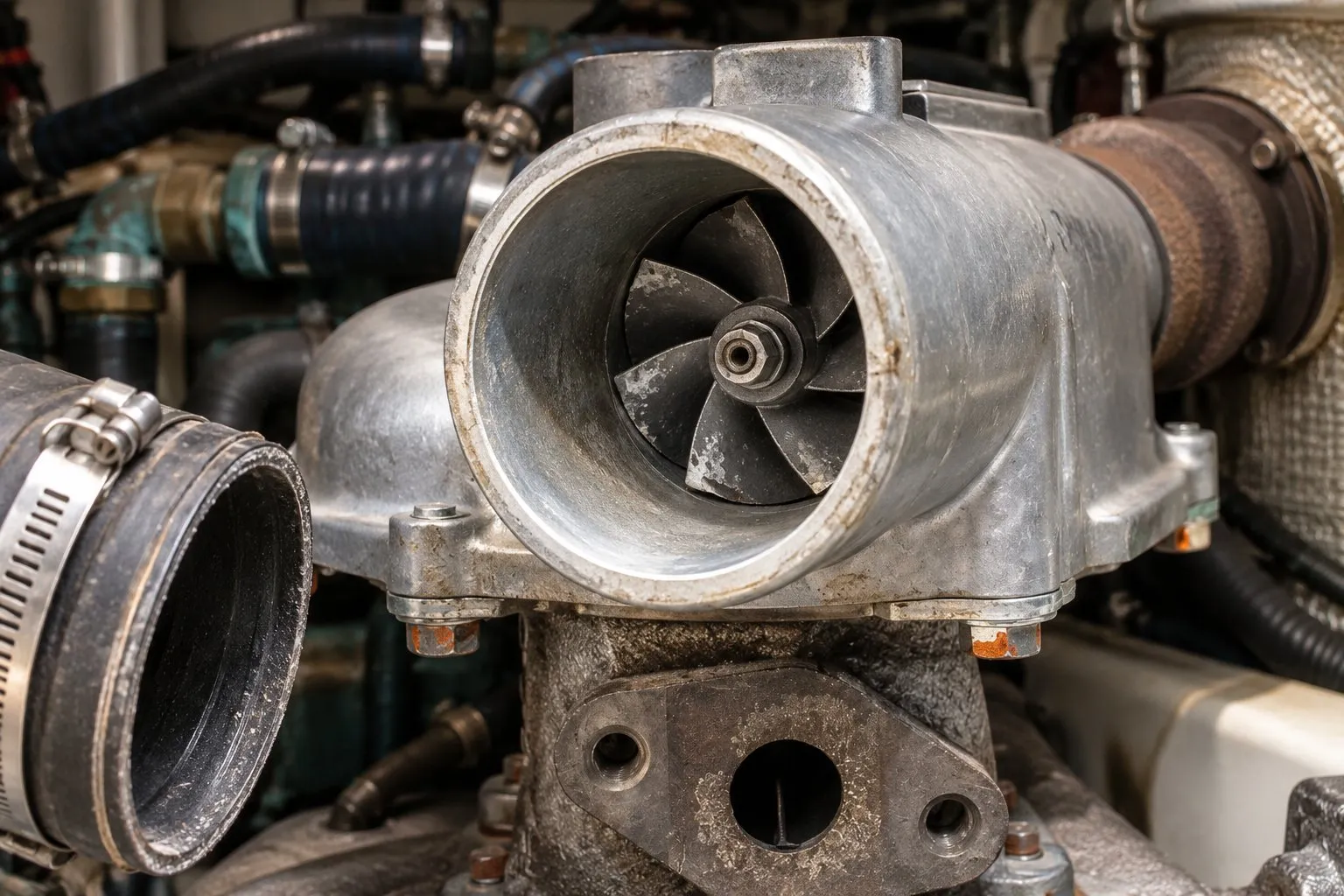
The RHB5 is a conventional journal-bearing charger. Exhaust spins the turbine wheel, the shaft drives the compressor wheel on the other end, and the compressed air feeds the intake. Pressurized engine oil both lubricates the bearings and carries away heat, then drains back to the sump by gravity. If you want the plain-English version of that cycle, the turbocharger overview on Wikipedia lays it out well.
Most turbo failures trace back to the oil supply, not to the turbo itself. A small charger like this is unforgiving about dirty oil, extended drain intervals, a kinked or coked drain line, or a hot shutdown straight after hard work, without letting the engine idle first. On marine engines, add salt corrosion of the compressor wheel and housing to that list.
Here is how the common faults show up, sorted by what you will actually notice:
| Symptom | Likely cause | What to check first |
|---|---|---|
| Low boost, sluggish, dark gray or black smoke | Air leak before the turbo, worn wheels, or a leaking charge pipe | Air filter, inlet hose under suction, charge piping and clamps |
| Blue-gray smoke, oil in the charge pipe | Often crankcase pressure or a drain problem, not always a seal | Breather, oil level, drain line slope, air filter restriction |
| Whine, whistle, or grinding | Bearing wear or a wheel touching its housing | Shaft play by hand, look for wheel-to-housing contact marks |
| Oil at the turbine end after long idle | Normal pooling that usually clears under load | Drive it before condemning the turbo |
| Chipped or bent compressor blades | Debris ingestion or salt corrosion on a marine unit | Inducer leading edges, intake tract for grit or standing water |
One point that saves a lot of good turbos: some side-to-side shaft play is normal on a journal-bearing unit with no oil pressure. Condemn the charger for in-and-out play you can feel, for wheel contact against the housing, or for play past the maker’s limit, not for any movement at all. Use IHI’s clearance figures for your exact model rather than a guessed number.
Rebuild, Remanufacture, or Replace
An RHB5 is a strong candidate for rebuilding because the core is simple and the castings last. A rebuild kit carries new bearings, seal rings, and thrust parts, and the balanced cartridge goes back in your original housings. There is no magic “balance kit”; the cartridge is balanced on a vibration sorting rig so it runs true.
If you want a faster turnaround with a core to send back, a remanufactured unit is the move. The difference comes down to whether you keep your own core or swap for one we have already built:
| In-house rebuild | Remanufactured unit | |
|---|---|---|
| Your core | You keep your original housings | Swap; core returned within 30 days, you pay return shipping |
| Turnaround | Most rebuilds ship in 3 days or less | Ships from stock when available |
| Best when | Your core is sound and you want it back | You want a ready-to-bolt unit with minimal downtime |
| Warranty | 12 months, unlimited mileage | 12 months, unlimited mileage |
You can read the full turbocharger rebuild service details, browse remanufactured turbochargers, or check the turbo rebuild price list for your model. The rebuild price is confirmed after inspection and before any work starts, so there are no surprises. For a new RHB5 where we have one listed, current pricing is on the product page, or call (909) 824-1020.
Installing a Rebuilt or New RHB5 the Right Way
Prime the turbo before the first start. Fill the oil inlet with clean engine oil, turn the compressor wheel by hand, then crank the engine with fueling disabled for ten to fifteen seconds before you let it idle three to four minutes. That seats the oil film before the shaft ever sees full speed.
- Replace the oil feed line after any bearing failure or coked oil; do not reuse a line that may be carrying debris.
- Make sure the drain runs downhill, stays within about 15 to 20 degrees of straight down, and enters the pan above the oil level.
- Use no sealant on the oil inlet or drain gaskets.
- If the old wheel shed metal, clean the intake tract and replace the intercooler: intercooler makers advise replacing it after a compressor-wheel failure, because metal trapped in the fins cannot be flushed out reliably and debris left downstream of the compressor goes straight into the engine.
- Follow the maker’s first-start steps only: prime, idle, then load. There is no special mileage schedule or early oil change required beyond that.
Allow a short cooldown idle of 30 to 60 seconds after normal running, and one to three minutes after hard work or heavy load, so the bearing oil is not sitting and coking on a shut-down hot shaft.
Frequently Asked Questions
Is the IHI RHB5 a wastegated turbo?
It depends on the exact version. IHI built these small chargers in plain and wastegated variants across different engines, so you cannot tell from the model family alone. Read the data plate on the compressor housing and look for an external actuator and gate; if you are unsure, send us the number and a photo and we will confirm it.
Can you rebuild my RHB5 core, or do I have to buy a complete turbo?
If the housings and shaft are serviceable, a rebuild is usually the economical path and keeps your original castings. We inspect the core first, confirm the price before starting, and most rebuilds ship in 3 days or less. If your core is damaged or you need minimal downtime, a remanufactured exchange unit is the alternative.
How do I know if the problem is really the turbo and not something else?
Rule out the cheap stuff first. Low boost with dark smoke is usually an air leak, a clogged filter, or a loose charge pipe before it is a worn turbo, and oil in the charge pipe is often crankcase pressure or a drain issue rather than a failed seal. Check shaft play by hand and look for wheel-to-housing contact, and if you are still unsure, call us at (909) 824-1020 and we will walk through it.
Shopping by part number?
Every part number we stock for the IHI RHB5 is on one page, with live prices and stock: IHI RHB5 turbos and parts.
Need a Turbocharger?
PT Turbo has rebuilt and sold turbochargers since 1978. We stock remanufactured units for Cummins, Duramax, Power Stroke, Detroit Diesel, and more — backed by a 12-month unlimited mileage warranty. Units in stock at our shop in San Bernardino, CA ship the same day when ordered before 2 PM Pacific, Monday through Friday.
📞 (909) 824-1020 · 346 S I St. #3, San Bernardino, CA 92410 · [email protected]